A workforce hidden in the clay
Just 45% of 79 fingerprints examined on China's Terracotta Army were attributed to adult men in a new statistical analysis. The researchers estimated that 32.7% came from adult women and 22.3% from juveniles under 15. Together, the last two categories account for 55% of the sample, offering the first quantitative biological evidence that women and young people participated in producing the famous figures buried more than 2,200 years ago.
Contents
- A workforce hidden in the clay
- What 79 fingerprints reveal about the work
- How can clay preserve a clue about age and sex?
- Why the percentages are not a census of artisans
- Workshop marks and written records fill out the picture
- What women and apprentices may have done
- The dates behind the discovery
- Why the method matters beyond Pit 1
- What to Know
The research was conducted by the Emperor Qinshihuang's Mausoleum Site Museum in Xi'an and Shandong University's School of Archaeology in Jinan. Archaeologist Xiaoxi Li, corresponding author Jingyi Shen and six coauthors signed the paper. Shen is an associate professor of archaeology at Shandong University and holds a doctorate in scientific archaeology from the University of Nottingham. The paper appears in the Journal of Cultural Heritage and is listed for Volume 82 at the end of 2026.
The findings address a basic question about an immense undertaking: whose hands actually made the army? Estimates of the burial complex commonly include roughly 8,000 clay figures, 130 chariots drawn by 520 horses and another 150 cavalry horses. Earlier research on Qin dynasty labor relied mainly on legal texts and often treated adult men as the default workers. Workshop inscriptions had already complicated that picture, but the ages and sexes of the Terracotta Army's makers had never before been measured in this way.
What 79 fingerprints reveal about the work
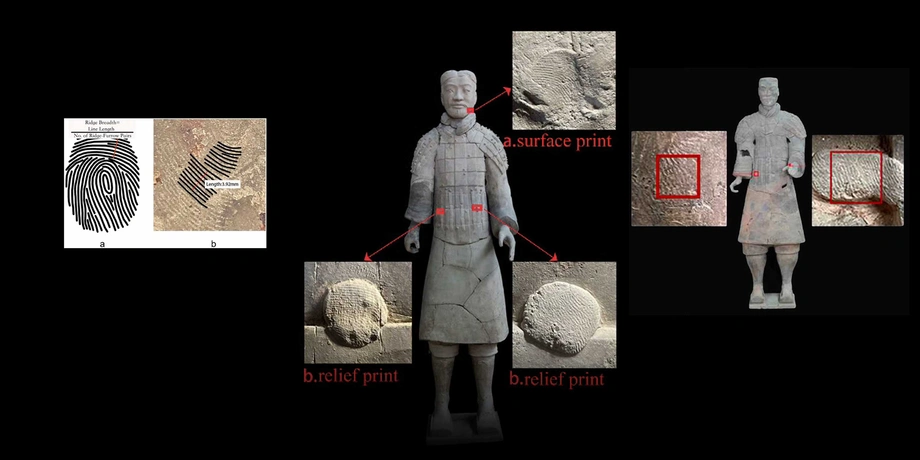
Pit 1 supplied the evidence, specifically an excavation area called unit T23. It contains 227 figures, about one tenth of those excavated in the pit. During restoration work, the researchers photographed fingerprints and digitally enhanced the images so that the tiny ridges and furrows could be measured. They discarded prints that were eroded, smudged or distorted, as well as likely duplicates found close together on the same body part. The paper describes a final sample of 79 prints on 36 figures, while an early summary of the findings put the number of figures at 23.
Of the 79 prints, 73 were impressions left directly on soft clay. The other six were raised marks created when artisans pressed decorative elements, including armor rivets and belts, onto a figure. Most appeared on heads, arms and armor, places where a worker would naturally grip, smooth or join components. Their locations fit the known production system: heads, limbs, torsos and armor details were molded separately before being assembled. A touch that might seem incidental therefore preserves a small record of a particular stage in the workshop process.
The adult makers were also young. Male prints clustered around age 20, while the typical age associated with female prints was about 18. The researchers said the juvenile share is consistent with historical references to apprentices working beside master craftsmen during the Qin dynasty, which lasted from 221 to 206 BC. Women and juveniles may have taken part in shaping, moving or assembling figures, although the prints do not assign a particular task to any named individual.
How can clay preserve a clue about age and sex?
The ridges on a fingertip form the lines visible in a fingerprint. Their spacing changes as a person grows: children's ridges sit closer together, while adult men generally have wider spacing than adult women. The researchers used mean ridge breadth, or MRB, a numerical measure related to the spacing and thickness of those ridges. Some of the differences involved are around half a millimetre (0.02 inches), roughly the thickness of the lead in a mechanical pencil.
Two complications make a simple classification unreliable. Adult women and teenage boys can have almost identical ridge patterns, so a narrow print does not automatically reveal its maker's age or sex. Clay can also shrink by between 2% and 12% as it dries and is fired, depending on its composition. An ancient print may consequently be smaller than the finger that left it, and the precise amount of shrinkage is unclear.
The reference evidence adds another difficulty. The team drew on a 2003 study by Czech researchers Miroslav Králík and Vladimír Novotný, based on fingerprints from living people. In that reference material, children under 15 occupy the narrow end of the measurement range and adult men the wide end. Applying those measurements to fired Chinese clay required the researchers to account for both physical changes in the material and differences between ancient and modern populations.
Their answer was a Bayesian mixture model, building on a 2023 MethodsX paper by Andrew Burchill, Akiva Sanders and Thomas Morgan. Instead of declaring with certainty who left each print, the method tests many possible combinations of ages and sexes against all the measurements. It retains the combinations that fit best and expresses the result as probabilities. The researchers compared the ridge measurements with values projected from growth curves, producing estimates for individuals and for the sample as a whole. The approach resembles an opinion poll: it can estimate the composition of a group without claiming perfect knowledge of every person within it.
Why the percentages are not a census of artisans
The percentages count prints, not people. One artisan could have left several fingerprints, while another could have left none. Removing likely duplicates reduces that problem but cannot guarantee that every remaining print represents a different worker. The 45%, 32.7% and 22.3% figures therefore describe the statistical makeup of this sample rather than providing a headcount of the Terracotta Army's labor force.
A master's working habits could also distort the sample. Experienced artisans were more likely to use tools and to smooth clay after touching it, erasing their marks. Apprentices or helpers might forget that final smoothing and leave more prints behind. This could raise the apparent share of juveniles. Print location presents a related clue: many marks sit where heads and arms were attached, suggesting that less experienced hands may have been involved at those stages.
The modern reference database creates further uncertainty. It was based on Czech people of European ancestry rather than a broad collection of prints from East Asian populations, and it contained more female samples. Either feature could influence the model's estimates. The researchers also acknowledged that similarities between female and adolescent prints remain a source of ambiguity even with the mixture model.
The T23 sample covers only a small part of an army whose construction took more than a decade. Whether the same proportions apply to other pits, workshops or periods of construction is not yet known. The researchers present their work as a foundation for larger fingerprint surveys elsewhere in the mausoleum complex, but they have not announced a timetable for completing such a survey.
Workshop marks and written records fill out the picture
Marks on the figures had already shown that production was divided among workshops. The character Gong (宫) identified craftsmen connected with imperial workshops, while Xianyang (咸阳) pointed toward local potters associated with the Qin capital. Chemical analyses of the clay support that division, indicating two groups of workshops using somewhat different materials and techniques. Those discoveries explained how production was organized without revealing the ages or sexes of the workers.
Inscriptions on Qin lacquer objects supplied an important written clue. They mention an adult woman, a girl and a boy, showing that women and minors could work in state workshops. The fingerprint team also used legal evidence to define who counted as a juvenile. Bamboo slips from Shuihudi, found in a tomb in the Yunmeng area, and the Hanshu, the official history of the Han dynasty that followed the Qin, place 15 at the threshold for criminal responsibility, compulsory labor and military service. The study consequently treats anyone under 15 as a juvenile.
Sima Qian's Records of the Grand Historian, written about a century after the emperor's death, gives a sense of the mausoleum project's enormous labor demand. In chapter 6, he wrote that 700,000 men were sent there from across the empire after China's unification. That figure concerns the wider tomb project, and some historians question the reliability of his account. It cannot serve as a count of the artisans who made the clay warriors.
What women and apprentices may have done
Li, Shen and their coauthors connected the fingerprint estimates with historical descriptions of workshops in which adults and young learners worked together. In the paper, they described the scene they believe the combined evidence reconstructs.
This biological evidence highly corroborates numerous historical records, vividly reconstructing the production scene in the Qin dynasty's state-run workshops where men and women served together, and adult artisans worked alongside juveniles, who may have been helpers or apprentices.
Sima Qian's account describes a mixed workforce of free peasants, craftsmen, convicts, debtors and slaves. Women could belong to any of those categories, and Qin legal texts record convicted women performing earthmoving work beside men. The paper's authors also suggest that smoothing surfaces or painting figures required patience and precision more than physical strength, making those plausible tasks for women. They present that suggestion as an interpretation drawn from the texts and workshop evidence.
A political change may also have affected women's working lives. The authors point to the household separation law promoted by the statesman Shang Yang, which required adult sons to live apart from their parents. They argue that this arrangement could have increased women's economic roles. This argument supplies social context for the fingerprints rather than a measurement derived from the prints themselves.
Evidence concerning young workers is more specific. The Shuihudi slips set the value of five young slaves as equal to that of one craftsman, indicating that their labor was counted in units of production. Qin bamboo slips held by the Yuelu Academy describe apprenticeships in state workshops. According to those texts, a capable master could train an apprentice in one year, while training a new craftsman took two. Such records make the presence of helpers or learners beside experienced artisans plausible, though the fingerprints cannot show exactly what each young person was taught.
The dates behind the discovery
The research joins archaeological evidence, historical texts and statistical methods developed across very different periods.
- 221 BC: Qin Shi Huang unified China, beginning the Qin dynasty, which lasted until 206 BC.
- 210 BC: The first emperor died. His tomb complex near Mount Li included the terracotta figures intended to accompany him after death.
- 1974: Farmers digging a well near Xi'an encountered the first figures, bringing the buried army to modern attention.
- 2003: Králík and Novotný published the modern fingerprint reference study used for ridge measurements.
- 2023: Burchill, Sanders and Morgan published the statistical approach adapted by the Terracotta Army researchers.
- October 2026: The fingerprint findings were made public, with the paper listed for the Journal of Cultural Heritage's Volume 82 at the end of the year.
Much of the mausoleum complex remains underground. The excavated pits therefore represent an continuing source of evidence about both the objects and the people who produced them.
Why the method matters beyond Pit 1
Larger surveys could test whether the pattern found in T23 appears in other pits and whether print measurements vary between workshops or stages of construction. They could also build a broader basis for comparing ancient prints with modern reference populations. For other archaeological sites, the method offers a way to study groups of craftspeople even when individual fingerprints cannot be classified with confidence.
Li described the work as an advance in method as well as a finding about Qin labor. Speaking as the archaeologist who led the investigation at the mausoleum museum, he said its importance would survive the uncertainties surrounding the sample.
Notwithstanding these limitations, this study marks an important methodological breakthrough in Terracotta Army archaeology.
The immediate change is a more crowded and varied workshop floor. Adult men remain part of the picture, but the statistical results place young adult women and juvenile helpers beside them. The workers are still unnamed, yet the impressions left by their fingers provide direct physical evidence for testing assumptions that legal texts and workshop marks alone could not settle.
What to Know
- Researchers analyzed 79 fingerprints from Pit 1, with the paper identifying 36 figures in the sample.
- The model attributed 45% of prints to adult men, 32.7% to adult women and 22.3% to juveniles under 15.
- Most prints were left on heads, arms and armor while components were shaped or assembled.
- Typical estimated ages were about 20 for adult male makers and 18 for adult female makers.
- A Bayesian mixture model was used because individual prints can be ambiguous and clay may shrink during drying and firing.
- The percentages describe prints rather than individual workers, and skilled artisans may have left fewer impressions.
- Qin inscriptions and legal texts independently record women, girls, boys and apprentices working within state production systems.
- Future surveys in other pits are needed to establish whether the T23 pattern extends across the Terracotta Army.