First Foreign Astronaut Through the Hatch of Tiangong
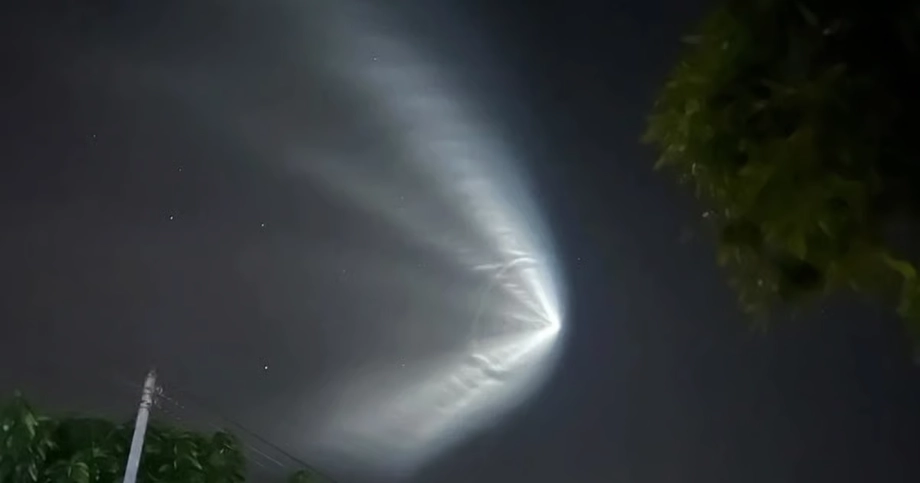
At 8:18 a.m. Beijing time on Wednesday, a Long March-2F rocket lifted off from the Jiuquan Satellite Launch Center in the Gobi Desert of northwestern China with three astronauts aboard, one of them a citizen of another country for the first time. Muhammad Zeeshan Ali, a 40-year-old Pakistan Air Force pilot, flew as payload specialist on Shenzhou-24 beside Chinese commander Tang Hongbo and flight engineer Wu Yi.
Contents
- First Foreign Astronaut Through the Hatch of Tiangong
- Seven Months in Beijing to Learn a Chinese Spaceship
- Two Pilots, One Seat and a Deal Signed in Islamabad
- What a Week in Orbit Is Meant to Prove
- Why Beijing Handed a Seat to Pakistan
- A Full Year in Orbit for the Astronaut Who Stays Behind
- The Station Left Alone When the ISS Retires
- From a 1990 Satellite to a Rover at the Lunar South Pole
- What the Flight Changes on the Ground
- Key Points
Ten minutes after liftoff the spacecraft separated from its rocket and entered the planned orbit. An automated rendezvous brought it to the forward port of the Tianhe core module three hours and 38 minutes after launch, the China Manned Space Agency said. The hatch opened at 2:35 p.m. Beijing time and Ali floated through into the arms of three Shenzhou-23 crew members already aboard, grinning broadly. CMSA called the moment the first "space handshake" between Chinese and foreign astronauts.
The Shenzhou-23 crew had prepared a cake, and the two teams posed for photographs marking the ninth space get-together in the country's aerospace history, Xinhua reported. CGTN said the dinner for six included a halal selection of more than 100 dishes prepared for Ali, among them beef nihari, lamb korma and curried chickpeas, with butter chicken also on the menu.
Pakistan has sent a person above the atmosphere before. Namira Salim, a polar explorer and artist based in Monaco, flew on Virgin Galactic's Galactic 04 mission in October 2023 and reached an altitude of 87.4 kilometres, below the 100 kilometre Karman line that scientists generally treat as the edge of space. Ali is the first Pakistani in orbit and the first non-Chinese astronaut to board Tiangong.
Seven Months in Beijing to Learn a Chinese Spaceship
Ali reached the Astronaut Center of China in Beijing in April with a second Pakistani air force pilot, Khurram Daud, and trained for seven months. The preparation covered spacecraft systems, emergency procedures, survival drills and centrifuge runs that simulate the forces of launch. The hardest part, he said in a promotional video released by the Chinese space agency, was the language.
But the real challenge, honestly speaking, was mastering the Chinese language, because all the switches, all the software, all the programmes, all the voice announcements, everything is in Chinese. So we had to learn that and master that technical Chinese.
The centre built a course around high frequency flight vocabulary and commands, and later added classical Chinese poetry. Shi Yusheng, an expert at the Astronaut Center of China, said the methods were designed to make sure Ali could follow instructions when it counted. Ali practised calligraphy, played table tennis, learned Chinese songs, and recited a line of classical verse at a press conference in Jiayuguan the day before the launch.
Tang told reporters that differences of language and culture had made learning to work together more difficult, and that the effort had paid off. Wu said the Chinese crew used English as a supplementary tool, and that the three men moved from merely understanding one another to anticipating each other's actions. Engineers wrote bilingual Chinese and English operating manuals, and the station's supplies were chosen for Ali's diet.
Two Pilots, One Seat and a Deal Signed in Islamabad
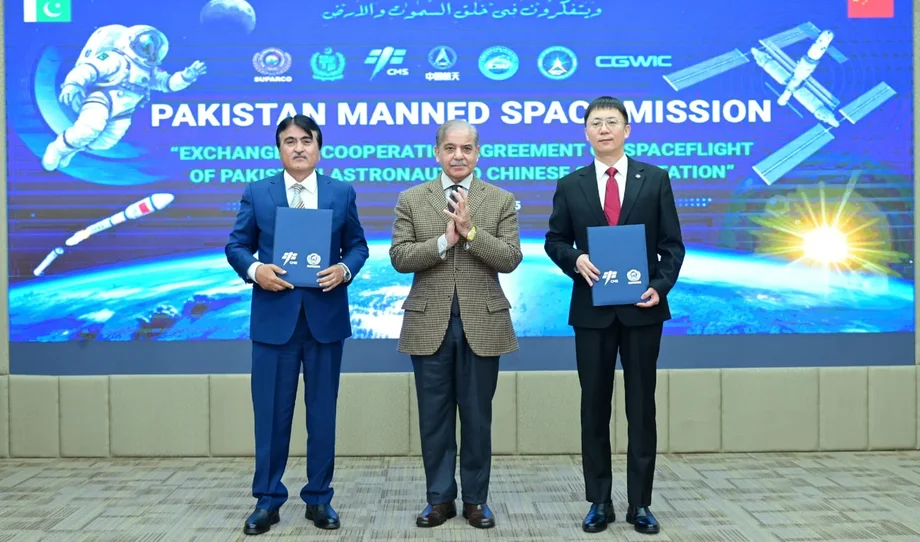
The programme began with an agreement signed on 28 February 2025 at the Prime Minister's Office in Islamabad by Lin Xiqiang, deputy director of the China Manned Space Engineering Office, and Mohammad Yousaf Khan, chairman of Pakistan's Space and Upper Atmosphere Research Commission, known as SUPARCO. Titled the Cooperation Agreement on the Selection, Training of Pakistani Astronauts and Participation in China's Space Station Flight Mission, it set out two trainees, one flight seat and a scientific role. The Chinese office said the signing marked the first time the Chinese government would select and train astronauts for another country.
Selection moved through three stages, starting with screening in Pakistan and medical, psychological and technical assessments, then a final round in China. Officials named Ali and Daud as reserve astronauts on 22 April 2026 from a group of about 20 finalists that included experienced pilots and researchers holding doctorates in aerospace fields. On 24 April, China's Space Day, both men joined the Astronaut Center of China.
Daud, who stayed behind as backup, recorded a message in Urdu for Pakistan's Ministry of Information and Broadcasting:
My message to you all is to pray for me, so that I can complete this training and this mission well, and make my nation and my country proud.
Ali thanked his instructors and both countries' space agencies at his final press conference. "No matter who flies, we have already made the history together," he said. Ahsan Iqbal, Pakistan's planning minister, who travelled to China for the launch, posted on X about the two men.
They trained in centrifuges and simulators, in emergency drills and in a new language. Both performed exceptionally well in training. Though Zeeshan Ali will fly tomorrow both have already made Pakistan proud.
- 28 February 2025: China and Pakistan sign the astronaut agreement in Islamabad.
- 22 April 2026: Ali and Daud are named reserve astronauts.
- 24 April 2026: Both begin training at the Astronaut Center of China.
- 21 November 2026: the crew completes a full dress rehearsal in the Gobi Desert before the flight.
- 25 November 2026: Shenzhou-24 lifts off with Ali aboard and docks the same day.
Daud was not named in the crew, and no date has been given for a second Pakistani flight. SUPARCO said the backup astronaut would serve as an expert to help carry the programme forward.
What a Week in Orbit Is Meant to Prove
Four joint projects in biotechnology and materials are scheduled for the visit, part of more than 90 experiments and technology tests planned for the Shenzhou-24 mission. CMSA lists the wider programme across space life sciences, materials science, microgravity fluid physics and combustion science, fundamental physics, space medicine and new space technologies.
The experiment proposed by SUPARCO uses photosynthetic cyanobacteria, microorganisms that draw energy from light and that researchers hope can help regenerate oxygen. Chen Mengyun, who leads international cooperation projects at the Technology and Engineering Center for Space Utilization under the Chinese Academy of Sciences, said the work should supply "a biological basis and data support for oxygen regeneration and biomanufacturing at future space stations and deep-space bases." Ali is also tending microalgae as a possible food and oxygen source, and studying how quinoa seeds respond to spaceflight.
A second project, led by the University of Agriculture, Faisalabad, will place 32 quinoa seed samples outside the station for about a year to test their tolerance of stress and their longevity, with the aim of selecting superior varieties. The remaining two cover hybrid composites built on multilayer graphene and carbon fibre composites that repair themselves when heated by the sun, materials with obvious uses for future spacecraft. Chinese institutions picked the four from more than 300 proposals submitted by Pakistani universities.
Microgravity, the near weightlessness of orbit, matters here because materials and living cells behave differently when they are not pulled down by gravity, which is why the station hosts this work. Ali's stay of five to 10 days, which SUPARCO describes as about a week, is meant to start and install the experiments and to record data confirming that the equipment survived launch vibrations and sits safely in orbit. "Completing the four experiments takes between six and 12 months," SUPARCO said.
Qamarul Islam, a space scientist and former senior official at the Institute of Space Technology in Islamabad, said the experiments came from a national call for proposals. "Primarily these experiments are the experiments of the research institutes, universities and others, from Pakistan," he said. Iqbal tied the research to farming at home, saying Pakistan needs smart and climate resilient agriculture. "The mission gives Pakistani scientists rare access to space laboratories, offering potential breakthroughs to boost productivity and climate resilience," he said.
Why Beijing Handed a Seat to Pakistan
Zhang Jingbo, a CMSA spokesperson, called the joint flight a landmark achievement in bilateral cooperation in the year the two countries mark 75 years of diplomatic ties, and said China's human spaceflight programme follows principles of peaceful use, equality, mutual benefit and common development. President Xi Jinping exchanged congratulations with his Pakistani counterpart, Asif Ali Zardari, and told him Beijing was "willing to work with all countries ... to uphold the banner of the peaceful use of outer space". A Chinese Foreign Ministry spokesperson described the mission as a new milestone in international cooperation, and UN spokesperson Stephane Dujarric said the United Nations welcomed the peaceful use of outer space and the cooperation the flight represents.
Blaine Curcio, managing director at Orbital Gateway Consulting, said the flight carries weight for both governments.
Sending another country's astronaut to space is a major undertaking. Pakistan is putting a lot of trust into Beijing by having him fly into space on a Chinese-built rocket.
Curcio added that the security dimension runs both ways, since Ali is "getting detailed insights into China's crewed space programme". The arrangement, he said, "makes China better prepared to do it again, and also makes it clear to other countries that China is open to this type of collaboration." He expects countries such as Brazil and Egypt to look for seats on later missions.
Pakistan's ambassador to China, Syed Ali Asad Gillani, described the flight as taking the relationship "from Earth to space" and called it "an excellent model for South-South cooperation", a phrase used for partnerships among developing countries. Qamar said the two countries' orbital positions explain part of the symbolism: China built its own station after being kept out of the International Space Station partnership, and Pakistani astronauts had no route to that station either.
Space cooperation between the two neighbours goes back further than the crewed programme. China launched Pakistan's first experimental satellite, Badr-1, from the Xichang Satellite Launch Center in 1990, and it has flown Pakistani payloads since.
A Full Year in Orbit for the Astronaut Who Stays Behind
Zhu Yangzhu has already spent six months aboard Tiangong and will not come home with Shenzhou-23. He stays to complete a full year in orbit, the first such stay by a Chinese astronaut, while Tang and Wu remain for about six months.
Zhang said the yearlong test will build a research database on the human body in space, examine how the body adapts and remodels during long flights, and add practical experience in life support, health protection and the daily routines that keep a crew working. The data is meant to inform planning for journeys further from Earth, including China's lunar ambitions.
Shenzhou-24's stated objectives are to hand over the station from the Shenzhou-23 crew, keep the outpost running, conduct science and application work, and carry out maintenance, public outreach and payload tests. Shenzhou-24 is the 24th flight of the Shenzhou spacecraft, the 18th crewed flight and the 41st mission of China's human spaceflight programme, and the last crewed launch on the 2026 calendar.
China's space agency said on 27 February 2026 that this year's plan covered Shenzhou-23, Shenzhou-24 and the Tianzhou-10 cargo resupply, and that astronauts from Hong Kong and Macau could fly as early as this year. Ali returns to Earth aboard Shenzhou-23 with two of its crew, named in one account as Zhang Zhiyuan and Li Jiaying; another lists Lai Ka-ying, Hong Kong's first astronaut and the only woman aboard the station, alongside Zhang Zhiyuan.
The Station Left Alone When the ISS Retires
Tiangong was assembled from three modules: Tianhe, launched in April 2021, Wentian in July 2022 and Mengtian in October 2022, forming a T shape. It weighs about 66 metric tons, offers up to 110 cubic metres of living space, orbits at 340 to 450 kilometres and normally houses three astronauts, with room for six during handovers. Its designed service life is more than 10 years.
The International Space Station is a far larger machine. NASA puts its mass at about 420,000 kilograms with 388 cubic metres of habitable volume, which makes it more than six times as heavy as Tiangong and gives it more than three times the living room. It has been continuously occupied since 2 November 2000 and normally carries seven astronauts from five agencies representing 15 countries. NASA says it will cease operations from 2030.
US law keeps the two programmes apart. The Wolf Amendment, adopted in 2011, bars NASA from using federal funds for bilateral cooperation with China without meeting specific legal conditions, and in 2025 NASA blocked Chinese citizens from its facilities altogether. China's exclusion dates to the station's founding: NASA confirmed in 2010 that Beijing had never received a formal invitation to join the partnership.
US lawmakers have moved to extend the life of the ISS, citing China's "permanent human presence in low Earth orbit" through Tiangong, though progress on turning that proposal into law has been slow. NASA has said that after the station it expects to be "one of many customers in a robust commercial marketplace in low Earth orbit."
Andrew Jones, a journalist who specialises in China's space programme, said renewed cooperation with Russia on a successor station looks "unlikely", and that China is understood to be preparing to double Tiangong's size, "likely with the end of the ISS in mind".
These developments could allow China to expand its international engagement, and potentially space tourism. With the ISS nearing the end of its life and the future of western commercial space stations uncertain, China could for a time have the only permanently crewed outpost in low Earth orbit.
European and Chinese astronauts once trained together with a view to a visit to Tiangong, Jones said, but that cooperation ended for political and budgetary reasons. Curcio said that if the ISS retires without a western replacement, whether government or commercial, European astronauts or even Russia's could eventually travel to Tiangong.
From a 1990 Satellite to a Rover at the Lunar South Pole
Pakistan's robotic programme has been edging toward the Moon. Its first lunar satellite, ICUBE-Q, built by students at the Institute of Space Technology with Shanghai Jiao Tong University, flew aboard China's Chang'e-6 mission in 2024 and captured lunar images and magnetic field data. In April 2026 a Long March-6 rocket placed a Pakistani remote sensing satellite in orbit.
A rover built by SUPARCO is due to fly on China's Chang'e-8 mission around 2028 and land at the lunar south pole with instruments designed by Pakistani, Chinese and European scientists. Pakistani scientists will operate it from Earth, mapping the surface, analysing soil and studying radiation.
Beijing aims to put Chinese astronauts on the Moon before 2030, using the Long March-10 rocket, the Mengzhou crewed spacecraft and the Lanyue lander. Tests completed so far include an escape test of Mengzhou, a landing and takeoff trial of Lanyue and a low altitude demonstration flight, and construction of lunar mission facilities at the Wenchang launch site is scheduled for 2026. The United States is aiming to return astronauts to the lunar surface in 2028 under its Artemis programme.
Ali framed the flight as a beginning rather than an end. "This mission is not a finish line; it is a launchpad," he said, adding that he hoped the next chapter would grow from one astronaut and one flight to multiple joint flights, toward the Moon and Mars.
What the Flight Changes on the Ground
Prime Minister Shehbaz Sharif said the journey belonged to the country and not only to one man, describing it as that of "240 million Pakistanis, particularly the younger generation, scientists and their dreams". He said Pakistan would be the first country after China to reach Tiangong, called the flight a reflection of the "ironclad friendship" between the two states, and thanked Beijing for including Pakistan in the mission.
Foreign Minister Ishaq Dar marked the anniversary in his message. "I thank President Xi Jinping and the Chinese leadership for their support and commend the teams of both countries for this achievement, which reflects our enduring friendship and commitment to the peaceful exploration of space," he wrote on X. The military's public relations arm, Inter-Services Public Relations, issued congratulations on behalf of Field Marshal Asim Munir, Admiral Naveed Ashraf, Air Chief Marshal Zaheer Ahmed Baber Sidhu and General Syed Aamer Raza, saying the friendship had reached "beyond the frontiers of Earth into outer space".
Ali carried the moment himself at the preflight briefing. "I carry the name of Pakistan on my shoulder, the hopes of 250 million Pakistanis," he told reporters, switching between Urdu, Mandarin and English. "To every child who is watching while I'm in orbit, just look up at the sky and remember that I am up there with your dreams."
The gains are concrete but narrow. Pakistan supplies an astronaut and research experiments; China supplies the rocket, the spacecraft, the training system and the orbital laboratory, so the flight adds a human presence in orbit without adding an independent way to reach it. Qamar said sending a person to space raises scientific problems beyond the technology of getting there, including isolation and the supply of oxygen and food, and that working through them would teach Pakistani institutions a great deal.
Iqbal, watching the launch in China, wrote on X that "a new era begins for Pakistan's space programme" and that the flag had risen into orbit with the hopes of "260 million Pakistanis", closing with the word URAN, Urdu for flight. Ali's own summary was shorter. "The two great nations of China and Pakistan have turned a pilot into an astronaut in a remarkably short span of time," he said.
Key Points
- Muhammad Zeeshan Ali, 40, became the first foreign astronaut on China's Tiangong space station and the first Pakistani in orbit.
- Shenzhou-24 launched at 8:18 a.m. Beijing time from Jiuquan on a Long March-2F rocket and docked three hours and 38 minutes later.
- Ali flies as payload specialist with commander Tang Hongbo and flight engineer Wu Yi, and returns aboard Shenzhou-23 after five to 10 days.
- China and Pakistan signed the astronaut agreement in Islamabad on 28 February 2025; Ali and Khurram Daud were named reserve astronauts in April 2026, with Daud as backup.
- Four joint experiments cover cyanobacteria, quinoa seeds, graphene composites and carbon fibre composites that heal when heated, within more than 90 tests on the mission.
- Zhu Yangzhu stays aboard to complete China's first yearlong stay in orbit while Tang and Wu remain for about six months.
- Tiangong weighs about 66 metric tons against the ISS's 420,000 kilograms, and the ISS is due to stop operating from 2030.
- A Pakistani rover is due to fly on China's Chang'e-8 mission around 2028, as Beijing pursues a crewed lunar landing before 2030.