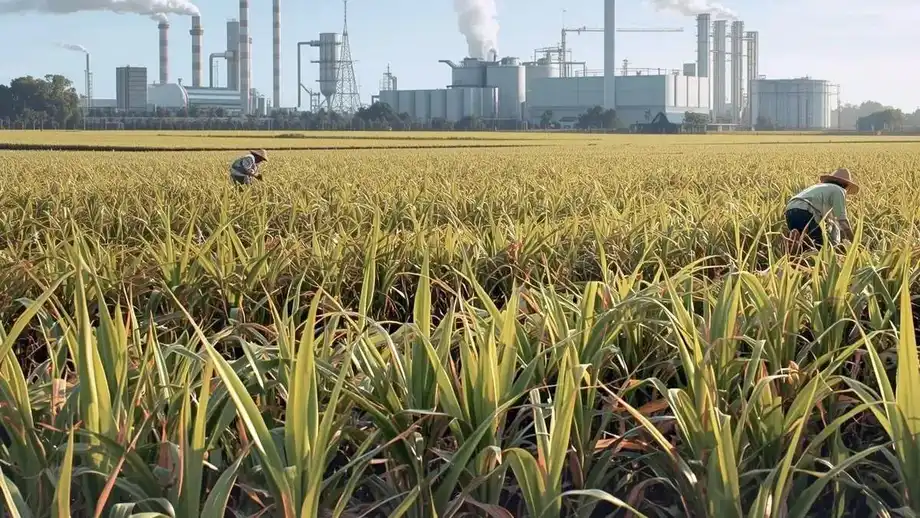
A fuel milestone runs into a sugar shortage
India's oil marketing companies have tendered for about 1,100 crore litres, or 11 billion litres, of ethanol for 2026-27 while excluding fuel made from sugarcane juice, sugar syrup and B-heavy molasses. Only C-heavy molasses remains eligible among the feedstocks derived from sugarcane. The direction to reduce sugar diversion to zero withdraws the flexibility that allowed mills to choose between selling more sugar and making more ethanol.
Contents
- A fuel milestone runs into a sugar shortage
- What the stock and production figures show
- Why the crop is shrinking
- How the feedstock rules changed
- What the reset means for mills and farmers
- Can imports protect consumers?
- Maize carries more of the blending burden
- The fiscal and water costs of rice
- What drivers pay and how residues could help
- What a more predictable policy would look like
- What to Know
The immediate reason is a smaller crop and thin inventories. The Indian Sugar and Bio-Energy Manufacturers Association (ISMA) has estimated production in 2026-27 at 26.52 million tonnes, or 265.2 lakh tonnes, the lowest in a decade. Gross and net output are the same in this estimate because no sugar is expected to be diverted for ethanol. Gross production would fall about 15 per cent from 31.21 million tonnes in 2025-26.
The restriction follows a rapid expansion of ethanol blending. Blending rose from 1.53 per cent in 2013-14 to 20 per cent in Ethanol Supply Year 2025-26, five years ahead of the original 2030 deadline. E20 means that petrol contains 20 per cent ethanol and 80 per cent petrol. India has shown that it can buy and blend much larger volumes, but the sugar shortage has changed the question from how much ethanol can be produced to which crops should supply it.
Consumers are already feeling the sugar squeeze. Retail sugar inflation exceeded 30 per cent across 21 States and Union Territories in September. Protecting food availability therefore takes precedence this season, even though distilleries and mills made substantial investments after the government encouraged ethanol production.
What the stock and production figures show
Government estimates put net sugar output in 2025-26 at 27.95 million tonnes, excluding 3.05 million tonnes diverted for ethanol. After allowing shipments of 0.85 million tonnes, the closing stock on September 30 was 3.55 million tonnes, down from 5 million tonnes a year earlier. That is a decline of 1.45 million tonnes, or 29 per cent. Total availability in 2025-26 was 32.95 million tonnes.
ISMA put last season's diversion higher, at 32.42 lakh tonnes, or 3.242 million tonnes. The government estimate was 3.05 million tonnes, while an earlier policy assessment used 29 lakh tonnes. ISMA's figure shows where the diversion was concentrated: Maharashtra accounted for 1.328 million tonnes, Karnataka for 1.224 million tonnes and Uttar Pradesh for 0.568 million tonnes. Other states together accounted for 0.103 million tonnes, followed by Tamil Nadu with 16,000 tonnes and Gujarat with 3,000 tonnes.
For the current season, the government is working with production of 27.5 to 28.5 million tonnes against consumption of about 29 million tonnes. ISMA's lower crop estimate is 26.52 million tonnes, and its demand estimate is 28 to 28.5 million tonnes. An industry balance using opening stocks of about 3.65 million tonnes, production of 26.5 million tonnes and imports of 1 million tonnes gives total availability of about 31.15 million tonnes. Consumption of 29 million tonnes would leave roughly 2.2 million tonnes at the end of the season.
A government official has warned that the closing stock on September 30, 2027 could fall as low as 2 million tonnes. Total availability this season is expected to slip to 31 or 32 million tonnes from 32.95 million tonnes. These balances explain why rebuilding inventories, rather than merely surviving until the next harvest, has become central to the policy debate.
Why the crop is shrinking
Sugarcane acreage has fallen by 3.2 per cent, from 57.35 lakh hectares in 2025-26 to 55.53 lakh hectares in 2026-27. ISMA has also cited uneven weather, including El Niño-related climate variability, drought-like stress and moisture shortages in some districts, and excessive rain, waterlogging and flooding in others. Crop lodging, where cane falls over and becomes harder to harvest, has added to the damage in certain areas.
Maharashtra is expected to produce about 8.68 million tonnes, down from 11.24 million tonnes, a fall of almost 23 per cent. Karnataka's output is projected at 4.62 million tonnes, compared with 6.18 million tonnes. Uttar Pradesh is relatively stable but still lower, at 8.89 million tonnes against 9.54 million tonnes, a decline of 6.81 per cent. Maharashtra, Uttar Pradesh and Karnataka together account for more than 80 per cent of India's annual sugar production.
ISMA used satellite imagery, field surveys, rainfall and irrigation information, feedback from mills and farmers, district analysis, crop assessments and regression models using artificial intelligence and machine learning. Deepak Ballani, Director General of ISMA, said the figures would be reviewed as crushing provides firmer information about cane availability and sugar recovery. He summarised the preliminary findings in these words.
The assessment indicates that sugarcane availability is likely to be lower during the 2026-27 season, particularly in Maharashtra and Karnataka, while Uttar Pradesh is expected to witness a relatively moderate decline
Final output will depend on the harvestable area, cane yield, crop maturity, the length of crushing and the amount of sugar recovered from each tonne of cane. ISMA plans a revised assessment in January 2027, or earlier if conditions warrant. Reduced water availability has also affected planting for 2027-28 in Maharashtra and Karnataka. Market estimates point to another production loss of 2 to 2.5 million tonnes, while an internal assessment by a multinational company used previous El Niño years to outline a more severe scenario of 23 to 24 million tonnes. The actual outcome will depend heavily on crop conditions and the 2027 monsoon.
How the feedstock rules changed
The three excluded routes use sugar that could otherwise reach consumers. Sugarcane juice and syrup can be fermented directly. B-heavy molasses is drawn off earlier in the sugar extraction process and still contains considerable sugar. C-heavy molasses is the residue left after mills have recovered as much sugar as they practically can, making it the remaining sugarcane feedstock eligible for the tender.
Sugarcane juice and B-heavy molasses supplied approximately 266 crore litres, or 2.66 billion litres, of ethanol last year. Much of the capacity behind those supplies was developed with government interest subvention schemes beginning in 2018. Interest subvention reduces the cost of borrowing for an approved investment. Distilleries built around the excluded routes now have no tender outlet for that output in the current supply year. They must use C-heavy molasses, invest in equipment for grain, sell other products where possible or operate below installed capacity.
- 2003: The Ethanol Blended Petrol Programme began with 5 per cent blending in nine states and four Union Territories.
- 2018: The National Policy on Biofuels admitted maize and surplus foodgrains, widening supply beyond sugarcane.
- 2019-20: Blending was about 5 per cent, before assured purchases and new capacity accelerated growth.
- 2025-26: India reached E20 and ISMA estimated that about 3.24 million tonnes of sugar had been diverted.
- October 2026: The oil company tender excluded cane juice, sugar syrup and B-heavy molasses for 2026-27.
- January 2027: ISMA is due to reassess the sugar crop as crushing progresses.
Ashok Gulati, distinguished professor at ICRIER, and Raya Das, a fellow at the institution, argue that assured oil company purchases and administered prices solved the problem of scale. Their concern is that successive procurement decisions now move large quantities of sugar, rice and maize without giving farms, mills and feed buyers enough time to adjust.
What the reset means for mills and farmers
Sugar economics were already strained before the restriction. The minimum selling price of sugar has remained Rs 31 per kilogram since February 2019. The national Fair and Remunerative Price for sugarcane, the minimum cane price linked to recovery, has risen to Rs 365 per quintal for 2026-27. A quintal is 100 kilograms. The procurement price for ethanol made from C-heavy molasses remains Rs 57.97 per litre.
High market prices are providing temporary relief. Pramod Patwari, Chief Financial Officer at Balrampur Chini Mills, said sugar economics now remove much of the incentive to divert cane even without a formal prohibition.
Considering the sugar prices at this point in time and the ethanol prices which are in place, there is no economic sense to divert even a kg of sugar towards ethanol
Balrampur Chini's sugar realisations rose from an average of Rs 44 per kilogram over six months to Rs 46 in the quarter ending September 2026, then Rs 50 in October and Rs 54 more recently. The company expects its annual sugar availability to rise by roughly 200,000 tonnes. It operates five distilleries and plans no further capacity expansion: one will run on rice and maize this year, while four will make extra neutral alcohol and ethanol through C-heavy molasses.
Other mills cannot necessarily make the same transition without new spending. Losing the option to adjust the production mix also removes a useful outlet when sugar supplies are ample. Strong sugar prices support cash flow for now, but sustained financial pressure can delay cane payments to farmers. Uttar Pradesh's State Advised Price for cane is around Rs 400 per quintal after last year's increase of Rs 30, and the rate for the coming season is still awaited.
Can imports protect consumers?
The central government permitted duty-free imports of 1 million tonnes of raw sugar in August under a Tariff Rate Quota. This mechanism allows a specified volume to enter under more favourable duty terms. Officials are also considering whether bulk consumers such as food processing companies should be allowed to import refined sugar directly under permits. Another possibility is wider raw sugar imports under the Open General Licence, a mechanism last used substantially in 2016-17. No final decision on those wider measures has been announced.
Union Food Minister Pralhad Joshi reviewed production, stocks, consumption and imports with senior Food Ministry officials on November 23. In a post on X, he described the purpose of the discussion.
Discussions focused on effective stock management, balancing domestic demand and supply, and ensuring adequate and stable sugar availability for consumers
Traders have projected an import need exceeding 2 million tonnes. Industry estimates put the total requirement at 3.2 to 4 million tonnes in 2026-27, including the 1 million tonnes already permitted, depending on the stock reserve the government wants and whether international prices make purchases commercially viable. The landed cost of imported white sugar at Indian ports has been around Rs 51 to Rs 52 per kilogram.
GK Sood, chairman of KN Agri Ltd, argues that a closing stock near 2 million tonnes leaves too little protection against another weak harvest.
A closing stock of around 5 million tonnes is considered a more comfortable level, which would require the government to facilitate additional supplies, including through imports
Prices demonstrate why that reserve matters. When closing stocks were around 3.5 million tonnes, retail sugar was about Rs 60 per kilogram, compared with roughly Rs 45 a year earlier, when stocks were near 5 million tonnes. Imports can relieve that pressure, but their timing, cost and form, raw or refined, will determine how quickly they reach the market.
Maize carries more of the blending burden
Maize supplied 6 per cent of ethanol feedstock in Ethanol Supply Year 2023 and accounts for 47 per cent of allocations for 2026-27. In 2025-26, about 614 crore litres were allocated to producers using maize, of which around 413 crore litres had been delivered by the end of September. Grain distillers anticipate a 40 to 50 per cent increase in maize demand next year, even as the United States Department of Agriculture projects an approximately 10 per cent decline in India's maize output.
The competition extends beyond fuel. Maize is a principal ingredient in poultry feed and is increasingly used by dairy and starch producers. Mandi prices have reached Rs 2,800 per quintal, according to Agmarknet, compared with a minimum support price of Rs 2,400. Distillers can bid prices higher, passing costs to poultry farms and milk consumers, or struggle to fulfil their ethanol commitments.
Ethanol production also creates a feed ingredient, so the effect is not a simple loss of every tonne used. Grain distilleries remove starch for fermentation and leave protein, fats and minerals that can become distillers dried grains with solubles, or DDGS. The expansion has already produced cheaper animal feed, while adding competition for soybean farmers. The USDA's New Delhi office estimated DDGS supply at 3.2 million tonnes in 2024-25 and forecast 4.2 million tonnes in 2025-26. Rice DDGS was quoted at Rs 25 to 29 per kilogram and maize DDGS at Rs 12.5 to Rs 15.5, against Rs 55 to Rs 59 for soybean meal, although their nutritional properties differ.
A. Amarender Reddy, Joint Director for Policy Support Research at ICAR in Raipur, says maize can complement cane because it is largely rainfed and needs much less irrigation. He calls for higher yielding hybrids, better seed availability, improved agronomy and stronger storage and market connections so that fuel demand raises farm incomes without squeezing feed supplies.
The fiscal and water costs of rice
Rice supplied by the Food Corporation of India (FCI) accounted for less than 1 per cent of ethanol supply in 2020-21, reached 13.5 per cent by Ethanol Supply Year 2025 and represents 44 per cent of allocations for 2026-27. FCI holds 39 million tonnes of rice and another 20.27 million tonnes in rice-equivalent paddy, more than five times the October 1 buffer norm. Using surplus stocks can therefore look attractive when warehouses are full.
Gulati and Das calculate that the latest allocation of 483.8 crore litres of ethanol from rice, comprising 159.9 crore litres from damaged rice and 323.9 crore litres from surplus rice, implies roughly 11.2 million tonnes of grain using NITI Aayog conversion factors. Rice allocations for ethanol had risen from 3.11 million tonnes in Ethanol Supply Year 2025 to an initial estimate of 7.2 million tonnes for 2026-27. Allocations from damaged foodgrains also rose 164 per cent over the previous supply year, prompting concern about quality losses during storage.
The fiscal arithmetic is substantial. FCI sells rice to distilleries at Rs 23.20 per kilogram, 47 per cent below its stated economic cost of Rs 43.91. ICRIER research adds roughly Rs 10 per kilogram for power and fertiliser support in the Punjab and Haryana belt, taking the estimated real economic cost to Rs 53.91. At an average use of 2.75 kilograms of rice per litre, Gulati and Das put the public expenditure embodied in each litre at Rs 148. Oil companies pay Rs 60.32 per litre, leaving an indirect subsidy of Rs 87.93. Applied to 11.2 million tonnes of rice, their calculation gives a fiscal cost exceeding Rs 35,800 crore, or Rs 358 billion.
The resource calculation is equally large. The Petroleum Ministry informed Parliament in March 2026 that rice was the most water-intensive ethanol feedstock. Using 4,000 litres of irrigation water per kilogram of rice and 2.75 kilograms per litre of ethanol gives 11,000 litres of water for each litre of fuel. The full rice allocation implies a potential water footprint of 44.8 billion cubic metres. Flooded paddy also emits methane, with ICRIER research estimating 5 tonnes of carbon dioxide equivalent per hectare in Punjab and Haryana. Rainfed maize requires about one fifth as much irrigation water as rice and produces much less methane.
What drivers pay and how residues could help
The blending programme has delivered a measurable benefit at the national level. The Ministry of Petroleum and Natural Gas says ethanol blending has saved nearly Rs 2 lakh crore, or Rs 2 trillion, in foreign exchange since 2014-15 by reducing petrol requirements. That gain sits alongside the feedstock, fiscal and water costs rather than erasing them.
Motorists also face a basic technical trade-off. Ethanol contains about 21 megajoules of energy per litre, against roughly 33 for petrol. E20 therefore lowers the energy content of each litre of blended fuel by about 6 to 7 per cent. Actual mileage depends on engine design, calibration and driving conditions. Vehicles designed for higher blends adapt better, while older vehicles may require attention to some rubber and fuel system components. Clear manufacturer guidance can help owners understand servicing and fuel choices.
Sugarcane has its own water footprint. The NITI Aayog roadmap estimates that a litre of ethanol made from cane embodies roughly 3,000 litres of water, although actual use varies by region and irrigation practice. Reddy argues against abandoning cane and instead supports using it where water is plentiful, expanding maize where rainfed productivity can be raised sustainably, and turning residues into fuel wherever sufficient biomass is available.
India generates about 500 million tonnes of crop residue each year. The Ministry of New and Renewable Energy estimates that 90 to 100 million tonnes are burned in fields, contributing to seasonal air pollution. Second generation ethanol uses material such as rice straw, wheat straw, cane trash and maize stover instead of food grain. Indian Oil's Panipat plant and BPCL's Bargarh plant provide early examples, each processing rice straw at about 100 kilolitres per day. Wider use still requires dependable collection and storage, affordable transport, better enzymes and workable biomass supply chains.
The PM JI-VAN Yojana, extended to 2028-29, supports ethanol from crop residues, industrial waste and algae. Gulati and Das also propose research and pilot coastal biorefineries using seaweed, which needs no farmland, fertiliser or irrigation. Seaweed yields are not yet commercially viable, while residue plants remain few and paddy straw continues to be burned.
What a more predictable policy would look like
Mill operators first need procurement decisions early enough to plan maintenance, investment and crushing. A late change can leave equipment idle and contracts exposed. Annual diversion limits could instead reflect opening sugar stocks, production estimates and consumption. A calibrated allowance for B-heavy molasses when supplies improve would preserve sugar availability in deficit years while giving existing distilleries an outlet in better ones.
Prices need to be considered together as well. Sugar's minimum selling price, cane's Fair and Remunerative Price, state cane prices and ethanol rates for each feedstock all affect the same mill account. The committee under Professor Ramesh Chand that is reviewing sugarcane and sugar pricing offers an opportunity to examine those connections, beginning with the unchanged C-heavy ethanol price. No date has been announced for a revision.
Gulati and Das propose a full assessment for each feedstock, from cultivation and processing to transport and combustion, benchmarked against the landed cost of imported ethanol. They also favour a preannounced E15-E20 blending band linked to sugar output, grain stocks and maize prices. Blending could contract toward 15 per cent in deficit years and return toward 20 per cent in surplus years, with ethanol imports acting as a reserve.
The immediate tests are concrete: the size of the import programme, the final cane price in Uttar Pradesh, the January crop revision and the treatment of existing distillery capacity. A stable framework would give consumers protection during shortages, farmers a clearer market, mills predictable operating rules and the fuel programme a broader supply base without assuming that one crop can carry every target.
What to Know
- India's tender for about 11 billion litres of ethanol excludes cane juice, sugar syrup and B-heavy molasses, leaving C-heavy molasses as the only eligible sugarcane feedstock.
- ISMA estimates 2026-27 sugar production at 26.52 million tonnes, a decade low, with gross output down about 15 per cent.
- The government put closing sugar stocks at 3.55 million tonnes on September 30, down from 5 million tonnes a year earlier.
- Projections for September 2027 range around 2 to 2.2 million tonnes, prompting estimates that India may need 3.2 to 4 million tonnes of imports.
- Mills face an unchanged sugar minimum price of Rs 31 per kilogram, higher cane costs and an unchanged C-heavy ethanol price of Rs 57.97 per litre.
- Maize accounts for 47 per cent of current ethanol allocations and rice for 44 per cent, increasing exposure to feed prices, public spending and water use.
- Researchers estimate more than Rs 35,800 crore in fiscal costs and a water footprint of 44.8 billion cubic metres for the calculated rice requirement.
- E20 reduces fuel energy content by about 6 to 7 per cent, while the Petroleum Ministry credits blending with saving nearly Rs 2 trillion in foreign exchange since 2014-15.
- ISMA will revisit its crop estimate in January 2027, and decisions on wider sugar imports and cane pricing remain pending.