Two layers, one weak seam, and stitches that hold
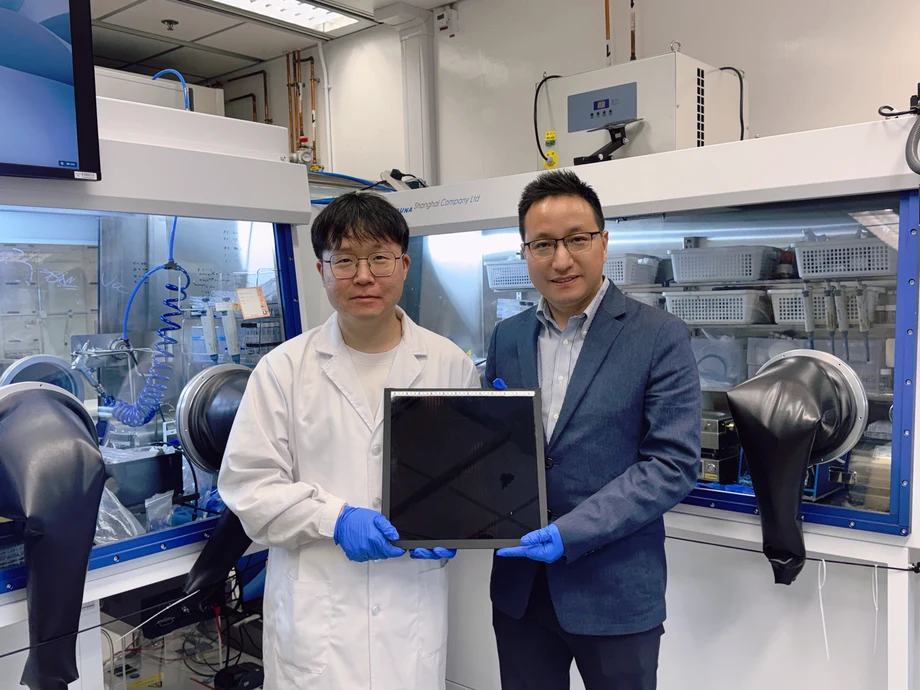
The best perovskite solar cell built by Zhou Yuanyuan's team at the Hong Kong University of Science and Technology turned 27.04% of incoming sunlight into electricity. An outside laboratory measured 26.67% on a single device. The figure the researchers keep returning to is 1,400: of 50 identical cells given their treatment, 46 ran for at least that many hours before output fell to 80% of where it began.
Contents
- Two layers, one weak seam, and stitches that hold
- What actually breaks inside a solar cell
- How the stitching works
- The efficiency figures and who checked them
- A tougher join, measured in joules per square metre
- Why 46 out of 50 may matter more than 27.04%
- Heat, humidity and the limits of a 1,400 hour test
- A patent, a corporate backer and a 2050 deadline
- Key Points
Perovskite cells have passed 27% in laboratories for several years. What they have rarely done is behave the same way twice. In the same HKUST test, untreated control cells lasted anywhere from a few dozen hours to more than 1,800 hours, a spread no factory could plan around. The treated cells clustered between 1,300 and 2,100 hours instead.
The technique is called trans-interface engineering (TIE). It does something structurally different from what the field has tried: rather than laying a patch between two layers, it grows polymer chains through both of them and locks them together with chemical bonds. The work appears in Nature Photonics as the cover article of the November 2026 issue (Volume 20, Issue 11), and the university set out the results in its own announcement.
What actually breaks inside a solar cell
A perovskite solar cell is a stack. A light absorbing layer of perovskite crystals sits on a charge transport layer, in these devices usually tin oxide, which carries electrons toward an electrode. Light knocks electrons loose in the perovskite, and every one of them has to cross into the oxide and travel on. The boundary between the two materials is a few nanometres thick.
Perovskite is not a single material but a family of crystal structures whose recipe can be adjusted to absorb different parts of sunlight. The appeal is manufacturing: the crystals can be printed from a liquid ink onto glass or flexible film instead of grown as a silicon ingot at high temperature.
Heat is the enemy of the join. A panel on a roof warms and cools every day. The perovskite film and the oxide beneath it expand and contract by different amounts, so the boundary absorbs the strain. A crack opens and spreads, the layers start to peel apart, and output drops with them.
The usual remedy is a flat interlayer placed at the join. Such layers mop up surface defects and improve grip, but they carry a cost. A coating thick enough to hold the stack together tends to obstruct the flow of charge, and it sits on top of a damaged interface rather than repairing it. Zhou, acting head of HKUST's Department of Materials and the paper's only corresponding author, put the difference this way.
Conventional interface engineering attempts to repair interfaces like applying a Band-Aid, but fails to fundamentally address mechanical failure," Zhou said. "TIE is more like stitching the layers together. Through trans-interface covalent linkages, we connect the perovskite and charge-transport layers together at the molecular level, substantially improving mechanical reliability and stability without compromising optoelectronic performance.
How the stitching works
Two different monomers go into the cell during manufacture. TMTA, a molecule with three reactive sites, is mixed into the perovskite side. AM, a molecule with one reactive site, goes into the tin oxide side. Heating the stack breaks azobisisobutyronitrile, shortened to AIBN, into cyanoisopropyl radicals, highly reactive fragments that start the monomers polymerizing.
The polymer grows inside both layers at once and bonds across the boundary, forming vertical links rather than a horizontal blanket. The imbalance between the molecules matters. Three arms on one side and one on the other produce a network that runs through the film instead of a carpet resting on its surface. Cross sectional electron microscope images in the paper show the polymer reaching from the perovskite grain boundaries down into the tin oxide, and the team confirmed both molecules were present after washing the films in solvent.
The link is covalent, meaning the two atoms share electrons. Earlier interface designs relied on weaker hooks, such as coordination bonds and hydrogen bonds, which hold under gentle conditions and give way under repeated stress.
The efficiency figures and who checked them
Comparing the best cells, the treated device reached 27.04% efficiency against 25.95% for an untreated control from the same batch, a gain of 1.09 percentage points. Open circuit voltage, the voltage a cell shows when no current is drawn, rose from 1.209 V to 1.220 V. Short circuit current density, the current per unit area when the terminals are connected directly, went from 25.89 mA/cm2 to 26.35 mA/cm2.
The certified 26.67% was measured on one treated cell by the Tianjin Institute of Metrological Supervision and Testing, whose report is filed in the paper's supplementary material.
The efficiency cell and the cells used to study lifetime were not the same recipe. The 27.04% device used a perovskite written as (FA0.95Cs0.05PbI3)0.975(MAPbBr3)0.025 with spiro-OMeTAD as the hole transport layer, while the durability tests used FA0.9Cs0.1PbI3 with PTAA, a different hole transport material. Those strings are recipes for the crystal, naming the ions in the mix and their proportions. Tin oxide served as the electron transport layer in both designs.
A tougher join, measured in joules per square metre
To put a number on the repair, the team measured interfacial fracture toughness, the energy needed to push a crack across a unit area of the join. The control cells averaged 0.76 joules per square metre, with a sample standard deviation of 0.23. The treated cells averaged 1.72, with a standard deviation of 0.30. A third group, whose interface was bonded by a different method, measured 0.67.
That works out to about 2.3 times the energy for the same crack advance, calculated across groups of 10 samples behind the paper's toughness figure. HKUST describes the improvement as nearly threefold.
Microscopy backs the measurement. In a cross section of an untreated cell run for 600 hours at room temperature, the boundary between perovskite and oxide had come apart. A treated cell kept its bond after 1,500 hours. The team checked whether preparing samples for the microscope could have caused the damage and found delamination in regions less exposed to that processing as well.
Why 46 out of 50 may matter more than 27.04%
Solar manufacturing is a statistics business. A record cell that works once tells a production line little; what a factory needs is a tight distribution, so that a warranty can be written against it. HKUST tested more than 50 devices under continuous illumination at one sun, the standard intensity of full daylight, while tracking the operating point of maximum power. It reported that 92% of the treated devices reached a T80 lifetime of at least 1,400 hours. T80 is the time a cell takes to fall to 80% of its initial efficiency, which lets devices that started at different outputs be compared.
The paper's lifetime comparison aggregates 50 treated cells and 50 control cells. The individual runs it shows began at 22.82% for a control device and 23.73% for a treated one, which is why relative loss rather than absolute output is the measure. The control group spanned a few dozen hours to beyond 1,800 hours in the university's description; the binned data behind the figure place control cells between 100 and 1,900 hours and treated cells between 1,300 and 2,100 hours. Fewer early failures and a narrower spread are the parts a manufacturer would notice.
Guo Pengfei, one of the paper's two first authors and a former postdoctoral research fellow in Zhou's group, said the work had identified a cause of instability that the field had treated as a secondary effect.
Our study reveals that mechanical failure is a key factor behind the poor stability of perovskite solar cells," Guo said. "TIE not only addresses this long-overlooked issue but also opens a new avenue for interface design in multilayer optoelectronic devices.
Heat, humidity and the limits of a 1,400 hour test
Beyond the room temperature runs, the team put treated cells through accelerated aging at 85°C and 85% relative humidity, the combination widely used to approximate years of outdoor service in weeks. The treated devices held up better, and with more consistent results between cells, than controls. No separate lifetime figure was released for that test.
A 1,400 hour run is not a service life. Solar modules are sold with performance warranties of 25 to 30 years, and 1,400 hours is roughly two months of continuous illumination. The lifetime cells were measured in a nitrogen atmosphere rather than open air, which removes oxygen and humidity from the test. The study reports no module scale data and no commercial production date.
Yu Wenjian, the paper's other first author and a doctoral student in Zhou's group, said the treatment had been tried on different chemistries and device designs rather than a single architecture.
"We have validated TIE across different perovskite compositions, charge-transport materials, and device architectures, demonstrating its broad applicability and engineering potential," Yu said.
A patent, a corporate backer and a 2050 deadline
HKUST says the research was conducted independently by its team, that a patent has been filed on the technique, and that China Merchants Group has agreed to support efforts to move it toward industrial use. The paper, with Guo and Yu as first authors and Mingwei Hao among the co-authors, went online in Nature Photonics on 29 September 2026 under DOI 10.1038/s41566-026-02007-w.
- 29 September 2026: the paper is published online by Nature Photonics.
- 25 November 2026: HKUST announces the results.
- November 2026: the study runs as the cover article of Volume 20, Issue 11.
Hong Kong has set a target of reaching carbon neutrality before 2050, and solar power is one of the routes the city is counting on. A cell that holds its output for longer matters to that plan as much as another fraction of a percentage point of efficiency, because the cost of solar electricity depends on how much power a panel delivers across its life rather than on its best hour.
Higher output is being chased on a parallel track. In November, researchers at Hainan University and partner institutions reported tandem perovskite cells that reached a certified 30.8% by stacking two light absorbing layers, a different route to more electricity from the same patch of roof. Their devices kept more than 85% of initial performance after 1,000 hours.
Key Points
- A team led by Zhou Yuanyuan at HKUST built a perovskite solar cell with 27.04% power conversion efficiency, certified at 26.67% by the Tianjin Institute of Metrological Supervision and Testing.
- Trans-interface engineering replaces a flat interlayer with polymer chains grown through both the perovskite and the electron transport layer and held by covalent bonds.
- Interfacial fracture toughness rose from 0.76 to 1.72 joules per square metre, about 2.3 times, against the nearly threefold increase described by the university.
- 46 of 50 treated cells kept at least 80% of initial output beyond 1,400 hours, while control cells ranged from a few dozen hours to more than 1,800 hours.
- The paper appeared in Nature Photonics on 29 September 2026 and on the cover of the November issue; a patent has been filed and China Merchants Group is backing commercialization.
- No module scale result and no commercial production date have been given, and the 1,400 hour test used a nitrogen atmosphere rather than outdoor conditions.