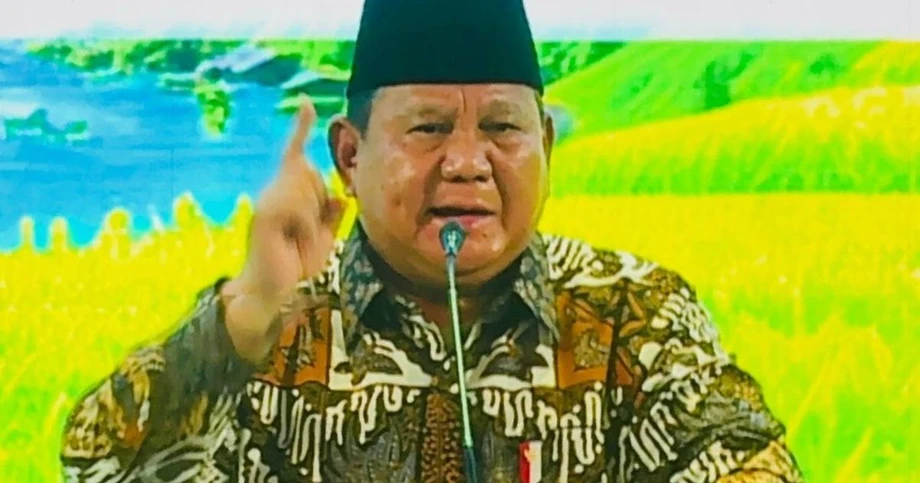
Prabowo takes his fire warning to Indonesia's financial elite
President Prabowo Subianto told bankers and business leaders on Friday, November 27, 2026, that Indonesian police and prosecutors were examining hundreds of corporations over forest and land fires. Speaking at Bank Indonesia's Annual Meeting in Jakarta, he described the fires as the result of human activity and promised action against companies that violate permit conditions or allow land under their control to burn.
Contents
- Prabowo takes his fire warning to Indonesia's financial elite
- What Indonesia Incorporated demands from business
- What investigators and ministries have done
- What the burn maps reveal about concessions and peat
- Why human ignition becomes a much larger disaster
- The Rp565 trillion economic and health bill
- Warnings, revocations and an apology to neighbors
- The speech also pressed banks, markets and procurement
- Prevention now depends on ownership, monitoring and regional work
- Key Points
The president delivered the warning at Grha Bhasvara Icchana in the central bank's head office complex. The meeting carried the theme Synergy Toward a Stronger and More Resilient Indonesia. Prabowo said some officials and public figures still believed they could deceive the state, challenge its authority and damage the national economy because of greed or personal and group ambition.
In the central warning of his address, the president said his patience had run out and identified the two institutions handling the investigations.
I will no longer show any tolerance; I will not hesitate. The police and the Attorney General's Office are investigating hundreds of corporations.
Prabowo did not name the companies during the speech. He said enough was enough and promised that the Unitary State of the Republic of Indonesia, known as NKRI, would act without favoritism when businesses failed to respect its laws.
What Indonesia Incorporated demands from business
Prabowo repeatedly separated his enforcement message from hostility toward private enterprise. He said corporations were needed to support investment, create jobs, build factories, process natural resources within Indonesia and produce goods with greater value. Economic development, he argued, could not be left to the government alone.
Economic development cannot be carried out by the government alone.
The president's complaint centered on companies that had already received substantial benefits from the state. He listed land concessions, HGU (Hak Guna Usaha), or land cultivation rights, HTI permits for industrial forest plantations, and IUP (Izin Usaha Pertambangan), meaning mining business permits. Some recipients had also obtained credit from government banks, yet still failed to meet permit requirements or prevent fires in their concessions.
Indonesia Incorporated, the cooperation model Prabowo said he advocates, therefore comes with a condition. The government will work with large businesses, but access to land, natural resources and public financing carries legal and environmental responsibilities. For corporate borrowers, the warning also connects their environmental record with a broader examination of who receives state credit.
What investigators and ministries have done
Bareskrim, the National Police criminal investigation unit, has named 20 corporations as suspects from 104 police reports. Those cases cover 29,168.78 hectares of burned land. Sixteen of the companies are local and four are corporations with foreign investment, known as PMA, originating from Singapore, Malaysia and South Korea. Police have also recommended the withdrawal of permits for 23 corporations.
A separate police count identified 245 individual suspects from 287 reports. The offences involved in the corporate cases carry potential prison sentences of three to five years and fines ranging from Rp3 billion to Rp15 billion. The figures measure different things: companies, individual suspects and police reports should not be added together as if they were a single caseload.
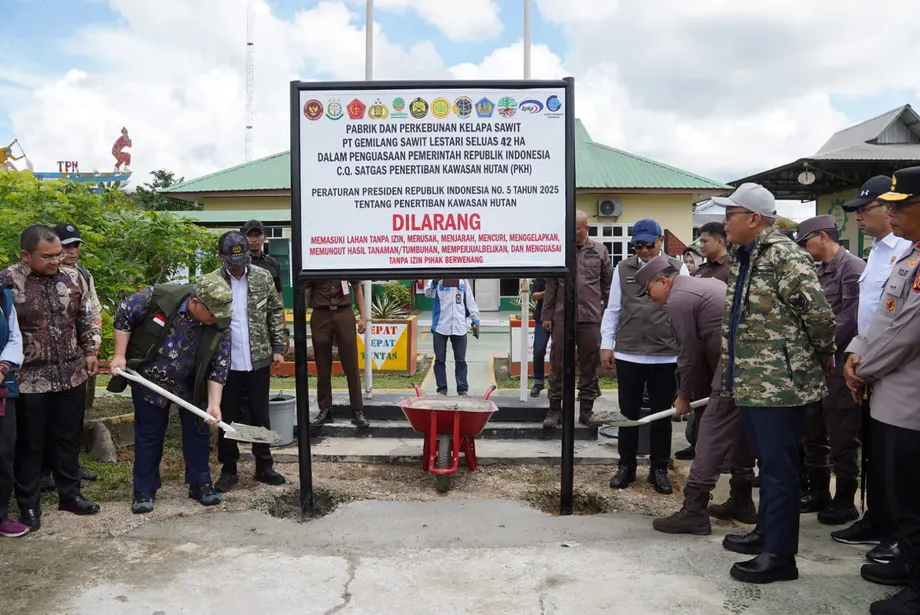
The Forestry Ministry has imposed administrative sanctions on 32 companies across seven provinces, involving 12,926.74 hectares of burned land. The measures include freezing permits, compelling ecosystem restoration and revoking the permits of five legal entities. On October 31, its law enforcement directorate named PT MAP and PT GAP as suspects. PT GAP is a Singapore linked foreign investment company managing an oil palm plantation in East Kotawaringin.
Dwi Januanto Nugroho, the ministry's director general for law enforcement, said Indonesian law applies equally to local companies and corporations with foreign investment. Investigators are also examining ownership structures and operational control so that responsibility can reach the people who directed activities, rather than stopping at the company named on a permit.
What the burn maps reveal about concessions and peat
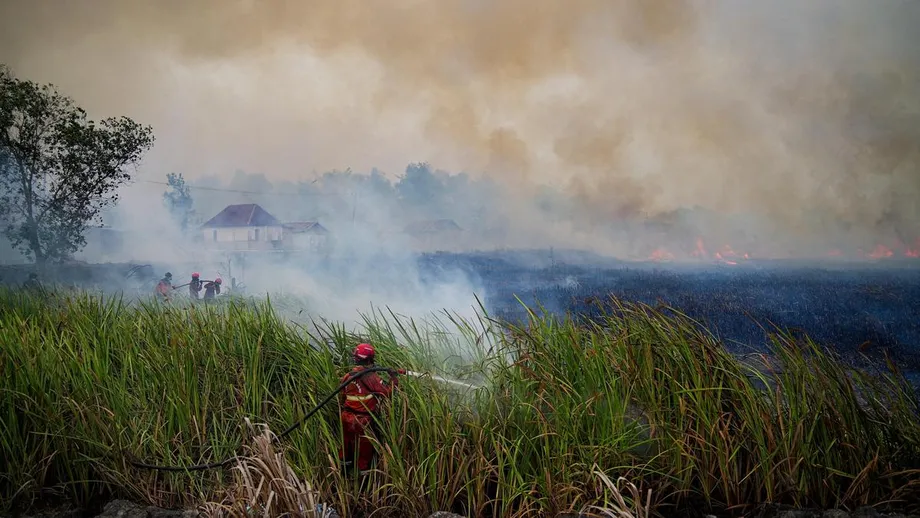
MADANI Berkelanjutan supplied a detailed picture of the earlier surge in its August crisis assessment. Its Indicative Burned Area model, known as AIT, estimated that 667,133 hectares had burned by August 20. Of that total, 465,174 hectares burned during the first 20 days of August, meaning that almost 70 percent of the area recorded by that date was lost in less than three weeks. July's figure was 109,244 hectares, while January through March accounted for 67,450 hectares.
West Kalimantan recorded the largest provincial area in that assessment at 217,641 hectares, followed by South Papua with 94,962.4 hectares and Central Kalimantan with 87,003 hectares. Fires also reached 212,739 hectares of peatland. The peat total was divided almost evenly between 106,273 hectares designated for cultivation and 106,466 hectares carrying a protection function.
The location of the fires gives Prabowo's concession warning a measurable basis. MADANI calculated that 338,459 hectares, or 50.7 percent, burned inside licensed concessions, compared with 328,675 hectares, or 49.3 percent, outside them. Palm oil plantation permits accounted for 131,331 hectares and forestry PBPH permits, which authorize forest utilization businesses, accounted for 69,016 hectares. Areas with overlapping licenses added another 73,510.4 hectares.
AIT uses satellite hotspot readings with high confidence ratings, filters out heat from sources such as factories, cities and volcanoes, and can update every three days. MADANI said its estimates through July exceeded the government's SiPongi figures by 14,224.7 hectares in West Kalimantan and 16,701.7 hectares in South Papua. It also reported a correlation above 90 percent between the two monitoring series for January through July, and urged institutions to compare their strengths rather than rely on one map alone.
Why human ignition becomes a much larger disaster
The president's focus on human responsibility addresses how fires begin and how land is managed. Weather helps determine how far they spread. El Niño is a natural climate pattern that can bring unusually dry conditions to Indonesia, and an exceptionally strong episode in 2026 lowered moisture levels and left vegetation and drained peat more vulnerable to flames.
Herry Purnomo, Indonesia country program director at the Center for International Forestry Research, explained that El Niño does not have to start each fire to make the season worse. It intensifies existing fires and helps them spread. He also said Indonesia had strengthened prevention, monitoring and response since earlier disasters, leading him to expect a less catastrophic outcome than in 2015.
Nisa Novita, a peatlands researcher at the Indonesian conservation organization YKAN, gave a more cautious assessment of the fire season's scale earlier in the crisis.
The magnitude of the 2026 fire season is currently very similar to that of 2015.
Indonesia holds nearly 40 percent of the world's tropical peatland. Healthy peat is waterlogged and stores large amounts of carbon, but drainage for plantations can leave it dry and combustible. Guillermo Rein, a professor of fire science at Imperial College London, described degraded peat exposed to drought as a vast store of ready fuel. Belgis Habiba of Greenpeace Indonesia linked that danger directly to plantation drainage. Dominick Spracklen of the University of Leeds warned that peat fires can continue for weeks, burn underground and reignite while conditions remain dry.
The 2015 disaster remains the main comparison. Fires during that strong El Niño episode burned about 2.6 million hectares, cost as much as USD28 billion and may have contributed to 100,000 premature deaths across Indonesia, Malaysia and Singapore. In 2026, the Indonesian Agency for Meteorology, Climatology and Geophysics detected more than 23,000 hotspots over eight months. Copernicus, the European Union's climate service, said August fire emissions were the highest for that month in 24 years and estimated nearly 49 million tons of carbon released over three weeks, exceeding the same period in 2015.
Authorities deployed more than 50 aircraft for water bombing and cloud seeding, an attempt to encourage rainfall. Smoke also delayed flights, closed parks and forced thousands of schools to shut earlier in the season.
The Rp565 trillion economic and health bill
A Celios report titled Membakar Hutan Hanguskan Ekonomi estimated economic and health losses from the fires at Rp565.03 trillion for January through October 2026. That amount equals 14.92 percent of Indonesia's 2026 state budget. Its lower estimate was Rp359.58 trillion, based on data available through October 20. The assessment put the burned area at 1.92 million hectares, covering a longer period than MADANI's August snapshot.
The main loss estimate combines Rp340.38 trillion from destroyed physical assets and interrupted economic activity with Rp224.65 trillion in health costs. The first component equals 2.69 percent of gross domestic product, or GDP, the value of goods and services produced by the economy. Forestry and logging accounted for Rp262.33 trillion of the losses, while regional governments stood to lose Rp4.06 trillion in net tax revenue.
Papua carried the largest regional economic burden at an estimated Rp59.43 trillion, equivalent to 40.60 percent of its gross regional domestic product, the regional equivalent of GDP. South Papua recorded 319,119.68 hectares of burned land in the assessment, the largest provincial total, followed by West Kalimantan and East Nusa Tenggara.
The health consequences extend beyond balance sheets. A study by the Centre for Research on Energy and Clean Air estimated 3,560 deaths associated with smoke in September 2026, while 58 million people were exposed to dangerous air. Earlier in the crisis, Indonesia's Health Ministry linked more than 50,000 respiratory infections to the fires. Malaysia's Health Ministry reported a 259 percent rise in asthma cases during the affected period. Wildfire smoke contains fine particles known as PM2.5, which can enter deep into the lungs and contribute to breathing and heart problems.
Warnings, revocations and an apology to neighbors
The November speech followed a series of increasingly specific warnings and enforcement steps:
- October 22: Prabowo told a national meeting on regional financial access that some companies had violated regulations as many as 19 times.
- October 31: Forestry Ministry investigators named PT MAP and PT GAP as suspects.
- November 15: Prabowo told the 49th ASEAN Summit in Manila that police were investigating 104 companies and apologized to Malaysia and Singapore for transboundary haze.
- November 19: The Forest Area Control Task Force revoked PT RAPP's forest utilization business permit in Riau.
- November 27: Prabowo renewed his no tolerance warning before Indonesia's financial and business leadership.
At the October 22 meeting, Prabowo accused some foreign companies operating in Kalimantan and Sumatra of contributing to the fires and said their names would be announced later. He also rejected the idea that local Kalimantan communities, whose livelihoods depend on forests and land, were responsible. The president praised the military, police and regional governments for their firefighting work and suggested that local governments and universities help identify Indonesians capable of managing plantations taken from violators.
In my view, enough is enough. If they violate the rules twice, just revoke their permits.
At the ASEAN Summit, Prabowo said 17 company concessions had been revoked. He also listed 26 companies under investigation, 11 that had been charged and 23 expected to face charges, while giving 104 as the total number under police investigation, according to a Presidential Secretariat statement. His apology acknowledged that smoke had crossed Indonesia's borders despite the response effort.
The president also described the human and operational cost of fighting the fires.
We deployed 71,000 forest firefighters. Sixteen people died, many others were injured while battling the fires, and we lost two helicopters.
The PT RAPP decision covered a concession of 338,536 hectares. Authorities said it followed repeated peat fires and spatial planning violations. Within the area, they reported finding 18,362.74 hectares of oil palm plantations, illegal mining and damage to protected land.
The speech also pressed banks, markets and procurement
Prabowo used the same Bank Indonesia event to argue that enforcement should protect economic growth rather than suppress business. He said the economy expanded 5.47 percent in the third quarter of 2026 despite global turmoil and uncertainty, describing that as evidence of strong fundamentals. He thanked Bank Indonesia, financial authorities, banks and business leaders for preserving economic resilience, while saying growth must be felt in factories, rice fields, markets and ordinary households.
The audience included Bank Indonesia Governor Destry Damayanti, Coordinating Minister for Economic Affairs Airlangga Hartarto, Finance Minister Suahasil Nazara, Housing and Settlement Minister Maruarar Sirait, National Police Chief General Suyudi Ario Seto and Financial Services Authority board chair Friderica Widyasari Dewi. Prabowo noted the presence of 30 ministers and officials at ministerial level, 22 deputy ministers and 35 governors.
On financial markets, he criticized wealthy people who pump up share prices at the expense of young and ordinary investors and warned that millions could be harmed. He said about 60 people had been handed over for investigation in connection with stock market cases. His instruction on supervision was concise.
Good governance. This is in our interest.
Prabowo also challenged executives at Himbara, the association of banks owned by the state, over lending that he said repeatedly went to the same small circle of borrowers. He urged them to examine irrigation, visit rice fields and cooperatives, and meet fishermen. Digital records, he added, make questionable lending decisions easier to trace.
The money you manage is the people's money.
His wider governance argument included government purchasing. Prabowo put spending on goods and services at 30 percent of the state budget, about USD70 billion, and claimed that USD21 billion was lost to inflated prices. He proposed a special body to organize procurement, building on the Rp480 trillion savings claim he made on November 11 when calling for consolidated government purchasing.
Prevention now depends on ownership, monitoring and regional work
Police and Forestry Ministry investigators are seeking the people who ultimately own or control companies, commonly called beneficial owners, even when their names do not appear on an operating permit. That work is intended to identify who gave instructions and who benefited from the operations under investigation.
At the ASEAN Summit, Prabowo also announced plans for a new agency and a shift from extinguishing fires toward systematic prevention. He gave no launch date for the agency. His Friday address supplied no court dates for the corporate investigations and did not provide the company names he had promised in October.
Regional cooperation is moving alongside domestic enforcement. Philippine Foreign Affairs Secretary Ma. Theresa Lazaro said ASEAN leaders encouraged members to prioritize ratification of the agreement establishing the ASEAN Coordinating Centre for Transboundary Haze Pollution Control. Singapore proposed broader cooperation on investigations into companies suspected of contributing to haze, including greater sharing of information among member states.
MADANI's assessment called for concession compliance audits and meaningful sanctions, together with investment in community prevention and canal blocking outside licensed areas. Canal blocking uses dams to retain water and keep peat wet. The organization also cited the dissolution of the Peat and Mangrove Restoration Agency as a governance failure. A government circular, Number 16 of 2026, had already sought to anticipate El Niño from July, leaving prevention, ownership investigations and consistent monitoring as the immediate tests of Prabowo's warning.
Key Points
- Prabowo said on November 27 that police and prosecutors were examining hundreds of corporations and that human caused forest fires would receive no further tolerance.
- He linked concessions, cultivation rights, plantation and mining permits, and state bank credit to a duty to obey the law and prevent fires.
- Police have named 20 corporate suspects, including four companies with foreign investment, and 245 individual suspects in separate counts.
- MADANI estimated 667,133 hectares burned by August 20, with 50.7 percent of that area inside licensed concessions.
- Celios estimated January to October economic and health losses at Rp565.03 trillion, with 1.92 million hectares burned.
- Prabowo apologized to Malaysia and Singapore on November 15 and said 16 firefighters had died among a deployment of 71,000 personnel.
- A new prevention agency is planned, but no launch date, company list from the Friday speech or court schedule has been announced.