Hanoi summit puts polluted rivers on the regional agenda
Prime Minister Anutin Charnvirakul arrived at Noi Bai International Airport in Hanoi on the morning of 28 November 2026, carrying a northern Thai water crisis into a regional summit. Vietnamese Deputy Minister of Foreign Affairs Nguyen Minh Hang greeted him. The Thai delegation included his spouse Thananon Charnvirakul, Deputy Prime Minister and Foreign Minister Sihasak Phuangketkeow, Defence Minister Lieutenant General Adul Boonthumjaroen, and Ambassador to Vietnam Urawadee Sriphiromya.
Contents
- Hanoi summit puts polluted rivers on the regional agenda
- How mining in Shan State reaches Thai taps
- What the pollution means at home
- Timeline: from testing to a border agreement
- What Bangkok and Nay Pyi Taw agreed
- China's leverage and the limits of pressure
- Thailand's own controls reach mines, labs and riverbanks
- New screening tests aim for an answer in 20 minutes
- Communities demand maps, access and a fund for recovery
- What is settled, and what still needs a decision
- Key Points
The 11th Ayeyawady Chao Phraya Mekong Economic Cooperation Strategy summit, known as ACMECS, brought together Cambodia, Laos, Myanmar, Thailand and Vietnam at Vietnam's National Convention Centre on 28 and 29 November. The meeting is held every two years. Thailand proposed ACMECS in 2003 and is due to take the chair from Myanmar for 2027 and 2028. Its stated theme was Strengthening Socio-Economic Development Towards Smart and Sustainable ACMECS.
Anutin planned to put river pollution beside trade and online scam networks. Economic items include simpler customs procedures, wider use of digital finance and better transport links. Leaders were expected to review progress under the ACMECS master plan, endorse the draft Nay Pyi Taw Declaration and approve a second document on the work of a group reviewing priority projects. Anutin also had separate talks scheduled on 29 November with Myanmar President Min Aung Hlaing and Vietnamese President To Lam. China is not an ACMECS member, so Thailand also planned to raise the issue through the Mekong Lancang Cooperation summit in China late in December.
How mining in Shan State reaches Thai taps
The contaminated waterways are the Kok, Sai, Ruak and Mekong rivers. The Kok rises in Myanmar's Shan State and runs into Chiang Rai province. The Sai and Ruak form parts of the border. The Pollution Control Department detected arsenic and other heavy metals in water and sediment samples from the Kok and its tributaries, the Sai, the Ruak and the Mekong between March and September 2025. Wider official responses have also named the Salween and Kraburi, which form parts of the Myanmar Thailand border.
A Senate committee inspection in Chiang Rai from 19 to 21 September 2025 traced the path from mines in Shan State through the Sai and Ruak rivers into the Kok and then the Mekong. The committee was led by Noraseth Prachayakorn, chair of the Senate Committee on Political Development, Public Participation, Human Rights, Liberties and Consumer Protection. He said joint work was harder because Thailand caps arsenic in water at 0.01 mg/L while Myanmar allows 0.05 mg/L, five times higher.
This makes resolution difficult and requires multiple diplomatic mechanisms.
The committee recommended sediment trapping weirs in irrigation canals, a central water testing laboratory at Mae Fah Luang University, backup raw water from the Mae Suai and Mae Kham reservoirs, and a national task force chaired by the prime minister or a deputy prime minister. Committee member Maneerat Khemawong said the issue should be treated as a national priority because it affected Thailand and regional security.
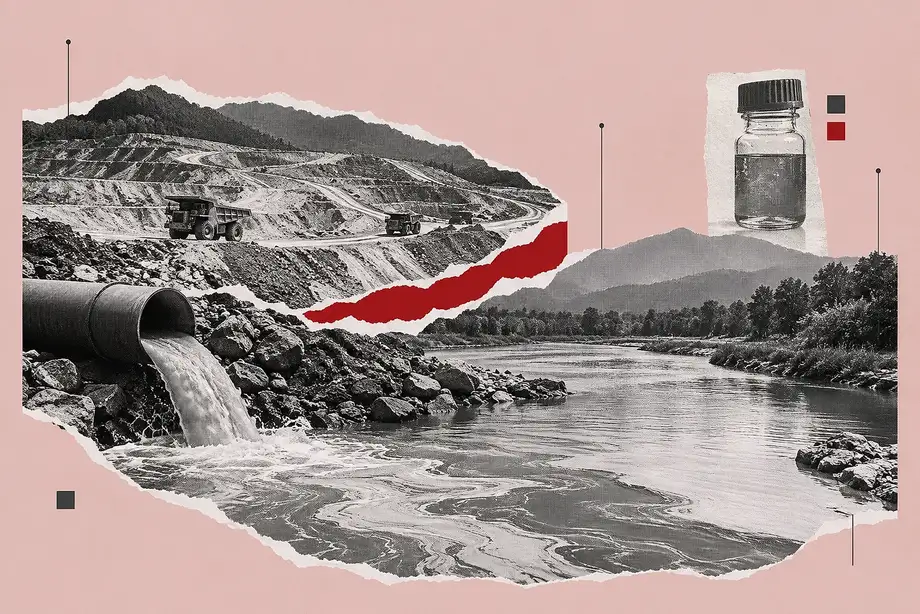
Arsenic is a natural element in rock and soil. Mining can expose it, and rain can wash it into streams. It has no color or smell, which makes testing the only reliable way to know whether water is safe. Chemical fingerprinting found that about 39 percent to 50 percent of excess arsenic in the Kok River matched signatures used in rare earth extraction, while the rest aligned with gold and sulfide ore processing. Rare earth elements are metals used in magnets for phones, wind turbines, medical devices and electric vehicles. One mining method, called in situ leaching, pumps chemical solution into hillsides to dissolve those metals. Heavy rain can carry the solution into streams. The Stimson Center, based in the United States, identified more than 2,400 mines across mainland Southeast Asia that could release chemicals such as cyanide and mercury. Thai authorities pointed to two gold mines across from Mae Sai as main contributors to arsenic in the Sai River.
What the pollution means at home
Tap water from 14 village supplies in Mae Sai district was suspended earlier in November after arsenic in the local waterworks measured nearly 30 times the government limit. Municipal officials said treated Provincial Waterworks Authority supplies in the Kok and Ruak areas tested within standards. Officials identified 10 groundwater sources in Chiang Rai and prepared 14 village water supply systems to serve nearly 20,000 people. About 82,000 Chiang Rai households use Provincial Waterworks tap water, while more than 400,000 rely on community systems and shallow wells that may lack heavy metal filtration.
Fisheries officials took more than 500 samples from the Mekong, Salween, Sai, Kok and Ruak rivers. Eighteen samples exceeded safety limits. Mercury, lead, cadmium and arsenic were above standards in 10 species, including freshwater shrimp, river snails, freshwater mussels, horse mussels and fish that feed on them. In some samples, arsenic was nearly four times the permitted limit and lead nearly six times. Farmed aquatic species showed no contamination.
Saengwaree Suvirakan, a farmer from Tha Ton in Chiang Mai province, joined a protest in Bangkok and described the loss of fish stocks and customers.
Fish are harder to find and even if you find, people won't buy it.
She said the Loy Krathong festival, when people send small floats onto waterways, was usually busy, but Tha Ton had no tourists. Earlier Salween arsenic restrictions barred residents from using affected river water or eating fish from some stretches after arsenic reached five times the national standard in Mae Sariang. In the Kok, Sai and Ruak basins, Chiang Rai soil tests found about 20 percent of tested agricultural areas above the soil standard and another 50 percent needing monitoring.
A Suan Dusit University poll released on 22 November found that 89.2 percent of respondents were concerned about river contamination, while 85.9 percent had little or no confidence in the government response. Suwanna Pinsuwan, secretary of the Chiang Rai Hotel Association, said member properties recorded immediate room cancellations and more than 100 room blocks put on hold.
Timeline: from testing to a border agreement
Government action accelerated in November as health findings, border diplomacy and regional meetings converged. The main dates were:
- 16 November 2026: Thailand and Laos began joint arsenic testing in the Mekong with support from Japan. Fieldwork was due to finish on 27 November, with results expected in early December.
- 20 November: Anutin discussed the pollution with Chinese President Xi Jinping during the APEC meeting in Shenzhen.
- 21 November: Yodchanan Wongsawat announced plans to restrict mining chemicals and said Thailand would raise the issue at ACMECS.
- 22 November: Yodchanan visited Chiang Rai, held talks with academics on clearer public communication and heard proposals from river protection networks.
- 24 November: Thai and Myanmar ministers met, with China taking part in discussions about technical help.
- 25 and 26 November: The first Thailand Myanmar Joint Working Group on water quality met in Bangkok.
- 27 November: Officials held the first meeting to prepare a pollution control zone along 150 kilometers of the Kok River on the Thai side. Chiang Rai river networks held their own public forum.
- 28 and 29 November: ACMECS leaders met in Hanoi.
- 29 November: Sihasak was scheduled to inspect the border opposite Mae Fah Luang district and hold bilateral talks with Myanmar and Vietnamese leaders.
- 2 December: Thailand planned to consider declaring the Kok pollution control zone and setting up 20 continuous water monitoring points in Chiang Mai and Chiang Rai.
- 15 December: A red, yellow and green zoning map of risk areas was due to be completed.
- Late December: Anutin planned to carry the issue to the Mekong Lancang Cooperation summit in China.
- December 2026 to January 2027: The first round of joint sampling at 12 sites was expected to begin.
The Mekong arsenic tests check the main river itself, while the Kok and Sai samples focus on tributaries where upstream mining is suspected. Sweden's embassy in Bangkok voiced concern on 25 November after the Mekong River Commission Council met in Hanoi on 20 November. The commission said its regional network has analysed 19 water quality indicators since 1985, and Japan is backing a heavy metal monitoring programme for the Lower Mekong Basin from 2026 to 2028.
What Bangkok and Nay Pyi Taw agreed
The first Thailand Myanmar Joint Working Group on Water Quality Management in Border and Transboundary Rivers met in Bangkok on 25 and 26 November 2026. The Thai side was led by Raweewan Bhuridej, permanent secretary of the Ministry of Natural Resources and Environment, and Surin Worakijthamrong, director general of the Pollution Control Department. Myanmar was represented by Hla Maung Thein, permanent secretary of the Ministry of Natural Resources and Environmental Conservation, and San Oo, director general of the Environmental Conservation Department. Officials from Shan State also attended.
Both sides endorsed a working framework for one year and agreed to develop an action plan covering three years with five priorities: joint water quality monitoring, source identification and risk assessment, public health protection, capacity building and technical cooperation, and policy coordination. The Pollution Control Department and Myanmar's Environmental Conservation Department will coordinate implementation. The second meeting will be held in Nay Pyi Taw.
The formal statement described 12 joint sampling locations: eight on the Kok, four in Thailand and four in Myanmar, and four on the Sai, two in each country. An earlier government summary of the same meeting described six monitoring stations, four on the Kok and two on the Sai. Officials had also spoken of eight stations split evenly between the two countries. All three descriptions point to the same practical goal, which is taking readings from both banks so each side can compare results. Data will be exchanged through designated departments at least twice a year. Later monitoring will cover sediment, fish and other aquatic organisms, agricultural soil and vegetables. Officials also planned to meet the governor of Tachileik to improve alerts about incidents affecting water quality.
Thailand asked Myanmar to pause mining at suspected sites for six months so each mine could be inspected. No public agreement was reached on that request, and no date was given for a halt. An August bilateral monitoring agreement had not produced a working group meeting before mid November. Thanapon Piman, senior research fellow at the Stockholm Environment Institute, said joint sampling was needed before governments could act on sources.
This is going to be a first step to agree on the evidence, otherwise you cannot move to the next step, like stopping mining activity.
Thanapon also said intervention by Myanmar would be "really difficult" because armed groups control parts of the mining areas and the civil war continues.
China's leverage and the limits of pressure
China is not an ACMECS member, but it is central to the pollution diplomacy. Beijing is the main buyer of rare earth materials from Myanmar, and many mining operations in Shan State are run by Chinese companies or operate near areas influenced by groups with ties to China. Zhang Jianwei, the Chinese ambassador to Thailand, said on 26 November that China had discussed water quality with Thailand at prime ministerial level and supported joint inspection by Thailand and Myanmar.
Zhang said Chinese companies working overseas must follow local law and that China opposes damage to the environment. He was responding to questions about whether Chinese operators were involved in pollution that crosses into Thailand.
The Chinese government has called on Chinese companies and operators doing business abroad to strictly abide by the laws and regulations of the countries where they operate, and China opposes all forms of conduct that cause damage to the environment and ecosystems.
Zhang said water pollution had several causes, including geology, climate change and human activity, and said investigations should rely on facts, science and professional methods before remedies are set. Beijing offered technical help, including information sharing, joint surveys, water quality measurement and a joint laboratory in northern Thailand. Chinese technical experts were due to travel to Chiang Rai with Thai and Myanmar teams.
Sihasak Phuangketkeow, Thailand's deputy prime minister and foreign minister, said China had recognised that private Chinese companies were mining in Shan State. He described Beijing's position after contacts at senior level with Thailand.
China acknowledged that they are aware of mining by private Chinese companies in Shan state. China made clear that they do not support activities that are improper, illegal or cause harm.
Thailand also sought Chinese backing for the proposed pause in mining. The obstacle is control on the ground. Of 2,245 mining sites identified by the Stimson Center, only 577 were in areas under Myanmar's central government control. Many others sit in territory held by ethnic armed organisations, including the Kachin Independence Army and the United Wa State Army. Anutin acknowledged Thailand's limited leverage before leaving for Hanoi.
We have nothing we can use to pressure them. If we sue, who would we sue?
Thailand's own controls reach mines, labs and riverbanks
Thailand is pairing diplomacy with domestic restrictions. Yodchanan announced on 21 November that the government would ban exports and transit shipments of chemicals used in rare earth mining. Officials were reviewing rules to avoid harming other industries. The earlier mining chemical ban was paired with tighter checks on mineral imports and exports passing through Thailand from Myanmar. The plan also covers six minerals, including gold and rare earths, making it harder for unregulated mines across the border to receive chemical inputs or sell material through Thai channels.
A pollution control zone along more than 150 kilometers of the Kok River on the Thai side is planned from 2 December. A pollution control zone is an area where agencies can apply tighter environmental rules, coordinate emergency plans and focus monitoring. Natural Resources and Environment Minister Suchart Chomklin said agencies planned about 20 monitoring points on affected rivers and tributaries, laboratories in Chiang Mai and Chiang Rai, and a map that marks areas red, yellow and green by toxicity level.
Deputy Prime Minister Thongsak Thongsi, chair of the National Environment Board, was due to consider the zone and the monitoring network on 2 December. The Department of Groundwater Resources is drilling deep wells in Mae Sai district. The Water Resources Department is looking for more raw water sources, while the Agriculture Ministry is checking effects on fish, soil, crops and rice fields. Authorities plan to issue public updates twice a day in Chiang Mai and Chiang Rai.
New screening tests aim for an answer in 20 minutes
The Ministry of Public Health assigned the Department of Medical Sciences to develop a urine screening test for arsenic exposure. The test gives a result in 20 minutes. A urine screen checks body waste for arsenic recently passed out of the body. It can flag people who need follow up, while a confirmatory laboratory test is used when a result needs attention.
Ploythalee Laksmisangchan, a deputy government spokeswoman, said the kit was in trial use and that faster screening would help health staff in areas at higher risk. The ministry planned to deliver 2,000 kits first, then send 10,000 kits in December to public health offices and subdistrict health promotion hospitals. The future plan is to make the kit simple and safe enough for trained village health volunteers to use. No number of people already screened with the new kit was given.
A fast screen can reduce waiting and anxiety at village level, especially where people rely on community water systems. Clean water, fish advisories and source investigation remain part of the response because screening identifies exposure after it has happened.
Communities demand maps, access and a fund for recovery
River protection groups in Chiang Rai gathered at the Chiang Rai Contemporary Art Museum on 27 November. The network protecting the Kok, Sai, Ruak and Mekong rivers was led by Suebsakun Kitnukorn and joined by academics, business representatives and civic groups, including Neramit Jittraksa of Chiang Rai Rajabhat University and Somkiat Khuean Chiangsa of the River for Life Association.
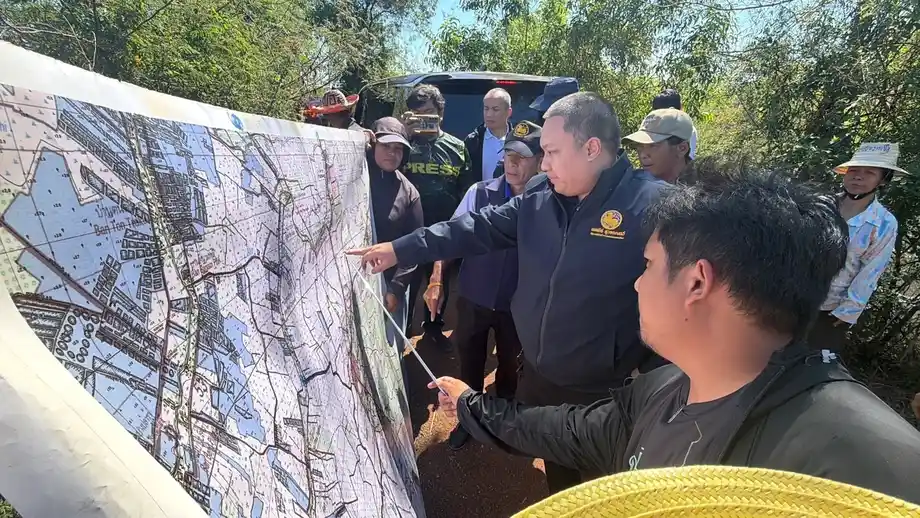
The groups asked for a public risk map and a map of safe areas. They asked the prime minister and his team to visit Chiang Rai on 29 November and inspect mining areas at Ban Mong Kao Lang, Ban Mong Paet Lang and Ban Phaya Phrai in Mae Fah Luang district. They also asked for clear boundaries for the pollution control zone, including its length, width, affected areas, budget and assistance for people harmed.
They want the coordinates of water sampling points and the results of analysis under Thai Myanmar cooperation to be disclosed. At present, results from the joint process need approval from both sides before publication. Some advocates want a fund covering recovery over 10 to 20 years under the Mekong Lancang Cooperation framework. They also want Chinese buyers to stop purchasing minerals from unregulated mines in Shan State. Thailand proposed mineral traceability rules so buyers could check whether rare earths came from regulated sites.
The pollution issue also touches civil status in border communities. Pornchai Witthayalertphan, a senator who joined the Senate inspection, said many ethnic minority applicants in Chiang Rai faced delays in nationality processing because of insufficient evidence, understaffed offices and a lack of equipment. He urged faster processing so those residents receive rights fairly and promptly.
What is settled, and what still needs a decision
Several steps are now fixed. ACMECS leaders met in Hanoi. Thailand is due to take the chair for 2027 and 2028. Thai and Myanmar officials have agreed on joint sampling, data exchange and a framework for cooperation. Thailand has prepared a pollution control zone, water testing, alternative supplies and public maps.
What is still open is harder. There is no public agreement to suspend mining for six months, no published timetable for cleanup, and no decision on who will pay for recovery over many years. The dates to watch are early December for Mekong test results, 2 December for the Kok zone, 15 December for the zoning map, late December for the Mekong Lancang summit and December to January for joint sampling.
The pollution has changed the everyday calculation in Chiang Rai. Families want to know which tap, well or village system is safe. Farmers want maps that match the fields they use. Hotel operators want clear information that visitors can trust. Officials can answer some of that with faster tests and public data, but the river will keep carrying contamination until the sources are inspected and controlled. Anutin's trip to Hanoi is a test of regional cooperation, and the practical measure will be whether stations are installed, samples are shared, mines are inspected and affected communities receive clean water and clear answers.
Key Points
- Anutin arrived in Hanoi for the 11th ACMECS summit on 28 and 29 November 2026, with river pollution, trade and online scams on the agenda.
- Thailand linked arsenic and heavy metals in the Kok, Sai, Ruak and Mekong rivers to gold and rare earth mining in Myanmar's Shan State.
- Tap water to 14 Mae Sai villages was suspended after arsenic measured nearly 30 times the government limit, and officials warned against eating some river species.
- Thailand and Myanmar agreed on joint sampling, data exchange and an action plan covering three years, but no public deal was made to pause mining for six months.
- Thailand planned a pollution control zone along more than 150 kilometers of the Kok from 2 December, plus 10,000 arsenic test kits to be delivered in December.
- Community groups want public risk maps, pollution zone boundaries, compensation, transparent sample results and a recovery fund covering 10 to 20 years.