A Deadline Built on Water Samples
Thailand plans to give Myanmar a scientific case by January showing how mines in Shan State are polluting rivers that run into northern Thailand, and it wants practical help for affected communities within six months. Deputy Prime Minister Yodchanan Wongsawat, who also serves as minister of higher education, science, research and innovation, said the evidence already exists in Thai measurements and will be strengthened by joint sampling. The plan puts a date on a dispute that has grown as arsenic, lead and other heavy metals appear in rivers, tap water, fish and farms near the Thai border.
Contents
- A Deadline Built on Water Samples
- What the Bangkok Talks Produced
- Timeline: From Outcry to On the Ground Checks
- What Thai Tests Found in Rivers, Tap Water and Food
- How Scientists Traced the Pollution Upstream
- Two Gold Mining Areas Move to the Front of the List
- Why Shan State Mines Are Hard to Reach
- What Myanmar and China Have Put on the Table
- What Changes for People Downstream
- Where the Agreement Stops and What Comes Next
- Key Points
Bangkok's approach has two parts. The first is to show where the contamination comes from, using water tests, chemical fingerprints and satellite images. The second is to secure measures that people can feel: clean water for villages, warnings about unsafe fish and crops, and an eventual pause at mines suspected of releasing toxic waste. Thai officials want Myanmar to identify which mines are under government control and which are not. If neither Myanmar's government nor local armed groups can control them, Thailand intends to ask China for help.
Yodchanan said Myanmar officials have questioned responsibility and asked for more proof. The deputy prime minister described the gap between the two positions in plain terms.
They kind of believe it's not their fault, but we have the evidence, we have the data.
A Myanmar government spokesperson did not immediately respond to a request for comment. The suspension lasting six months requested by Thailand remained under consideration after the Nov 24 talks, and no date was given for a final decision on mine closures or access for inspectors.
What the Bangkok Talks Produced
The agreement followed the first meeting of the Thailand and Myanmar Joint Working Group on Water Quality Management in Boundary and Transboundary Rivers in Bangkok on Nov 25 and 26. Deputy government spokeswoman Lalida Persvivatana said the government of Prime Minister Anutin Charnvirakul had endorsed an initial framework lasting one year and agreed to develop a plan lasting three years. The two sides also signed terms of reference on Aug 6 that set out five areas of cooperation.
Senior officials from both environment ministries led the talks. Thailand's delegation was led by Raweewan Bhuridej, permanent secretary of the Ministry of Natural Resources and Environment, and Surin Worakijthamrong, director general of the Pollution Control Department. Myanmar's delegation was led by Hla Maung Thein, permanent secretary of the Ministry of Natural Resources and Environmental Conservation, and San Oo, director general of the Environmental Conservation Department. Officials from Shan State also took part, a sign that the pollution issue reaches beyond the formal chain of command in Nay Pyi Taw.
Under the framework lasting one year, the agencies will work on:
- Joint water quality monitoring.
- Identifying pollution sources and assessing risks, including possible warning systems.
- Protecting public health.
- Building capacity and sharing technical knowledge.
- Coordinating policy and strategy.
The two countries agreed in principle to 12 joint water sampling locations. Thai officials described earlier trilateral talks as considering eight coordinated stations, four in each country; the announced framework settled on the following split:
- Kok River: eight locations, four in Thailand and four in Myanmar.
- Sai River: four locations, two in Thailand and two in Myanmar.
The Pollution Control Department and Myanmar's Environmental Conservation Department will coordinate implementation. Water quality results will be exchanged at least twice a year, with later monitoring extending to river sediment, contaminants in fish and other aquatic life, agricultural soil and vegetables.
Timeline: From Outcry to On the Ground Checks
The pace quickened in late November, after months of complaints from communities in Chiang Rai and a surge of public attention over unsafe tap water and river food. Before the technical talks, Prime Minister Anutin and Natural Resources and Environment Minister Suchart Chomklin pushed to accelerate the working group schedule. The main dates now shaping the response are:
- Nov 24, 2026: Thai, Myanmar and Chinese officials met at Thailand's Ministry of Foreign Affairs. China's ambassador, Yunnan specialists, Myanmar diplomats and representatives from Shan State attended. Thai leaders included Deputy Prime Minister and Foreign Minister Sihasak Phuangketkeow, Yodchanan and Suchart.
- Nov 25 to 26, 2026: The first Joint Working Group meeting and a workshop on the action plan took place in Bangkok.
- Nov 26, 2026: Thailand's request for a suspension lasting six months at suspected mines was still under consideration.
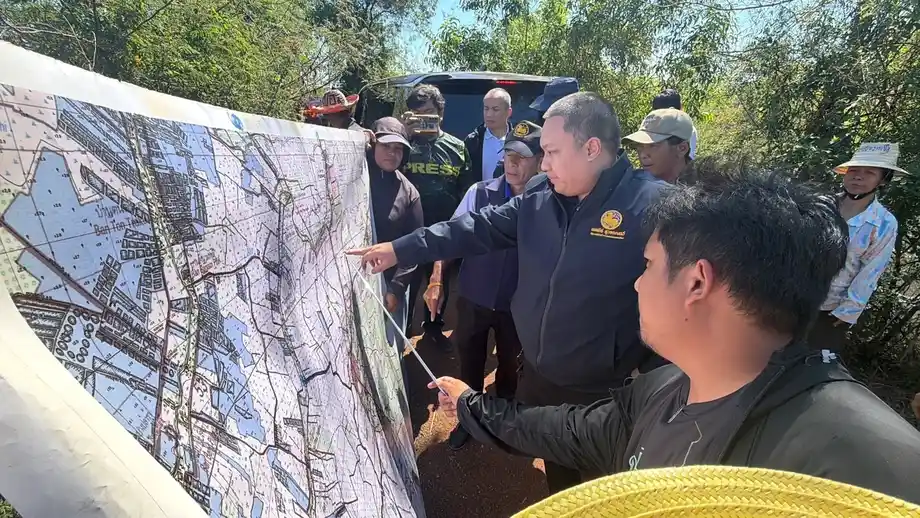
- Nov 28 to 29, 2026: Joint field inspections in Chiang Rai were scheduled.
- Dec 2, 2026: Thailand's National Environment Board was due to review a proposal for a pollution control zone along a stretch of the Kok River extending 150 kilometers.
- Dec 15, 2026: A public online risk map of water, soil and crop safety was due, along with daily public briefings through a dedicated website and Facebook page.
- December 2026 to January 2027: The first round of joint water sampling is expected, depending on operational readiness.
- Later: The second Joint Working Group meeting will be hosted by Myanmar in Nay Pyi Taw.
None of the new joint stations were operating at the time of the Bangkok agreement. The schedule gives officials a clear path for collecting comparable data, but it leaves the hardest political decision, stopping the mines, for separate talks.
What Thai Tests Found in Rivers, Tap Water and Food
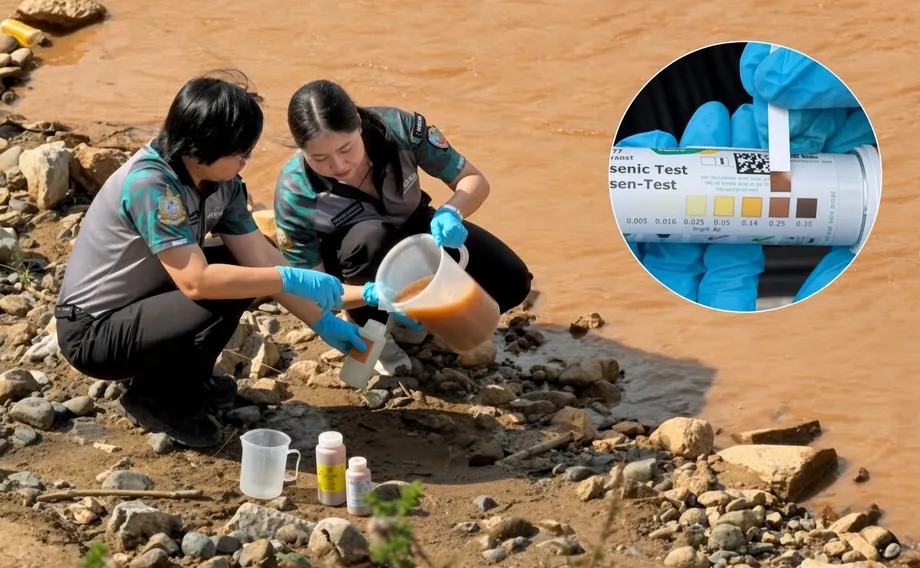
Thailand's Pollution Control Department found arsenic above standard levels in August at multiple locations along the Kok, Sai and Ruak rivers. The Kok flows from Shan State into Chiang Rai province. The Sai and Ruak form parts of the border before feeding into larger river systems, so contamination upstream can reach Thai communities before any local factory or city has released pollution.
Heavy metals are metals such as arsenic, lead, cadmium and mercury that can harm people even at low levels. Arsenic can damage skin and nerves and is linked to cancers after long exposure. Lead is especially dangerous for children because it can affect brain development. These metals do not simply vanish when water moves downstream; they settle in sediment, enter plants and build up in animals.
Testing of aquatic life found contamination in 10 species. An official from Thailand's Fisheries Department, who was not authorised to speak publicly, said more than 500 samples were taken from the Mekong, Salween, Sai, Kok and Ruak rivers. Eighteen samples had heavy metal levels above safety standards. Arsenic appeared at nearly four times the permitted limit in some samples, and lead at nearly six times the limit.
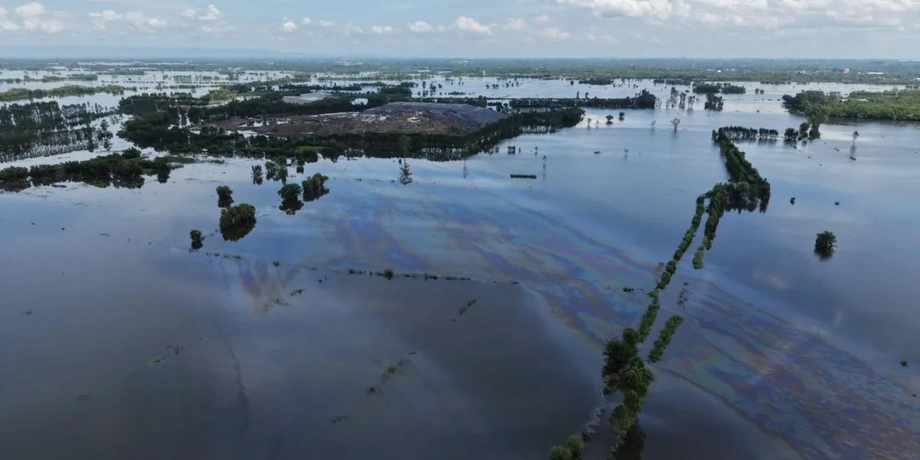
The affected species included freshwater shrimp, river snails, freshwater mussels, horse mussels and local fish that eat them. No contamination was found in farmed aquatic species. Tap water supplies to 14 villages in Mae Sai district were suspended this month after arsenic in the local waterworks measured 30 times safe limits. In November, raw water drawn from the Sai reached 28 times the accepted national standard. Local disruption figures put the number of affected households in Mae Sai at more than 20,000.
Saengwaree Suvirakan, a farmer from Chiang Mai who joined a protest in Bangkok, said fear had changed what people buy and eat.
Fish are harder to find and even if you find, people won't buy it.
Farmers along the Kok and Ruak basins have also warned that contaminated irrigation could threaten about 16,000 hectares of rice paddies and orchards. Arsenic has been detected in urine samples among residents of Nong Khai, showing that exposure concerns are not limited to the first villages along the border.
How Scientists Traced the Pollution Upstream
Researchers working with Thailand Science Research and Innovation used chemistry, past samples and satellites to narrow the search. Associate Professor Tanapon Phenrat led a team that compared water and riverbed samples from 2008 and 2009 with samples from 2025 and 2026. In the earlier period, almost 98 percent of surface water samples met the arsenic standard. By 2025 and 2026, 29 percent exceeded it. Riverbed sediment above the relevant standard rose from about 29 percent to 82 percent.
The team examined 227 water samples over 26 rounds of testing. In nine rounds when arsenic was high at the border, concentrations fell as the river moved farther into Thailand. That pattern pointed to a source upstream, because pollution entering at the border would be strongest there and then dilute or settle as it travels.
The researchers used thorium as a chemical marker. Thorium occurs naturally, but the relative chemical signature can help separate mining types in the same way a fingerprint separates people. In the Sai River, an estimated 32 to 33 percent of arsenic above natural background levels had a signature associated with rare earth mining. The remaining 67 to 68 percent was consistent with gold or sulphide ore mining. In the Kok River, the estimates were 39 to 50 percent for rare earth mining and 50 to 61 percent for gold or sulphide ore mining.
Another calculation estimated that an average of 143 kilograms of arsenic crosses the border each day through the Sai River. The figure gives a sense of scale, though stopping that flow depends on knowing exactly which mines are responsible and having access to them.
Two Gold Mining Areas Move to the Front of the List
Researchers combined 17 Sentinel-2 satellite images with a model of how sediment moves downstream. Sentinel-2 is a satellite tool that repeatedly photographs the earth in several wavelengths, useful for spotting land clearing and muddy water. The model estimated that two gold mining areas together accounted for about two thirds of the Sai River's turbidity by the time it reached Mae Sai district. Turbidity means cloudiness caused by suspended particles.
One area near Ban Kan was estimated to account for about 30 percent of the cloudiness, and one near Pang Tung for about 36 percent. Those figures measure cloudiness. Determining how much arsenic comes from a particular mine requires samples from inside the sites, which is why joint inspection matters.
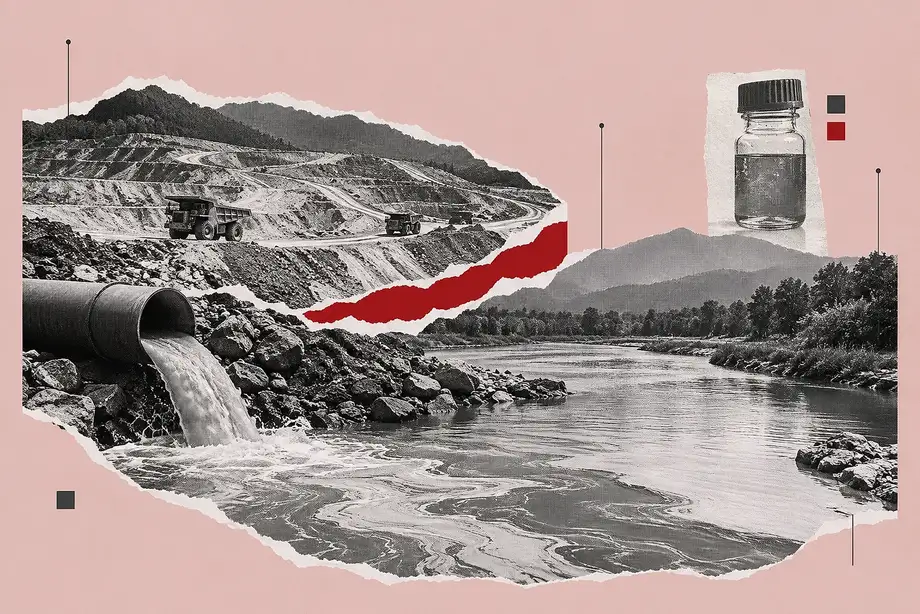
Thai investigators also identified a large gold and rare earth mining area near Ban Mae Cho, or Ban Mae Chok, in Shan State across from Ban Mang Paet in Mae Fah Luang district. A field investigation reached the Thai side of the border and described hills stripped in layers, machinery working openly and workers' quarters below. A monk practising near the border said he no longer dared drink water from natural streams and bought water instead; rice donated by local residents was cooked with water from below the mine.
Former workers quoted in the same field reporting described danger and violence at the mines. Akha workers who had crossed from Thailand to work said they fled back after threats and beatings. The accounts add a labour and safety crisis to the environmental one. Thai officials still need site access to link individual operators to specific pollution loads.
Why Shan State Mines Are Hard to Reach
Geography puts Chiang Rai close to the source. The Kok River begins in eastern Shan State and enters northern Thailand. The Sai and Ruak trace parts of the international boundary before feeding the Mekong basin. Mines on hills above these tributaries can affect villages downstream within days, while Thai inspectors have no authority to enter the mining sites. Because the mines lie outside Thai jurisdiction, Bangkok previously relied on checks after pollution had already entered Thailand.
Myanmar's civil war began after a coup in 2021 that removed an elected civilian government and triggered an armed uprising. The military lost control of large areas, including major mining belts. Crisis Group analysis found that the area affected by mining in Shan State tripled between 2024 and 2025. A regional study by the Stimson Center counted more than 2,400 mines across mainland Southeast Asia, many of them unregulated gold and rare earth operations in areas affected by conflict.
The United Wa State Army controls territory along parts of the Thai frontier, including areas near the Kok and Sai headwaters. The group built its finances through methamphetamine and heroin production in the Golden Triangle and later diversified into casinos, real estate, agriculture and mining. Its Southern Military Region sits opposite Chiang Mai and Chiang Rai. Bangkok has long sought to avoid direct military escalation along this frontier, which leaves environmental enforcement dependent on negotiation.
Rare earths add another layer. These metals are used to make powerful magnets for wind turbines, medical devices and electric vehicles. Myanmar is among the world's largest sources, and much of the output goes to China. Some Chinese miners opened rare earth mines in remote Shan hills under United Wa State Army protection. Some operations use leaching, a process that sends chemicals through ore to dissolve metals, creating waste that can enter streams if controls are weak.
Paskorn Jumlongrach, a veteran Thai border journalist, has described a network of hard to trace Chinese investment, Wa authorities and Myanmar military commanders sharing mining revenues. He also alleged that patronage networks have helped people linked to Wa settlements obtain Thai identity cards while some longstanding ethnic minority residents remain stateless. The allegations matter because mining profits can feed local political influence as well as pollution.
What Myanmar and China Have Put on the Table
Myanmar delegates brought pollution measurements to the Bangkok talks. Raweewan said the charts included a standard line between 0.01 and 0.05, showing that readings had passed Myanmar's own benchmark as well as Thailand's. Myanmar officials also said they could not yet test contaminated sediment, and Thailand offered equipment and laboratory help for water, plants, vegetables and aquatic animals.
Raweewan said access to some mining areas requires discussions with representatives of Shan State. She described the practical talks as involving four parties: Thailand, Myanmar, China and Shan State representatives. At the Nov 24 meeting, China's ambassador said Beijing was following the pollution issue closely and would provide technical support and experts. China also holds a joint chair role in the Lancang-Mekong Cooperation framework and is expected to help develop a model for joint work when that framework advances in December.
Sihasak said Chinese leaders confirmed they did not support illegal or destructive mining in Shan State and agreed to assist with technical verification. Beijing has said Chinese companies operating abroad must follow local rules and meet social obligations. In a statement on Chinese firms overseas, Beijing said they were required to:
abide by local laws and regulations and actively fulfill their social responsibilities.
Thailand and China plan to set up a laboratory at Mae Fah Luang University in Chiang Rai to compare chemical fingerprints from individual mines. China has offered mining expertise and support for joint surveys. Yodchanan said Thailand will ask Beijing to step in if Myanmar cannot control every mine.
The deputy prime minister said Myanmar should check its own reach over the sites.
We also would like them to check whether they can control every mine or they cannot.
The deputy prime minister added that Beijing's role would depend on the answer.
If they cannot, we will ask China to help.
Aditak Wasinon, director general of the Department of Primary Industries and Mines, said Thailand is preparing tighter rules for mineral imports and exports. A draft would require certificates of origin and mining permits from the exporting country for commodities such as antimony, lead, gold, copper, tin and rare earths. Thailand is also preparing to ban exports of chemicals used in rare earth extraction.
What Changes for People Downstream
The dispute over pollution that crosses the border has immediate consequences at the taps, markets and fields of Chiang Rai. Fourteen villages in Mae Sai lost surface water supplies after the waterworks tested far above safety limits. The Department of Groundwater Resources is drilling deep wells to provide clean water to those villages, while Chiang Rai province has opened an operations centre and tracks water quality at more than 200 points along the Kok, Sai and Mekong rivers.
Chiang Rai governor Sucheepong Phongsai said the province must protect health while keeping the local economy running. Provincial teams are tailoring help to each area because risk levels differ from one village to another. A proposed pollution control zone along 150 kilometers of the Kok River would give authorities a stronger base for plans and enforcement if approved.
The Ministry of Agriculture and Cooperatives was due to publish an online risk map by Dec 15 covering soil, crops and water safety. Daily briefings through a dedicated website and Facebook page aim to replace rumours with test results, infographics and practical advice. Residents near Mae Sai and Tachileik have been waiting for a timetable that says when upstream discharges will stop.
Health monitoring will expand beyond water. Officials plan to look at sediment, fish, vegetables and agricultural soil because arsenic can move from rivers into food. Bioaccumulation means pollutants build up in living bodies over time; a fish may carry more contamination than the water around it. That is why fisheries warnings matter for families who once relied on river shrimp, snails and local fish.
Where the Agreement Stops and What Comes Next
The Bangkok agreement creates a shared measurement system, but it does not assign legal blame or name mine operators. That choice made agreement easier: officials can compare samples and health data before arguing over responsibility. It also means the measures announced so far focus on monitoring, data exchange and public health rather than the physical closure of mines.
Yodchanan's request for a suspension lasting six months remains the most direct proposed action. He said Thai officials asked Myanmar and Chinese counterparts on Nov 24 to close suspected mines so investigators could collect samples and trace contaminated sediment entering the rivers. The proposal was still under consideration on Nov 26.
The deputy prime minister said the key question is whether Myanmar's government can control all relevant mines. He described the request this way:
I asked them to close the mines for six months.
What remained undecided was who would carry out inspections, which sites would be visited first and whether a suspension would begin before the first joint sampling round. Myanmar has not disclosed the locations of the mines behind the pollution, citing limits on access for Thai investigators. No firm enforcement date has been set for stopping discharges, and the next listed milestone is the working group meeting in Nay Pyi Taw.
The coming weeks will test two tracks at once. The technical track can produce comparable numbers from 12 sites and a fuller picture of exposure in fish, crops and people. The diplomatic track must turn those numbers into access, mine controls and clean water guarantees for communities that have already changed how they eat, wash and farm.
Key Points
- Thailand plans to give Myanmar evidence supported by data by January and wants concrete measures for affected communities within six months.
- Thailand and Myanmar agreed to 12 joint water sampling locations: four on the Kok and two on the Sai in each country.
- Joint sampling is expected between December 2026 and January 2027, with water quality results exchanged at least twice a year.
- Thai tests found arsenic above standards in the Kok, Sai and Ruak rivers, while fish testing found arsenic and lead above safety limits in some samples.
- Researchers linked pollution to mining in Shan State and identified Ban Kan and Pang Tung as priority areas for inspection.
- Thailand has requested a suspension lasting six months at suspected mines, but the proposal was still under consideration on Nov 26.
- Myanmar agreed to further talks, while China offered technical help and support for joint surveys.
- Deep wells are being drilled for 14 villages in Mae Sai, and a public risk map was due by Dec 15.