A flood exposes pollution beside homes and rice fields
Water collected about 65 metres from a leaking embankment beside an industrial waste landfill in Thailand's Prachin Buri province contained 114,860 milligrams per litre of petroleum hydrocarbons, according to Pollution Control Department laboratory results dated October 12, 2026. Two samples taken farther away, at 435 and 850 metres, each contained less than 3 milligrams per litre.
Contents
- A flood exposes pollution beside homes and rice fields
- What the landfill tests found
- How complaints became an enforcement case
- Families face smells, flooded wells and health worries
- Health teams respond across a wider disaster area
- River sampling adds a different set of concerns
- Downstream livelihoods are already under pressure
- Waste mixed with chicken manure widens the investigation
- Why waste facilities are beside agricultural land
- Residents demand cleanup before further industrial expansion
- Key Points
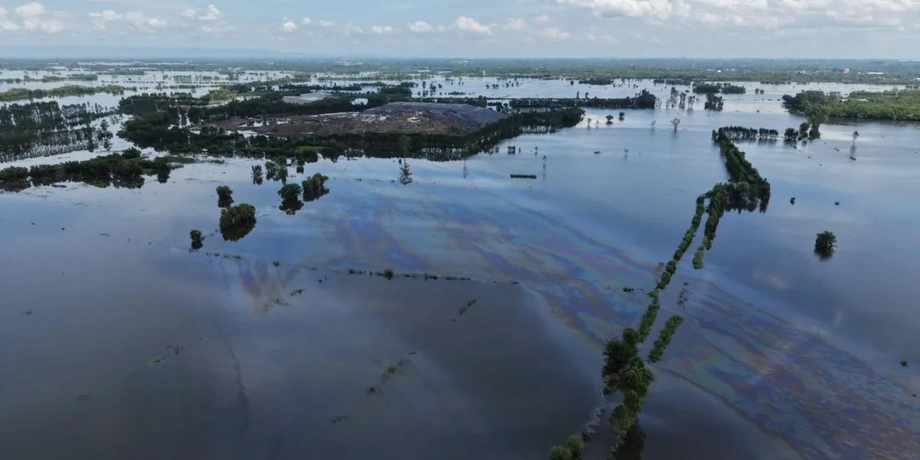
The sharp contrast has put the landfill in Hua Wa subdistrict, Si Maha Phot district, at the centre of an investigation into rainbow coloured floodwater, persistent chemical smells and possible contamination of farmland. The Department of Industrial Works ordered its operator, Green Environment Technology, to temporarily stop operations on October 15.
Residents describe a problem that reaches beyond the flood itself. Some worry about water entering household wells. Others are waiting to learn whether they can safely irrigate rice or raise shrimp. Downstream in Chachoengsao, uncertainty over water quality has delayed planting and threatened the timing of the next harvest.
Green Environment Technology said on October 2 that it did not accept waste that would produce the wastewater alleged, and that its storage and treatment complied with the law. It also said testing had not confirmed it as the pollution source. Authorities subsequently reported petroleum contamination downstream and began assembling evidence for possible legal action.
The immediate task is to contain the pollution. The larger challenge is to trace several suspected sources across a river basin where industrial waste facilities, homes, rice fields and aquaculture ponds share connected waterways.
What the landfill tests found
Environment and Pollution Control Office 7, based in Saraburi, collected the three samples on October 1 after residents reported an oily sheen spreading over floodwater. Officers sampled an area extending roughly one kilometre from the landfill embankment.
Petroleum hydrocarbons are a broad group of substances associated with oil and fuels. The reported concentration at the nearest sampling point was more than 38,000 times the reporting threshold of 3 milligrams per litre used for the two more distant samples. That steep difference makes the locations and movement of polluted water central to the investigation.
The nearest sample also contained iron at 0.98 milligrams per litre, aluminium at 1.146, barium at 0.041 and copper at 0.01. Aluminium reached 1.294 milligrams per litre at the second point, showing that different substances had different patterns across the sampling area.
Oil films can restrict the exchange of oxygen between air and water. Petroleum substances can also settle with sediment or accumulate in organisms. For residents, this means the investigation must continue after visible floodwater disappears, when pollution may remain in mud, drains and fields.
How complaints became an enforcement case
Strong Prachinburi environmental activist Sumet Rianpongnam said residents had observed leakage before the flood and that heavy rain on September 25 caused landfill water to overflow into rice fields. His estimate that oily scum covered thousands of rai described the extent observed by the community, while officials began sampling specific locations.
The sequence of complaints, tests and government action stretched across several weeks:
- September 25: Heavy rain reportedly caused water at the landfill to overflow into surrounding fields.
- September 28: Strong Prachinburi lodged a complaint with the provincial industry office. The group initially said it had received no response.
- September 29: The Ecological Alert and Recovery Thailand Foundation, known as EARTH, received photographs of oily floodwater from residents.
- October 1: Environmental officers collected samples at three distances from the leaking embankment.
- October 12 and 13: Laboratory findings confirmed high petroleum hydrocarbon contamination near the embankment, followed by public disclosure.
- October 15: The Department of Industrial Works ordered a temporary suspension of operations.
- October 19: Industry Minister Varawut Silpa-archa called for removal of the oil, compensation for residents and measures to prevent another incident.
The Pollution Control Department is compiling evidence under the Hazardous Substances Act 1992, the Factory Act and the Enhancement and Conservation of National Environmental Quality Act 1992. Its proposed response follows the polluter pays principle, meaning those responsible should bear the costs of addressing the damage.
Families face smells, flooded wells and health worries
Sunthorn Koonwat lives less than two kilometres from the Hua Wa landfill. From his home, he can see a waste mound resembling a hill. He describes sharp smells arriving almost daily, especially in the evening or at night, and becoming stronger during the flood.
Sunthorn and relatives used sandbags to block a pipe opening that emitted a strong smell. He also kept floodwater in a bottle because of its chemical odour. He says he previously had arsenic detected in his body and worries about his son, aged three, who is frequently ill and regularly needs hospital care. Doctors have yet to determine whether the child's symptoms are related to environmental exposure.
Nearby resident Somyong Dechson built her house in 2023, attracted by the fresh air and open view. She later learned that the apparent hill across the fields was industrial waste. Family members developed red rashes after walking through floodwater, she said, while her young grandchild often has allergy symptoms when the smell reaches the house.
Somyong's immediate concern is a household groundwater well that was submerged by water carrying a rainbow sheen. Sunthorn, who also grows rice, fears pollution could enter groundwater and affect farming. Their concerns connect household health with the water used to produce food.
In Lat Takhian subdistrict of Kabin Buri district, a resident identified as Nid lives less than 600 metres from another waste facility. She reported an irritating smell and feared that floodwater reaching her home carried contamination from both waste operations and a pig farm upstream. Black residue and rainbow sheens were still being observed in parts of the province more than a month after the flooding.
Health teams respond across a wider disaster area
Dr Thiti Sawaengtham, director general of the Department of Health, identified Si Maha Phot as an area of particular concern because of its concentration of waste sorting, recycling and landfill facilities. He warned that polluted floodwater could affect household supplies, soil and air.
Used lubricating oil and solvents were among the substances requiring attention. Dr Thiti identified benzene and toluene as possible concerns associated with such materials. These chemicals can evaporate into the air, creating another route of exposure alongside skin contact or swallowing polluted water.
The Department of Health and the Prachin Buri Provincial Public Health Office formed mobile teams for screening and treatment. Residents were advised to avoid contact with floodwater, keep it out of household consumption and wear masks where odours were strong.
Health investigators also examined 11 residents, with two showing styrene above a reference value. Follow up includes examining exposure histories, other possible sources and continuing symptoms. The wider flood emergency affected 55,286 households across seven declared disaster districts, with nine deaths attributed to drowning or electrocution.
River sampling adds a different set of concerns
Fish deaths in the Prachin Buri River prompted testing beyond the landfill's immediate surroundings. Results disclosed on October 28 from five river locations between Kabin Buri and Ban Sang showed water generally above pH 7 and aluminium at 0.559 milligrams per litre in Si Maha Phot. Copper, zinc, cadmium, lead, nickel, arsenic and mercury were not detected in that testing.
A broader sampling exercise on October 12 covered four tributary locations and five river locations. Reported aluminium concentrations at some points ranged from 0.559 to 3.547 milligrams per litre, with the highest value in Kabin Buri. Dissolved oxygen ranged from 2.5 to 7.5 milligrams per litre. Dissolved oxygen is the oxygen available in water for fish and other aquatic animals to breathe.
Thailand has no specific surface water standard for aluminium. Investigators therefore referred to a United States Environmental Protection Agency benchmark for protecting aquatic life. The purpose of that comparison is to assess possible effects on organisms exposed over time.
Chachoengsao's provincial administration commissioned sampling at eight locations on November 5, extending through agricultural districts to the Bang Pakong estuary. Aluminium was found at every point, ranging from 0.192 to 0.527 milligrams per litre. Those figures were about 2.2 to 6.1 times the 0.087 milligrams per litre benchmark cited in the laboratory report for prolonged exposure of freshwater organisms.
Most other tested measures met the relevant Thai surface water standards. Cadmium, lead, arsenic, cyanide and the tested chlorine based pesticides were not detected, while mercury and manganese remained within the prescribed limits. Identifying the source of the aluminium is part of the continuing investigation.
Downstream livelihoods are already under pressure
Rungsak Phadungsak, a fisherman aged 67 in Bang Khla district, Chachoengsao, said his shrimp catch had fallen from 10 to 20 kilograms a day to zero. He associated the disappearance with stagnant floodwater draining into the river and reducing oxygen. His family had lost its main income.
In Ratchasan district, rice farmer Sumet Chimpalee described a different pressure: farmers needed receding floodwater for irrigation but hesitated to pump it onto their land while awaiting test results. He said waiting more than a month delayed cultivation and could push the usual January harvest into March.
A later harvest would bring the crop closer to the dry season and could leave less water for the following planting cycle. Shrimp farmers faced similar uncertainty, with Sumet describing young shrimp dying after being introduced into water remaining in flooded fields.
Prachin Buri farmers have also suffered direct flood losses. A rice field covering 10 rai in Si Mahosot district was destroyed only weeks before harvest. A papaya grower beside Khlong Cho Fa, around two kilometres from a factory, worried about irrigation water after contamination was found in the canal.
Khok Pip community leaders collected water at six locations and submitted a petition on October 26. Environmental officers sampled eight additional points on October 30, while the Provincial Waterworks Authority sampled two. Residents were still seeking clear official findings on the water they used.
Waste mixed with chicken manure widens the investigation
A November 12 public policy forum at Ban Khao Mai Kaeo School examined another suspected route into farmland: industrial waste mixed with chicken manure in Khao Mai Kaeo subdistrict, Kabin Buri. Village head Siripong Thobun described runoff moving toward canals, sugarcane land and nearby rice fields.
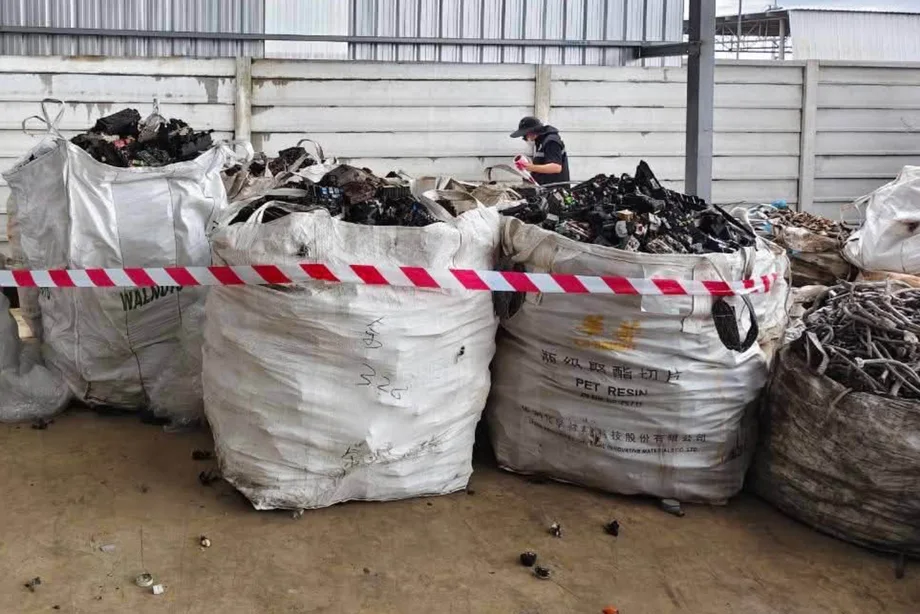
Thanawut Norat, an enforcement official at Environment and Pollution Control Office 7, said findings involving four metals fell under the Hazardous Substances Act and were being pursued through legal proceedings. Chiang Mai University environmental engineering professor Puangrat Kajitvichyanukul identified high concentrations of copper, lead, zinc and nickel, and warned that finely shredded copper could spread through soil and be taken up by plants.
EARTH's Penchom Saetang raised concerns about plastics and cable coverings mixed into the material and said the foundation had collected samples for further chemical testing. Provincial natural resources and environment director Yanyong Intharit said 18 locations, including the manure pile, still awaited waste removal while the origins were investigated.
The food safety work now extends from water to crops and aquatic animals. Chachoengsao authorities announced plans for monitoring from December 2026, including rice, mangoes, coconuts and vegetables. Farmers need those results to decide when to plant, what water to use and when their produce can go to market.
Why waste facilities are beside agricultural land
Prachin Buri had 140 facilities in industrial categories 101, 105 and 106 in 2026, according to provincial industry office figures: 20 in category 101, 74 in category 105 and 46 in category 106. The latter two categories together accounted for 120 facilities, about 86 percent of that total.
Green Environment Technology holds category 105 permission for sorting and landfilling waste classified as nonhazardous, and category 106 permission for turning factory waste into raw materials or new products. Its authorised activities also include processing used lubricants and solvents, shredding electronic parts and making bricks from nonhazardous waste.
EARTH official Narathip Thongthanom traces the expansion of such operations to National Council for Peace and Order Order No. 4/2559, issued in 2016 using Section 44 powers. It exempted certain waste, recycling and power generation activities from comprehensive town planning restrictions, allowing facilities in some agricultural zones.
Environmental academic Sonthi Kotchawat questioned the assessment of flood risk when permitting waste facilities on agricultural land that receives floodwater. He also pointed to requirements for environmental and safety assessments and annual operating reports. Narathip said convenient transport connections to the Eastern Economic Corridor and Laem Chabang port helped make Prachin Buri attractive to waste operators.
EARTH's compilation recorded 380 reported illegal industrial waste dumping incidents from 2017 to 2025. Earlier Prachin Buri enforcement cases included an October 2024 chemical leak in Tha Tum and a November 2024 seizure of about 41.5 tonnes of hazardous substances at another recycling operation.
Residents demand cleanup before further industrial expansion
The Prachin Strong Network and residents gathered at the King Rama V monument outside the former provincial hall on November 15, 2026. They opposed the proposed extension of the Eastern Economic Corridor into Prachin Buri and demanded permanent closure of factories accused of pollution.
The network presented its position through a rally slogan:
No EEC, end grey capital, restore clean air to our land.
Other demands included removing industrial waste and hazardous chemicals, restoring soil, water and air, compensating affected households and investigating groups allegedly behind illegal dumping. Protesters also called for a permanent ban on industrial waste imports.
Authorities plan joint landfill inspections, checks on waste accepted under the operator's licences, and sediment sampling once affected ground dries. No fixed completion date was announced for that work. December monitoring in Chachoengsao is the next stated step for examining agricultural produce and aquatic animals.
For Bangkok, Nonthaburi and Samut Prakan consumers, the Metropolitan Waterworks Authority said its tap water production uses the Chao Phraya and Mae Klong rivers rather than the Bang Pakong. Governor Suwara Thawitchasri said raw water is monitored around the clock. Communities within the affected basin face a more immediate need for reliable local water supplies, health follow up and published testing that helps them resume daily life.
Key Points
- Petroleum hydrocarbons reached 114,860 milligrams per litre near a landfill embankment; two farther samples contained less than 3.
- Green Environment Technology was ordered to suspend operations temporarily on October 15.
- Residents report persistent odours, flooded wells, skin symptoms and uncertainty over household water.
- Downstream farmers have delayed planting, while fishermen report lost shrimp catches.
- Investigations cover landfill runoff, river sediment and industrial waste mixed into material placed on farmland.
- Crop and aquatic animal monitoring was planned from December 2026, alongside demands for cleanup, compensation and tighter controls.