Pollution penalties leave a costly gap
A fine of about 600,000 baht can be 25 to 50 times cheaper than properly treating hazardous waste, according to Veerayuth Kanchuchat, a People's Party MP and deputy leader. In Prachinburi, where investigators have found electronic waste, contaminated soil and factories operating despite closure orders, that gap has become a central argument for changing Thailand's environmental laws.
Contents
- Pollution penalties leave a costly gap
- What inspectors found in Prachinburi
- Another factory, another closure order
- How the main events unfolded
- Why cheap disposal attracts business
- Farmland faces the consequences
- A nationwide inspection push
- Customs targets the import route
- Disclosure, restoration and local livelihoods
- Key Points
Speaking at Chulalongkorn University's Faculty of Political Science on November 14, 2026, Veerayuth called for prosecution and restoration of polluted areas, public disclosure of pollution data, tighter import controls and recognition of environmental crime in the next constitution.
The financial comparison points to a basic problem: a business can save money by avoiding treatment, while residents face the consequences in water supplies, farmland and lost income. Industry Minister Varawut Silpa-archa has separately cited legal treatment bills of 800,000 to 1 million baht against disposal fines of roughly 200,000 to 300,000 baht.
Those amounts concern different offences and waste handling situations. Thailand's enforcement framework includes factory penalties, hazardous substance offences, customs settlements, possible prison terms and continuing daily fines. The practical issue is how much an operator ultimately pays, including cleanup, compared with the money saved by breaking the rules.
What inspectors found in Prachinburi
The Department of Industrial Works documented repeated defiance at T & T Waste Management 2017 in Si Maha Phot district. Its December 2024 inspection statement describes a third inspection on December 12, conducted under a search warrant from Prachinburi Provincial Court after the factory had been ordered to stop operating.
Inspectors found continued factory activity, movement of seized material and installation of metal melting furnaces without engineering certification. Industrial waste dumped near a large pond had increased since an inspection on November 1, 2024. Samples of soil, water and waste contained dangerous metals, including lead and chromium.
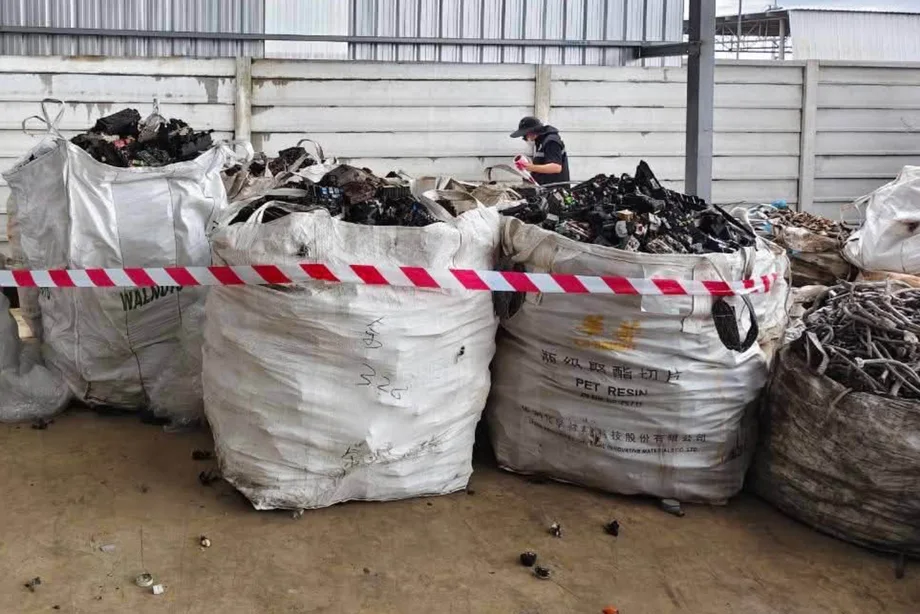
Two adjacent sites without factory licences contained large quantities of electronic waste. Officials suspected illegal imports and sought shipping declarations to identify the cargo's origin and recipients. The department noted that Thailand had prohibited electronic waste imports since 2020.
The statement set out specific potential penalties. Defying a factory closure order carried up to two years in prison, a fine of up to 200,000 baht, or both, plus 5,000 baht for each day of continued operation. Unauthorised possession of the relevant hazardous substances carried up to two years in prison, a fine of up to 200,000 baht, or both. Moving or destroying seized property could bring separate criminal penalties.
Officials found a coordinator and workers rather than the owner. They recorded the findings with police for further legal action, placing the next enforcement step beyond the inspection itself.
Another factory, another closure order
On October 10, 2026, provincial authorities inspected G.K.C. Recycle's Kabin Buri branch after community monitors identified two suspicious container trucks. Officials found approximately 80 tonnes of electronic waste, including shredded material and cable coverings.
Shipping documents described the cargo as mixed metal and named an importer in Bangkok's Khlong Toei area. Drivers said they had collected the loads from Laem Chabang in Chonburi. Inside the factory, workers were separating electronic components, and officials observed polluted water in a holding pond.
The facility held permission under category 105 to sort general waste that was not hazardous, according to the acting provincial governor. Authorities said the material and melting activities they found fell outside those conditions. The factory had already received two closure orders, including one earlier that month.
Provincial industry officials filed complaints concerning unauthorised factory establishment, operation without the required licence and possession of hazardous substances. Community representative Sunthorn Khomkhai called for a halt to additional relevant factory licences, saying Prachinburi already had more than 200 and local oversight capacity was stretched.
How the main events unfolded
Thailand's waste disputes connect imports, domestic transport, processing and disposal across several provinces. The sequence shows why inspections at ports and inspections at factories address different parts of the same chain.
- April 2024: Investigators traced approximately 13,000 to 15,000 tonnes of cadmium bearing tailings from Tak to other provinces, including Samut Sakhon, Chonburi and Bangkok. Eight workers were reported to have elevated blood cadmium.
- December 12, 2024: The Department of Industrial Works conducted its third inspection of T & T Waste Management 2017 and documented continued operation and metal contamination.
- July 31, 2026: Authorities intercepted a truck with 22 wheels and Prachinburi registration plates during unauthorised waste disposal at a laterite pit covering about 500 rai in Sa Kaeo.
- October 10, 2026: Officials found about 80 tonnes of electronic waste at the G.K.C. Recycle facility in Kabin Buri.
- November 12, 2026: A community forum in Prachinburi examined contaminated material near agricultural land and delays in removing waste.
- November 14, 2026: Veerayuth presented proposals for stronger penalties, pollution disclosure and constitutional recognition of environmental crime.
The cadmium case illustrates the distances involved. Waste removed from a registered disposal site in Tak reached facilities elsewhere, including a plant authorised for aluminium recycling. Tracking a load therefore requires more than checking whether its first destination holds a licence.
Why cheap disposal attracts business
The Ecological Alert and Recovery Thailand foundation, known as EARTH, has described acid treatment costing at least 10,000 baht per tonne, compared with charges of 1,800 to 2,000 baht by Win Process and Aek U Thai. That is a price difference of at least five times, creating strong pressure on legitimate treatment businesses competing for customers.
The Department of Industrial Works found 89,700 tonnes of the chemical at Aek U Thai. At the quoted low disposal prices, accepting that volume could generate roughly 170 million baht in revenue. Revenue is the money a business receives before its expenses are deducted.
Research attributed to the Thailand Development Research Institute places some hazardous waste disposal costs as high as 150,000 baht per tonne. At that rate, treating two tonnes would cost 300,000 baht, already above a 200,000 baht fine. Actual liability can also include imprisonment, daily penalties, other charges and restoration costs.
Akaradej Wongpitakroj cited another case in which a 300,000 baht fine contrasted with 70 million baht saved during five years of wrongdoing. Proposed Factory Act amendments would raise fines to between 200,000 and 10 million baht and permit prison terms of up to five years.
Some industrial waste violations have also been subject to a limitation period of one year, creating pressure to investigate quickly. Cross provincial movements and multiple contractors make that task harder when records fail to connect the waste producer, transporter and final treatment facility.
Farmland faces the consequences
At Ban Khao Mai Kaeo School in Kabin Buri on November 12, 2026, residents, officials and researchers discussed piles described as chicken manure mixed with industrial waste. The location lies upstream of waterways connecting to the Prachinburi and Bang Pakong rivers.
Village head Siripong Thobun said authorities had covered the material with plastic sheeting and built earth barriers, but heavy rain washed material toward surrounding farmland. Nearby crops included sugar cane and rice. The landowner told officials the material had been brought there in October 2025.
Testing identified copper, lead, zinc and nickel at levels described as exceeding standards. Siripong said copper in a sample from the pile was 43 times the relevant limit. The case was being handled at Kabin Buri police station.
Professor Puangrat Kajitvichyanukul, an environmental engineering researcher at Chiang Mai University, warned that finely shredded copper could spread through agricultural soil and be absorbed by plants. Penchom Saetang, EARTH's executive director, also sought testing for substances in cable coverings and plastics that could persist in the environment.
Officials identified 18 locations, including the manure pile, where waste still awaited removal while its origin was investigated. The amount already distributed to farms, the results of further chemical testing, the final scope of crop contamination and firm removal dates remained unresolved.
Residents need decisions about the land itself: where sampling will take place, whether crops can enter processing facilities and who will pay for safe removal. Penchom urged authorities to investigate those who supplied the material and protect villagers who may have accepted it believing it was soil or fertiliser.
A nationwide inspection push
The Industry Ministry is deploying 50 teams to inspect more than 1,500 waste facilities across Rayong, Chonburi, Chachoengsao, Samut Prakan and Prachinburi. Each province is assigned 10 teams.
Varawut said Thailand had 3,049 licensed factories in categories 105 and 106, covering waste sorting, disposal and recycling activities. Around half were concentrated in those five provinces. Earlier Department of Industrial Works figures listed 1,785 category 105 factories and 1,125 category 106 factories in September 2025, a combined 2,910.
Varawut, the industry minister, outlined the possible consequences for operators during his parliamentary response:
"If we find that they are not operating correctly, they will be closed and their licences can be revoked," Varawut said.
The ministry expected a clearer picture within one to two months of the announcement. It was also coordinating with the Anti-Money Laundering Office to trace financial flows and examine possible asset seizures in serious cases.
The Department of Business Development identified four Prachinburi companies for investigation over suspected nominee ownership arrangements. Such arrangements use Thai shareholders to conceal effective foreign control. Officials also flagged 44 entities for closer examination, comprising 41 businesses handling waste classified as not hazardous and three handling hazardous waste.
Varawut said dangerous material posing an immediate public threat could be removed before court proceedings ended. Authorities could later seek to recover treatment and restoration costs from the responsible operator once legal responsibility was established.
Customs targets the import route
Customs Director General Phantong Loykulnanta proposed limiting scrap metal imports to operators with recycling facilities and authorised smelting plants. Traders and intermediaries without their own facilities would lose eligibility under the proposal scheduled for a committee meeting chaired by Deputy Prime Minister and Commerce Minister Suphajee Suthumpun on November 11, 2026.
Since early November, customs settlement fines for attempts to evade relevant import restrictions had been set at the maximum 500,000 baht. Previously, settlements were calculated at 20% of the goods' value, capped at 500,000 baht. Offenders must also pay the full cost of returning seized goods out of Thailand.
Customs recorded 198 cases involving 20.50 million kilograms of seized waste in fiscal 2026, compared with 92 cases and 2.30 million kilograms in fiscal 2024. The seized quantity rose about 8.9 times, while the number of cases a little more than doubled. The department attributed increased detection to stronger screening, including container X rays and physical inspections at checkpoints and destination factories.
Veerayuth raised a related concern about rising aluminium scrap imports and information presented by state agencies to a parliamentary committee. His proposal is to connect import declarations with records of where material goes and how it is processed. Lawful scrap imports remain part of recycling commerce; enforcement depends on accurate declarations, suitable facilities and proper handling of the remaining waste.
Disclosure, restoration and local livelihoods
Veerayuth's proposed Pollutant Release and Transfer Register legislation, or PRTR, would require reporting and disclosure of pollutant releases and movements. In practical terms, it would help people follow which substances a facility releases or sends elsewhere, alongside the records used to track waste shipments.
The People's Party is also drafting circular economy legislation. A circular economy keeps useful materials in circulation through reuse and recycling, while providing safe treatment for hazardous residues. Other proposals discussed in the reform debate include an Industrial Waste Management Act, legislation on waste electrical and electronic equipment, changes to hazardous substance listings and stronger penalties.
Penchom has proposed environmental financial guarantees, setting aside resources before damage occurs so restoration does not depend entirely on a lengthy lawsuit or an operator's remaining assets. Her work with communities in Rayong, Ratchaburi, Phetchabun and Ayutthaya has also focused on connections among companies and facilities across provincial boundaries.
Rayong resident Sanit Manisi described the loss of food and income around Nong Phawa, near the Win Process factory:
What we used to be able to gather, fish and vegetables, to eat and sell, nowadays we have to buy it all. That area cannot be restored to what it was ten years ago.
Fifteen Nong Phawa residents won a civil judgment in 2022 awarding 20,823,714 baht for pollution damage. They were subsequently described as still awaiting payment. A fire at the factory in April 2024 added another source of pollution to the area's existing problems.
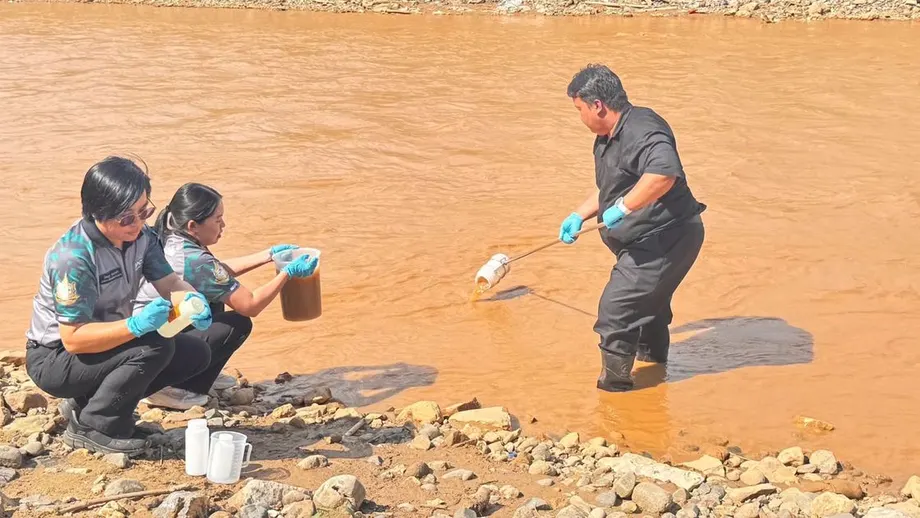
The Chulalongkorn discussion also considered concerns about the Sai and Kok rivers and suspected pollution sources around mining areas in Myanmar's Shan State. Journalist Thapanee Ietsrichai described the difficulty of investigating possible sources across the border while communities in Thailand need information about water quality and supplies.
Veerayuth paired stronger environmental penalties with alternative local employment. Properly regulated sorting and materials recovery could provide jobs, while public pollution records, financial guarantees and verified disposal would address different stages of the damage now being borne by communities.
Key Points
- Veerayuth says a fine of about 600,000 baht can be 25 to 50 times cheaper than proper hazardous waste treatment.
- Official inspections in Prachinburi documented continued factory operation despite closure orders and contamination involving lead and chromium.
- Authorities are sending 50 teams to inspect more than 1,500 waste facilities in five provinces.
- Customs has increased relevant settlement fines to 500,000 baht and proposed tighter eligibility for scrap metal importers.
- Contaminated material near Prachinburi farmland has prompted calls for wider testing, urgent removal and protection for affected residents.
- Reform proposals combine pollution disclosure, stronger penalties, financial guarantees, restoration and safer local employment.