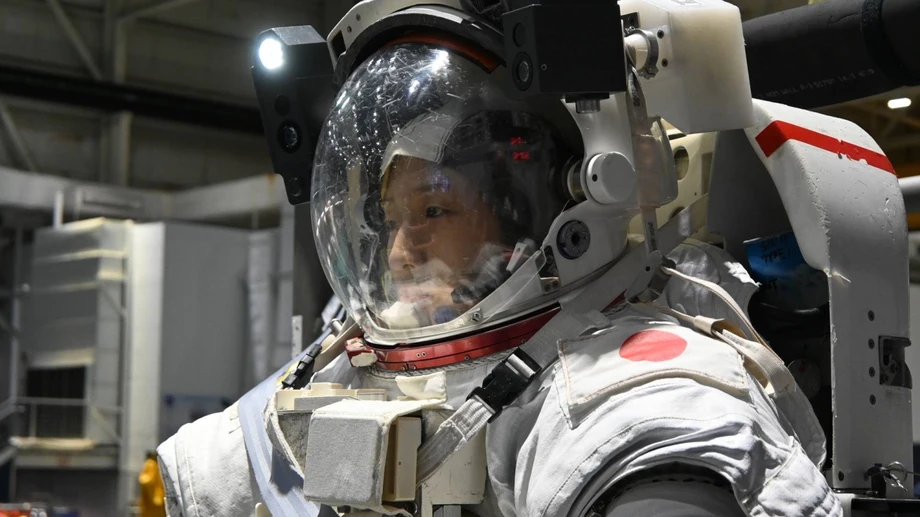
A Japanese Voice From the Moon
Neil Armstrong first stepped onto the moon in 1969. Since then, every word broadcast from the lunar surface has been in English. Ayu Yoneda, 31, an astronaut with the Japan Aerospace Exploration Agency, wants that record to change. In a November 3 interview, she said she would speak Japanese if she ever reached the moon, using the language to reach people in Japan and Japanese learners around the world.
Contents
- A Japanese Voice From the Moon
- From a Manga Book to an Astronaut Badge
- How a Record Applicant Pool Became Two Astronauts
- Certification Turns Candidates into Crew Members
- Life in Houston Is Study, Machines and Night Shifts
- Underwater Suits, Robotic Arms and Dark Caves
- Admitting Mistakes and Working Across Differences
- The Radio Is Harder Than Daily English
- Artemis Opens a Door, But Not a Date
- Japan's Moon Plans Reach Beyond the Crew
- A Childhood Dream Without a Script
- Key Points
If I'm able to go to the moon, I want to share my thoughts in Japanese.
Yoneda's wish sits against a stark record. Only 12 people have walked on the moon, all American men. Roughly 100 women have flown to space among more than 600 people, about one in six space travelers. No Japanese woman has flown since Naoko Yamazaki in 2010. Yoneda is not yet assigned to a flight, but she has passed the training that makes her eligible for one.
From a Manga Book to an Astronaut Badge
Yoneda was born in Tokyo in 1995 and attended high school in Nishinomiya, Hyogo Prefecture, with a period of study in Switzerland. She earned a Doctor of Medicine degree from the University of Tokyo in March 2019. Her hospital path ran through the University of Tokyo Hospital, the Japanese Red Cross Medical Center as a surgeon from April 2021, and Toranomon Hospital from October 2022 until she resigned in March 2023 to join JAXA.
Her inspiration began with a manga biography of Chiaki Mukai, one of the two Japanese women who had flown in space before her. Yoneda followed Mukai into medicine and then into the astronaut corps. Both entered as surgeons, a background that matters when a crew is far from emergency medical care and must make quick decisions about illness or injury.
Yoneda, now a certified JAXA astronaut, said her medical training remains part of her daily identity.
Where there are people, the chance of a medical event is never zero.
She is the fourth physician chosen for Japan's astronaut corps, and she keeps clinical skills alongside spacecraft study. In space, there is no ambulance from a hospital and no quick trip home. A physician on a crew can stabilize a problem, judge whether a task is safe and help Mission Control decide what to do next.
The main dates in Yoneda's path are fixed:
- 1995: born in Tokyo.
- March 2019: earned a Doctor of Medicine degree from the University of Tokyo.
- February 28, 2023: selected by JAXA as an astronaut candidate at age 28.
- September 2024: trained on the Canadarm2 robotic arm in Quebec.
- October 22, 2024: certified as an astronaut at age 29.
- June 2026: joined ESA cave training in Italy.
- November 3, 2026: said she wants to speak Japanese from the moon.
That climb from medical school to a lunar ambition makes her a useful example of how Japan is building a new generation of astronauts, not simply choosing people who fit one old pattern.
How a Record Applicant Pool Became Two Astronauts
JAXA president Hiroshi Yamakawa announced Yoneda and Makoto Suwa as astronaut candidates in Tokyo on February 28, 2023. The agency had opened the drive in November 2021 under the Hello! Explorers Project, its first astronaut selection in more than 13 years and the first that did not set a college diploma as a basic requirement. Both successful candidates held advanced degrees.
The numbers show how narrow the door was. JAXA received 4,127 applications, a record, and selected two people, about one place for every 2,064 applicants. Exams included English and liberal arts. Four stages of screening cut the field to 50 and then 10 by December 2022. Yoneda was the youngest finalist at 28, and Suwa was the oldest at 46.
At the selection event, Yoneda spoke about the moon with the caution of someone who had not been assigned to fly there. She said she wanted to take on the challenge if the chance came and to pass on the experience if she stood on the surface.
If I had a chance to go there, I want to take on the challenge.
Suwa, selected alongside Yoneda and then a senior disaster risk management specialist at the World Bank, described the moon as an object with a special place in Japanese life. He said he wanted to contribute to the Artemis program as much as possible. Their selection made them the 12th and 13th people chosen for Japan's human spaceflight program since 1985.
Certification Turns Candidates into Crew Members
Yoneda began basic training in April 2023 and formally joined JAXA that month. The two years that followed were required before she could be certified and considered for flight assignments. JAXA announced on October 22, 2024, that Yoneda and Suwa had completed training in Japan and abroad. Yoneda was 29 at certification, the youngest Japanese astronaut at that point, while Suwa was 47 and the oldest.
The certification changed the roster's size and shape. Yoneda became JAXA's third female astronaut, after Chiaki Mukai and Naoko Yamazaki. At the time, JAXA said 13 astronauts had belonged to the agency, with seven active and six retired. In the current recruitment plan, JAXA lists six active astronauts with an average age of 49. At 31, Yoneda is 18 years younger than that average.
Yoneda spoke at a Tokyo news conference on October 23, 2024, a day after certification. The new astronaut linked her role to children who need to see a path into space.
I want to become an astronaut who can inspire children with how fascinating space is.
Norishige Kanai, head of JAXA's astronaut group, welcomed the two in the certification announcement. He said he had watched their efforts during basic training and looked toward a new era of human space exploration.
I'm truly pleased that the two were certified as astronauts, as I have witnessed their efforts while being close to them during their basic training.
Let's pave the way for human space exploration of the new era together.
Together, the remarks framed certification as both a personal milestone and preparation for a new phase of exploration.
Life in Houston Is Study, Machines and Night Shifts
After joining the corps, Yoneda moved her base to NASA's Johnson Space Center in Houston. She trains with international peers and commutes regularly between Texas and Japan for JAXA duties. Her first two years were basic training, a period she described as a return to school.
Yoneda, a JAXA astronaut, said she did not know what the work involved before she started and was surprised by the number of people behind each astronaut.
Before I started, I genuinely had no idea what astronauts did all day.
Once you're in, it turns into continuous study.
Training at Johnson Space Center generally follows standard working hours, but astronauts also take night flights in jet aircraft or ground control shifts that support live missions. Between physical sessions, Yoneda works through technical modules, studies for operational exams and prepares outreach material for JAXA. The routine is ordinary in shape, with an extraordinary subject.
Basic training covered spacecraft systems, piloting skills and operational theory, with dedicated instructors for each area. The point is to make routine actions automatic before an astronaut has to perform them while tired, busy or short of time.
Houston changed her daily life outside training as well. Yoneda had spent years in Tokyo using public transport. In Texas, she learned to drive and now uses time off for road trips across the United States.
Underwater Suits, Robotic Arms and Dark Caves
The physical work changes quickly. On one day, Yoneda might study spacecraft systems on a monitor. On another, she might spend hours underwater in a spacesuit. The water cancels most of the pull of gravity, an exercise called neutral buoyancy, and lets astronauts practice moving as they would in weightlessness.
Her preparation also includes the space station's robotic arm. In September 2024, she trained on Canadarm2 at the Canadian Space Agency in Longueuil, Quebec. Astronauts use robotic arms to move equipment, capture spacecraft and help with work outside a station, so practice with a real system is a core part of flight preparation.
Space agencies also test how people behave when a mission goes wrong. Yoneda trained for emergency survival situations in which a spacecraft lands away from its planned site. In June 2026, she joined the ESA CAVES 2026 program in Italy with Ben Bailey of NASA, John McFall of ESA, Tracy Caldwell Dyson of NASA and Rosemary Coogan of ESA. The group spent four days mapping caverns and using a single rope for drops of 20 to 30 meters.
Yoneda said the exercise was not about becoming an expert caver. She said it trained the group to stay focused in a narrow, dark place where each person depended on the others.
It wasn't really about mastering cave skills.
Climbing and descending cliffs on a single rope in the dark, you have no choice but to rely on each other.
Those exercises fit the same goal as the simulator sessions: make unfamiliar conditions manageable before a real mission removes the option to step outside and reset.
Admitting Mistakes and Working Across Differences
Astronaut training has a psychological side that is easy to miss from the outside. A small crew cannot hide an error if the error affects a machine, a medical decision or a timetable. Yoneda said the astronaut group treats mistakes as shared information rather than private shame.
I really appreciate the culture within the astronaut group of not hiding failures.
Speaking up about your own missteps might help reassure someone else.
Yoneda also describes a workplace where gender is less important than the task. Men still outnumber women in astronaut corps around the world, but she said height, arm length and body size are treated as practical details. A larger frame can help in some drills. A smaller body can move more easily through tight spaces.
The certified astronaut said her best contribution to future applicants is to do the job well in public view. She said astronauts are succeeding regardless of gender and that the same is true at JAXA.
Right now, the best thing I can do to encourage more women to apply is just work hard in this role.
The Radio Is Harder Than Daily English
Yoneda is comfortable using English in daily conversation and technical work, but the radio is a different test. Astronauts often speak to people they cannot see, through audio that may carry static. Contact windows are limited, so a message must be short, exact and easy to understand the first time.
Yoneda said the hardest part is the exchange between Earth and space.
You can't see the other person's face, and you're relying entirely on audio that is often scratchy with static.
On top of that, contact time with spacecraft is limited, so delivering information briefly, compactly, and without error is a real challenge.
Radio speech matters to her lunar wish. A Japanese phrase spoken on the moon would not only be a personal statement. It would be a technical act performed in a setting where clear speech helps keep people safe.
Artemis Opens a Door, But Not a Date
Yoneda is now eligible for mission assignment. Japan is preparing for NASA's Artemis program, which has targeted a lunar landing as early as 2028 and a sustained human presence from the 2030s. Artemis is the program under which Japan expects to put its first astronauts on the moon, using a broader set of spacecraft than the Apollo landings of the last century.
Japan has been promised two opportunities for Japanese astronauts to walk on the moon in exchange for supplying a crewed pressurized lunar rover known as the Lunar Cruiser. The Gateway, a platform planned for lunar orbit and developed with JAXA, could also give Japanese astronauts work near the moon before a landing.
What remains unsettled is straightforward: Yoneda has no flight assignment, and the two promised Japanese moon walks have no fixed dates. The next dated step in the pipeline is recruitment. The Ministry of Education, Culture, Sports, Science and Technology announced on November 27 that JAXA will open a new drive around April 2027, with guidelines then, applications from around June for about three months and results around autumn 2028.
Yoshihiro Seki, Japan's science minister, said the agency wants applicants who can imagine space as a human frontier.
I look forward to seeing applications from many people with the ambition to explore space, a new frontier for humanity.
The new drive will be JAXA's seventh, the first since 2021, and will hire a small number of candidates without educational or specialty requirements. The agency said years of training and the need to pass skills from current astronauts drove the decision.
Japan's Moon Plans Reach Beyond the Crew
Japan's crewed ambitions sit beside robotic missions already in motion. The lunar water rover being tested in Tokyo is a test model built at one fifth of the flight vehicle's size. JAXA plans to land the flight rover near the lunar south pole in 2028 under LUPEX, a mission with India. It is expected to weigh about 350 kilograms with instruments and work for about 100 days, with a year as an optimistic ceiling.
Water is central because it is heavy to launch from Earth and can be split into hydrogen and oxygen for rocket fuel, with oxygen also useful for breathing. Engineers want to learn whether ice in permanently shadowed craters can support future missions. That work connects to the case for a sustained lunar presence in the 2030s.
China's moon landing plan sets a different timetable for a different national program. Chinese planners aim to land astronauts before 2030 using two rockets, a crew spacecraft called Mengzhou and a lander called Lanyue. Uncrewed test flights are planned before people rely on the vehicles. The contrast shows why training pipelines and hardware schedules move together.
For Yoneda, the contrast is personal. She is one of the people Japan can draw on if its promised lunar opportunities become flights, and she is also a public face for the recruitment push starting in 2027.
A Childhood Dream Without a Script
Yoneda's lunar language plan brings the story back to the book that pushed her toward space as a schoolgirl. Mukai and Yamazaki opened the path for Japanese women in space. Yoneda, certified in 2024 and still waiting for a flight, now stands closer to that path than any Japanese woman since 2010.
She imagines microgravity as a moment without pressure on the body. Microgravity is a condition close to weightlessness that astronauts feel in orbit, not the complete absence of gravity. She wants to close her eyes and notice what comes to mind.
Yoneda, a JAXA astronaut, said she has not prepared the words she might use on the lunar surface. The historic line, if she is chosen and reaches the moon, is still open.
I haven't decided what I'll say.
Her broader answer is clearer. A few Japanese words from the moon would connect a national audience, language learners and a child who once read about a Japanese astronaut and imagined a place far away.
Key Points
- Ayu Yoneda, 31, wants to speak Japanese if she reaches the moon.
- She was selected by JAXA on February 28, 2023, from 4,127 applicants and certified on October 22, 2024.
- She is JAXA's third female astronaut and a surgeon by training.
- Her preparation includes Houston training, Canadarm2 practice and ESA cave exercises in Italy in June 2026.
- Japan has been promised two moon walking opportunities in exchange for the Lunar Cruiser rover, but no dates have been fixed.
- JAXA plans a new astronaut recruitment drive around April 2027, with results around autumn 2028.