A Test Model Drives Over Simulated Moon Ground
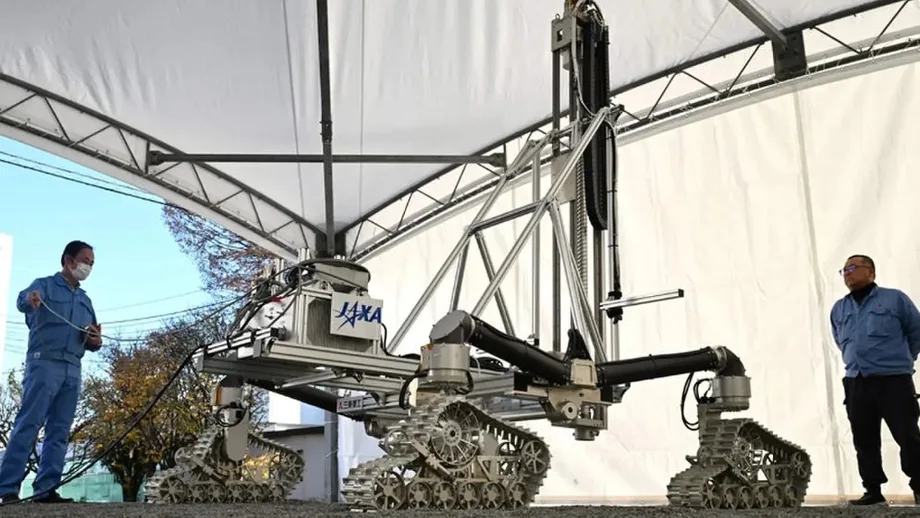
Reporters watched a low machine cross a gravel course at the Japan Aerospace Exploration Agency facility in Chofu, in western Tokyo, on November 25. Belts wrapped around wheels at the end of its four legs carried it over rocks and through shallow dips built to copy the surface of the Moon. What JAXA showed was a test model, built at one fifth of the size of the flight vehicle, of the rover it plans to land near the lunar south pole in 2028.
Contents
- A Test Model Drives Over Simulated Moon Ground
- Why Water Is Worth a 350 Kilogram Rover
- Seven Instruments and a Drill That Reaches 1.5 Meters Down
- Move, Drill and Live Through the Long Night
- Who Builds What
- A Landing Site Between Shackleton and De Gerlache
- A 24.8 Billion Yen Bill for Development
- From a 2017 Feasibility Study to a 2026 Test Drive
- Japan's Uneven Record at the Moon
- Key Points
The machine is the center of LUPEX, short for Lunar Polar Exploration, a mission Japan runs with India. The version that flies is expected to weigh about 350 kilograms with its instruments aboard and to work on the surface for about 100 days, with a full year as the optimistic ceiling. It will launch on an H3 rocket from the Tanegashima Space Center in Kagoshima Prefecture in fiscal 2028, a year that runs from April 2028 to March 2029 in Japan.
Engineers have been testing the machine in awkward situations rather than on flat ground. Takeshi Hoshino, the LUPEX project manager, said the trials included "climbing slopes using a single leg, continuous driving using two legs, and mobility trials under vacuum conditions".
Why Water Is Worth a 350 Kilogram Rover
Water is among the heaviest things a spacecraft routinely needs and one of the costliest to lift out of Earth's gravity. Split it into hydrogen and oxygen and it becomes rocket propellant, and the oxygen can be breathed. Making it on the Moon would cut the mass that later missions have to carry from home.
Hoshino put the goal plainly to reporters at the unveiling.
We ultimately want to use lunar water for rocket fuel.
Hoshino explained why recycling cannot close the loop in space the way it does in orbit. The International Space Station recycles more than 90 percent of the water its crew uses. A rocket engine that burns hydrogen and oxygen throws water out of its exhaust, and that vapour cannot be caught and used again.
That's why a key objective is to produce fuel on the Moon for future missions, whether returning to Earth or heading onward to Mars.
Nobody has yet measured the ice the mission is chasing. The polar regions hold permanently shadowed regions, stretches of crater floor that never receive direct sunlight and stay cold enough to keep water frozen, with temperatures near minus 200°C. Hoshino said lunar water has become one of the central questions in lunar science, and that his team hopes to contribute to human interest in the subject.
Seven Instruments and a Drill That Reaches 1.5 Meters Down
The rover carries a drill and a set of instruments built to answer three questions about lunar water: where it is, how much of it there is, and what form it takes. JAXA describes the drill as reaching more than a meter below the surface, so that samples come from soil never exposed to sunlight. A mission profile puts the target depth at 1.5 meters.
Japan, India, the United States and Europe all have sensors on the payload list.
- LTGA, a Japanese analyzer that heats drilled samples and weighs the water driven out of them.
- TRITON, a Japanese mass spectrometer that identifies which chemicals are present in a sample.
- ADORE, a Japanese instrument that measures water content by watching laser light fade inside a mirrored cavity.
- ALIS, a Japanese imaging spectrometer that looks for signals of water and the hydroxyl radical on the surface and in drilled soil.
- ISAP, an Indian package that measures the minerals and elements in a sample.
- PRATHIMA, an Indian probe pushed 20 to 30 centimeters into the ground to detect and quantify ice mixed into lunar soil.
- WaSSPeR, an Indian radar that scans up to 1.5 meters below the rover as it drives.
- MIR, an Indian spectrometer that reads water and hydroxyl signatures on the surface.
- A NASA neutron spectrometer that looks for hydrogen up to a meter underground.
- EMS-L, a European instrument that measures surface gas pressure, chemical species and temperature.
Some of that payload list is still described as candidate instruments. A rover found to be overweight is also being redesigned, so the final set of sensors can change before the launch.
Move, Drill and Live Through the Long Night
JAXA frames the mission around three skills the rover has to master in one of the hardest places in the Solar System: moving over broken, steep ground, drilling into frozen soil, and surviving the lunar night, a stretch of roughly 14 Earth days without sunlight.
The south polar zone is dark and cold in ways that strain ordinary spacecraft design. Permanently shadowed crater floors sit near minus 200°C, and their deep craters and steep slopes make driving slow and risky. Power is the second problem, because solar panels are useless through the night, so the rover must hold on to the heat its electronics generate until sunrise.
The redesign dropped radioisotope heater units, the small nuclear heat sources used on some spacecraft, in favour of an insulating system that keeps warmth from escaping during the night. The rover is also too heavy to be carried inside the lander the way India's Chandrayaan-3 rover was. It will ride on the outside and be lowered to the ground on a crane arrangement.
Who Builds What
India supplies the lander and Japan supplies the rover and the rocket. ISRO reworked the lander from the Vikram design that flew on Chandrayaan-3 in 2023, adding landing technology derived from JAXA's SLIM probe, which reached the Moon in January 2024. The heavier lander needs a bigger engine, and ISRO's Liquid Propulsion Systems Centre developed one that produces 3.1 kilonewtons of thrust; a prototype was hot fired earlier in 2025. ISRO expects to use the same engine in missions that later put people on the Moon.
The lander must carry at least 420 kilograms of payload, and the complete spacecraft will weigh about 6,650 kilograms at launch. Wikipedia's entry on the LUPEX mission lists an H3-24 rocket built by Mitsubishi Heavy Industries, which is also manufacturing the rover.
Paperwork has caught up with the hardware. India's Union Cabinet approved the mission on March 14, 2025. The two countries signed an implementing arrangement in August 2025 at their fourth technical interface meeting, and a fifth meeting in Japan that December settled an updated plan of operations. An ISRO delegation visited the Tanegashima spaceport in April 2026 to prepare joint development work.
India has a name for the project on its own books. LUPEX is listed as Chandrayaan-5, and it follows Chandrayaan-4, a mission designed to bring lunar samples back to Earth.
A Landing Site Between Shackleton and De Gerlache
The mission has a tentative target: 89.45 degrees south, 222.85 degrees east, on a raised ridge between the Shackleton and De Gerlache craters. Chandrayaan-2's orbiter camera surveyed the area, and the pictures show it strewn with small boulders.
Inoue Hiroka, a researcher on the Lunar Polar Exploration project team at JAXA's Space Exploration Center, says picking the precise spot is one of the biggest problems left. The south polar zone is the right region because the odds of finding water there are thought to be high. Level ground that also guarantees sunlight for power and a clear path for communications is scarce. The team plans to publish its chosen site once the matter is settled, partly because other countries may be aiming at the same patch of ground. No date has been given for that announcement.
A 24.8 Billion Yen Bill for Development
A document prepared by Japan's Ministry of Education, Culture, Sports, Science and Technology for the Space Activities Commission, dated April 24, 2024, puts the mission's total development cost at about 24.8 billion yen, not counting the cost of operating it. The figure covers the hardware Japan must design and test, the rover included, and leaves out what it costs to run the mission once built.
Timing remains loose. The two agencies have committed to fiscal 2028, while a mission profile gives 2028 to 2029 as the launch window, and the rover's landing site is still to be fixed.
From a 2017 Feasibility Study to a 2026 Test Drive
- December 2017: ISRO signs an implementation arrangement with JAXA for a joint study of a polar water mission.
- March 2018: the two agencies finish a feasibility report.
- September 2019: India's Chandrayaan-2 lander crashes during its descent, and India starts work on another attempt at landing.
- August 2023: Chandrayaan-3 lands near the lunar south pole.
- January 2024: JAXA's SLIM probe touches down at a crooked angle, making Japan the fifth country to achieve a soft landing on the Moon.
- April 2024: the development cost estimate goes to Japan's Space Activities Commission.
- March 2025: India's Union Cabinet approves the mission.
- August 2025: the implementing arrangement is signed, with Mitsubishi Heavy Industries named as rover manufacturer.
- December 2025: a fifth technical meeting in Japan finalises an updated operations plan.
- November 2026: JAXA shows the rover test model in Tokyo.
Japan's Uneven Record at the Moon
JAXA's recent lunar and planetary efforts have mixed success with failure. The SLIM lander reached the Moon in January 2024 on its side after a landing that left it tilted, and still made Japan the fifth country to complete a controlled descent. The Tokyo company ispace failed last year in its attempt to become the first private firm outside the United States to land on the Moon under its own control.
Last month JAXA launched a spacecraft toward one of Mars's moons on a mission to bring samples back, the first attempt of its kind. That mission, like LUPEX, depends on a lander and a spacecraft built in different countries to work as one machine.
Key Points
- JAXA displayed a test model of its LUPEX rover at its facility in Chofu, Tokyo, on November 25.
- The rover has four legs with tracked belts, weighs about 350 kilograms with instruments, and carries a drill that reaches 1.5 meters down.
- The mission is a joint project with India: ISRO builds the lander, Japan builds the rover and supplies the H3-24 rocket.
- Launch is planned for fiscal 2028 from the Tanegashima Space Center in Kagoshima Prefecture, with a window stretching to 2029.
- The rover is to work about 100 days, and up to a year, in temperatures near minus 200°C near permanently shadowed craters.
- Seven Japanese and Indian instruments plus NASA and European sensors will measure where lunar water is, how much there is and what form it takes.
- Hoshino says the aim is to make rocket fuel on the Moon for missions returning to Earth or traveling to Mars.
- Japan's development cost is put at about 24.8 billion yen in a 2024 ministry document, excluding operating costs.
- The landing site is tentatively set near 89.45 degrees south, 222.85 degrees east, between the Shackleton and De Gerlache craters.