A Claim Arrives at the Speed of Light
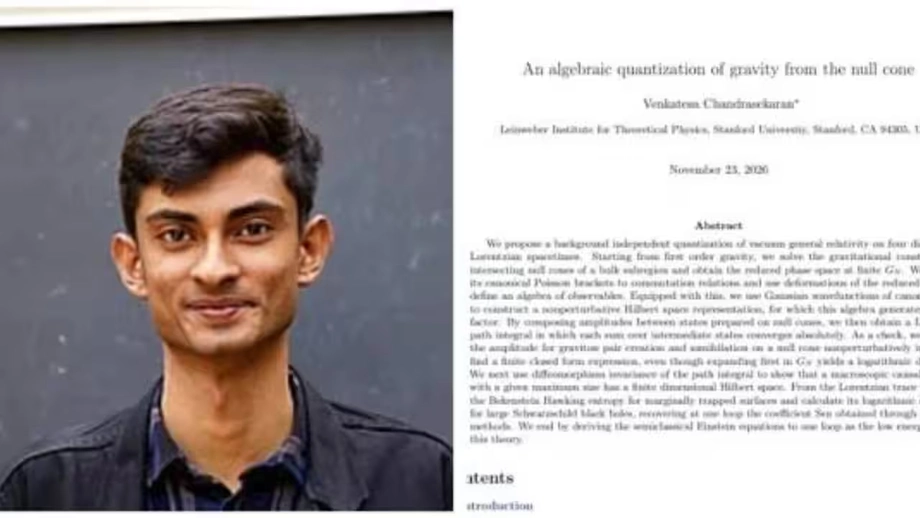
On November 25, 2026, Venkatesa Chandrasekaran, a theoretical physicist at Stanford's Leinweber Institute for Theoretical Physics, posted the arXiv preprint An algebraic quantization of gravity from the null cone. He is the only author. The paper proposes a way to quantize vacuum general relativity in four dimensional spacetime, meaning gravity with gravitational waves and black hole geometry but without matter such as electrons or quarks. arXiv lists the work under hep-th, gr-qc, math-ph and math.MP, and the document carries the arXiv.org nonexclusive-distrib/1.0 license. The full PDF runs 83 pages; the main text is 54 pages plus appendices and 34 figures.
Contents
- A Claim Arrives at the Speed of Light
- What the Paper Says It Achieves
- Why Light Cones Make the Problem Smaller
- From Classical Geometry to Quantum Rules
- The Graviton Sum That Stays Finite
- Black Hole Entropy and a Known Correction
- What GPT-6 Astra Actually Did
- A Timeline of a Rapid Debate
- Why Physicists Pushed Back
- What Is Still Open
- If the Math Holds, What Changes?
- Key Points
The stakes are high. General relativity, Albert Einstein's 1916 theory, explains planets and black holes as the curvature of space and time. Quantum mechanics explains atoms, light and subatomic particles. Physicists use both in their own domains, but a single rulebook covering both has resisted a century of work. Chandrasekaran says his method rebuilds gravity from surfaces traced by light, keeps Newton's constant finite during quantization, and avoids a common route to mathematical infinities. The paper is not peer reviewed, and its claims are already contested.
What the Paper Says It Achieves
Chandrasekaran's abstract reads like a set of checkpoints for quantum gravity proposals. The framework prepares quantum states on null cone boundaries, glues regions together and produces a path integral, a recipe for adding every possible way a quantum process can happen.
- A finite amplitude for a pair of gravitons, the hypothetical quanta of the gravitational field, to appear and then disappear.
- A finite number of quantum states for a causal diamond with an upper size limit.
- The Bekenstein-Hawking black hole entropy formula, which ties entropy to horizon area, plus a logarithmic correction for large Schwarzschild black holes.
- Einstein's equations at low energies, with the first quantum correction included.
The paper says its observables generate a type I factor, a term from operator algebra meaning the operators act like all bounded operators on a Hilbert space, the mathematical space where quantum states live. A short passage mentions ER = EPR, the speculative idea that entangled particles are linked by wormholes, but the tested results center on the four items above.
Why Light Cones Make the Problem Smaller
Chandrasekaran begins with a flash of light. In space and time, that flash spreads along a null cone, the boundary of everything the flash can affect. If an earlier event sends out a light cone and a later event is reached by a cone traced backward in time, the two cones overlap around a region shaped like a diamond, called a causal diamond. The diamond contains what the first event can signal and the second can receive.
The paper asks whether gravity inside that diamond can be described using only data on its light cone boundary. In ordinary general relativity, Einstein's equations are tangled constraints that link space and time in difficult ways. On null surfaces, those constraints become ordinary differential equations that can be integrated. What remains are the independent pieces of the gravitational field, including the two polarizations of gravitational waves, meaning the two ways a wave can stretch and squeeze space.
The shape of each light ray bundle also carries shear, a distortion that changes the cross section of the bundle. In the focusing equation, shear affects how the bundle area changes, so the wave data and the change in area cannot be chosen freely and separately. That link later helps limit how many quantum states can fit inside a bounded diamond.
From Classical Geometry to Quantum Rules
The construction follows a reduced phase space route. Chandrasekaran first solves the classical gravitational constraints on two intersecting light cones, then keeps the remaining freely specifiable variables and applies quantum rules to them. He does not start with flat spacetime as a fixed stage, and he does not expand the theory in small powers of Newton's constant before quantizing. That order is central to the paper's argument about infinities.
Because spacetime itself fluctuates, coordinates cannot tell every observer where a measurement sits. The paper anchors measurements to a reference frame built from the geometry at the corner where the two cones meet, and it adds edge modes, degrees of freedom tied to that boundary. It also defines a gravitational clock. The distance light has traveled along a cone, normalized at the boundary, acts as time read from the geometry rather than from an outside clock.
Larger regions are built by gluing diamonds along shared boundaries. Outgoing data from one region are matched to incoming data from the next, and the calculation sums over intermediate states on the seam. The paper argues that, for normalizable states and unitary evolution, meaning evolution that preserves quantum probabilities, sums at a fixed seam are absolutely convergent. Absolute convergence means the sum stays finite even when each term is replaced by its magnitude, so the result does not rely on delicate cancellations.
The Graviton Sum That Stays Finite
The sharpest test in the paper is a correlation function on a light cone linking two operations: creating and then annihilating a pair of gravitons with a chosen phase. Chandrasekaran fixes one polarization and one angular component, uses a Gaussian state, and labels radial wave modes by an integer k. He defines s = A/(4G_Nℏ), where A is the corner area, G_N is Newton's constant and ℏ is the quantum unit of action.
Equation 4.33 gives the amplitude as [1/(2s²)] times the sum from k = 1 to infinity of e^(−2ik/s)/k². The phase factor has magnitude one, so the absolute value of each term falls as 1/k² and the full sum converges. Expanding the phase in Newton's constant first produces a different result. Equation 4.34 gives the third order coefficient as −i/s³ times the sum from k = 1 to N of 1/k, which grows like a logarithm as N increases. The full method gives a finite replacement term, −i ln s/s³, at weak coupling.
This comparison is the paper's clearest evidence that order of operations matters. Keep Newton's constant positive and add all modes, including modes with very short wavelengths, and the answer is finite for any positive value. Expand in the coupling first, and the coefficient diverges. The result tends to zero as the coupling approaches zero from above, but its third derivative diverges there, one of the mathematical details specialists will examine.
Black Hole Entropy and a Known Correction
Black holes are the place where gravity and quantum theory are expected to meet most strongly. In the 1970s, Jacob Bekenstein and Stephen Hawking showed that a black hole has entropy proportional to the area of its event horizon. Entropy here means the amount of hidden information, in the same broad sense used in thermodynamics. Chandrasekaran says his framework recovers that area law by counting quantum states on light cone surfaces and on surfaces that behave like black holes. The finite state count also fits the holographic principle, which limits the information in a region by the area of its boundary.
The paper reports a logarithmic correction for large Schwarzschild black holes. The coefficient is 257/90 in counting with the gravitational clock and becomes 106/45 after conversion to fixed mass and summed angular momentum. Chandrasekaran says this agrees with Ashoke Sen's 212/45 ln a result, obtained earlier through Euclidean methods, which use imaginary time. Matching a known coefficient from a different route is a useful consistency check. It is not an observation of nature.
At low energies, the paper derives Einstein's equations and the first layer of quantum corrections. Any candidate quantum theory must return ordinary gravity at everyday energies, just as quantum mechanics must return ordinary motion for large objects. That check gives the paper a second anchor in known physics, alongside the black hole calculation.
What GPT-6 Astra Actually Did
The acknowledgments make the artificial intelligence role hard to miss. Chandrasekaran thanks Sam Altman, Sébastien Bubeck and OpenAI colleagues for encouragement, and says several calculations and proofs came from months of detailed work with OpenAI's GPT-6 Astra using about 400 million tokens. A token is a small piece of text that language models process; the figure measures the computing effort spent on the collaboration. GPT-6 Astra was OpenAI's most capable model until GPT-6.2 Astra arrived in mid November 2026.
The paper does not say which calculations or proofs came from the model. In an October 2026 OpenAI forum discussion, Chandrasekaran described a workflow in which the researcher sets the question, supplies the relevant material, defines what would count as a refutation, and intervenes when an agent changes a claim or leaves a derivation unfinished.
An October benchmark built with about 30 physicists gave GPT-6 Astra, running under Codex, 49 of 50 unpublished physics research problems, several in black hole physics and holography, with average compute under $3 per problem. The 49 of 50 number has not been independently verified. The benchmark gives each task a known answer, while an open problem such as quantum gravity does not, a limit discussed by Suvrat Raju, a professor at the International Centre for Theoretical Sciences in Bangalore, on November 25. The paper also arrived after AI proof claims for the Riemann Hypothesis and Navier Stokes equations.
A Timeline of a Rapid Debate
The proposal moved from a technical preprint to a public fight within days. The dates matter because most reactions arrived before any journal review or extended specialist audit.
- October 2026: Chandrasekaran describes his AI assisted research workflow, and the TheoPhysEval benchmark is introduced.
- November 25, 2026: An algebraic quantization of gravity from the null cone appears on arXiv as version 1, with no journal reference.
- November 26, 2026: Sam Altman praises Chandrasekaran's persistence and his early belief that AI could help with Millennium Prize problems; Greg Brockman shares the paper; Jonathan Oppenheim publishes objections.
- November 26 to 27, 2026: Peter Woit, Hontas Farmer, Nirmalya Kajuri, Alejandro Vilar and José Luis Barbón weigh in, with views ranging from dismissal to cautious interest.
- November 27, 2026: Automated and human checks circulate, but no journal decision, formal proof in a system such as Lean, or agreed test of the full theory has been announced.
The speed reflects two things at once: the paper makes concrete mathematical claims, and it arrives with prominent AI industry attention. Chandrasekaran is affiliated with Stanford and is also employed at OpenAI, a fact highlighted by some physicists because the preprint lists his Stanford affiliation.
Why Physicists Pushed Back
Jonathan Oppenheim, a physics professor at University College London who works on a competing line called postquantum gravity, published a November 26 essay saying the paper falls far short of its headline ambition. He said the classical light cone starting point looks sound, but the paper has not supplied the steps needed to reach a full quantum theory.
The paper doesn't even come close to establishing a quantum theory of gravity.
Oppenheim's objections focus on three tests. He says the entropy result uses an older analytic continuation argument instead of counting microstates, that diffeomorphism invariance, the requirement that physics not depend on coordinate labels, is imposed as an axiom rather than demonstrated, and that the claimed classical limit relies on a Hamiltonian operator, the rule that should evolve the system in time, which the paper never constructs. He also notes that reduced phase space quantization is not unique, so different choices may lead to different quantum theories.
To widen the check, Oppenheim used Claude agents with adversarial checks by OpenAI's Codex. They listed 21 known obstacles in canonical quantization: the paper solves one relatively minor point, sidesteps seven, assumes its way past six, and does not mention the other seven. The automated notes were not verified by a human reviewer, and Oppenheim develops a competing approach, a detail relevant when weighing his objections.
Alejandro Vilar, a theoretical physicist at the University of British Columbia, said the work is interesting but far from a solid solution. He also objected to the undisclosed OpenAI role in the paper's author line.
It would have been cleaner if he said so openly.
Peter Woit, a mathematician at Columbia University, called the episode a publicity stunt and used harsher language for the paper. Hontas Farmer, a theoretical astrophysicist at Chicago State University, said the work appears mathematically sound in places but offers no testable prediction and overlaps earlier ideas. Nirmalya Kajuri, a theoretical physicist, called it interesting progress while saying it does not solve quantum gravity. Sean Carroll, a physicist at Caltech, described Chandrasekaran as a serious physicist and said the claim would be a big deal if true. José Luis Barbón, a theoretical physicist near Madrid, said technical assumptions may change the physics and called for much more scrutiny.
What Is Still Open
Kajuri notes that the construction supplies a quantum state on part of the algebra and then extends it to the full algebra using a theorem that does not select one unique extension. Oppenheim says the finite state proof assumes a finite trace, a way of totaling diagonal contributions. Raghu Mahajan has argued that a stronger test would be the Goroff and Sagnotti calculation for graviton scattering at two loops, where ordinary perturbation theory needs a new term in the action.
The paper itself leaves a related question in a footnote. Chandrasekaran does not settle whether changing the reference quantum state gives physically equivalent representations over the same clock range. In a two dimensional model examined in the paper, infinitely many orthogonal states survived, showing that the result about finite states needs careful extension to the full four dimensional theory.
No date was given for a journal submission, revision or formal review. No experiment was proposed that could tell this framework from its rivals, and no device can reach the energies where quantum gravity effects become large in the near future. For readers, the practical point is simple: the paper offers mathematical checks, not a measurement.
If the Math Holds, What Changes?
For physics, a validated version of this framework would offer a new way to organize quantum gravity around boundaries rather than fixed spacetime snapshots. It could help researchers model conditions near black hole singularities, the first moments after the Big Bang and questions about vacuum energy, where current descriptions stop working.
For everyday life, nothing follows directly. The paper does not announce a new energy source, antigravity device or product. Its immediate impact is in how science is done. A physicist openly credits a commercial language model with months of calculation and proof work, and physicists now face the task of checking long, specialized reasoning that arrives with corporate amplification. Related null cone work by Reisenberger, Wolfgang Wieland, and Charalampos Theofilis with Wieland predates this paper, as do Chandrasekaran and Éanna Flanagan's studies of subregion algebras.
Key Points
- Venkatesa Chandrasekaran posted an unreviewed 83 page preprint on November 25, 2026, as its sole author.
- The paper proposes quantizing vacuum gravity in four dimensions from light cone boundaries and causal diamonds.
- It reports a finite graviton pair amplitude, a finite state count, black hole entropy with a known correction, and Einstein's equations at low energies.
- GPT-6 Astra helped with calculations and proofs over months, using about 400 million tokens supplied by OpenAI.
- Jonathan Oppenheim and other physicists dispute whether the construction reaches a full quantum theory of gravity.
- No experiment, peer review date or agreed checklist for acceptance has been announced.