Three films, one act of defiance
Aamir Khan first rejected Lagaan because its story sounded bizarre. Madhur Bhandarkar spent six months visiting Mumbai dance bars before filming Chandni Bar. Farhan Akhtar, preparing his first film as a director, refused to follow the familiar Bollywood formula of action, melodrama and scenes designed primarily to please crowds. Those decisions, revisited 25 years later, showed how much persistence sat behind three celebrated films of 2001.
Contents
- Three films, one act of defiance
- Why failure changed their idea of success
- How a narration lasting three hours rescued Lagaan
- Six months of research behind Chandni Bar
- Why Bhandarkar kept women at the centre
- Dil Chahta Hai and the texture of real friendship
- What opening weekends cannot measure
- Rewrites, pauses and the danger of too much promotion
- Where AI stops and human storytelling begins
- What they would change, and what comes next
- Key Points
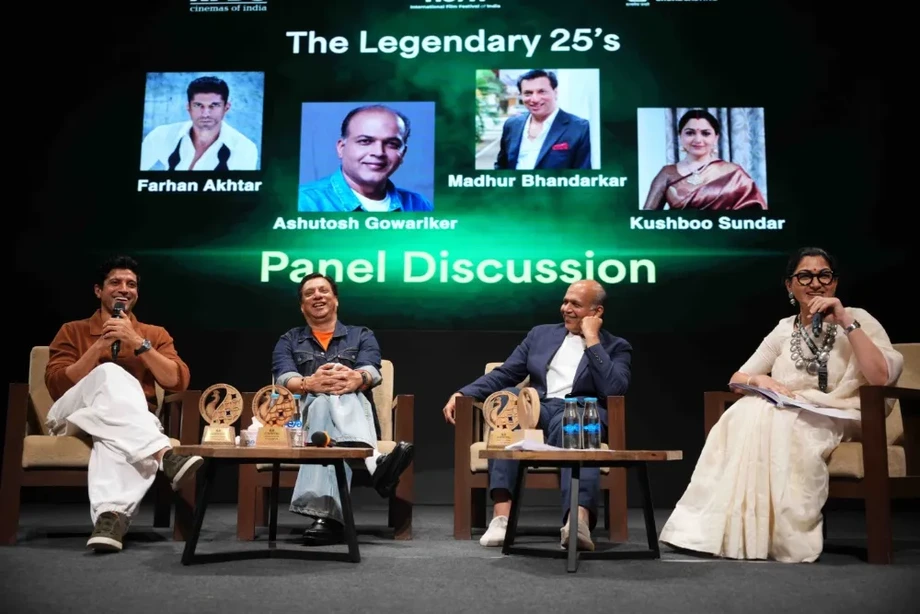
Akhtar, Ashutosh Gowariker and Bhandarkar reunited on Friday, 27 November 2026, for The Legendary 25s, a special masterclass held at Kala Academy in Panaji on the eighth day of the 57th International Film Festival of India. Actor and producer Khushboo Sundar moderated the session. Gowariker was also the festival director for the edition, whose theme was Stories Without Borders.
The three films had taken sharply different routes. Lagaan turned a village cricket match against British rulers into a story of resistance and later received an Oscar nomination. Dil Chahta Hai followed three friends negotiating adulthood, while Chandni Bar brought the lives of women working in Mumbai dance bars into mainstream Hindi cinema. Their makers used the reunion to discuss box office pressure, changing viewing habits, acting, historical research and artificial intelligence.
- 1988: Akhtar, then a schoolboy, watched Mansoor Khan's Qayamat Se Qayamat Tak, which later influenced his approach to romance, family relationships and youthful emotion.
- 2001: Dil Chahta Hai, Lagaan and Chandni Bar reached cinemas, each moving away from established conventions in a different way.
- 27 November 2026: their directors reunited in Panaji to mark 25 years and examine an industry now preoccupied with opening weekends, social media and AI.
Why failure changed their idea of success
Gowariker and Bhandarkar already had directing experience before their 2001 films established their creative identities. Gowariker's first two films had failed after he initially pursued commercial entertainment. Akhtar was in a different position: Dil Chahta Hai was his directorial debut, but he likewise had no interest in reproducing the prevailing potboiler template.
Gowariker, who wrote and directed Lagaan, said the failure of his earlier work forced him to reconsider what he wanted from his next project.
My next film had to be something I believe in, something that I want to make first, and then hope to God that the audience also likes it. So that's how the genesis of Lagaan happened.
That principle connected the three accounts. Gowariker developed a period story about a group of village heroes, Bhandarkar researched a world he had personally encountered, and Akhtar drew on friendships and attractions that felt familiar to him. Their common argument was that conviction came before calculations about the market.
How a narration lasting three hours rescued Lagaan
Gowariker said it took him a year and a half simply to get hold of Aamir Khan and present the idea. The actor then rejected it. The story was set in 1893 and involved 11 villagers wearing dhotis who played cricket against the British, with payment of lagaan, an agricultural tax, at stake.
Gowariker told the festival audience that he understood Khan's reservation. Sports drama was not then an established mainstream genre in Hindi cinema, village films faced commercial resistance, and the proposal required a major star to alter his hair, clothing and familiar screen image.
If I tell you a story like this today, that 11 people wearing dhotis will play cricket in the village and will pay taxes against the British, in 1893, when you know that these genres were not there then. There was no sports drama. You couldn't make a village movie.
Their earlier collaboration, Baazi, had also failed to perform as expected. Rather than abandon the new idea, Gowariker wrote the entire screenplay so that Khan could assess the characters and narrative instead of a bare premise. When he returned, he initially withheld the title. Khan soon recognised the project and objected to hearing about dhotis, lagaan and Champaner again.
Gowariker said he made one final request for a complete narration of the dialogue script.
Just give me three hours of your life. After that, even if you don't say it, just listen to it once.
Khan laughed and became tearful during the narration, according to Gowariker, and finished by saying that he definitely wanted to make the film. The actor who had rejected the premise therefore became its star and one of its producers. The film went on to receive an Academy Award nomination in the foreign language film category.
Research supported that narrative persistence. Gowariker studied the British Raj, village communities, cricket and life in the 19th century. He said historians and subject experts also contributed to his historical films, naming Lagaan, Jodhaa Akbar and Panipat. Their knowledge helped establish authenticity, while the finished works still involved dramatic interpretation.
Six months of research behind Chandni Bar
A visit to a dance bar with a friend gave Bhandarkar the subject for Chandni Bar. He then spent nearly six months visiting bars across Mumbai, learning about the circumstances and struggles of people connected with that world. Tabu starred in the finished film, which asked viewers to look at lives that popular cinema had largely left unseen.
Bhandarkar said he would still have valued the film if it had failed commercially, because it represented both the cinema he wanted to make and the world he had observed. His later work continued to examine people and institutions from close range: Page 3 looked at media and celebrity culture, Corporate at business, and Fashion at the fashion industry.
The writer and director explained that his interest lay in realities hidden from public view rather than in comforting versions of social life.
I have always wanted to make films about subjects that people hesitate to talk about or even explore. I am drawn to the stories behind the scenes, the realities that often remain hidden from the public eye. For me, cinema has always been a mirror to society. I would rather explore real life than create an idealised reel life.
That approach also gave him a practical answer to passing fashions. Research supplied characters and conflicts, rather than an attempt to predict what might sell on a particular weekend.
Why Bhandarkar kept women at the centre
Bhandarkar said people repeatedly responded to his scripts with a commercial suggestion: retain the story, but shift its perspective to a man. He named Corporate, Heroine and Fashion as projects for which he was asked to cast a male protagonist.
It's good, why not tell the story from a male point of view, it will be good for you also.
His reply was that he wanted to tell those stories from women's points of view. He said he was comfortable with the resulting label of a filmmaker whose cinema centres on women, because research and meetings with people continued to present him with experiences that deserved that perspective.
The characters he described were deliberately varied. Tabu's character in Chandni Bar was subdued and submissive and eventually gave in to the system. Raveena Tandon's politically ambitious character in Satta fought it. Bhandarkar called them diametrically opposite and said he preferred complex, flawed and sometimes highly intelligent people to idealised portraits.
The industry around those choices had changed. Bhandarkar recalled barely a few filmmakers working in the same space when he began, with some observers dismissing his productions because of their budgets. He said many more directors and actresses now want to make cinema centred on women, including films built around a solo female lead. He welcomed that shift. His own filmography has since extended from Chandni Bar, Page 3, Corporate and Fashion to Heroine and Babli Bouncer.
Dil Chahta Hai and the texture of real friendship
Akhtar's debut starred Aamir Khan, Saif Ali Khan and Akshaye Khanna as three friends. He wanted their time together to resemble the behaviour he recognised from life, rather than the exaggerated declarations and gestures that he felt had accumulated around male friendship in Hindi films.
He cited Qayamat Se Qayamat Tak as an important influence. Watching it as a schoolboy exposed him to a fresher treatment of romance, family relationships and youthful feelings. For his own film, the immediate problem with screen friendship was simpler.
The relationship had become cheesy, filmy.
The romance between the characters played by Akshaye Khanna and Dimple Kapadia supplied another departure. A younger man falling in love with an older woman was rarely explored in mainstream Hindi cinema at the time, and the storyline challenged familiar social attitudes. Asked where the idea originated, Akhtar gave a personal answer.
From many crushes that I had on older women, that's the honest truth.
His advice to younger filmmakers followed the same logic. Individual experiences offer material that cannot be obtained by copying a successful formula or trying to guess a universal audience preference.
What opening weekends cannot measure
Akhtar's strongest criticism concerned the way people now discuss films. He said filmmakers had done the industry a disservice by placing earnings at the centre of the conversation, ahead of creative merit, emotional effect and storytelling. He did not blame audiences for that shift.
How much money this film has made, why are you interested in that? Did you like the film? Did you enjoy the film?
He said he would rather know what a viewer thought than receive congratulations on a successful weekend. Gowariker placed that complaint within a longer history. Measures of success had moved from silver and golden jubilees, associated with lengthy theatrical runs, to runs lasting 100 days and then to opening weekends and collections in the first week.
Gowariker called every new production a reset to zero and warned against reducing films of different budgets and genres to one financial ranking. Each project has its own commercial potential, he said, and its earnings need to be considered in relation to the investment behind it. He found film festivals refreshing because delegates were more likely to ask whether they liked a work than how much business it had done.
The director also argued that unusual films need room to travel beyond their first audience.
Anything that is new, different or unconventional needs more time to find its audience. We must not judge a film only by its opening weekend.
Bhandarkar offered a complementary commercial view. Critical acclaim and earnings both mattered, he said, because successful films attract investors and create opportunities for future work. The disagreement was therefore not about whether filmmakers need money, but about whether a figure should replace every other judgment.
Rewrites, pauses and the danger of too much promotion
Akhtar described a screenplay as a living, breathing thing. Actors and crew members contribute to it during production, and its development can continue into the edit. That account presents the script less as a fixed instruction manual than as a foundation that a collective keeps testing.
He urged writers and directors to remain receptive without abandoning their convictions.
A director or writer must keep an open heart and mind, and leave their ego behind. Be fearless, believe in your vision and tell the story you truly want to tell.
Gowariker turned from writing to acting and located part of a performance between lines of dialogue.
For me, a true performance lies in the pauses. Listening is one of the most important qualities of an actor. How an actor listens and reacts to a cue is equally important.
Audience behaviour produced another exchange. Akhtar recalled advice from his father, screenwriter Javed Akhtar, against assuming that filmmakers know what viewers want or can dictate what they should watch. Gowariker described a continuing exchange instead: social and political circumstances influence what filmmakers choose, while cinema can affect public thought.
Promotion required its own balance. Akhtar said trailers and other promotional material often attract viewers more effectively than repeated appearances by actors and directors. Excessive exposure before release can create fatigue and allow publicity to overshadow the film. He also refused to recut Dil Chahta Hai into short social media reels, saying films are conceived for a particular mode of consumption and that he wanted audiences to experience his work in that form.
Where AI stops and human storytelling begins
The panel considered artificial intelligence, visual effects and images generated by computers as production tools with a shared limitation. AI can assist with tasks and produce material, while visual effects can add to or transform what a camera records. The directors argued that neither supplies the lived experience from which a convincing character grows.
Gowariker compared tools assisted by AI with the arrival of spellcheck in Microsoft Word. Writers could accept useful technical help without mistaking it for imagination. His condition for using such tools was direct.
The core is the story, that should be a human story.
Bhandarkar said technology could increase visual scale and expand what filmmakers are able to show, but could not reproduce the personality and emotional connection through which viewers identify with people on screen.
Technology can create images, but it cannot replicate human emotions, sensitivity and the emotional connect that breathe life into a character.
The three men therefore did not reject new production methods. They placed them below research, observation, performance and writing in the creative order. For Bhandarkar, real human characters remained the test; for Gowariker, technology had to serve the story; for Akhtar, a filmmaker's particular experience remained the starting point.
What they would change, and what comes next
A closing exchange tested their admiration for one another's work. Akhtar said he would leave Lagaan untouched, although if he were its producer he would ask Gowariker to direct it again. Gowariker said he might add a soulful song to Chandni Bar. Bhandarkar said he would find it difficult to remake either Lagaan or Dil Chahta Hai.
Gowariker is now preparing Lalkaara, another period sports drama about cricket, with Aamir Khan. The project would bring the actor and director together again after Lagaan. No release date was given.
For younger filmmakers in the audience, the practical lessons were unusually concrete. A rejected pitch could need a complete screenplay rather than a louder argument. An unfamiliar social world could require months of observation. Friendship could be written from daily behaviour instead of inherited screen gestures. The anniversary session presented those choices as the work beneath the reputation, 25 years after the films first reached audiences.
Key Points
- Farhan Akhtar, Ashutosh Gowariker and Madhur Bhandarkar marked 25 years of Dil Chahta Hai, Lagaan and Chandni Bar at the 57th IFFI in Goa.
- Aamir Khan initially rejected Lagaan; Gowariker said a complete narration lasting three hours changed his mind.
- Bhandarkar researched Chandni Bar for six months in Mumbai dance bars and resisted requests to give later stories to male protagonists.
- Akhtar said male friendship in Hindi films had become artificial and drew the older woman's romance in Dil Chahta Hai from personal experience.
- The directors criticised reducing films to opening earnings, while Bhandarkar said commercial success still helps attract investors.
- Gowariker and Bhandarkar treated AI and visual effects as useful tools that cannot replace human imagination or emotion.
- Gowariker is preparing Lalkaara, a period cricket drama with Aamir Khan, but no release date was announced.