Moscow talks put 80.5 million tons of freight in focus
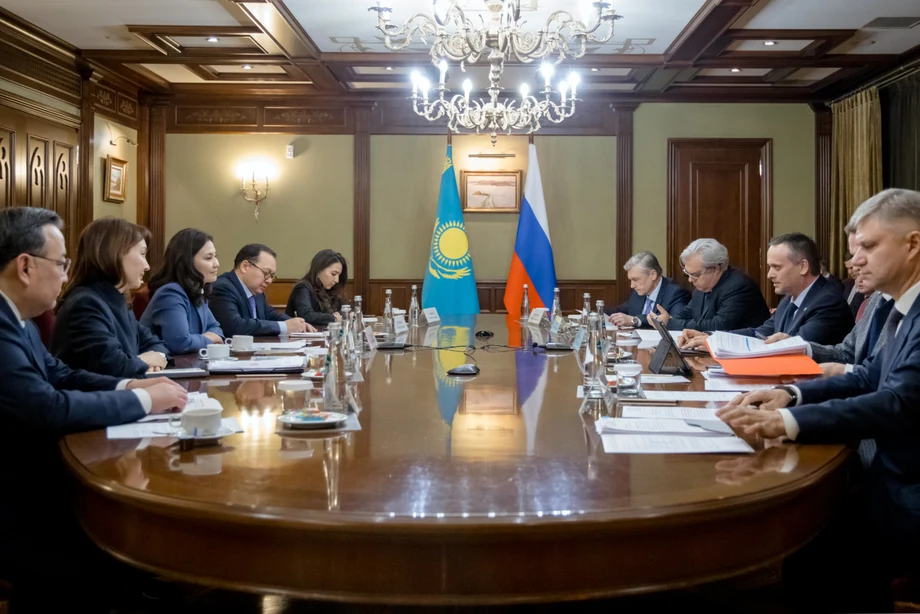
Rail freight between Kazakhstan and Russia reached 80.5 million metric tons in the first ten months of 2026, an increase of 3.1% from the same period a year earlier. The figure anchored talks in Moscow on November 26 between Asel Zhanasova, Kazakhstan's deputy prime minister and transport minister, and Russian Deputy Prime Minister Andrei Nikitin.
Contents
- Moscow talks put 80.5 million tons of freight in focus
- Faster trains and mixed signals from air traffic
- Why North to South is receiving special attention
- Border checkpoints now have numerical capacity targets
- Permits, Mongolia and the daily business of road haulage
- Digital pilots are moving toward shared platforms
- Tokayev sets a wider digital ambition
- The timetable stretches from 2027 permits to 2050 logistics
- Physical bottlenecks remain the practical test
- Key Points
Oleg Belozerov, head of Russian Railways, also took part. Zhanasova, who became deputy prime minister and transport minister earlier in November, separately met Russian Transport Minister Dmitry Yadrov during her first round of talks with Russian counterparts in her new role.
The officials discussed higher freight volumes, border infrastructure, digital transport documents, additional air services and road corridors. Transit from China to Europe through Kazakhstan and Russia was another central subject, alongside the eastern branch of the international North to South Transport Corridor.
Zhanasova described Russia as one of Kazakhstan's principal transport partners and connected future growth to construction, technology and closer coordination.
We see considerable potential to further increase freight volumes, develop border infrastructure and expand transport corridors. We attach particular importance to digitalizing the industry, introducing modern solutions and exchanging experience. I am confident that joint work in these areas will raise our transport cooperation to a new level.
For exporters and freight companies, that agenda concerns basic operating costs: how long a container spends in transit, whether a truck can obtain a permit, how many vehicles a checkpoint can process and whether documents must be entered repeatedly into different national systems.
Faster trains and mixed signals from air traffic
The latest railway increase follows growth of 4% in 2025. Air transport expanded faster last year, with passenger traffic between the two countries rising 8% and air cargo increasing 20%. During the first nine months of 2026, however, air traffic remained at approximately the previous year's level. Zhanasova and Nikitin nevertheless discussed expanding aviation links.
Russian Railways supplied two additional measures of corridor activity. Rail freight on the eastern route of the North to South corridor rose 13.1% in the first ten months of 2026 compared with the same period in 2025. Transit through Kazakhstan on the East to West corridor increased by more than 18%. These figures cover different routes and traffic categories from the 80.5 million tons moved between the two countries.
Common tariff conditions introduced in 2026 by the railways of Russia, Kazakhstan, Turkmenistan and Iran have produced a concrete time saving on the eastern North to South route. Average journeys for container trains fell from 33 days to 16 days, a reduction of 17 days, or about 52%. For a shipper, that means goods can reach a customer sooner and less money remains tied up in cargo moving along the route.
Why North to South is receiving special attention
Two days before the Moscow transport meeting, Russian Presidential Decree No. 863 appointed Nikitin as the president's special representative for developing the North to South corridor. The decree is dated November 24, 2026. Nikitin also chairs a working group created inside Russia to coordinate the work.
His immediate priorities include building a larger cargo base, working with Turkmenistan and developing road transport within the corridor. Kazakhstan participates in the eastern branch, making its railways, roads and border facilities important to Russia's efforts to reach markets in the Middle East, South Asia and Africa.
Alexei Borodavkin, Russia's ambassador to Kazakhstan, told the Fourth International Forum on the North to South corridor in Astrakhan on November 26 that the route could soon receive a dedicated logistics operator. Such an operator would organize services across parts of the journey rather than leaving every shipper to assemble each segment separately. Borodavkin put cargo flow on the route at 21.5 million metric tons after growth of one third over five years.
The ambassador explained where he expects competition between routes to concentrate.
Competition will develop around service quality, the provision of through services, unified digital documentation, predictable border procedures and the level of tariffs.
The transport diplomacy followed Kremlin talks between Russian President Vladimir Putin and Kazakh President Kassym-Jomart Tokayev that began the previous evening and continued past midnight. Kremlin spokesman Dmitry Peskov described those discussions as very productive.
Border checkpoints now have numerical capacity targets
Agreements signed in 2025 on transit and road connection points provide the basis for coordinated construction along the border. The central idea is to expand facilities on both sides in step, so that a wider road or additional processing lanes in one country do not simply move a queue to the other side of the boundary.
Three checkpoints have published capacity goals for after reconstruction. Bugristoye is intended to handle 4,000 vehicles a day, twice its present capacity, with 32 traffic lanes. Karauzek is planned for 2,000 vehicles a day and 16 lanes, while Mashtakovo is expected to process almost 4,700 vehicles a day using 36 lanes. Comprehensive modernization is also planned at Sagarchin and Petukhovo.
Kazakhstan wants digital tools installed at crossing points as well as electronic document exchange and connections between national information systems. No completion dates were announced for the checkpoint reconstruction projects, so the capacity figures are planning targets rather than current availability.
The two governments are also finishing an update to their plan for developing roads between Russia and Kazakhstan. Kazakhstan says its broader program includes modernizing transport infrastructure, increasing route capacity and removing physical restrictions that prevent existing corridors from carrying more traffic.
Permits, Mongolia and the daily business of road haulage
Road carriers received a separate set of practical arrangements during a Moscow working visit by Kazakh Vice Transport Minister Maksat Kaliakparov. After meetings with Russia's Transport Ministry, the two sides preliminarily agreed on an exchange of international road freight permit forms for 2027 and an additional exchange to meet carrier demand during 2026.
These permits authorize international truck journeys. Their number and distribution affect whether a transport company can accept orders, plan routes and promise delivery dates. Kazakhstan's Transport Ministry said predictable procedures and timely documents help companies maintain stable logistics chains. The number of forms covered by the preliminary agreement was not disclosed.
Kaliakparov also met the Association of International Road Carriers, known as ASMAP. Participants discussed everyday difficulties experienced by Kazakh and Russian truck operators, possible remedies and closer contacts between industry associations. That channel gives companies a way to raise administrative problems directly alongside negotiations between government agencies.
The wider road agenda includes a possible Kazakhstan to Russia to Mongolia corridor passing through the Altai Republic. Officials examined its prospects without announcing an opening date. Zhanasova also proposed cooperation between Russian research organizations and Kazakhstan's KazdorNII road research institute.
Areas identified for that scientific work include digital road management, intelligent transport systems, construction quality control, bridge management and checks on vehicle weight and dimensions. Intelligent transport systems use tools such as sensors, cameras and communications equipment to monitor traffic and support road management.
Digital pilots are moving toward shared platforms
Two experiments during 2026 give the digital discussions a practical foundation. In May, Kazakhstan and Russia completed their first international freight journey using partially autonomous operation. In October, they conducted a pilot international road shipment using an electronic consignment note known as e-CMR.
An e-CMR is the electronic version of the standard document accompanying an international road shipment. It records information including the sender, recipient, carrier and goods. Replacing paper handling with mutually recognized electronic records can reduce repeated data entry and make document checks easier to trace.
The transport ministries signed a digitalization action plan in May. Current work includes connections between Russian and Kazakh logistics systems. On the Russian side, this involves Lotus, the organization developing the National Digital Transport and Logistics Platform, as well as the GosLog system. Kazakhstan's SmartCargo platform is the counterpart named in the integration plans.
Officials also discussed digital freight procedures for routes linking China with Russia and Belarus, including rail movements along the China to Kazakhstan to Russia to Belarus route. Nikitin identified full use of e-CMR throughout the Eurasian Economic Union as the next task after the October pilot.
Electronic documents address only one part of a journey. A shipment still needs railway capacity, road access and checkpoint processing, which is why the digital program is being discussed alongside construction and permit arrangements.
Tokayev sets a wider digital ambition
President Tokayev expanded on that objective at the eleventh AI Journey conference in Moscow on November 26. He connected the future of freight transport with artificial intelligence and compatible government information systems, then raised the possibility of a complete digital transport corridor between Kazakhstan and Russia.
It is important to ensure the compatibility of national information systems and expand the practical use of such innovative solutions in transport and logistics. This is not a simple task, but it can be solved if both sides are willing. In the future, we could talk about forming a full digital transport corridor between Kazakhstan and Russia.
Tokayev also said the two countries could become trendsetters in transport and logistics. Compatibility would mean that a document or data record accepted by one national system could be recognized by the other without rebuilding the same information for each authority.
The president presented the corridor as a future possibility. No launch date, construction budget or technical standard for the proposed corridor was announced.
The timetable stretches from 2027 permits to 2050 logistics
In remarks published on November 23, Nikitin said Russia wants freight volumes on its international corridors to reach at least 1.5 times their 2021 level by 2030. That is equivalent to an increase of at least 50%. He listed five principal directions: North to South, Eastern, Azov and Black Sea, Northwestern, and the Transarctic corridor, which includes the Northern Sea Route.
His longer timetable calls for technological transformation and connected logistics by 2036 and through 2050. Digital corridors with mutual recognition of electronic transport documents are intended to begin within the Eurasian Economic Union before extending to the North to South corridor and routes toward the east.
The Eurasian Economic Union is a regional bloc whose members coordinate parts of their trade and economic rules. Russia and Kazakhstan are carrying out its transport policy road map for 2024 to 2026 and consulting on an update covering 2027 to 2029. Approval of that update remains outstanding.
Several dates connect the immediate work with those longer plans:
- May 2026: the first partially autonomous international freight journey took place, and the transport ministries signed their digitalization action plan.
- July 2026: the twenty second Forum of Interregional Cooperation highlighted transport as a driver of economic integration.
- October 2026: the two countries conducted their pilot road shipment using e-CMR.
- November 24, 2026: Decree No. 863 appointed Nikitin as special representative for the North to South corridor.
- November 26, 2026: transport talks, Tokayev's digital corridor proposal and the Astrakhan corridor forum all took place.
- 2027: the preliminary exchange of road freight permit forms is due to take effect, while consultations continue on the union's transport road map for 2027 to 2029.
- 2030: Russia aims to have international corridor freight volumes at least 1.5 times their 2021 level.
Physical bottlenecks remain the practical test
Recent freight disruptions show why infrastructure capacity remains central to the negotiations. In October, Russian Railways rejected Kazakh grain applications for shipments toward Estonia, citing insufficient railway capacity. The affected exports included durum wheat, wheat with high protein content and flaxseed. Neither the volume affected nor a date for resolving the refusals was disclosed.
Kazakhstan also made an oil transit request in early November, asking Russia to restore Druzhba shipments to Germany. That route carried 1.02 million metric tons during the first four months of 2026 before transit stopped on May 1. The request concerned a different commodity and network, but it illustrated Kazakhstan's continuing reliance on Russian infrastructure for access to some customers.
Shippers will therefore judge the latest talks through measurable changes: whether additional permits become available, whether reconstructed checkpoints process more vehicles, whether the 16 day container journey is sustained and whether electronic records are accepted across borders.
The meetings produced confirmations of intent, numerical infrastructure targets and preliminary permit arrangements. They did not publish a combined investment total, construction schedules for the checkpoints or a launch date for Tokayev's proposed digital corridor.
Key Points
- Kazakhstan and Russia carried 80.5 million metric tons of rail freight between January and October 2026, up 3.1% year on year.
- Common railway tariffs helped reduce average container train journeys on the eastern North to South route from 33 days to 16 days.
- Nikitin was appointed Russia's special representative for the corridor under Presidential Decree No. 863 on November 24.
- Bugristoye, Karauzek and Mashtakovo have published capacity targets, while Sagarchin and Petukhovo are also slated for modernization.
- The countries preliminarily agreed on road freight permit exchanges for 2027 and an additional exchange for 2026.
- Officials examined a possible road corridor to Mongolia through the Altai Republic without announcing an opening date.
- Partially autonomous freight and e-CMR pilots in 2026 underpin plans to connect Russian and Kazakh logistics systems.
- Tokayev proposed an eventual full digital transport corridor, but no budget or launch date was given.