A request to reopen a route carrying 1.02 million tons
Kazakhstan has asked Russia to restore oil shipments to Germany through the Druzhba pipeline, seeking to reopen a route that carried 1.02 million metric tons of Kazakh crude before Moscow suspended transit on May 1, 2026. The appeal comes as another brief interruption has exposed how heavily Kazakhstan still depends on Russian infrastructure to reach its customers.
Contents
- A request to reopen a route carrying 1.02 million tons
- How an expanding trade came to a halt
- The key dates behind the suspension
- What Russia has said about the shutdown
- Why Schwedt matters to Berlin
- Russian ownership, German control
- Where Kazakhstan sent the displaced oil
- A Caspian alternative is growing from a small base
- Production plans meet transport and political pressures
- Key Points
Energy Minister Yerlan Akkenzhenov said at a November 4 news conference in Astana that he had personally submitted the request to Russian officials. Kazakhstan has the technical capacity to restart deliveries, he said, but needs Moscow's agreement.
"I personally submitted the official request in a face-to-face meeting. The request has been delivered. Kazakhstan is awaiting a response from the Russian side," Akkenzhenov said.
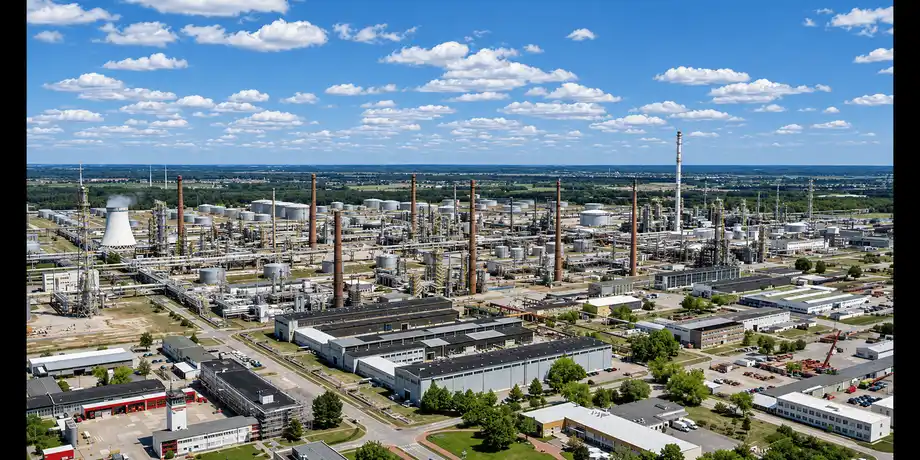
The destination is the PCK refinery in Schwedt, northeastern Germany, a major supplier of fuel to Berlin and Brandenburg. Kazakhstan shipped about 2.1 million tons there through Druzhba in 2025 and had sought to expand that trade in 2026.
The request followed a drone attack on facilities at Russia's Samara oil transit hub that stopped pumping through the Atyrau–Samara pipeline on November 2. Shipments resumed the next day after technical checks. That pipeline links western Kazakhstan's oil fields to Russia's wider transport network, including the system used for onward deliveries toward Druzhba.
Germany has found replacement crude, while Kazakhstan has redirected exports. Restoring their established pipeline trade would nevertheless give both sides another supply option. Russia has announced neither a decision nor a timetable for answering the request, and no restart date or shipment schedule has been agreed.
How an expanding trade came to a halt
Kazakhstan began delivering oil to Germany through the Russian pipeline system in 2023, when Germany ended direct imports of Russian crude. The arrangement allowed Schwedt to receive oil from a different producer while continuing to use an existing pipeline connection.
Deliveries grew from about 1 million tons in 2023 to 1.5 million tons in 2024 and 2.1 million tons in 2025. The 2025 total was therefore more than double the volume shipped in the first year.
German demand had room to grow. On April 28, 2025, Akkenzhenov described interest in larger purchases while identifying the transit constraint that would later become central to the dispute.
"We plan to add volumes and increase supplies to Germany. The German side is ready to double or even triple the volumes. However, this depends on Russia's transit capacity and relevant commercial agreements," Akkenzhenov said.
The main stated target for 2026 was approximately 3 million tons, although another published figure attributed to Kazakhstan's Energy Ministry put the plan at 2.5 million tons. Against the 3 million ton target, the 1.02 million tons delivered from January through April represented 34%, leaving 1.98 million tons still to be shipped when transit stopped.
A supply contract signed in 2023 between KazMunayGas and Rosneft Deutschland was expanded in 2026 from 100,000 to 130,000 tons a month. That was a 30% increase under the contract. In October 2025, the parties had also extended supplies through the end of 2026.
The key dates behind the suspension
Kazakhstan's effort to restore the route follows months of warnings, diversions and discussions. The disruption developed after a period in which producers and buyers had been planning for more trade.
- April 28, 2025: Akkenzhenov said Germany was ready to buy larger volumes, subject to Russian transit capacity and commercial agreements.
- October 2025: The parties extended supplies through the end of 2026.
- April 22, 2026: Akkenzhenov said Kazakhstan had received unofficial information about a possible suspension but had not received formal Russian notification.
- May 1, 2026: Russia suspended Kazakh oil transit to Germany through Druzhba, citing technical restrictions.
- August 2026: A Schwedt spokesperson said imports through Poland's Gdańsk port had fully replaced the missing Kazakh volumes.
- November 2–3, 2026: The Atyrau–Samara pipeline stopped after a drone attack at Samara and resumed shipments the following day.
- November 4, 2026: Akkenzhenov confirmed that he had personally delivered Kazakhstan's request to restart Druzhba transit.
Akkenzhenov had previously said deliveries would not resume during September, October or November. The new request renews Kazakhstan's push for access after that prolonged interruption.
What Russia has said about the shutdown
Russian Deputy Prime Minister Alexander Novak attributed the suspension to technical limitations in April and said the oil would move through other export routes. Transneft, the Russian pipeline operator, was also described as citing infrastructure damage and insufficient technical capacity.
Drone attacks on Russian pumping stations have featured in explanations of the disruption. Akkenzhenov said on April 22 that recent strikes might have caused technical difficulties, while making clear that he was working from unofficial information. The precise damage responsible for the May suspension has not been publicly detailed by Russia.
Druzhba's geography matters. Kazakhstan's oil travels through Russia, Belarus and Poland to Germany along the northern branch. That route does not cross Ukraine. The southern branch crosses Ukraine and carries Russian oil toward Hungary and Slovakia.
Disruptions on the two branches have affected different flows. Russian deliveries through the southern route have continued following interruptions earlier in 2026, while Kazakhstan's access to the German route has remained suspended since May.
Why Schwedt matters to Berlin
The Schwedt refinery says it supplies approximately 90% of the gasoline, diesel, jet fuel and heating oil used in Berlin and Brandenburg. Its operations therefore reach far beyond the refinery gates, affecting fuel for cars, aircraft, freight and homes across the region.
Kazakh crude accounted for about 17% of the refinery's intake before the halt. Other published estimates placed its share at 20–30%, without specifying a matching measurement period. Losing the route removed a substantial source of crude from a refinery that had already changed its purchasing arrangements after Germany stopped importing Russian oil directly.
Germany's Economy Ministry said in the spring that the interruption would not threaten national fuel supplies, although Schwedt would need to operate at reduced capacity. The refinery subsequently brought in replacement oil through Gdańsk, and it also receives crude through Germany's port of Rostock.
A refinery spokesperson said in August that Gdańsk imports had fully replaced the missing Kazakh volumes. By October 28, regional authorities put Schwedt's operating rate at more than 86% of capacity. Management said alternative supplies had kept operations stable despite the loss of the Druzhba deliveries.
Russian ownership, German control
Rosneft remains the majority owner of Schwedt through its German subsidiaries, but the German government has controlled those interests since 2022. Berlin placed them under a new trusteeship in February 2026, and Rosneft challenged the move toward prolonged government control in court.
A trusteeship allows an appointed administrator to exercise control over business interests while ownership remains with the existing owner. At Schwedt, that means the identity of the majority shareholder and the authority directing those interests are different.
The supply chain adds another layer. Kazakhstan produces the crude, Russian infrastructure carries it for part of the journey, and a refinery operating under German government control processes it. Commercial agreements between a seller and buyer still require access to pipelines in the countries between them.
For Germany, restoring Kazakh deliveries would broaden the refinery's supply choices alongside Gdańsk and Rostock. For Kazakhstan, it would reopen an established route to a European customer after months of sending those volumes elsewhere.
Where Kazakhstan sent the displaced oil
Kazakhstan's Energy Ministry allocated 260,000 tons of planned May shipments to alternative routes after the suspension. Of that amount, 160,000 tons went to the Caspian Pipeline Consortium, or CPC, and 100,000 tons to Russia's Baltic port of Ust-Luga.
CPC carries oil from Kazakhstan to Russia's Black Sea coast for loading onto tankers near Novorossiysk. Ust-Luga provides a Baltic Sea outlet. Both routes let producers continue exporting, but both require Russian transport infrastructure.
The scale of that dependence is large. CPC transported 64.8 million tons of Kazakh oil in 2025, while Atyrau–Samara handled approximately 9.3 million tons for export. Together, those volumes amounted to about 74.1 million tons, compared with the 2.1 million tons shipped to Germany through Druzhba.
Redirecting cargoes also places more demand on the routes receiving them, including CPC and terminals around Novorossiysk. Those facilities have faced their own interruptions, and CPC infrastructure and tankers have suffered repeated attacks in 2026. Longer disruptions have forced some producers to reduce output.
Igor Yushkov, an analyst at Russia's government run Financial University, warned that continued attacks on Russian export terminals could interrupt Kazakh oil as well as Russian supplies. The November stoppage at Samara illustrated how an attack within Russia can interrupt exports originating across the border.
A Caspian alternative is growing from a small base
KazMunayGas and Azerbaijan's SOCAR discussed increasing oil transit across the Caspian Sea on November 3. The corridor takes crude from Kazakhstan's Aktau port to Azerbaijan and then through the Baku–Tbilisi–Ceyhan pipeline to Türkiye, bypassing Russia.
Shipments along that corridor reached 1.16 million tons in the first nine months of 2026, up 24% from the same period a year earlier. Kazakhstan is targeting 1.7 million tons for the full year.
The difference in scale shows why this alternative cannot quickly replace Russia's routes. The 1.7 million ton annual target equals about 2.6% of the 64.8 million tons CPC carried in 2025. Even with growth, the Caspian corridor handles only a small fraction of the volume using the main Black Sea pipeline.
Kazakhstan is therefore pursuing two tasks at once: expanding an outlet independent of Russia and trying to restore access to existing Russian infrastructure. Each additional route gives producers more choice when another is interrupted, but the largest export flows still depend on the Russian network.
Production plans meet transport and political pressures
Akkenzhenov said Kazakhstan expects to produce 96 million tons of oil and gas condensate in 2026, down from about 99.4 million tons in 2025. Condensate is a light liquid hydrocarbon recovered alongside natural gas. The projected decline is about 3.4 million tons, or 3.4%.
Attacks on export infrastructure, temporary CPC shipment suspensions and technical problems at Tengiz, Kazakhstan's largest oil field, have affected production during 2026. The government is considering a target of around 99 million tons for 2027, an increase of 3 million tons from this year's expected output.
Transport access will matter to those plans because producers need a dependable way to move crude to buyers. In April, Kazakhstan said it could redirect the oil displaced from Druzhba without cutting production. The wider experience of 2026 has included disruptions on several routes, making reliable export capacity a continuing concern.
Andrey Baklanov, deputy chairman of the Association of Russian Diplomats and a professor at the Higher School of Economics, has argued that restoring transit is also a political issue. He said Moscow would find it difficult to approve the service without reciprocal steps from Germany and a change in Berlin's policy toward Russia. That is Baklanov's assessment; Russia's stated explanation for the suspension has been technical restrictions.
Kazakhstan's immediate objective is concrete: permission to pump oil again toward Schwedt. Germany has secured replacement supplies, and Kazakhstan has kept exporting through other outlets, but reopening Druzhba would restore a trading connection that both had expected to expand.
Key Points
- Kazakhstan formally asked Russia to restore Druzhba oil shipments to Germany, suspended since May 1, 2026.
- Energy Minister Yerlan Akkenzhenov said Kazakhstan has the technical capacity to restart and is awaiting Russia's response.
- The route carried 1.02 million tons from January through April, equivalent to 34% of the stated 3 million ton annual target.
- Schwedt replaced the missing Kazakh crude through Gdańsk and was operating above 86% of capacity by October 28.
- Kazakhstan redirected exports through CPC and Ust-Luga, both dependent on Russian infrastructure.
- The Caspian corridor bypassing Russia is growing, but its planned annual volume remains small beside CPC shipments.
- Kazakhstan expects production of 96 million tons in 2026 and is considering approximately 99 million tons for 2027.