Security expands across the industrial belt
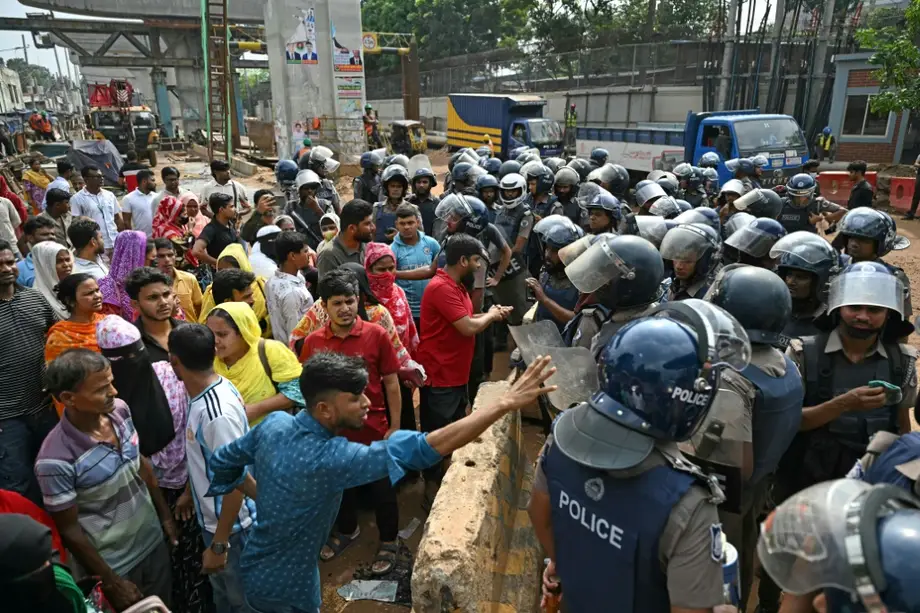
Border Guard Bangladesh deployed 33 platoons across Dhaka and nearby industrial districts on November 5, 2026, using live drone surveillance, cameras worn by personnel and armoured vehicles as garment workers pressed for a minimum monthly wage of 30,000 taka.
Contents
- Security expands across the industrial belt
- Where the platoons are stationed
- How the surveillance operation works
- How the protests developed
- Ashulia faces fresh shutdowns
- Quieter roads in Gazipur and Fatullah
- Why workers want 30,000 taka
- What the wage board has promised
- Deaths, arrests and the cost of disruption
- Key Points
A BGB press release issued that day placed 12 platoons in Gazipur, 11 in Savar and Ashulia, seven in Narayanganj and three in Mirpur. A monitoring cell at the force's headquarters is coordinating operations around the clock with local administrations and police.
The expanded security operation comes as the newly formed garment wage board promises that revised wages will take effect in December, with workers receiving the increased payments in January 2027. The amount of the increase has not been announced.
Workers currently receive a minimum monthly wage of 12,500 taka. Their demand for 30,000 taka would add 17,500 taka a month, an increase of 140 percent. Factory shutdowns, highway blockades and clashes have continued despite the creation of a formal process to negotiate new pay.
Conditions on November 5 varied across the industrial belt. Gazipur and Fatullah in Narayanganj were quieter, while fresh confrontations in Ashulia prompted factory holidays. Security patrols continued even where roads had reopened and demonstrations had subsided.
Where the platoons are stationed
Gazipur and Savar-Ashulia account for 23 of the 33 BGB platoons, nearly 70 percent of the deployment. Both areas contain large concentrations of garment factories and roads used by workers, freight vehicles and other travellers.
BGB's November 3 statement had listed 12 platoons: 10 in Gazipur's Shafipur, Kaliakair and Konabari areas, and two in Chashara, Narayanganj. At that stage, the force said it was also closely monitoring Ashulia and Mirpur.
An intervening deployment update from BGB Public Relations Officer Md Shariful Islam listed 24 platoons, including five in Savar-Ashulia, 13 in Gazipur and six in Narayanganj. The November 5 statement subsequently gave the total as 33, with a changed distribution and an explicit allocation for Mirpur.
A platoon is a military unit whose size can vary. BGB did not give a total personnel count, so the deployment figures describe units rather than an exact number of members on duty.
Armoured Personnel Carriers, or APCs, and Riot Control Vehicles, or RCVs, have also been deployed. BGB said its mission was to protect factories and other industrial establishments, maintain public safety and help preserve normal industrial activity.
How the surveillance operation works
Drones are transmitting live images of important roads, intersections and locations identified as sensitive. Cameras worn by BGB personnel provide another view, showing events from the position of members working on the ground.
BGB's November 3 statement said headquarters staff were watching both streams of footage directly. The central cell can assess developing situations, coordinate units and issue operational instructions. The November 5 announcement confirmed that the monitoring operation continued 24 hours a day.
BGB also said footage from cameras worn by personnel was being monitored for transparency and accountability. This gives supervisors a way to examine how security operations are conducted, alongside the aerial view used to track crowds and road conditions.
Local administrations and police remain part of the response. Executive magistrates have been deployed alongside BGB in Gazipur, while industrial police, district police and metropolitan police have worked to reopen roads and guard factory areas.
The immediate tasks include keeping factory entrances accessible, responding to violence and maintaining traffic on routes such as the Dhaka-Tangail and Dhaka-Mymensingh highways. Those roads carry people and goods well beyond the factories where the wage dispute began.
How the protests developed
The latest wave of demonstrations began on Saturday, October 31, and spread across several manufacturing centres. Workers demanded higher pay as well as an end to blacklisting and layoffs. Blacklisting means excluding particular workers from employment, potentially making it difficult for them to find another factory job.
The main developments have unfolded over several days:
- November 1: The government formed a wage board as demonstrations disrupted production at 529 factories, according to the Bangladesh Garment Manufacturers and Exporters Association.
- November 2: Protests and road blockades spread across Gazipur, Savar-Ashulia and Narayanganj. Industrial Police-1 confirmed holidays at 264 factories in Savar and Ashulia.
- November 3: BGB announced 12 platoons in Gazipur and Narayanganj, supported by live drone and body camera monitoring.
- November 4: The wage board held its first meeting and announced that revised December wages would be paid in January. Further clashes and factory shutdowns occurred.
- November 5: BGB announced a deployment of 33 platoons. Gazipur and Fatullah were quieter, while unrest continued in parts of Ashulia.
Industry representatives put the number of factories affected on November 2 at about 670, while a BGMEA count gave 679. The disruption followed the 529 factories affected the previous day, showing how quickly the dispute spread.
Police and local administrators have also given figures for particular districts and individual days. Those local counts describe a changing pattern of closures, with some factories reopening while others declared holidays to prevent further confrontations.
Ashulia faces fresh shutdowns
Industrial Police-1 Superintendent Mohammad Mominul Islam Bhuiyan said 70 of the 1,863 factories in Savar and Ashulia declared holidays on November 5 because of instability and concern about further unrest. That represents about 3.8 percent of factories in the two areas, compared with 264 closures confirmed there on November 2.
Workers blocked the Abdullahpur-Baipail road at Jamgora at about 8:30am. Police attempts to clear the road were followed by chases, damage to a police vehicle and the use of tear gas and sound grenades to disperse protesters.
Witness accounts described a crowd of roughly 400 to 500 people breaking two gates at Fabrica Knit Composite in Doshaid around 9:30am. The factory then declared a holiday, followed by several neighbouring factories.
Some workers said they were beaten after refusing to join demonstrations outside their workplaces. Such pressure added another risk for employees trying to decide whether to remain at work, join the wage campaign or return home.
Lieutenant Colonel Taimur Hasan Khan, commander of Dhaka Battalion, 5 BGB, described conditions as better than on previous days and said traffic was moving normally in the areas covered by his update. He cited five platoons in Savar and Ashulia; the subsequent BGB headquarters statement allocated 11 platoons to those areas.
Quieter roads in Gazipur and Fatullah
Gazipur had experienced five consecutive days of protests, road blockades and clashes before conditions eased on November 5. No worker protests had been reported there by 3pm, and traffic was moving normally on the Dhaka-Tangail and Dhaka-Mymensingh highways.
Gazipur Industrial Police Superintendent Mohammad Amzad Hossain said police were working to keep the highways open. Some factories that had previously declared holidays remained closed. Ten Ansar platoons were also deployed in Gazipur, six on Wednesday and four more on Thursday, according to Ansar and Village Defence Party Director General Major General Abdul Motaleb Sajjad Mahmud.
Fatullah's main roads were also free of worker demonstrations and blockades on Thursday morning after three days of unrest. Police, BGB and industrial police remained at important locations, with armoured vehicles and water cannon patrolling major roads.
The Fatullah protests began among workers from Metro Knitting, Palmal Garments and Abir Fashion in the Kutubail-Katherpool area before moving to Shibu Market on the Dhaka-Narayanganj Link Road.
Repeated blockades had disrupted journeys for commuters, students, patients and passengers travelling longer distances. Some people walked substantial stretches when public transport stopped. Earlier in the week, discussions involving Narayanganj-2 MP Nazrul Islam Azad and district officials helped end a blockade at Shibu Market.
Why workers want 30,000 taka
The minimum garment wage was last revised in December 2023. Workers say food, rent, transport, electricity and healthcare now consume more of their earnings. Annual inflation reached 8.34 percent in September, including 7.22 percent for food and 9.30 percent for other expenses.
Inflation means prices are rising. When wages stay the same while essential goods become more expensive, a worker can buy less even though the number on the payslip has not changed.
Laili Begum, 37, a sewing operator at Virtual Bottoms Limited near Dhaka, earns about 15,000 taka a month, rising to between 18,000 and 20,000 taka with overtime. She said her daughter, 15, and son, 12, had left school because she could no longer afford their education.
Begum described the food shortage facing her family:
We can barely afford one proper meal a day. This morning, we had only puffed rice and Bombay mix [a snack]. There was nothing for lunch. We've been going hungry, hoping to have a proper meal tonight. Yesterday was the same. This is how we survive now.
Her monthly rent is 3,500 taka, about 23 percent of her basic earnings. A cooking gas cylinder costing about 2,200 taka would take another roughly 15 percent. She said she had resorted to burning discarded paper and other materials for cooking.
Rasel Khan, a garment worker in Ashulia supporting his wife, child, mother and younger brother, said earnings of 18,000 to 20,000 taka including overtime were insufficient. He had accumulated about 100,000 taka in debt, equivalent to five months of earnings at the upper end of that range.
Zahid Hussain, former lead economist at the World Bank's Dhaka office, said persistent inflation had reduced the purchasing power of workers with low wages. With little or no surplus income, families respond by cutting everyday spending, including food and other necessities.
What the wage board has promised
The government established a board of six members on November 1 to review garment wages. The process brings worker and employer representatives together to negotiate a new minimum, rather than automatically adopting the 30,000 taka demand.
District and Sessions Judge Syed Azad Subhani, identified as the board's chairman after its first meeting on November 4, said the revised structure would take effect in December. He explained when workers would receive the money:
So, the workers will receive their increased wages in January,
The board said its next meeting would consider proposals from workers, factory owners and other organisations. No date was given for that meeting. Babul Akhter, the workers' representative, urged employees to return to their factories while negotiations proceed.
Akhter made his appeal after meeting other labour leaders on Monday night:
Please go back to your factories,
He also promised to press for fair wages and has sought the release of arrested workers and withdrawal of cases against them. Workers such as Ashulia garment employee Alia Akter have said they want a clear figure for the increase, alongside the payment schedule.
Deaths, arrests and the cost of disruption
Garment worker Toufiq Hossain, 35, died on November 3 while receiving treatment at an Uttara hospital after being injured during the unrest. He worked at Laila Styles Ltd in Gazipur. Labour and Employment Minister Ariful Haque Choudhury said those responsible for his death would be brought to justice.
Police spokesperson Kamarum Munira said 58 officers had been injured since the protests began. Workers also described numerous injuries among protesters. Journalists covering clashes in Gazipur and Savar were among those injured or assaulted.
Police have filed cases against thousands of unidentified people over alleged arson, vandalism and other offences. In Narayanganj, a case under the Anti-Terrorism Act named 21 people and between 1,000 and 1,500 unidentified others. Fatullah police said six detainees were brought before a court with a request for seven days of police custody for questioning.
Home Minister Salahuddin Ahmed has alleged that supporters of the banned Awami League exploited the unrest. Dhaka Metropolitan Police said 33 people linked to the party were arrested over alleged involvement during the preceding 24 hours. Evidence supporting the minister's broader political allegation was not made public.
Government information adviser Dr Zahed Ur Rahman said police must act lawfully and use force in proportion to the situation. He acknowledged that some footage circulating on social media appeared to show disproportionate force. Ahmed said officers had been instructed to avoid excessive force.
The dispute affects an industry employing about four million people and generating more than 80 percent of Bangladesh's export earnings. Low labour costs and duty free access to major Western markets helped make Bangladesh the world's second largest apparel exporter after China.
Sheikh Hossain Muhammad Mustafiz, a BGMEA official and managing director of Cute Dress Industry Ltd, said international buyers must pay prices that support better wages. He warned that factories face pressure from rising production costs and competition. For workers, shutdowns can also mean lost overtime earnings, adding immediate financial strain while they wait for a negotiated increase.
Key Points
- BGB announced 33 platoons across Gazipur, Savar-Ashulia, Narayanganj and Mirpur on November 5.
- Live drone footage and cameras worn by personnel are monitored around the clock from BGB headquarters.
- Workers demand a monthly minimum of 30,000 taka, up 140 percent from 12,500 taka.
- The wage board says revised December wages will be paid in January 2027; the increase has not been set.
- Gazipur and Fatullah were quieter on November 5, while 70 factories in Savar and Ashulia declared holidays.
- A worker's death, injuries, arrests and lost earnings have added urgency to negotiations over pay and working conditions.