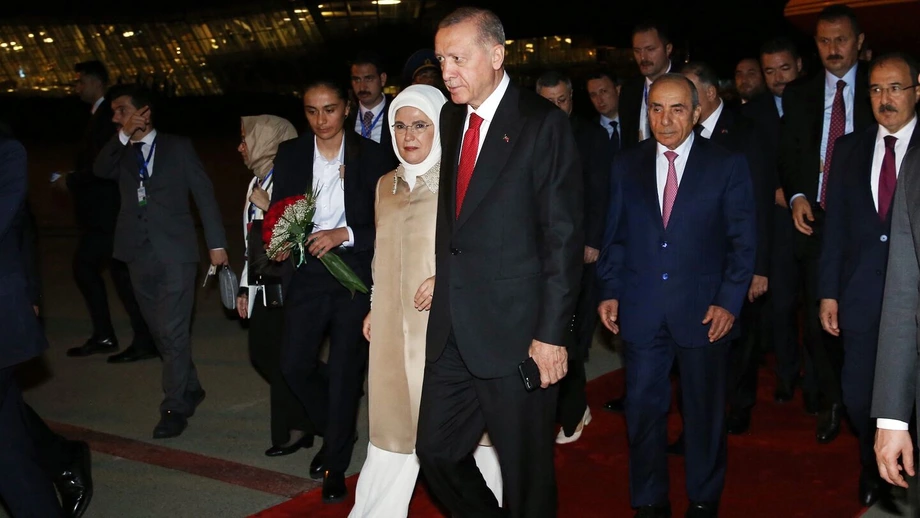
A victory celebration becomes a diplomatic test
Turkish President Recep Tayyip Erdogan plans to visit Baku on November 8, 2026, after a dispute over religious clothing in Azerbaijani schools reached the highest levels of an unusually close alliance. His announcement follows the dismissal of a Turkish presidential adviser, questioning of two Turkish religious commentators and Azerbaijani President Ilham Aliyev's absence from a gathering of Turkic leaders in Ankara.
Contents
- A victory celebration becomes a diplomatic test
- What changed in Azerbaijani schools?
- Why Baku sees a question of sovereignty
- Dismissal and questioning show the political cost
- Aliyev stays away from the Ankara summit
- Ministers, intelligence chiefs and first ladies
- How the dispute developed
- Israel exposes another difference between the allies
- What is at stake on November 8?
- Key Points
Erdogan intends to attend Azerbaijan's Victory Day celebrations, marking its military success against Armenia in the 2020 war over Nagorno-Karabakh. Speaking to journalists aboard his return flight from South Korea, he said the trip would go ahead unless extraordinary circumstances arose.
The Turkish president has already sent Foreign Minister Hakan Fidan and National Intelligence Organization chief Ibrahim Kalin to Azerbaijan. Telephone calls between the presidents, and between their wives, have added a personal channel to the diplomatic effort.
The immediate disagreement concerns school uniform rules introduced in September and criticism of their effect on Muslim girls wearing headscarves. Baku has treated interventions by Turkish political figures as interference in its domestic affairs. Ankara has sought to contain the dispute while defending a relationship both governments routinely describe as one nation, two states.
Erdogan, explaining his expectations for the planned visit, offered a broad promise rather than a specific agreement:
God willing, this visit will provide us with the opportunity to take the necessary steps.
He did not identify those steps or announce any change to Azerbaijan's clothing regulations. The immediate task is to restore confidence between the leaders while the underlying disagreement over religious expression and national sovereignty continues.
What changed in Azerbaijani schools?
Azerbaijan's Cabinet of Ministers adopted Decision No. 309 on September 21, amending public school uniform requirements. Decision No. 325, adopted on October 6, introduced separate clothing requirements for teachers. Those measures brought school dress into a wider argument about how a secular state regulates religious clothing.
The student rules prohibit additional clothing that disrupts the prescribed uniform or conflicts with the secular principle of general education. Secular education means that public schools operate independently of religious authority. The dispute concerns how that principle is applied to clothing worn by individual students and teachers.
Neither decision explicitly names the hijab, the headscarf worn by some Muslim women. Some schools have reportedly interpreted the requirements as grounds to exclude girls wearing it or to instruct teachers to remove their headscarves. For affected families, the practical issue is access to classrooms and employment while observing their faith.
Azerbaijan's Interior Ministry had announced 37 arrests connected with incidents surrounding enforcement by the time of the October school clothing dispute. The number of students and teachers affected had not been established. The student amendment also places responsibility on parents to ensure compliance, making enforcement a matter for households as well as school administrators.
Why Baku sees a question of sovereignty
Aliyev's ruling New Azerbaijan Party accused Turkish figures of meddling in Azerbaijan's internal affairs after criticism from presidential adviser Oktay Saral and lawmakers from Turkey's governing Justice and Development Party. Its response defended Baku's authority to set domestic policy, including education rules.
Aliyev had also rebuked external interference in an October 2 address to the eighth congress of his party. He did not name a foreign country. His remarks became a reference point as public criticism and political exchanges between the two allies intensified.
Azerbaijan is predominantly Shiite Muslim, yet its public institutions reflect a strongly secular tradition shaped partly by decades of Soviet rule. The disagreement therefore cuts across two commitments: a close relationship with Turkey and Baku's insistence that religious and education policy remain its own decisions.
The ruling party's response also rejected criticism of Azerbaijan's relations with Israel. Its argument was that political solidarity between the two countries gives neither government authority over the other's domestic or foreign policy choices.
Dismissal and questioning show the political cost
Erdogan dismissed Saral after the adviser publicly criticized Azerbaijan's restrictions on Islamic clothing. Removing a member of his own advisory circle was a concrete response to Baku's objections and showed how a dispute about schools had become a problem for the Turkish presidency.
Two Turkish Islamist commentators, Muhammed Emin Yildirim and Ahmet Sapa, were detained for questioning in late October and subsequently released. Both had criticized the restrictions, and Yildirim had called Aliyev a tyrant on social media.
The dismissal and questioning brought the controversy into Turkey's domestic political sphere. Criticism aimed at an allied government was now accompanied by consequences for people within Turkey, even as Erdogan publicly stressed the strength of the relationship.
Baku continued to insist on respect for its independence. Aliyev's subsequent absence from the Ankara gathering showed that removing the adviser had not immediately produced a public return to normal relations at presidential level.
Aliyev stays away from the Ankara summit
Aliyev skipped a summit of Turkic states in Ankara the week before Erdogan's November 5 remarks, despite receiving a personal invitation from the Turkish president. Azerbaijan's foreign minister represented the country instead.
The difference in representation mattered because the gathering brought together leaders of countries whose shared linguistic and cultural ties are central to Turkey's regional diplomacy. Azerbaijan retained a presence while its president stayed away.
Political analyst Asif Narimanli interpreted Aliyev's absence as a response to attacks on Azerbaijan by Turkish figures and a signal of Baku's limits. In his assessment, tensions had eased, but a full resolution was still uncertain.
Narimanli also viewed Erdogan's planned journey to Baku as evidence of the Turkish leader's interest in settling the disagreement. His reading places the two decisions together: Aliyev withheld a presidential appearance in Ankara, while Erdogan prepared to make one in Azerbaijan.
Ministers, intelligence chiefs and first ladies
Erdogan's account of the diplomatic effort shows several channels operating at once. Fidan's involvement put the foreign ministry directly into discussions, while Kalin's participation brought in the head of Turkey's intelligence service.
The Turkish president described those contacts to journalists returning with him from South Korea:
I have already held phone calls with the president of Azerbaijan, Mr Ilham Aliyev. In the meantime, I dispatched both my intelligence chief and my foreign minister to Azerbaijan.
Calls between the first ladies add another dimension. Mehriban Aliyeva, the Azerbaijani president's wife, is also the country's first vice president and a central figure in its leadership. Emine Erdogan holds no government office but is an influential figure around the Turkish president.
The involvement of the presidents, senior officials and their spouses shows how much attention both sides are giving the relationship. Erdogan's description of continuing telephone diplomacy also indicates that preparations for the visit are part of an active effort to manage the disagreement.
How the dispute developed
The controversy moved from school regulations to party statements and then presidential diplomacy over several weeks. The sequence helps explain why a national celebration has become an opportunity for political repair.
- September 21: Azerbaijan adopted Decision No. 309, amending public school uniform requirements.
- October 2: Aliyev criticized external interference in an address to the New Azerbaijan Party congress, without naming a country.
- October 6: Decision No. 325 introduced separate clothing requirements for teachers.
- By October 13: The ruling party had publicly rebuked Turkish critics, and Azerbaijan's Interior Ministry had announced 37 arrests linked to incidents surrounding enforcement.
- Late October: Turkish commentators Yildirim and Sapa were questioned and subsequently released.
- The week before November 5: Aliyev stayed away from the Ankara summit, sending his foreign minister instead.
- November 5: Erdogan's remarks described diplomatic contacts and his intention to visit Azerbaijan.
- November 8: Erdogan plans to attend Victory Day celebrations in Baku, subject to extraordinary circumstances.
The dates connect two tracks that now have to be managed together: enforcement of Azerbaijan's school policies and efforts to restore ease between the two governments.
Israel exposes another difference between the allies
Azerbaijan's close relationship with Israel adds a foreign policy dimension to the dispute. Israel supplied Baku with drones and other weapons during the 2020 war with Armenia, linking that relationship directly to the military success celebrated on Victory Day.
Turkey's relations with Israel have moved sharply in the opposite direction over the war in Gaza. Erdogan has accused Israel of genocide, while Turkish officials have publicized senior meetings with leaders of Hamas, the Palestinian Islamist movement whose October 2023 attacks on Israel triggered the war.
Baku's defense relationship with Israel and Ankara's confrontation with it create different priorities inside the Turkish and Azerbaijani partnership. Azerbaijan's ruling party addressed criticism of its Israeli ties alongside the school clothing dispute, bringing both issues into its defense of independent decision making.
The two governments therefore face more than an argument about a single garment. They are managing disagreements over how religious identity should shape public policy and how much freedom each ally has to maintain relationships the other finds objectionable.
What is at stake on November 8?
Victory Day gives Erdogan and Aliyev a setting built around shared political and military interests. Attending allows the Turkish president to demonstrate solidarity with Azerbaijan at a moment when public disagreements have challenged the language of brotherhood.
Erdogan presented the alliance in those terms when discussing the planned visit:
There is no obstacle that the brotherhood between Turkey and Azerbaijan cannot overcome.
For Ankara, a prolonged rupture would complicate efforts to expand its influence in a region where Russia has traditionally held considerable power. Azerbaijan is a close political and military partner in that effort, making the relationship more consequential than the immediate school controversy.
For Baku, the diplomatic challenge is to preserve that partnership while maintaining control over its own policies. For families affected by school enforcement, the practical issue remains whether children can attend classes wearing headscarves. A presidential visit offers a chance to lower political tensions; any change in classroom access would require decisions about the rules and their application.
Key Points
- Erdogan plans to visit Baku on November 8 for Azerbaijan's Victory Day celebrations.
- The dispute began with school clothing restrictions and Turkish criticism of their effect on religious dress.
- Azerbaijan's ruling party accused Turkish figures of interfering in domestic affairs.
- Erdogan dismissed adviser Oktay Saral, while two Turkish religious commentators were questioned and released.
- Aliyev skipped the Ankara summit despite Erdogan's invitation; Azerbaijan's foreign minister attended instead.
- Turkey's foreign minister and intelligence chief have joined diplomatic efforts, alongside calls between the presidents and their wives.
- Differences over Israel add to the challenge of repairing relations.