A head above the drain, then a warning
A motorist travelling on the Gua Musang to Lojing road towards Cameron Highlands filmed a Malayan tiger using a roadside drain as cover, in an encounter that reached millions of viewers within a day. The video, lasting 13 seconds, was posted on TikTok on 24 November 2026 by user @fiz01997, whose account was identified as H@f!zOl Cameron. By 25 November, it had attracted more than three million views.
Contents
- A head above the drain, then a warning
- What the poster said about logging and other sightings
- What drivers should do during an encounter
- Earlier sightings along the same forest route
- What officials established in the June Sungai Relai case
- A deadly encounter in Perak days earlier
- How close is the Malayan tiger to disappearing?
- Why a tiger might use a road or drain
- How sightings can help monitoring
- What to Know
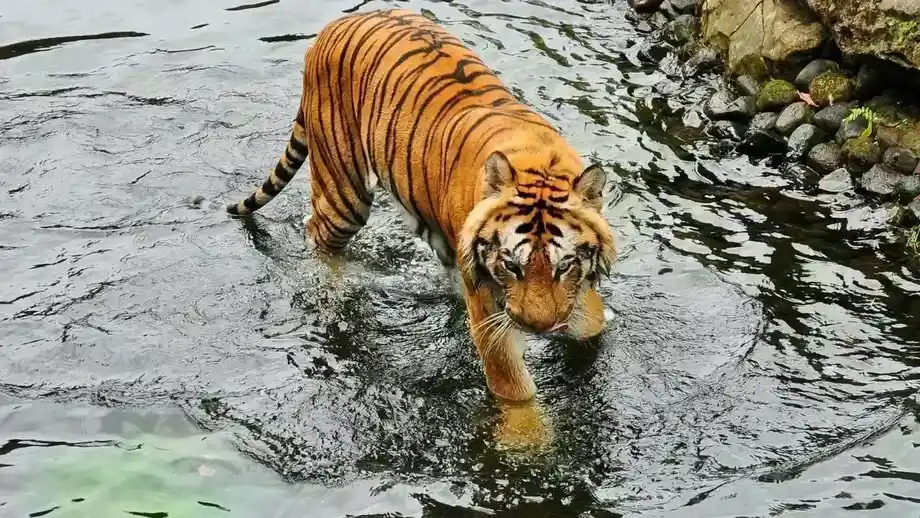
The tiger is seen on the road and inside the drain along Jalan Lojing Gua Musang. At one point, only its head rises above the edge as it watches passing traffic. It later comes far enough into the open to give the motorist a clear view before crossing towards the vegetated slope on the other side. Its cautious movements prompted many viewers to describe the animal as shy or cute.
One social media user summed up the affectionate reaction with a joke about treating the powerful wild predator like an abandoned pet.
Can somebody adopt this poor little cat?
The person who shared the footage struck a much more serious note. The post warned motorcyclists and other road users to be careful, said several tigers had been seen near the Pos Blau settlement and connected the animals' presence near the road with logging. A tiger weighing well over 100 kilograms can be dangerous at close range, however harmless its expression may appear on a phone screen.
What the poster said about logging and other sightings
In the caption accompanying the video, the poster advised particular care along the route and gave his explanation for the reported sightings.
Be careful on the Lojing–Gua Musang road, especially those riding motorcycles, people have already spotted quite a few of them roaming by the roadside, because the forest has been cleared out for logging.
Another person familiar with the route claimed that forest away from the roadside in Lojing had been heavily logged while trees beside the road were left standing. The same commenter warned that elephants also emerge at night to search for food. These were claims made by road users rather than an official assessment. Perhilitan, Malaysia's Department of Wildlife and National Parks, has not announced a cause for this particular tiger's presence beside the road.
The concern is nevertheless easy to understand. Tigers travel through forest in search of prey, mates and territory. When continuous forest is broken up by clearing, plantations or roads, those journeys can bring animals into places where people drive, farm and live.
What drivers should do during an encounter
The advice for anyone seeing a tiger near the route is direct: remain inside the vehicle, keep a safe distance and do not stop to approach or film the animal. Allow it to move away and report the location promptly to Perhilitan. Actions that appear harmless, such as stepping out for a clearer recording, can put both the person and the animal at risk.
Motorcyclists need particular care because they lack the physical protection provided by a car. A sudden meeting at close range can also frighten or startle a tiger. People encountering any large wild animal should avoid feeding it, cornering it or interfering with its path. Perhilitan has also advised the public to remain calm, refrain from approaching wildlife and use its official hotline to report sightings.
Earlier sightings along the same forest route
The November recording was not the first time tigers had drawn attention around Gua Musang and Lojing. After sightings in December 2023, Perhilitan sent personnel to the area, set traps and increased patrols. The road crosses Peninsular Malaysia's forested interior, where remaining habitat sits alongside farms, plantations and routes used by local communities and highland traffic.
Several dated events help distinguish the November drain video from other tiger encounters that have also circulated online.
- December 2023: Earlier tiger sightings around the route prompted Perhilitan personnel, traps and patrols.
- 8 to 9 June 2026: Kelantan Perhilitan received and investigated a report concerning a separate tiger sighting at Sungai Relai.
- 19 November 2026: Perhilitan shot a tiger in Sungai Siput, Perak, following a fatal conflict involving a villager and an attack on an officer.
- 24 November 2026: The video showing the tiger at the roadside drain near Gua Musang was posted on TikTok.
- 25 November 2026: The drain video passed three million views as safety advice spread alongside amused comments.
The dates matter because the official statements from June concerned Sungai Relai and a different recording showing a tiger wading in a river. No Perhilitan statement specifically addressing the November drain footage had been made public when that clip first spread.
What officials established in the June Sungai Relai case
Perhilitan Director-General Datuk Abdul Kadir Abu Hashim confirmed in June that wildlife officers had investigated a Malayan tiger seen near the Sungai Relai Bridge in Gua Musang, Kelantan. The department's initial assessment was that the animal had merely been passing through and had returned safely to its natural forest habitat. Searches at the location found no further evidence of the tiger, and there had been no complaints from residents before or after the incident.
Kelantan Perhilitan director Wan Mohd Adib Wan Mohd Yusoh described the status of that inquiry on 9 June, after the department received the report the previous day.
We received the report, and it is currently under investigation and monitoring.
Gua Musang district police chief Superintendent Sik Choon Foo also addressed people working near the Sungai Relai forest reserve. His advice focused on farmers entering plantation areas where wild animals may be present.
It is understood that the location is near a forest reserve, which is also a habitat for wild animals. Therefore, we hope residents, especially farmers in that area, move in groups when entering their plantation areas.
Perhilitan said monitoring would continue as part of its conservation work. Its public advice was to stay composed, avoid approaching wild animals and report sightings quickly so officers can track movements and respond to possible risks. Those measures applied to the June case; they were not an announcement that the tiger in the November drain video had been found or assessed.
A deadly encounter in Perak days earlier
Five days before the TikTok post, a far more serious incident unfolded in Sungai Siput, Perak. On 19 November, Perhilitan shot dead a tiger suspected of killing an Orang Asli villager in Kampung Bawong. The department said the following day that it fired after the animal attacked one of its officers during monitoring work in the forest.
That case illustrates the decisions facing wildlife officers. Every surviving tiger matters to a critically endangered population, yet authorities must also protect villagers, farmers and their own personnel. Orang Asli communities, whose homes and livelihoods are often close to forests, can face particular exposure when a tiger begins approaching people or settlements.
How close is the Malayan tiger to disappearing?
The Malayan tiger, known scientifically as Panthera tigris jacksoni, lives only in Peninsular Malaysia. It has been listed as Critically Endangered on the IUCN Red List since 2015. The subspecies was formally recognised in 2004 following genetic tests, and the animal holds a prominent place in Malaysian identity, including on the national coat of arms.
There is no official population figure. In January 2026, the Consumers Association of Penang estimated that fewer than 150 Malayan tigers remained in the wild. That number was an estimate rather than an official census, but it reflects the severe decline that has made every confirmed sighting and every death consequential.
Poaching is one major threat, including wire snares that may originally be set for other animals. Forest loss and fragmentation reduce the space available for tigers, while excessive hunting of deer and wild boar can leave them with less prey. Roads bring additional dangers through vehicle collisions and by providing easier access into forests for poachers.
Why a tiger might use a road or drain
The Gua Musang to Lojing route runs through a landscape associated with the Main Range, the mountainous spine of Peninsular Malaysia. Large forest blocks there can connect with other tiger habitat, but roads, plantations and highland farms interrupt that terrain. A tiger moving between feeding or resting areas may therefore encounter traffic even when it has not entered a town.
A quiet road at the forest edge can provide an easy travel route, while a drain offers concealment close to the asphalt. Tigers range over large areas to find prey and mates. Young animals searching for territories of their own may travel especially long distances, increasing the chance that they will cross roads or pass farms and settlements.
Tigers also play an ecological role as apex predators, meaning they sit at the top of the food chain. By hunting deer, wild boar and other large animals, they influence prey numbers and, indirectly, the vegetation those animals eat. Protecting sufficient forest for tigers can shelter many smaller species within the same habitat, which is why tigers are described as an umbrella species.
Conservationists in Malaysia have advocated wildlife crossings, including viaducts that allow animals to pass beneath major roads, and lower speed limits where routes cut through tiger habitat. Such measures can reduce collisions while preserving connections between forest areas.
How sightings can help monitoring
Much of what researchers learn about Malayan tigers comes from camera traps, which are cameras attached to trees and triggered by movement. Every tiger has a unique stripe pattern, allowing researchers to distinguish individuals and estimate how many occupy an area. Repeated images can also reveal the routes animals use and whether the same tiger returns to a particular location.
Public videos can add useful details about place and time, especially when several sightings occur along the same stretch of road. For people near Gua Musang and Lojing, the practical response is to keep a safe distance and give Perhilitan the location promptly rather than attempt to follow the animal. Continued monitoring announced in June applied to Sungai Relai; no date was given for a further public update on the November drain video.
What to Know
- A video lasting 13 seconds showed a Malayan tiger beside the Gua Musang to Lojing road on 24 November 2026.
- The tiger used a roadside drain as cover, raised its head towards traffic and was later seen clearly as it crossed the route.
- The TikTok clip passed three million views by 25 November, with many viewers calling the animal cute.
- Drivers were advised to stay inside their vehicles, avoid stopping or approaching the tiger and report sightings to Perhilitan.
- The poster cited logging and repeated sightings near Pos Blau, but officials have not announced a cause for this tiger's roadside appearance.
- Perhilitan's June confirmation concerned a separate river video at Sungai Relai, where officers found no further sign of that tiger.
- On 19 November, a tiger was shot in Sungai Siput after a suspected fatal attack on a villager and an attack on a Perhilitan officer.
- The Malayan tiger is Critically Endangered; fewer than 150 were estimated to remain in January 2026, although no official population count exists.