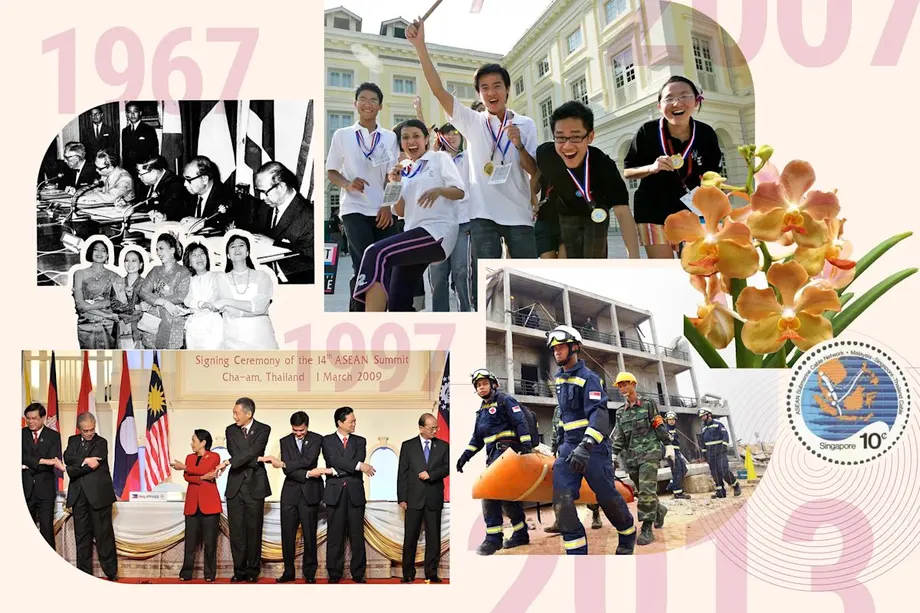
Singapore takes the helm in a milestone year
On 17 November 2026, the Philippines passed the ASEAN chairmanship to Singapore at the closing ceremony of the 49th ASEAN Summit in Manila. Prime Minister Lawrence Wong received the symbolic gavel from Philippine President Ferdinand R. Marcos Jr. as leaders closed a year of economic deals, security strains and regional negotiations. Singapore formally takes over on 1 January 2027, when ASEAN turns 60.
Contents
- Singapore takes the helm in a milestone year
- Why the founding fear still matters
- From Bali rules to a habit of consultation
- Ten members, 12 partners, one difficult balancing act
- What deeper integration means in daily life
- The economic groundwork is already being laid
- Digital trade moves from agreement to practical use
- Electricity is the next integration test
- Trade deals arrive, political disputes do not wait
- Why collective weight matters
- What readers should watch in 2027
- Key Points
An ASEAN handover statement from the ASEAN Secretariat said Secretary-General Dr Kao Kim Hourn witnessed the transfer during the ceremony in Manila. It said Singapore's chairmanship theme is Deeper Integration, Wider Partnerships. The theme places two goals side by side: making ASEAN economies work more closely together and widening ties with countries beyond Southeast Asia.
The Manila handover set the course for a year in which Singapore will host the 50th and 51st ASEAN summits. The rotating chair moves annually, and Thailand is due to take over in 2028. Singapore last held the post in 2018. Timor-Leste, admitted in 2025, is due to chair in 2029, a sign of how much the grouping has changed since its five founders first met.
Why the founding fear still matters
In August 1967, five men left Bangkok for Bang Saen, a seaside resort in Thailand. They were Adam Malik of Indonesia, Narciso Ramos of the Philippines, Tun Abdul Razak of Malaysia, S. Rajaratnam of Singapore and their host, Thanat Khoman of Thailand. They wore sports shirts, spoke candidly and played some golf. Rajaratnam did not play, but the meeting was never about leisure.
The mood was tense. Indonesia's confrontation with Malaysia had ended only a year earlier. Malaysia and the Philippines were divided over Sabah. Singapore had been independent for just two years. Thailand faced the Vietnam War at its doorstep. S Rajaratnam, Singapore's foreign minister and one of the five founders, later described the reason for the meeting with unusual bluntness. He said ASEAN grew from a sense of danger, not a grand dream of regional unity:
'was born out of fear rather than idealistic convictions about regionalism'.
On 8 August 1967, the five signed the Bangkok Declaration. It promised greater economic and cultural cooperation, social progress and a future shaped by the region's own people. The first years were built through repeated meetings. Officials learned which subjects their neighbours could accept, which ones they could not and when silence helped more than a public statement.
From Bali rules to a habit of consultation
By February 1976, the habit of meeting had brought the five heads of government to Bali for ASEAN's first summit. The Treaty of Amity and Cooperation and the Bali Concord gave the grouping clearer rules. Members agreed to respect sovereignty, avoid interference in one another's affairs, settle disputes peacefully and cooperate beyond diplomacy.
ASEAN's style became known as the ASEAN Way. It favours consensus where possible, quiet diplomacy when emotions run high and a willingness to meet again when agreement is not reached. Lee Hsien Loong, Singapore's prime minister at the time of a 2017 Council on Foreign Relations Dialogue in Washington, described the method in plain language. He said members accept disagreement and keep the conversation alive:
We agree to disagree and we will discuss the matter again one day.
That approach helped ASEAN move from political reassurance to practical work. The 2004 Boxing Day tsunami, Cyclone Nargis and Covid-19 pushed members to coordinate disaster response, health measures and supplies. The habit of talking did not remove crises, but it gave governments a route for working together while crises were underway.
Ten members, 12 partners, one difficult balancing act
ASEAN began with five members and now has 11. It also built a wide network outside the region. The main dates show how the table grew:
- 1974: ASEAN gained its first Dialogue Partner.
- 1976: leaders held the first ASEAN summit in Bali.
- 1978: the foreign ministers' trip to Bonn showed a more relaxed side of the group, after all five wore business coats and ties when they learned Rajaratnam had not packed formal evening clothes.
- 1984: Brunei joined.
- 1999: Vietnam, Laos, Myanmar and Cambodia had joined.
- 2007: the ASEAN Charter was signed in Singapore and later ratified by every member state.
- 2025: Timor-Leste became the 11th member.
A Dialogue Partner is an outside country or regional body formally invited to hold regular talks with ASEAN. The network grew from one Dialogue Partner in 1974 to 12. More members and more partners gave ASEAN greater weight, but also more differences to manage. A bigger room makes consultation more important, because each decision can affect more people and more economies.
What deeper integration means in daily life
Singapore's 2027 agenda turns that habit into economic projects. Prime Minister Lawrence Wong, accepting the chairmanship in Manila, said ASEAN could not shape every outside event but could choose a joint response. He set out the reasoning behind the theme this way:
We cannot control all these external developments. But we can decide how ASEAN responds.
A single ASEAN market is one of the goals. In simple terms, it would make it easier for a company in one member state to set up, pay workers, move goods and serve customers in another without facing separate systems at every step. It would also give people more chances to work, invest and build businesses across borders.
The October priorities set out by Singapore's foreign minister described ASEAN as the world's fourth largest economy. Singapore's Prime Minister's Office published the S Rajaratnam Lecture speech, delivered by Prime Minister Wong on 16 April 2025, which called ASEAN the world's fifth largest economy. The two figures reflect different moments of description, and both point to the same practical task: turning regional scale into better opportunities for households and companies.
The economic groundwork is already being laid
The official lecture said the ASEAN Free Trade Area is virtually tariff free, but not at the goal of 100 percent tariff elimination. It also called for fewer barriers other than tariffs, such as rules or paperwork that can slow trade. The lecture set out plans to conclude the ASEAN Digital Economic Framework Agreement, known as DEFA, and to accelerate the ASEAN Power Grid.
Those projects are now moving from policy papers toward implementation. The upgraded ASEAN Trade in Goods Agreement is due to take formal effect on 1 June 2027. Members agreed to apply it early only between states that have notified the ASEAN Secretary-General, so its benefits will arrive unevenly until the formal date. The agreement is meant to reduce barriers other than tariffs and simplify digital trade procedures.
The ASEAN China Free Trade Agreement 3.0 also secured early entry into force under the Philippine chairmanship. In 2027, ASEAN will mark the 50th anniversaries of relations with the United States, Canada and the European Union, plus the 30th anniversary of ASEAN Plus Three, which brings together the bloc with China, Japan and South Korea. These dates give Singapore useful moments to widen partnerships.
Digital trade moves from agreement to practical use
Digital links are among the clearest examples of how regional cooperation reaches ordinary life. Across ASEAN, border crossing QR payments reached 36.2 million transactions worth US$716.4 million in 2025. Singapore and Indonesia already link QR payments using the Singapore dollar or the rupiah. Central banks in Indonesia, Malaysia, Thailand and the Philippines also signed a memorandum of understanding to promote local currencies in cross border investment and trade.
DEFA was signed in Manila, three years after talks began in September 2023. Each member still needs to ratify and implement it, and no date has been given for every ratification. ASEAN officials expect the first projects in early 2027 and estimate the pact could help the digital economy reach as much as US$2 trillion by 2030. Ratification means a member state formally agrees to be bound by the pact under its own laws.
A 2025 push for ASEAN EU digital talks showed how Singapore wanted common rules before trade became even harder. Gan Kim Yong, Singapore's deputy prime minister and trade minister, said a wider digital pact between the two regions would be a major advance. He described the goal this way:
If the EU and ASEAN can come together to discuss a digital economic agreement, it would be a major breakthrough.
Electricity is the next integration test
All ASEAN members have signed an enhanced memorandum of understanding on the ASEAN Power Grid. It covers planning, regulation and financing for power lines across national borders and subsea cables. The memorandum makes electricity market integration voluntary and gradual, leaving each member to set its own pace. That matters because one country's grid rules can affect whether a neighbouring project earns enough to attract investors.
The scale of the task is visible in the money. About US$2 billion has gone into interconnections over more than five decades, against roughly US$27 billion needed by 2040. That leaves a gap of about US$25 billion. Much of the past spending supported exports in one direction, often from hydropower dams in Laos, rather than links that let electricity move in both directions between national grids.
The main working example is the power integration project linking Lao PDR, Thailand, Malaysia and Singapore. Its capacity doubled to 200 MW in October 2025 after Malaysia began supplying power alongside Laos. Singapore and Thailand, which takes the ASEAN chair in 2028, plan to use their successive terms to tackle rules such as wheeling charges, paid when power passes through another country's grid, and taxes on electricity exports.
Carbon markets are another unfinished piece. A carbon market lets companies trade permits or credits for greenhouse gas emissions. ASEAN economic ministers agreed in September to prepare for a possible ASEAN Green Economy Framework Agreement that could support regional carbon markets able to work with one another. Markets remain split along national lines. An industry framework for common carbon rules, renewed at COP31, seeks more alignment but binds no government. One of its Singapore leaders has said it will work with the Singapore government during the chairmanship.
Energy choices also reach beyond the power grid. A 7 November 2025 nuclear readiness review found that Singapore had made no decision to deploy nuclear power, while several neighbours discussed possible plants in the 2030s. Regional electricity demand is projected to triple by 2050. Coal and gas supplied about two thirds of ASEAN's electricity in 2022, while renewables supplied roughly one third.
Trade deals arrive, political disputes do not wait
Singapore's chairmanship inherits finished agreements and unfinished political work. The Philippines handed over the chair under the theme Navigating Our Future, Together after a year that produced the digital economy pact, early implementation steps for the upgraded goods trade agreement and progress on Timor-Leste's integration. President Marcos framed the handover around linked challenges, saying that secure energy underpins economic security and stable seas support peace, trade and livelihoods. The Philippines ended its term without a breakthrough on the South China Sea Code of Conduct with China or on the Myanmar crisis. Neither issue has a set date for resolution.
Security questions will still sit beside the economic agenda. Prime Minister Hun Manet of Cambodia pledged support to Singapore's chairmanship after the summit, and Cambodian officials said Singapore would also mediate and observe the border situation between Cambodia and Thailand. That role builds on mediation started by Malaysia in 2025 and continued by the Philippines from January. Cambodia and Singapore also agreed to expand work in artificial intelligence, the digital economy, cybersecurity, transnational crime, national security and defence.
At the Manila summit, US President Donald J. Trump attended the 49th ASEAN Summit and a leaders' dinner with ASEAN and US representatives on 17 November. In 2027, ASEAN's anniversaries with the United States, Canada and the European Union, together with ASEAN Plus Three, will give the chairship several chances to keep major powers engaged. The ASEAN Outlook on the Indo Pacific, or AOIP, stresses openness, inclusivity and cooperation and rejects dominance by any single power. Singapore has said it will work with the Malaysian chair and East Asia Summit partners on AOIP projects.
Why collective weight matters
The original argument for ASEAN was that small and divided countries had more room to act together than alone. Prime Minister Lawrence Wong told the World Economic Forum's Summer Davos Dialogue in 2025 that size did not tell the full story. He said:
No single country in ASEAN may have the same size and scale, but when you add ASEAN up altogether, collectively, we are not small.
At the Manila handover, the economic case was quantified: an ASEAN economy of about US$4.5 trillion could reach US$10 trillion by the early 2040s with further integration, reform and growth. That would add US$5.5 trillion, taking it to more than twice its present size. The April 2025 lecture set the wider backdrop: support for global engagement has declined in the United States, China has become a competitor close to the United States in power, trade tools such as tariffs and export controls are being used for national goals, and the world is becoming more fragmented.
A simple way to understand the strain is the trilemma described in that lecture: countries can usually combine two of three goals, economic interdependence, economic security and geopolitical competition, but not all three at full strength. Wong also said ASEAN was once an arena for Cold War proxy wars and did not want that to happen again. That line connects the 1967 fear to the 2027 agenda. The modern version of the fear is not only battlefields near borders; it is supply chains, energy routes, data rules and trade systems being pulled into rivalry between major powers.
What readers should watch in 2027
For travellers, the results may appear as smoother flights and more consistent services across borders. For shopkeepers and factories, the tests are whether goods move with less paperwork, whether digital payments work across markets and whether electricity supplies are reliable enough for expansion. For workers and families, the stakes are jobs, prices and the ability to live with fewer disruptions from disasters or energy shocks.
The chairmanship logo centres on the ASEAN emblem, surrounded by 60 ascending, step-like lines forming the number 60. Each step represents a year in ASEAN history. Dylan Loh, an associate professor of public policy and global affairs at Nanyang Technological University, expected progress on artificial intelligence and on climate and energy resilience. Joanne Lin Weiling of the ISEAS Yusof Ishak Institute said Singapore could turn DEFA and the power grid into practical benefits while staying realistic about political disputes.
The next dates are clear even where outcomes are not. Singapore takes office on 1 January 2027. DEFA's first projects are expected early in the year. The upgraded goods trade agreement formally begins on 1 June 2027. ASEAN will hold its 50th and 51st summits during the year, and its 60th anniversary will shape the political message. The South China Sea code and the Myanmar crisis remain open, with no date given for a settlement.
The image that closes the founding story is simple: at summits, leaders line up, cross their arms and take the hands of neighbours on both sides. After six decades, there are more hands in the line. Singapore's chairmanship will test whether those hands can still turn talk into practical results across an economy of 11 members and a region of many different interests.
Key Points
- Singapore receives the ASEAN chairmanship on 1 January 2027, the year ASEAN marks 60 years.
- The chairmanship theme is Deeper Integration, Wider Partnerships, with finance, digital technology and energy at the centre.
- ASEAN began with five members in 1967 and now has 11, with 12 Dialogue Partners.
- The ASEAN Charter was signed in Singapore in 2007 and later ratified by every member state.
- DEFA, the upgraded goods trade agreement and the ASEAN Power Grid are central economic projects.
- Regional power links have attracted about US$2 billion over more than five decades, against roughly US$27 billion needed by 2040.
- Singapore will also handle political files left open, including the South China Sea code, the Myanmar crisis and the border situation between Cambodia and Thailand.