A Trade Breakthrough in Manila
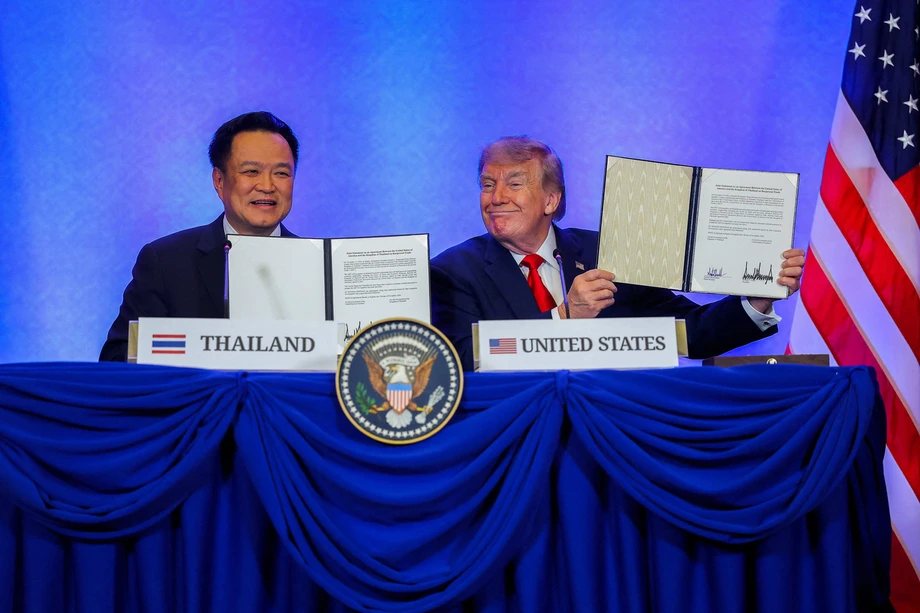
Thai Prime Minister Anutin Charnvirakul and United States President Donald Trump met on November 17, 2026, in Manila, Philippines, to sign a joint trade statement. The document marks a substantial conclusion to negotiations for the Agreement Between the United States of America and the Kingdom of Thailand on Reciprocal Trade, known as ART. While political leaders celebrated the milestone, the pact still requires extensive internal legal scrubbing, Cabinet review, and parliamentary approval before taking effect.
Contents
- A Trade Breakthrough in Manila
- Understanding the Tariff Strategy and Section 301 Pressures
- The Timeline From Joint Statement to Full Implementation
- Agricultural Concessions and the Political Backlash at Home
- The Direct Threat to Thai Pig Farmers
- Controversy Over Growth Promoters and Food Safety Standards
- Proposed Alternative Concessions on Feed Ingredients
- The Broader Impact Across Other Agricultural Sectors
- Government Support Mechanisms and Future Steps
- The Bottom Line
The United States remains Thailand's largest export market, accounting for approximately a quarter of the kingdom's overseas shipments. Government figures show that Thai exports to the United States reached 2.37 trillion baht in 2025, supporting roughly 1.25 million domestic jobs. Negotiators structured the trade talks to protect these vital export channels against higher punitive tariffs while navigating complex demands for increased American agricultural imports.
Understanding the Tariff Strategy and Section 301 Pressures
Thai trade officials entered the negotiations aiming to narrow a costly tariff disadvantage compared to regional competitors. Before the agreement, the United States imposed Section 301 tariffs related to forced labor concerns, setting the rate for Thai products at 12.5 percent. Meanwhile, neighboring countries such as Malaysia, Indonesia, and Cambodia secured a reduced rate of 10 percent after concluding their own trade accords. Chotima Eiamsawasdikul, Director-General of the Department of International Trade Negotiations at the Ministry of Commerce, explained that reducing this gap is essential for maintaining competitive pricing in the American market.
During bilateral discussions held on November 18, 2026, in Shenzhen, China, Deputy Prime Minister and Minister of Commerce Suphajee Suthumpun raised the tariff discrepancy directly with U.S. Deputy Trade Representative Rick Switzer. Officials noted that the ART could prompt Washington to reduce the Section 301 rate to 10 percent. However, officials also warned that the U.S. is considering additional tariffs concerning excess manufacturing capacity, which could complicate export planning.
The Timeline From Joint Statement to Full Implementation
Government representatives have emphasized that the joint statement signed in Manila creates no immediate legal changes. Customs duties and import regulations remain entirely unaffected while administrative agencies draft the formal treaty text. According to Thailand Clears Joint Trade Statement With Trump, the Cabinet authorized the initial framework on November 10, 2026, allowing leaders to establish political alignment without bypassing domestic legal procedures.
- November 10, 2026: The Thai Cabinet approves the Commerce Ministry draft for the Manila joint statement.
- November 17, 2026: Prime Minister Anutin Charnvirakul and President Donald Trump sign the joint trade statement in Manila.
- November 19, 2026: The Swine Raisers Association of Thailand issues a public statement opposing market access for American pork.
- November 22, 2026: Department Director-General Chotima Eiamsawasdikul outlines upcoming legal steps and public consultation requirements.
- 1 to 2 Years Post-Signing: Estimated timeframe for the ART to complete domestic procedures and officially enter into force.
Agricultural Concessions and the Political Backlash at Home
The pending trade agreement has triggered intense political debate within Thailand, particularly concerning proposed agricultural imports valued at $2.6 billion annually. Former Prime Minister Abhisit Vejjajiva challenged the sweeping concessions, questioning the economic rationale of trading extensive market access for a modest 2.5 percentage point reduction in U.S. tariffs. Critics also raised concerns regarding potential compromises on digital services taxation, pharmaceutical standards, and medical equipment regulations.
Prime Minister Anutin defended the negotiating strategy during his weekly broadcast, maintaining that the government prioritized national economic stability and export protection. Deputy Prime Minister Suphajee Suthumpun similarly rejected claims of compulsory purchasing quotas, explaining that private importers will retain complete freedom to select suppliers based on price and quality.
The Direct Threat to Thai Pig Farmers
While industrial exporters welcome the trade framework, domestic livestock producers face severe economic pressures. The Swine Raisers Association of Thailand reported that local pig farmers suffered accumulated financial losses totaling 36.7 billion baht from 2023 through 2025, with output expected to reach 24.3 million pigs in 2026 amid weak consumer demand. Kasikorn Research Center estimates that increased U.S. competition could reduce the value of the domestic pork industry by roughly 112 billion baht and impact approximately 149,000 smallholder farmers.
Association adviser Anan Traidechapong warned that even small import volumes could devastate local producers, whose production costs exceed American pork prices by roughly 35 percent. Commenting on the inclusion of pork in the trade discussions, Anan told Bloomberg:
That may not seem like a large amount, but what we are particularly concerned about is the ability to control the volume.
Controversy Over Growth Promoters and Food Safety Standards
A central point of contention involves the potential introduction of American pork produced with ractopamine, a feed additive used to promote lean muscle growth that is strictly prohibited under Thai agricultural law. Trade publication reports and industry statements indicate that U.S. officials pushed for fewer non-tariff barriers, raising fears among consumers and farmers regarding food safety.
Government ministers have moved to dispel public anxiety over food safety standards. Permanent Secretary Poonpong Naiyanapakorn assured the public that the ministry did not negotiate agreements that would compromise public health. Echoing those assurances, Deputy Minister of Agriculture and Cooperatives Watcharapol Khaokham confirmed that the administration maintains a strict ban on hormone-treated meat.
The Swine Raisers Association has urged the government to lodge an official reservation regarding a 2012 Codex Alimentarius Commission decision that established international residue limits for ractopamine based on a U.S. proposal. Farmers argue that filing an unconditional reservation is necessary to preserve domestic legal protections against foreign trade pressure.
Proposed Alternative Concessions on Feed Ingredients
Seeking to avert pork imports, livestock representatives proposed redirecting Thailand's agricultural import purchases toward feed ingredients that the country genuinely lacks. Thailand grows insufficient feed corn to satisfy domestic requirements and relies heavily on imported soybeans and soybean meal to sustain its livestock sector. Association records indicate that Brazil currently supplies more than 90 percent of Thailand's soybean imports.
Industry leaders suggested shifting a portion of those soybean and feed corn purchases to American suppliers as a constructive trade compromise. Proponents argue this substitution would satisfy Washington's demand for expanded agricultural trade without overwhelming domestic pig producers. However, agricultural economists note that excessive imports of feed ingredients could also depress local crop prices if volumes exceed national demand.
The Broader Impact Across Other Agricultural Sectors
Beyond the pork industry, the reciprocal trade framework carries varied implications for other segments of Thai agriculture. Assoc. Prof. Dr. Ath Pisarnwanich from the Faculty of Economics at Rangsit University noted that sugarcane and cassava producers face potential price declines due to anticipated competition from imported American ethanol. Conversely, imports of beef are expected to face stiff competition from established Australian suppliers, limiting the immediate disruption to local cattle producers.
Poultry producers also face intensified rivalry as American meat gains smoother entry under the proposed terms. Meanwhile, U.S. Meat Export Federation CEO Dan Halstrom estimated that initial U.S. pork sales could reach $10 million to $25 million annually, representing a fraction of total American exports but posing a significant challenge to small Thai operations.
Government Support Mechanisms and Future Steps
To cushion the blow for vulnerable agricultural sectors, the Ministry of Agriculture and Cooperatives is preparing adjustment measures centered around the existing FTA assistance fund. Officials plan to utilize financial resources to help farmers improve production efficiency, upgrade operational standards, and explore alternative export markets. However, critics point out that existing funding allocations remain modest compared to the scale of potential agricultural imports.
The formal trade pact must still undergo rigorous legal review, public hearings, and parliamentary debate before it can be signed into law. As Trump and Anutin Sign Thailand–US Trade Statement noted during earlier diplomatic briefings, the path from a signed joint statement to an enforced treaty requires navigating extensive legislative hurdles in Bangkok.
The Bottom Line
- Prime Minister Anutin Charnvirakul and U.S. President Donald Trump signed a joint trade statement in Manila on November 17, 2026.
- The proposed Agreement on Reciprocal Trade aims to secure competitive tariff rates for Thai industrial exports to the United States.
- Thai pig farmers strongly oppose opening the domestic market to U.S. pork following three consecutive years of financial losses.
- Government officials maintain that domestic health regulations and bans on growth-promoting substances will remain fully enforced.
- Livestock associations have proposed buying American feed corn and soybeans instead of importing foreign pork.
- The agreement awaits further legal scrubbing, public consultations, and parliamentary approval before taking effect.