A Fresh Script for Daily Life
Uzbekistan is preparing for a nationwide shift to a revised Latin alphabet, bringing changes to official documents, school textbooks, media publications, and digital services. The legal foundation for this transition was established when President Shavkat Mirziyoyev signed a law on October 21, 2026, coinciding with Uzbek Language Day, as explored in Uzbekistan Prepares for Nationwide Rollout published earlier. The update modifies four specific character forms to better align with the phonetics of the Uzbek language and addresses long-standing challenges in digital communication. Saida Mirziyoyeva, head of the Presidential Administration, spoke about the significance of the reform and explained the reasoning behind the legislative changes, characterizing the transition as a correction of past mistakes that will strengthen the position of the national language in the digital age. The Ministry of Justice of the Republic of Uzbekistan published a comprehensive draft resolution titled Oʻzbek alifbosiga kiritilgan oʻzgartirishlarni jamiyat hayotining barcha sohalariga joriy etish chora-tadbirlari toʻgʻrisida to outline how government agencies, businesses, and educational institutions will adopt the new writing system.
Contents
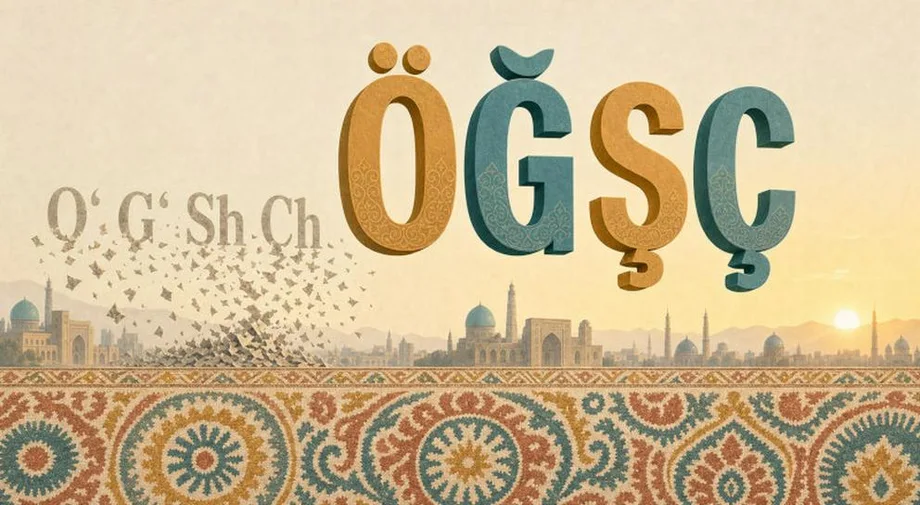
Public discussion on the proposed implementation roadmap runs through December 6, 2026, giving citizens and organizations time to review the steps ahead. The reform replaces complex two-letter combinations with single characters carrying diacritic marks. Specifically, the letter forms Oʻ and oʻ change to Ö and ö, Gʻ and gʻ change to Ğ and ğ, Sh and sh change to Ş and ş, and Ch and ch change to Ç and ç. Additionally, the letter combination Ng is removed as a separate alphabetical entry from the script. The finalized system consists of 28 letters and a single apostrophe sign known as the tutuq belgisi, officially taking effect on April 22, 2027.
Document Renewal and Official Identification
Citizens will not need to rush out and replace their identity papers immediately once the new rules take effect. Existing identity cards, passports, and property certificates will retain their full legal validity until they reach their normal expiration dates. Government bodies are expressly prohibited from denying services, rejecting applications, or questioning a person identity simply because a name is spelled using older letter forms. When new documents are issued after April 22, 2027, they will incorporate the updated characters in accordance with the modernized alphabet rules.
State authorities have set specific operational deadlines for document processing systems and physical supplies. Blank forms printed under the previous alphabet rules may continue in use until January 1, 2028. Behind the scenes, the Ministry of Internal Affairs, the Ministry of Digital Technologies, the Ministry of Foreign Affairs, and the Academy of Sciences must evaluate technical capabilities by January 2027. These agencies will prepare personalization proposals by April 2027 to ensure that visual data zones on biometric passports and identification cards align with international standards set by the International Civil Aviation Organization.
Phased Education Rollout in Schools
Classrooms across the country will transition to the modernized script over a multi-year period running from 2027 through 2031. Educational authorities will inventory existing textbooks by December 2026 to map out replacement schedules by grade and subject. First-grade pupils will be the first to receive newly printed textbooks utilizing the revised alphabet beginning with the 2027/2028 academic year. Textbooks for older grades will be updated progressively as regular publishing cycles require new print runs.
Educators will receive professional development through specialized training courses, seminars, and webinars starting in 2027 to master the updated spelling rules. To ease the adjustment for older pupils, the draft resolution proposes temporary leniency in grading spelling accuracy for students in grades 5 through 11. This supportive measure will apply to routine classroom assignments, final state examinations, and university entrance exams until August 1, 2028. Meanwhile, preschool children will encounter the new letters through illustrated alphabet books, magnetic toys, interactive animated clips, and a dedicated four-part animated series titled Adventures of the Magic Letters.
Business Transition and Retail Packaging
Commercial enterprises and manufacturers receive a structured transition period to update product labels, packaging materials, and store signage. Retailers and producers can use both old and new alphabet spellings simultaneously on product packaging and labels between April 22, 2027, and April 22, 2028. New packaging orders placed after April 22, 2028, must use the updated Latin script exclusively. Existing packaging inventory printed under the previous rules remains authorized for use until April 22, 2029, and goods already marked before that date may be sold until their expiration dates.
Public-facing infrastructure will also transform over time. State organizations must update their official nameplates and digital portals immediately upon the law taking effect. Local authorities, transport operators, and commercial establishments will gradually replace street signs, airport display boards, railway station notices, and public transit destination indicators starting in 2027. Official inscriptions on the state coat of arms and state awards are scheduled for revision under separate documents planned for preparation by next year.
Digital Infrastructure and Artificial Intelligence Integration
Digital platforms and software systems require extensive updates to support the new diacritic characters properly across consumer devices. The Ministry of Digital Technologies will oversee the creation of a unified Uzbek keyboard standard compatible with Android, iOS, macOS, and Windows operating systems. Government digital portals such as OneID and my.gov.uz, along with electronic school gradebooks and administrative document workflows, will be upgraded before the law becomes operative.
Authorities are taking an active approach to global technology platforms by reaching out directly to major artificial intelligence developers. During 2026 and 2027, official requests will be sent to OpenAI, Google, Anthropic, xAI, DeepSeek, and Meta to request that their respective models—including ChatGPT, Gemini, Claude, Grok, DeepSeek, and Meta AI—adapt their natural language processing to the revised Uzbek alphabet and orthography rules. E-commerce aggregators, streaming operators, and digital catalogs overseen by the National Agency for Project Management and the Chamber of Commerce and Industry must also ensure their interfaces reflect the updated script.
Implementation Timeline
- December 2026: Completion of inventory for existing school textbooks and teaching materials
- January 2027: Study of technical capabilities for passport visual data zones and launch of teacher training courses
- April 2027: Official entry into force of the law on the revised alphabet
- April 22, 2027 to April 22, 2028: Permitted parallel use of old and new spelling on product packaging
- August 1, 2028: Conclusion of temporary spelling leniency for students in grades 5 through 11
- January 1, 2028: Deadline for exhausting remaining stocks of older official document blanks
- April 22, 2029: Final deadline for using previously printed packaging inventory
- 2027 to 2031: Phased replacement of school textbooks for grades 1 through 11
Funding and Institutional Accountability
Financing for the nationwide transition will draw directly from state resources under specific budgetary guidelines. Expenses incurred during 2027 will be covered within the existing funds already allocated to government ministries and local administrations from the republican budget. Appropriations for subsequent years will be integrated directly into regular state budget parameters starting in 2028, alongside permitted use of departmental extrabudgetary funds.
Every state agency, economic association, and local government body must draft and formally approve an internal roadmap within one month of the final resolution adoption. These roadmaps must establish precise execution mechanisms, financial sources, and named supervisors. Agency leadership will hold personal responsibility for meeting these targets, and progress will be reviewed at official administrative meetings at least once every month.
The Essentials
- The modernized Uzbek alphabet consists of 28 letters and a single apostrophe, replacing specific two-letter combinations with diacritic characters like Ö, Ğ, Ş, and Ç.
- Existing identity papers and official documents retain full legal validity without requiring mandatory replacement.
- First-grade students will begin learning the new script with dedicated textbooks starting in the 2027/2028 academic year.
- Businesses have until April 2029 to exhaust older packaging materials and transition fully to the updated alphabet on product labels.
- Government authorities will engage major artificial intelligence providers including OpenAI and Google to adapt language models to the new orthography rules.