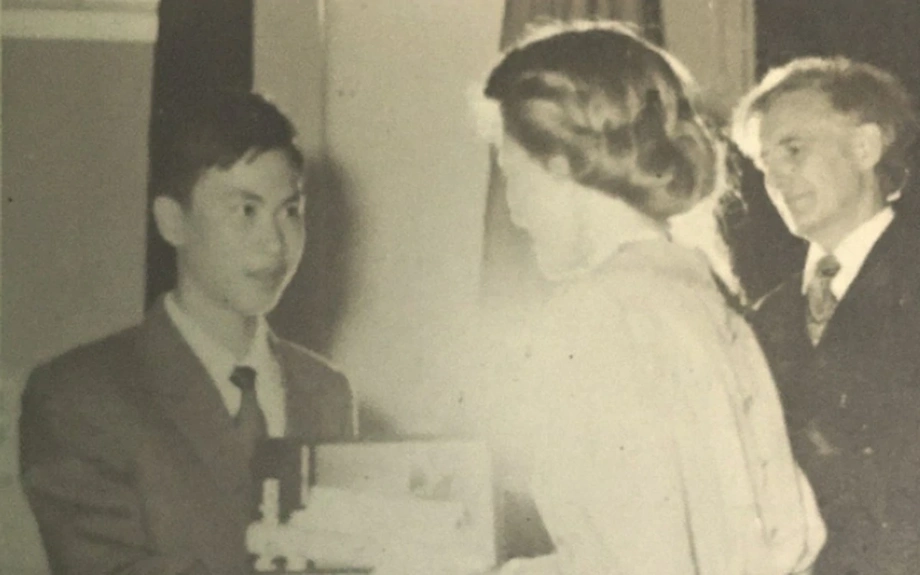
The Historic Triumph in London
Lê Bá Khánh Trình was born on May 19, 1962, in Phong Chương, Phong Điền, Thừa Thiên (now part of Huế city) into a large family of six siblings where his father taught at a medical university and his mother taught at a secondary school. In 1979, while studying in the specialized mathematics class at Quốc Học High School in Huế, he was selected as one of five students to represent Vietnam at the International Mathematical Olympiad held in London, United Kingdom. At just 17 years old, he secured a gold medal with a perfect score of 40 out of 40 points, marking a monumental milestone for the country on the global academic stage.
Contents
The competition brings together exceptionally talented teenagers from around the world to solve demanding mathematical problems under tight time constraints. Achieving a top score requires absolute precision, deep analytical thinking, and mastery of advanced mathematical concepts. Beyond his perfect score, the young Vietnamese contestant captured international attention by earning a special prize for presenting the most elegant and original solution to a complex geometry problem. Within the history of Vietnamese participation in the competition, he remains the sole student to receive this unique distinction.
A Happy Accident in the Exam Room
The remarkable story behind the winning geometry solution stems from an initial misunderstanding of the exam paper text. The problem required contestants to prove a property involving two points moving at a constant speed along two intersecting circles starting from a common intersection point A, moving in the same direction, and returning to point A simultaneously. Due to the high pressure of the exam environment, the 17-year-old student initially misread the prompt and solved the problem assuming the two points moved in opposite directions.
After finishing the problem under that initial assumption, he reviewed his work and realized his reading error. With very little time remaining while other contestants had already completed their exams, he urgently formulated a new approach to satisfy the actual prompt requiring movement in the same direction. Rather than crossing out his previous work, he chose to retain the solution for the opposite direction scenario alongside his new solution. Consequently, his exam paper successfully addressed both movement directions.
Unusual Proof That Stunned the Judges
When the grading committee evaluated the papers, several examiners grew suspicious of the unusual brevity of the solution provided by the student from Vietnam. A concise proof in advanced mathematics often raises concerns about potential logical gaps or hidden errors during rapid assessments. Following a thorough inspection, the judges recognized that the reasoning was entirely correct, mathematically rigorous, and remarkably creative.
British mathematician Tony Gardiner, who participated in grading the exam papers that year, formally proposed awarding a special prize to recognize the exceptional nature of the work. The solution later circulated widely within international mathematical competition problem collections, replacing the official committee answer key. The Lê Bá Khánh Trình biographical record documents these early achievements that earned him the enduring moniker of the golden boy of mathematics in Vietnam.
Academic Pursuits in Moscow
Following his triumph at the international competition in London, the young scholar received direct admission to the Department of Mathematics and Mechanics at Lomonosov Moscow State University in the Soviet Union. Living and studying abroad in a rigorous academic environment allowed him to deepen his expertise in advanced mathematical research. During his graduate studies, he worked under the direct supervision of Academician Andrey Alexandrovich Gonchar, a prominent mathematician who later served as Vice President of the Russian Academy of Sciences.
He successfully defended his doctoral dissertation, achieving the academic degree of candidate of sciences. His scholarly output during his research years included notable academic papers such as 'Inverse theorems for multipoint Padé approximants' and 'On the m-th row of a table of multipoint Padé approximations'. These works contributed to the study of rational approximation theory, which deals with approximating mathematical functions using fractions of polynomials.
Returning Home to Shape Future Generations
Rather than remaining abroad to pursue international research appointments, the newly minted doctor chose to return to his home country. He joined the faculty of the Department of Mathematics and Computer Science at the University of Science, part of Vietnam National University in Ho Chi Minh City. Over the course of nearly four decades standing in lecture halls, he shifted his primary focus entirely toward teaching and mentoring gifted students rather than continuing independent mathematical publishing.
He took charge of training the specialized mathematics competition teams at the High School for the Gifted in Ho Chi Minh City. His deep expertise and pedagogical dedication transformed him into a familiar and trusted mentor for generations of young mathematical talents. Beyond local classrooms, he frequently assumed leadership roles for national delegations traveling abroad for international competitions.
Guiding Vietnam on the Global Stage
The veteran educator brought his extensive experience to international arenas by serving as delegation leader for Vietnamese students at several global contests. In 2005, he led the national team to the 46th International Mathematical Olympiad held in Mexico. Eight years later, in July 2013, he guided the national squad to the 54th International Mathematical Olympiad held in Santa Marta, Colombia. Under his guidance, that specific delegation achieved an impressive haul of six medals, consisting of three gold medals and three silver medals.
- 1979: Won a gold medal with a perfect score of 40/40 and a special prize in London, United Kingdom.
- 1999: Married Phạm Thị Ái Trinh.
- 2005: Led the Vietnamese student delegation to the 46th International Mathematical Olympiad in Mexico.
- 2013: Led the Vietnamese student delegation to the 54th International Mathematical Olympiad in Santa Marta, Colombia.
- 2019: Reunited with British mathematician Tony Gardiner at the 60th International Mathematical Olympiad in the United Kingdom.
- 2025: Received official retirement notification in July after nearly 40 years of teaching.
A Four-Decade Reunion in Britain
One of the most remarkable moments in the educator's later life occurred in 2019 when he returned to the United Kingdom to lead the Vietnamese delegation at the 60th International Mathematical Olympiad. During the event, he experienced an emotional reunion with British professor Tony Gardiner exactly forty years after their first encounter in London.
During their conversation, the retired British professor recalled the exceptional exam paper submitted by the 17-year-old Vietnamese student four decades prior. Professor Gardiner recounted how the grading panel initially felt skeptical upon seeing the unusually brief geometric proof before verifying its absolute precision and imaginative approach. The meeting across four decades highlighted the lasting impression left by a brilliant young mind on the global mathematical community.
Retirement and Lasting Legacy
In July 2025, after nearly forty years dedicated to classroom instruction and nurturing young analytical minds, the esteemed educator received his official retirement decision. His departure from formal institutional duties marks the close of an era for specialized mathematics education in the country. Generations of students who passed through his classrooms carry forward analytical principles shaped by a teacher who once turned a test room mistake into an immortalized mathematical proof.
The impact of his career extends far beyond medal counts and institutional titles, residing instead in the cultivated problem-solving abilities of countless students. Future cohorts of competitors will continue to study his concise geometry proofs as a testament to creative thinking under pressure. Through decades of quiet dedication in university lecture halls and high school training camps, his legacy remains firmly etched in the history of national education.
At a Glance
- Lê Bá Khánh Trình was born on May 19, 1962, in Thừa Thiên (now Huế city), Vietnam.
- He became the first Vietnamese student to achieve a perfect 40/40 score at the International Mathematical Olympiad in 1979.
- He received a rare special prize in London for an ingenious geometric solution derived after misreading the exam prompt.
- He completed his doctorate at Lomonosov Moscow State University under Academician Andrey Alexandrovich Gonchar.
- He spent nearly forty years teaching at the University of Science in Ho Chi Minh City and training national competition teams.
- He led national delegations to international olympiads in Mexico in 2005 and Colombia in 2013.
- He reunited with British examiner Tony Gardiner in 2019 during the 60th International Mathematical Olympiad.
- He concluded his decades-long teaching career upon receiving his retirement decision in July 2025.