A New Chapter for Uzbek Writing
Uzbekistan is preparing for a nationwide shift to a revised Latin alphabet, bringing changes to official documents, school textbooks, media publications, and digital services. The legal foundation for this transition was established when President Shavkat Mirziyoyev signed a law on October 21, 2026, coinciding with Uzbek Language Day. The update modifies four specific character forms to better align with the phonetics of the Uzbek language and addresses long-standing challenges in digital communication.
Contents
Saida Mirziyoyeva, head of the Presidential Administration, spoke about the significance of the reform and explained the reasoning behind the legislative changes. She characterized the transition as a correction of past mistakes that will strengthen the position of the national language in the digital age. Speaking on the adoption of the rules, she emphasized that the reform is structured to avoid placing unnecessary financial burdens on citizens or the state budget.
This work is about addressing historical shortcomings and strengthening the position of the Uzbek language in the digital environment.
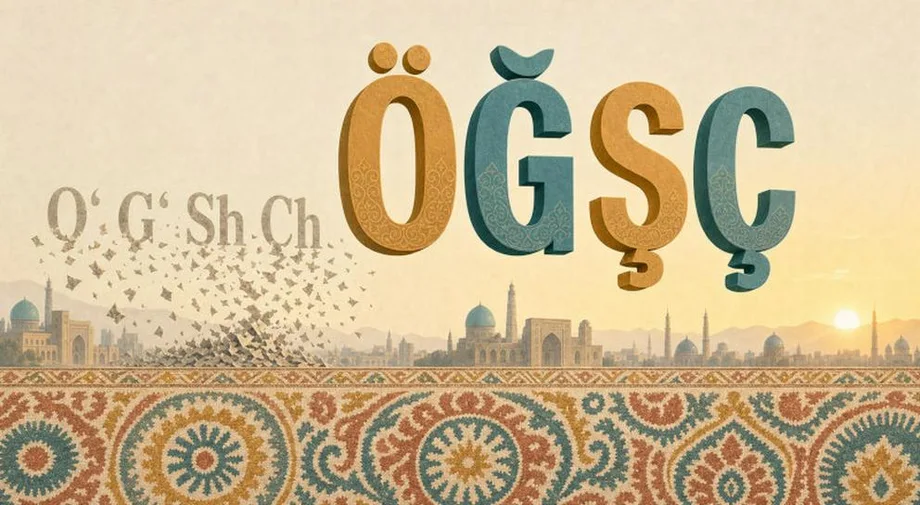
The revised alphabet reduces complexity by replacing letter combinations with single characters carrying diacritic marks. Specifically, the letter forms Oʻ oʻ change to Ö ö, Gʻ gʻ change to Ğ ğ, Sh sh change to Ş ş, and Ch sh change to Ç ç. Additionally, the letter combination Ng is removed as a separate alphabetical entry. The finalized system consists of 28 letters and a single apostrophe sign known as the tutuq belgisi.
Understanding the Historical Context
The writing system of Uzbekistan has undergone multiple transformations over the past century, driven by shifting political and cultural priorities. Before the late 1920s, the population used an Arabic script that had undergone reforms by local intellectuals known as Jadids. The First Turkological Congress held in Baku in 1926 recommended moving Soviet Turkic languages to a Latin-based script called Yanalif, which replaced the Arabic alphabet in Uzbekistan by 1929.
Political shifts in 1940 led the Supreme Soviet of the Uzbek Soviet Socialist Republic to replace the Latin alphabet with Cyrillic writing, which remained dominant for five decades. Following independence, the Uzbek parliament passed a law on September 2, 1993, to introduce a Latin-based alphabet featuring diacritic characters very similar to those being reintroduced today. However, a 1995 revision replaced those diacritics with apostrophes and two-letter combinations to make typing easier on standard English keyboards. Linguists later criticized that decision as an obstacle to digital processing, and the full transition deadline was repeatedly postponed.
Phased Implementation for Schools and Students
The educational system faces a multi-year adjustment period to update textbooks and teaching materials across all grade levels. Beginning with the 2027/2028 academic year, first-grade pupils will receive textbooks utilizing the revised alphabet. The complete adaptation for grades one through eleven is scheduled to run from 2027 to 2031, with older materials replaced gradually as they reach the end of their normal publication cycles.
Educational authorities will conduct an inventory of existing school resources and establish replacement schedules organized by grade and subject. Teachers will participate in professional development seminars, training courses, and practical workshops to prepare for the new orthography. To assist older students during the transition, a temporary and lenient approach to spelling assessments is planned for pupils in grades 5 through 11, remaining in effect until August 1, 2028, for state examinations and entrance tests.
Preschool education will receive dedicated learning tools, including alphabet books, visual aids, interactive games, and cartoons. As part of this effort, a four-episode animated series titled Sehrli harflar sarguzashtlari, meaning Adventures of the Magic Letters, is scheduled for release in 2027. The characters in the animated program will represent the newly introduced letter forms to help young children learn the updated spelling rules.
Official Documents and Personal Rights
Citizens will not need to immediately replace their existing identification cards, passports, or property records when the law takes effect on April 22, 2027. Documents issued under previous rules will retain their legal validity, including papers confirming personal and property rights. When new documents are issued after the effective date, they will be prepared using the revised script.
State agencies are instructed not to reject public service applications, deny document processing, or refuse identity verification due to spelling differences caused by the alphabet change. Employee identification badges for government workers will be updated during scheduled renewals. Furthermore, the national currency and previously issued securities will remain valid without requiring reissuance.
Transition Rules for Commerce and Media
Manufacturers and commercial enterprises will have a structured transition period to update product packaging, labels, and marketing materials. Between April 22, 2027, and April 22, 2028, companies may use either the existing or revised writing systems on packaging to allow time for new printing plates and design adjustments. After April 22, 2028, newly ordered packaging must use the updated alphabet, while previously manufactured materials can be utilized until April 22, 2029.
Goods lawfully labelled before the end of the transition period may remain on sale until their expiry dates. Digital commercial infrastructure, including banking applications, automated teller machines, payment terminals, tax and customs platforms, and electronic marketplaces, will also be updated to support the new character set. Retail signage, road markers, airport boards, and public transport route descriptions will be replaced progressively as physical wear dictates.
Digital Adaptation and Artificial Intelligence Integration
The Ministry of Digital Technologies and partner agencies are tasked with creating a unified keyboard standard for the Uzbek language to facilitate the typing of the characters ö, ğ, ş, and ç. This standard will be designed for operating systems including Android, iOS, macOS, and Windows. In 2027, the government plans to contact international technology developers to request support for the layout.
State digital platforms, such as the OneID identification system and the my.gov.uz portal, will undergo technical updates to ensure compatibility with the revised writing rules. Authorities also intend to develop free electronic tools for spellchecking, text editing, and automated conversion. These tools will rely on artificial intelligence technologies, with official appeals scheduled between 2026 and 2027 to major technology companies including OpenAI, Google, Anthropic, xAI, DeepSeek, and Meta, proposing the adaptation of AI assistants such as ChatGPT, Gemini, Claude, Grok, DeepSeek, and Meta AI.
Technical identifiers that rely on standard ASCII characters will remain unaffected by the language reform. Domain names, electronic mail addresses, user login credentials, bank account numbers, and contract identifiers will not require changes or new registrations. Meanwhile, machine-readable zones on passports and ID cards will have their name transliteration rules reviewed in accordance with international standards set by the International Civil Aviation Organization.
Timeline of Key Developments
- September 2, 1993: Parliament adopts the initial law introducing a Latin-based alphabet for the Uzbek language.
- October 21, 2020: President Shavkat Mirziyoyev signs a decree focused on developing the state language and language policy.
- July 7, 2026: The Legislative Chamber of the Oliy Majlis adopts the revised alphabet law in three readings.
- September 10, 2026: The Senate approves the law modifying the Uzbek alphabet following discussions on unified media standards.
- October 21, 2026: President Shavkat Mirziyoyev signs the law updating the alphabet on Uzbek Language Day.
- November 21, 2026: The Ministry of Justice publishes the draft resolution detailing the implementation program for public discussion.
- December 6, 2026: Deadline for public comments and proposals regarding the implementation draft resolution.
- April 22, 2027: The law officially takes effect, initiating the operational transition across government, education, and commerce.
The Essentials
- The revised Uzbek alphabet consists of 28 letters and one apostrophe sign, removing multi-letter combinations for specific sounds.
- Four characters are modified: Oʻ becomes Ö, Gʻ becomes Ğ, Sh becomes Ş, and Ch becomes Ç, while Ng is no longer listed as a separate letter.
- Existing identity documents, national currency, and financial securities retain their full legal validity without mandatory replacement.
- School textbooks will be updated gradually from 2027 through 2031, starting with first-grade pupils in the 2027/2028 academic year.
- Technical identifiers like domain names, email addresses, and bank account numbers do not need to be re-registered or changed.