Uzbekistan Triumphs on Home Soil at Samarkand Olympiad
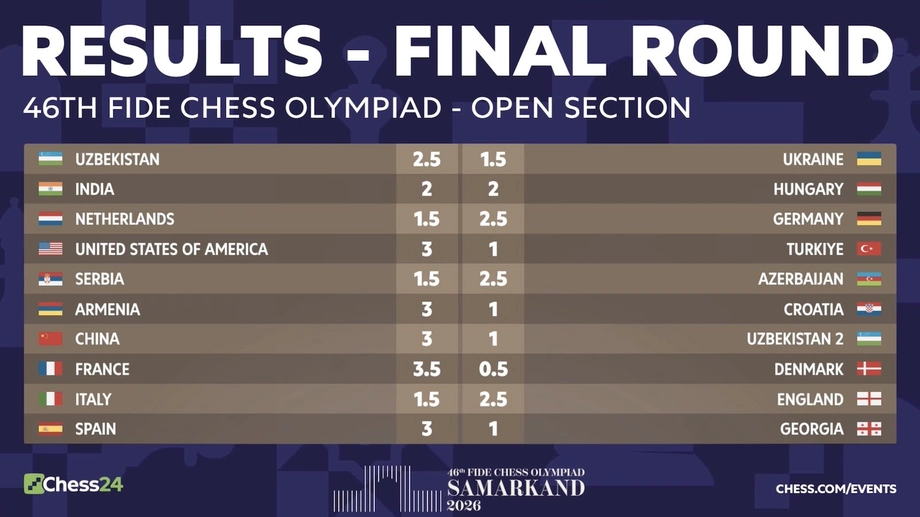
Uzbekistan secured its second Olympiad gold medal in the Open section at the 46th Chess Olympiad 2026 in Samarkand, finishing with 20 out of a possible 22 match points. The decisive moment came in the final round against Ukraine, where reserve player Mukhiddin Madaminov won a sharp endgame against European champion Roman Dehtiarov to seal a 2.5-1.5 victory. Earlier in the event, the host nation maintained a dominant run, which included wins over major contenders and a narrow escape when Nihal Sarin blundered his queen during a crucial round-six clash. The team's depth proved essential throughout the eleven rounds, backed by the strong individual performance of top board player Nodirbek Abdusattorov, who finished undefeated with a performance rating of 2869. India claimed silver after Gukesh Dommaraju drew with Hungary's Gleb Dudin and Arjun Erigaisi defeated Peter Leko, while Germany secured bronze following Matthias Bluebaum's win against Jorden van Foreest. These chess successes build on broader regional connections, much like how Tashkent talks put transport and investment first during high-level diplomatic meetings involving the nearly $60 billion project portfolio.
Contents
China Dominates Women Section in Samarkand
China claimed its seventh title in the FIDE Women's Chess Olympiad by defeating Vietnam 3-1 in the final round. Grandmaster Zhu Jiner and International Master Lu Miaoyi secured individual gold medals by winning their respective final games. The tournament featured intense competition at the top, with Kazakhstan taking silver following a 2-2 draw with Poland. India claimed the bronze medal after International Master Savitha Shri escaped a lost position against Georgia's International Master Meri Arabidze to salvage a 2-2 team draw. Several other major delegations finished level on points with India but missed out on the podium due to tiebreak scores.
Gukesh Faces Defend Pressure Ahead of Geneva Match
D Gukesh enters his first World Chess Championship title defence after a challenging period of results since becoming the youngest undisputed world chess champion at age 18 in December 2024. The 14-game match against challenger Javokhir Sindarov is scheduled to begin on November 24 in Geneva, Switzerland, with both players aged 20 at the start. Sindarov earned his right to challenge by winning the World Cup and the Candidates Tournament without losing a game. Gukesh has struggled with converting advantageous positions into wins due to time management difficulties during major tournaments earlier in the year. Akash Ganesan, co-founder of the Madras School of Chess and India's 66th Grandmaster, noted that these technical hurdles are closely tied to the clock. Grandmaster Shyam Sundar, founder of Chess Thulir Academy and a former Indian women's chess team coach, suggested that the young champion took a well-deserved break after years of intense personal sacrifice required to claim the world crown. Gukesh spent time trying new activities like surfing, playing box cricket, and watching movies with fellow grandmasters to reset his mental approach before returning to form at the September Olympiad in Samarkand.
Contrasting Systems Behind Chess Success
Uzbekistan's chess success stems from a unified national system and collaborative team structure rather than solely relying on individual brilliance. Despite having only 21 Grandmasters in total and roughly 10 active players with an Elo rating above 2500, the country has managed to secure two Olympiad gold medals in three editions. This contrasts sharply with regions like India's southern state of Tamil Nadu, which boasts 38 Grandmasters among a population of 8 crore. Uzbekistan's core group relies on shared preparation, with top player Nodirbek Abdusattorov assisting Javokhir Sindarov alongside coach Roman Vidonyak and second Mukhiddin Madaminov. Meanwhile, national coach Rustam Kasimdzhanov brings his experience as a former FIDE world champion to guide the squad.
Broader Questions Surround the Classical Crown
The upcoming championship match in Geneva carries significance beyond the immediate title holder, touching on debates regarding the best format to determine the world's strongest player. Legendary player Garry Kasparov suggested that a victory by Sindarov might encourage Magnus Carlsen to return to the classical championship cycle, while Carlsen has frequently questioned traditional classical match formats. The introduction of the FIDE-approved Total Chess World Championship Tour Pilot, which combines fast classical, rapid, and blitz formats, has added another layer to the discussion. Gukesh acknowledged the heavy public expectations and pressure he faced during his reign, admitting that handling the mental load of the title has been a significant learning experience.
Key Facts
- Uzbekistan won its second Olympiad gold medal with 20 match points out of 22.
- Mukhiddin Madaminov secured the final round victory against Roman Dehtiarov to defeat Ukraine 2.5-1.5.
- China won the women section gold medal by defeating Vietnam 3-1.
- The World Chess Championship match between Gukesh Dommaraju and Javokhir Sindarov begins on November 24 in Geneva, Switzerland.
- Sindarov qualified for the title match by winning the World Cup and Candidates tournaments.