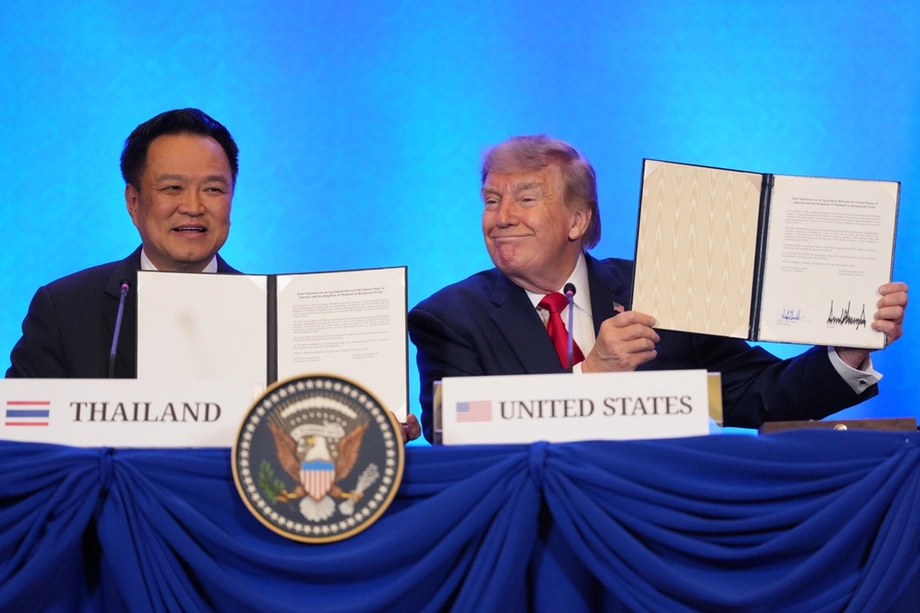
Manila signing advances tariff cuts and $2.6 billion farm pledge
U.S. President Donald Trump and Thai Prime Minister Anutin Charnvirakul signed a joint trade statement in Manila on November 17, 2026, advancing a proposed agreement that Trump said would eliminate Thai tariffs on American exports and bring an estimated $2.6 billion in additional U.S. agricultural purchases.
Contents
- Manila signing advances tariff cuts and $2.6 billion farm pledge
- What the leaders signed
- What Thailand would change for American goods
- What the agricultural purchase pledge covers
- What Thai exporters expect from Washington
- Gemstone businesses seek exemptions
- The steps before the agreement takes effect
- A trade announcement amid wider regional diplomacy
- Key Points
The document confirms that negotiations on the Agreement on Reciprocal Trade, known as ART, have reached a substantial conclusion. Both governments must now finish legal work and domestic procedures before the full agreement can be signed and take effect.
Thailand has a large stake in the outcome. The United States is its biggest export market, taking 24.6% of Thai exports so far this year, almost one dollar in every four. American agricultural suppliers, vehicle manufacturers and medical product companies are seeking easier access to Thailand, while Thai exporters want certainty about the duties their customers will pay in the United States.
Thai government spokesman Ekkapob Pianpises announced the signing at 7 p.m. local time, before a special ASEAN–U.S. summit. Deputy Prime Minister and Commerce Minister Suphajee Suthumpun led Thailand's negotiating team.
Trump described the pending agreement as historic and said he expected the formal text to be completed in the coming weeks. Anutin also welcomed the progress, while acknowledging that work remained.
What the leaders signed
The document is formally titled the Joint Statement on an Agreement Between the United States of America and the Kingdom of Thailand on Reciprocal Trade. It records the leaders' agreement that the main negotiating issues have been settled and directs both countries to begin the internal processes needed to prepare ART for signature and entry into force.
The statement itself contains no tariff schedule, purchase figures or implementation dates. The commercial details announced in Manila came from the leaders' remarks, while earlier commitments appeared in an October 2025 framework.
Anutin, Thailand's prime minister and interior minister, described the remaining work at the signing ceremony:
Yet there is still a little more to do. I'm confident that the agreement will be ready for us to sign real soon.
Thai deputy government spokeswoman Lalida Persvivatana also said the signing was not yet the formal ART agreement. Public consultation and legal procedures remain part of Thailand's process.
The agreement builds on two existing arrangements: the Treaty of Amity and Economic Relations signed in 1966 and the Trade and Investment Framework Agreement signed in 2002. ART would add new commitments to that longstanding economic relationship.
What Thailand would change for American goods
Trump said Thailand would eliminate all tariffs on U.S. exports and remove substantial barriers affecting American vehicles, medical devices, pharmaceuticals, ethanol and poultry.
A tariff is a tax charged when a product crosses a border. Other trade barriers can involve import permits, product testing or rules governing which safety certificates a country accepts. Removing a tariff lowers one cost of importing; changing approval rules can make it easier for a product to enter the market.
Trump, speaking alongside Anutin in Manila, described the tariff commitment:
Thailand will eliminate all tariffs on U.S. exports, which is something we've been after for a long time.
The October 2025 framework covered approximately 99% of U.S. goods, including industrial, food and agricultural products. Trump's announcement expanded that description to all exports. The final product schedule will define the coverage.
The earlier framework also described specific changes: Thailand would accept American vehicles meeting U.S. federal safety and emissions standards, recognize U.S. Food and Drug Administration certificates for medical devices and pharmaceuticals, and begin issuing import permits for American ethanol used as fuel.
Thailand also agreed during the negotiations to open its market to U.S. pork, a concession Thai officials had previously treated as a negotiating red line. That places sensitive agricultural market access alongside industrial and medical products in the broader bargain.
What the agricultural purchase pledge covers
Trump announced an estimated $2.6 billion in additional Thai purchases of U.S. agricultural products. The earlier framework described purchases worth $2.6 billion annually, covering feed corn, soybean meal and dried distillers grains with solubles.
Dried distillers grains, often called DDGS, are a product left after grain is processed to make ethanol. They can be used in animal feed. The commitments therefore connect several American businesses: grain growers, ethanol producers and companies selling feed ingredients.
Ryan LeGrand, president and chief executive of the U.S. Grains & BioProducts Council, said the annual purchase commitment would provide more reliable demand for American farmers once the agreement was finalized. His organization also welcomed the prospect of Thai import permits for U.S. ethanol.
The October framework extended beyond farming. A fact sheet from the Office of the U.S. Trade Representative listed estimated annual Thai energy purchases of $5.4 billion, including liquefied natural gas, crude oil and ethane. It also listed purchases of 80 U.S. aircraft worth $18.8 billion.
Those figures describe different commitments and time periods. The agricultural and energy figures were annual estimates in the earlier framework; the aircraft figure was a total purchase value. The Manila statement supplied no updated purchasing timetable.
What Thai exporters expect from Washington
Thai officials expect most Thai products to face a U.S. tariff of 19%, with selected goods receiving lower or zero rates. The October 2025 framework also envisaged a 19% American reciprocal tariff, down from a threatened rate of 36%.
A July measure was described as imposing new U.S. duties of 12.5% on Thai imports. The new joint statement gives no schedule explaining how existing duties would be treated under ART. On the Monday before the signing, Anutin said tariff measures would remain unchanged while the full agreement was prepared.
Thailand's objective is to preserve access to the American market at rates that allow its goods to compete with products from neighboring countries. For an exporter negotiating a price with a U.S. customer, the tariff can affect whether an order remains affordable.
U.S. Trade Representative figures put bilateral goods and services trade at an estimated $118.3 billion in 2025, up $30.6 billion, or 34.9%, from 2024. Those figures imply trade of approximately $87.7 billion in 2024.
The U.S. goods trade deficit with Thailand reached $71.7 billion in 2025, an increase of $26.6 billion, or 59.1%. A goods deficit means the United States bought more physical products from Thailand than it sold there. The same balance appears as a surplus from Thailand's side.
Gemstone businesses seek exemptions
The American Gem Trade Association sees ART as a route toward restoring duty free treatment for loose colored gemstones, natural pearls and diamonds imported from Thailand.
The association says many of these materials cannot be sourced commercially in the United States, making international supply chains central to American gem businesses. An exemption would reduce import costs for qualifying stones and pearls used by U.S. dealers and jewelers.
AGTA representatives traveled to Thailand in September for talks with government officials and the gem and jewelry industry. The association also held repeated discussions with the Office of the U.S. Trade Representative and other American officials.
John W. Ford Sr., AGTA's chief executive, thanked the participants in that effort:
AGTA extends its sincere appreciation to the United States Trade Representative, the members of Congress who have championed our efforts, and our valued partners in Thailand for their collaboration and commitment in achieving this important agreement.
The association described a pathway to exemptions, with approval and implementation steps still ahead. Its campaign illustrates why the product details matter: a broad tariff rate can have very different effects depending on whether a business imports food, finished manufactured goods or stones unavailable from domestic suppliers.
The steps before the agreement takes effect
Thailand and the United States will next refine and review the legal wording. Thailand's government plans to seek Cabinet approval for formal signature, invite comments from relevant sectors and submit the agreement to Parliament with the consultation results.
Ekkapob said Thailand's negotiating team had already consulted government agencies, businesses and other stakeholders to help shape its position. The next consultation stage gives affected sectors another opportunity to address the proposed commitments through Thailand's domestic procedures.
The main milestones are:
- October 2025: The countries announced a framework covering tariff reductions, regulatory changes and planned purchases.
- September 2026: American gemstone industry representatives visited Thailand for trade discussions.
- November 16, 2026: Anutin said tariff measures would remain unchanged during preparation of the full agreement.
- November 17, 2026: Trump and Anutin signed the joint statement in Manila confirming substantial conclusion of negotiations.
- Next steps: Complete legal drafting, obtain the required domestic approvals, sign the full agreement and complete procedures for entry into force.
Neither government announced an exact signing date, a parliamentary timetable or a date for tariff changes to begin. Trump's reference to the coming weeks and Anutin's expectation of an early signing remain the leaders' stated targets.
A trade announcement amid wider regional diplomacy
Trump signed the Thailand statement during an Asia trip that also included a Quad meeting with Indian Prime Minister Narendra Modi, Japanese Prime Minister Sanae Takaichi and Australian Prime Minister Anthony Albanese.
The Quad leaders discussed critical minerals and supply chains. Their joint statement expressed concern about economic coercion, including arbitrary export restrictions, without naming a country. Trump said new mineral agreements were intended to reduce dependence on any single foreign supplier.
The Quad also announced cooperation involving maritime surveillance, artificial intelligence and cable connections. Its plans included a business leaders' forum in early 2027 and a maritime exercise involving patrol aircraft in 2027.
Trump was due to travel to Shenzhen for the Asia-Pacific Economic Cooperation summit and expected meetings with Chinese President Xi Jinping and Russian President Vladimir Putin on November 19. He also said denuclearisation and the war in Ukraine would feature in his discussions.
At the Thailand signing, Trump recalled his role in efforts to secure peace between Thailand and Cambodia during the previous year's ASEAN summit. Anutin said Thailand wanted to deepen cooperation with Washington beyond trade and investment.
For businesses, the immediate focus is the legal text: which goods receive exemptions, how product approval rules change and when commitments begin. The Manila signing moves those decisions into the drafting and approval stage, with market access for Thai exporters and new sales opportunities for American suppliers at stake.
Key Points
- Trump and Anutin signed a joint trade statement in Manila on November 17, 2026, after substantially concluding ART negotiations.
- The full agreement still requires legal drafting, signature and domestic procedures, including consultation and parliamentary consideration in Thailand.
- Trump said Thailand would eliminate tariffs on U.S. exports and buy an estimated $2.6 billion in additional American agricultural products.
- Thai officials expect a 19% U.S. tariff on most Thai goods, with selected products potentially receiving lower or zero rates.
- American gemstone businesses are seeking restored duty free treatment for loose colored stones, natural pearls and diamonds.
- No exact date was announced for signing the full agreement or implementing tariff changes.