Three central banks link different systems to tackle a $1.4 trillion risk
The Bank of England, Monetary Authority of Singapore and Bank of Thailand announced on November 13, 2026, that they had completed trials linking foreign exchange payments across three different types of central bank settlement infrastructure. Project Meridian FX APAC tested whether both sides of a currency exchange could be coordinated safely even when the money moves through systems built on different technologies.
Contents
- Three central banks link different systems to tackle a $1.4 trillion risk
- How linked payments protect a currency trade
- What the three test environments contributed
- Singapore's escrow arrangement changed the operator's role
- Four stages, with a critical commitment point
- Netting could reduce the cash needed for settlement
- Failure tests exposed practical requirements
- Who would oversee a live service?
- From the first collaboration to the 2028 interface plan
- Key Points
The problem is substantial. According to the central banks, the 2025 BIS Triennial Central Bank Survey found that more than US$1.4 trillion, or 10% of average daily foreign exchange settlement in April 2025, remained fully exposed to settlement risk. That is the danger of paying away one currency without receiving the other.
The trials connected conventional Real-Time Gross Settlement systems with platforms using distributed ledger technology. They also tested whether offsetting payments among several participants could reduce the amount of money banks need to have available for settlement.
The Monetary Authority of Singapore's joint central bank announcement described successful experiments across the three institutions' test environments. The findings were published in three documents: Executive Summary and Introduction, Technical Report, and Policy Report.
The central banks achieved coordination without requiring every participant to adopt one shared ledger. The detailed findings also show why connecting systems involves more than exchanging messages: differences in how each platform reserves money changed the responsibilities of the operator linking them.
How linked payments protect a currency trade
A foreign exchange trade creates two payment obligations. A bank selling one currency must deliver it, while the buyer must deliver the agreed amount of another currency. Settlement is the stage when those obligations are completed through transfers of money.
Herstatt risk arises when one party pays but the other fails before delivering its currency. Payment-versus-payment, usually shortened to PvP, addresses that risk by making the transfer of one currency conditional on the transfer of the other.
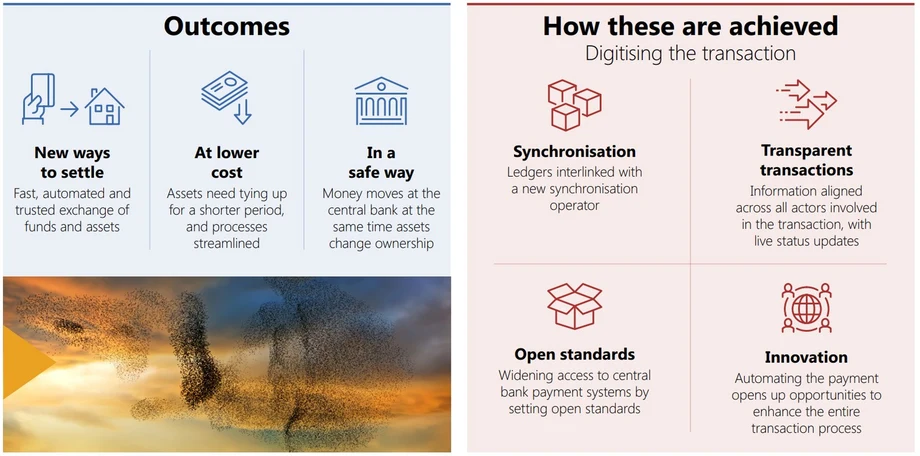
Project Meridian FX APAC used a Synchronisation Operator prototype developed, integrated and tested by Partior, a provider of clearing and settlement infrastructure using distributed ledger technology. The operator matched instructions, secured the necessary funds, checked that every payment was ready and coordinated completion.
The project describes the intended result as atomic settlement: linked transfers happen together, or none happens. In practice, the prototype managed this through reservations, settlement instructions and recovery procedures across separate systems.
Kenneth Gay, Chief FinTech Officer at the Monetary Authority of Singapore, explained the purpose of that coordination:
Project Meridian FX APAC has shown how synchronisation could help enable PvP settlement across these diverse environments, reducing settlement risk while supporting greater interoperability.
Interoperability means that different systems can work together. Here, the aim was to connect existing and emerging forms of wholesale settlement, the infrastructure banks and other financial institutions use to settle obligations with one another.
What the three test environments contributed
The Bank of England's project technical report identifies the participating environments as its Synchronisation Lab, the Bank of Thailand's Project SAN and the Monetary Authority of Singapore's SGD Testnet in a configuration outside live production.
The Synchronisation Lab simulated an account based RTGS system. RTGS systems settle payments individually as they are processed. In the experiment, the lab allowed funds to be earmarked directly in participants' accounts, meaning they stayed in place but could not be spent elsewhere while reserved.
Thailand's Project SAN used a centrally managed token ledger with an interoperability layer that routed instructions and returned transaction information. It secured funds through an internal escrow arrangement, conditionally holding them without the Synchronisation Operator taking custody.
Singapore's SGD Testnet represented infrastructure with wallets controlled by participants and support for wholesale central bank digital currency. A central bank digital currency, or CBDC, is digital money issued by a central bank; wholesale versions are designed for financial institutions rather than everyday shopping.
Synchronization can connect different forms of wholesale money without requiring every system to use a CBDC. The experiment's value lay in making these different designs work together while preserving settlement in central bank money.
Singapore's escrow arrangement changed the operator's role
SGD Testnet required a different approach because the test configuration did not provide direct earmarking of participant funds by the operator. The prototype instead used a dedicated wallet owned by a bank and managed under that bank's authorization, together with a technical escrow wallet.
Participant digital signatures authorized transfers into and out of the escrow arrangement. This allowed the prototype to reproduce the effect of reserving funds, but it also gave the operator responsibilities for holding or controlling money that went beyond simple coordination.
The central banks envisage an operator that normally coordinates settlement without taking custody of participants' funds. Reserving money in a participant's own account keeps that role narrower than moving money into an escrow wallet under the operator's control.
Singapore's arrangement brought questions about custody, safeguarding, credit, liquidity and insolvency into the policy analysis. For example, a live service would need clear rules governing control of the money and its treatment if an operator or participant became insolvent.
The central banks identified these arrangements as choices made for the experiment. Better support for authorized access and funds reservation could allow a future operator to perform fewer functions, reducing both integration complexity and the responsibilities attached to handling money.
Four stages, with a critical commitment point
The prototype followed four stages: receiving settlement instructions, matching the two sides of a trade, reserving funds and requesting settlement. Instructions identified details including the currency, amount, counterparty and settlement date.
During the initial, reversible phase, the operator could cancel reservations if a problem arose. If one bank had enough money but the other did not, the first bank's reserved funds could be released and the trade terminated before payment.
Once the workflow passed its commitment point and settlement instructions began to be issued, recovery followed a different path. The operator continued toward completion rather than releasing funds that might still be needed to match a payment already underway elsewhere.
A system outage after commitment therefore triggered retries. Releasing the remaining reservation at that stage could leave one currency delivered and the other unpaid, the very outcome the linked process was designed to prevent.
The report separates this technical commitment process from legal settlement finality. Finality is the point at which a payment is legally complete and cannot be revoked under the relevant rules. A live service would need an agreed legal outcome across the connected jurisdictions, alongside its technical workflow.
Netting could reduce the cash needed for settlement
The second major use case was multilateral net settlement. Instead of moving the full amount of every payment separately, netting offsets incoming and outgoing obligations and settles the remaining balances.
A bank with payments both coming in and going out may therefore need less available money than it would need to fund every outgoing payment individually. This is the liquidity benefit: less cash is tied up solely to complete settlement.
The prototype held eligible transactions in a queue and grouped them into settlement cycles. It then calculated net positions and sought reservations across all three systems for the same set of transactions.
That process required negotiation between systems. If a participant could not fund the proposed batch, the operator used error information to remove an eligible transaction and tried again. The process continued until all three systems accepted a common batch.
The experiment demonstrated the potential for liquidity savings without publishing a single percentage reduction in the joint announcement. Calculating net positions also expanded the operator's responsibilities, bringing its work closer to clearing, the process of working out payment obligations before settlement.
Failure tests exposed practical requirements
The trial tested insufficient funds, invalid account identifiers, batches containing multiple errors and infrastructure outages. These scenarios examined how the operator responded when a linked transaction could not proceed normally.
An invalid account or insufficient funds during the reversible phase led to cancellation and release of associated reservations. In a batch containing several problems, the prototype isolated failing transactions and continued processing the remaining eligible transactions.
An outage after commitment required repeated attempts to complete settlement, with progressively longer intervals between retries and a threshold for operator intervention. Reliable information about transaction status was essential to that response.
The findings identify idempotency as another requirement. In simple terms, an instruction sent more than once must still be processed only once. Without that protection, retrying after a lost response could create a duplicate payment.
The central banks also identified reliable event delivery and transaction status information that an operator can query as resilience requirements. Testing did not cover operating hours that fail to overlap or the expiry of funds reservations. Both remain practical challenges for coordinating payments across time zones.
Who would oversee a live service?
The Bank of England's project policy report groups the main considerations into operational risk, settlement integrity and finality, governance and accountability, and legal, data and international dependencies.
A coordination service could delay payments even when the underlying central bank systems remain available. Its cybersecurity, capacity, recovery arrangements and connections would therefore matter to the resilience of the whole settlement chain.
Rulebooks and contracts would need to allocate authority to approve, pause, cancel or retry transactions. They would also need to define liability and explain how persistent failures are handled. These responsibilities become greater when an operator controls money or calculates net obligations.
The report draws reference points from existing arrangements. The Reserve Bank of Australia's Batch Administrator framework shows how an external organization can submit settlement obligations under access and operational requirements. Swift's cooperative oversight offers an example of central banks sharing supervision of an international service.
CLS provides a reference for legally recognized PvP settlement, although its currency obligations settle on a common ledger. Meridian's approach coordinates payments across separate domestic systems. The report also considers Principles 2 and 8 of the Principles for Financial Market Infrastructures, covering governance and settlement finality, alongside the Global Layer One Market Infrastructure Toolkit.
Further policy work covers domestic access, international governance, operating hours, legal certainty and data exchange. The Reserve Bank of Australia and Bangko Sentral ng Pilipinas contributed perspectives as observer central banks.
From the first collaboration to the 2028 interface plan
Project Meridian FX APAC builds on Project Meridian FX, led by the BIS Innovation Hub London with the Bank of England, Bank of France, Deutsche Bundesbank, Bank of Italy and European Central Bank. The APAC experiment extended the approach across a wider range of currencies, technologies, infrastructures and time zones.
The development timeline spans the launch of the collaboration, publication of the results and a planned British infrastructure step:
- November 2025: The UK, Singapore and Thailand central banks first announced their collaboration.
- November 13, 2026: The central banks published the completed trial's findings and its three reports.
- 2028: The Bank of England plans to launch a live synchronization interface accommodating tokenized assets and different forms of wholesale money.
The central banks gave no launch date for a joint live Meridian FX APAC service. Future exploration could include more jurisdictions, financial institutions, currencies and transaction scenarios, alongside work on technical, legal, operational and governance arrangements.
Tom Mutton, the Bank of England's Executive Director of Payments, Innovation and Fintech, described how the experiment fits into that work:
Project Meridian FX APAC provides practical evidence of how synchronised settlement could help reduce risk and improve efficiency in cross-border FX transactions. The results provide a strong foundation for further collaboration as we explore how this approach could be developed towards real-world use.
For banks, the potential benefits are safer currency exchanges and less money tied up in settlement. Delivering those benefits in live markets will require both dependable coordination technology and clear agreements about who controls funds, who handles failures and when each payment becomes legally final.
Key Points
- The UK, Singapore and Thailand completed synchronized FX settlement trials and published findings on November 13, 2026.
- The experiment linked conventional and tokenized central bank test systems through a Partior prototype.
- More than US$1.4 trillion, or 10% of average daily FX settlement in April 2025, remained fully exposed to settlement risk, according to the BIS survey cited by the central banks.
- Payment-versus-payment linked currency deliveries, while multilateral netting offered potential liquidity savings.
- Singapore's test arrangement required escrow, expanding the operator's responsibilities beyond coordination.
- Legal finality, oversight, operating hours and recovery arrangements require further work before a live international service.
- The Bank of England plans a live synchronization interface in 2028; no joint Meridian FX APAC launch date was announced.