A Bangkok landmark planned on 20 to 30 rai
Mohamed Alabbar, the businessman behind Dubai's Burj Khalifa, is proposing a US$5 billion development in Bangkok that could include the world's tallest building, if Thai authorities permit its height. Eagle Hills would lead the project, combining homes, shops, offices and hotels on 20 to 30 rai of leased land.
Contents
- A Bangkok landmark planned on 20 to 30 rai
- What Eagle Hills wants to build
- How tall could the tower become?
- From the 2024 talks to a proposed agreement
- Thai partners and leased land
- Why Alabbar is looking beyond a weak market
- Tourism is central to the investment case
- What the development could bring to Bangkok
- Coastal resorts and Khlong Toei are also in view
- Key Points
The proposed investment, equivalent to approximately 160 billion to 170 billion baht, follows four years of studying Bangkok and about 18 months of negotiations, according to Alabbar. During his latest visit to Thailand in 2026, he said he hoped to conclude an agreement within one to two weeks.
The Bangkok location, proposed tower height, final investment partners and calendar dates for signing and construction have not been announced. Alabbar's immediate goal is to secure the agreement, with detailed design and applications for permission to follow.
The land would cover 32,000 to 48,000 square metres. Within that footprint, Eagle Hills intends to build a new development rather than acquire an existing business. The tallest tower would be its principal landmark, while the wider project would bring several types of property together.
What Eagle Hills wants to build
Eagle Hills would initially take responsibility for the Bangkok investment. Emaar Properties, which Alabbar also founded, could join later to develop the retail and hotel components. The proposal therefore gives the two companies different possible roles, with Eagle Hills at the centre of the current negotiations.
A mixed use development puts activities such as living, working, shopping and staying in hotels within the same project. For residents and visitors, the practical attraction is having several destinations close together. For the developer, homes, offices, shops and hotels provide different sources of income rather than relying on a single property business.
Alabbar described the proposal as a greenfield investment, meaning a development created from the beginning rather than the purchase of an operating project. That approach gives the developer scope to plan the buildings and shared spaces together, while requiring the design and permissions to be worked through before construction.
How tall could the tower become?
Alabbar said he would welcome the opportunity to build the world's tallest tower if local regulations and government approvals allowed it. He also presented the building as a symbol for Bangkok, with architectural quality and a recognisable identity central to his ambition.
The Burj Khalifa stands 828 metres tall. Magnolias Waterfront Residences Iconsiam, identified as Thailand's tallest building during the April 2024 discussions, stands 318 metres. Those figures put the scale of the ambition in perspective: 828 metres is 510 metres higher, or about 2.6 times 318 metres.
Thai architects would design the Bangkok tower, with Alabbar closely supervising their work. He wants the architecture to reflect Thai identity. His stated aim combines the international visibility of a very tall building with a design rooted in the country where it would stand.
Alternative construction methods were also raised during the earlier investment discussions. Those ideas included reducing reliance on conventional concrete through the use of stainless steel structures. The proposal still has to progress through detailed design, when the structure and construction approach would be worked out.
From the 2024 talks to a proposed agreement
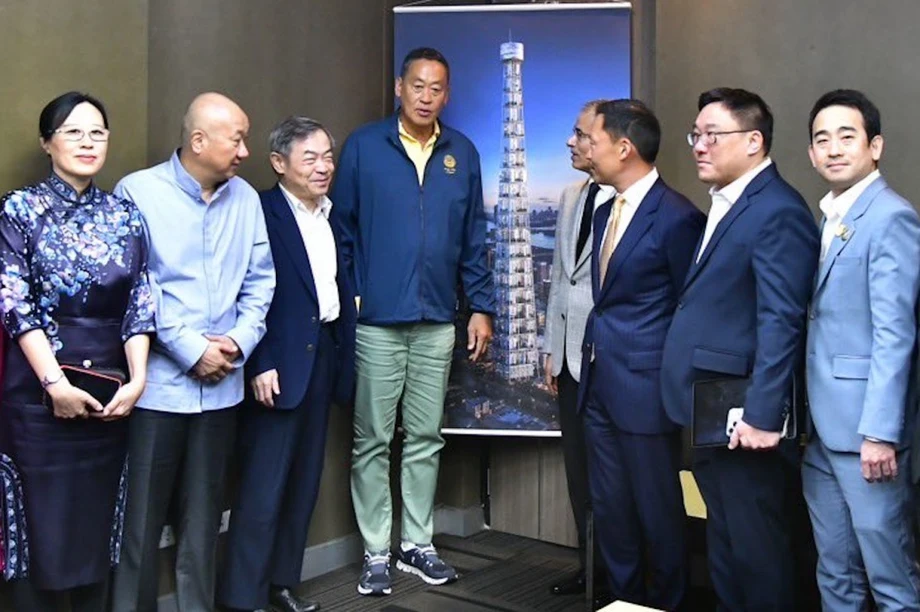
Srettha Thavisin, then Thailand's prime minister and finance minister, discussed the tower ambition with investors in April 2024. The companies involved in those talks included Emaar Group, Broad Group and Vatone Group. At that stage, investors were expected to study the opportunity and present an investment plan later.
Writing on X on Friday ahead of a trip to Phuket, Srettha said he had met representatives of Chinese and Arab companies, including those three groups. He described Emaar's construction approach as "non-concrete" and said: "Plans are underway to utilise this technology for constructing the world's tallest building in Thailand, which will function as an office building, financial centre, hotel, and entertainment centre."
Srettha described the intended economic benefit of the proposal in a public statement following the discussions:
It will create considerable investment value and attract tourists,
He presented the tower as a man-made tourism model and reiterated: "The promotion of investment from the private sector is a vital factor in stimulating the national economy and creating income for the people."
Chai Wacharonke, the government spokesman at the time, said the investors were interested in Bangkok. Explaining how the possibility of a record height entered the discussions, he said:
The prime minister put forward a challenge to them that they could build a tower here that's even taller than the one in Dubai. They didn't reject the idea,
The main stages described by Alabbar and Thai officials are:
- April 19, 2024: Details emerged of early discussions with Srettha about a Bangkok development that might compete for the world height record.
- During the latest visit in 2026: Alabbar outlined the US$5 billion Eagle Hills proposal after about 18 months of negotiations.
- Within one to two weeks of the latest interview: Alabbar hoped to finalise an agreement.
- During the first year of development: Work would focus on detailed design and obtaining permissions.
- Around 18 months into the process: Construction was expected to begin, within an estimated development period of three to five years.
Alabbar said in 2024 that the publicly traded Emaar company would not develop the project then under discussion, and that he was participating personally with other investors. The latest proposal names Eagle Hills as the initial developer and allows for Emaar to join specific components later.
Thai partners and leased land
Alabbar said Eagle Hills favours joint ventures and leases lasting many years rather than purchasing land. A joint venture allows businesses to share investment, responsibilities and returns. A lease gives a developer the right to use land under an agreement with its owner.
The proposed Bangkok site would follow that leasing approach. Alabbar said he was open to Thai partners and would look for a shared vision, particularly a commitment to creating a distinctive landmark that helps shape the city's image.
He also referred to his longstanding friendship with Sorapoj Techakraisri, chief executive of Pace Development Corporation, describing him as a personal adviser and someone he hoped to work with. The partnership structure remains part of the negotiations.
Why Alabbar is looking beyond a weak market
Thailand's slower economic growth and subdued property market form the backdrop to the proposal. Alabbar's response is to focus on development horizons of 10 to 15 years, during which demand and economic conditions can change several times.
He cited an investment in an unnamed European country where the economy contracted by 1% when the project began. Three years later, he said, the economy was growing by 5%. His argument is that a developer needs sufficient capital, careful planning and patience to continue through weaker periods.
The distinction between the two time horizons matters. The Bangkok project's estimated three to five years concerns design, permissions and construction. His broader 10 to 15 year outlook concerns the longer period over which a development becomes established and earns returns.
Alabbar pointed to Thailand's culture, location, industry, agriculture and workforce as reasons for confidence. He also described a personal connection with the country through family visits and earlier retail business interests, including involvement with Zara in Asia and Thailand about a decade ago.
Tourism is central to the investment case
Foreign tourist arrivals in Thailand fell approximately 4.6% during the first 10 months of 2026 compared with the same period a year earlier. Alabbar nevertheless remained positive about tourism and said Bangkok's tourism activity was growing by approximately 3%.
The national arrivals figure counts international visitors entering Thailand. The Bangkok figure was presented more broadly as tourism growth. Each describes a different part of the market, with the capital's appeal central to Alabbar's plans for hotels, retail and a landmark building.
Alabbar highlighted Bangkok's food, culture, music and people, and said visitors from the Middle East already found the city attractive. He expects tourism to recover from disruption linked to geopolitical tensions and energy prices.
Bangkok also influenced his earlier work in Dubai. Alabbar said his team studied the Thai capital's shopping centres while developing The Dubai Mall, looking at design, cleanliness and maintenance. He said the Dubai mall now receives more than 120 million visits annually, illustrating the scale of visitor activity he associates with a major retail destination.
What the development could bring to Bangkok
Alabbar described Eagle Hills' approach as building more than individual homes or apartments. Across its projects, he said, the company develops roads, parks, sports facilities, schools, medical facilities and recreation areas to support life outside the home.
For Bangkok, he pointed to construction and operating jobs, opportunities for new businesses, tax income and continued maintenance as potential benefits. The number of jobs, the value of tax receipts and the facilities to be included in this particular development will depend on its eventual design and investment agreement.
The combination of housing, hotels, offices and shops would bring several groups into the same area throughout the day. Residents would use it as a neighbourhood, employees as a workplace and travellers as a destination. How those uses fit together will be a central task for the architects planning the site.
Coastal resorts and Khlong Toei are also in view
Alabbar's interest extends beyond the Bangkok tower. He said Eagle Hills could consider acquiring or leasing 3,000 to 4,000 rai along Thailand's coast for a large resort development. That equals approximately 4.8 million to 6.4 million square metres.
Even the smaller coastal area would be 100 times the size of the largest proposed Bangkok site, using 3,000 rai and 30 rai as the comparison. A resort on that scale would involve a much larger land planning exercise than the compact urban project.
Alabbar cited experience with a beach project stretching six kilometres in Egypt and a resort development containing 9,000 homes and 11 hotels. He presented those projects as examples of the scale of coastal development his business could consider.
Khlong Toei Port is another area of interest. Alabbar said Eagle Hills would consider participating in its redevelopment if the Thai government opened the site to private investors. Thailand would also become the company's first investment destination in Southeast Asia under the Bangkok plan, with Indonesia being considered next.
Key Points
- Eagle Hills proposes a US$5 billion Bangkok development on 20 to 30 rai of leased land.
- The project would combine homes, retail, offices and hotels, with a landmark tower designed by Thai architects.
- A bid for the world's tallest building depends on Thai regulations and government permission.
- Alabbar hopes to conclude an agreement within one to two weeks of his latest interview.
- Development is estimated to take three to five years, with construction beginning around 18 months into the process.
- Emaar could join the retail and hotel components later.
- Alabbar is also considering Thai coastal resorts and possible participation in Khlong Toei Port redevelopment.