A fuel price dispute brings trucks to the ministry
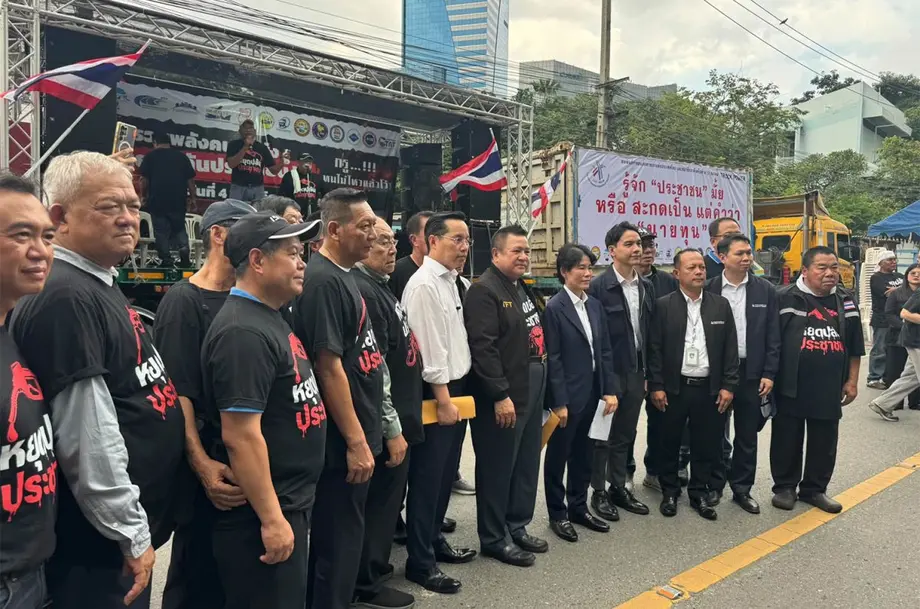
Thai transport operators demanded a diesel price cap of 35 baht per litre for one year at a rally outside the Ministry of Energy in Bangkok on November 4, 2026, giving the government about 60 days to respond. Standard B7 diesel was selling for 42.54 baht per litre after a recent reduction of one baht, leaving a gap of 7.54 baht between the pump price and their proposed ceiling.
Contents
- A fuel price dispute brings trucks to the ministry
- What a 35-baht cap would change
- A protest built on an earlier campaign
- The demands reach beyond pump prices
- The ministry points to savings already made
- Why cheaper blends have not settled the dispute
- Investigators pursue alleged fuel hoarding
- A March order forms part of the timeline
- What officials face before the deadline
- Key Points
The Land Transport Federation of Thailand and 13 allied associations submitted demands covering fuel taxes, refinery margins, alleged hoarding and the way Thailand calculates energy prices. Federation president Thongyu Khongkhan warned that a lack of progress during November and December could bring between 500 and 1,000 trucks into Bangkok.
The confrontation combines an immediate demand for cheaper diesel with a broader argument about who bears the cost of expensive energy. Thongyu said assistance must reach people across the country, and that the federation would reject a package restricted to transport and logistics businesses.
Energy Ministry officials accepted the petition and promised to put it before Energy Minister Akanat Promphan. They also defended measures already taken, citing annual consumer savings of 10.8 billion baht from changes to fuel pricing and almost 32 billion baht in excess refinery gains used to reduce prices.
What a 35-baht cap would change
The federation said diesel had risen by more than eight baht per litre, increasing operating costs while households were also dealing with flooding. At the November 4 price of 42.54 baht, bringing standard B7 diesel down to 35 baht would mean a reduction of about 17.7%.
A purchase of 1,000 litres illustrates the difference: it would cost 42,540 baht at the stated B7 price and 35,000 baht at the proposed ceiling, a saving of 7,540 baht. For businesses buying fuel repeatedly, the price per litre directly affects the money needed to keep vehicles moving.
B20 diesel was already cheaper than the requested ceiling, at 33.50 baht per litre, while premium diesel stood at 49.05 baht. The different prices matter because the federation is seeking changes across the fuel system rather than accepting cheaper access to one blend as a complete answer.
B7 and B20 identify diesel blends containing different proportions of biodiesel. E20, another fuel promoted by the ministry, is a petrol blend containing ethanol. A cheaper blend is useful only where vehicles can use it, making the price of standard diesel a central concern for truck operators.
A protest built on an earlier campaign
Thongyu described the Bangkok rally as an escalation of the federation's earlier Truck Power campaign in Chon Buri. He said the government had not given a clear response to previous demands, while rising fuel costs had deepened hardship for people recovering from flooding.
Trucks carried banners criticising major energy businesses. Organisers placed a coffin and funeral flowers outside the ministry as symbolic gestures, and transport representatives and a civil society network joined the gathering.
Speakers included Atavit Suwanpakdee, a party list MP and deputy leader of the United Thai Nation Party, and ML Kornkasiwat Kasemsri, an energy academic and deputy leader of the Palang Pracharath Party. Energy specialists and business representatives also addressed the rally.
Thongyu said the federation did not want to disrupt traffic, but would consider working with other protest groups or organising a large truck convoy if the government failed to act. His demand for nationwide relief places the dispute beyond a negotiation over support for freight companies alone.
The demands reach beyond pump prices
The federation presented a package described as 10 demands. Alongside the diesel ceiling, it called for changes to the oil and energy pricing structure, removal of imputed costs, a reduction in fuel excise duty to 5% and a review of refinery margins.
Imputed costs are amounts assigned within a pricing calculation rather than a simple record of a particular cash payment. Refinery margins describe the difference between the value of refined fuels and the crude oil used to produce them; refineries also have operating expenses to meet. Both have become points of contention over how much consumers should pay.
The federation also sought price controls on fuel, an investigation into more than 700 million litres of allegedly missing oil, dissolution of the Energy Regulatory Commission and creation of a national strategic oil reserve. Such a reserve would hold fuel for release during a serious supply disruption.
Thongyu urged Akanat to act more firmly against powerful energy businesses and people suspected of hoarding. He argued that tax reductions for B20 and E20, or removal of imputed costs alone, would leave the deeper pricing problems unresolved.
The package combines several different decisions. A price ceiling limits what buyers pay, a tax reduction lowers government revenue from fuel, and an investigation pursues suspected offences. The proposal to abolish a regulator would involve institutional change, while a strategic reserve would require arrangements for buying, storing and releasing oil.
The ministry points to savings already made
Ministry spokesperson Pongpol Yodmuangcharoen said the government had already removed so-called phantom costs that had been included in fuel pricing for more than 22 years. He put the resulting reduction in the burden on consumers at 10.8 billion baht annually.
Pongpol also valued excess refinery gains used to lower prices at almost 32 billion baht. He said the ministry would continue monitoring those gains so they could help reduce the prices charged when fuel leaves refineries, before it moves through the distribution chain to filling stations.
The two figures describe different measures: 10.8 billion baht is an annual savings estimate, while the almost 32 billion baht figure is the stated value of refinery gains applied to price reductions. The ministry's response focused on changes already made; the federation's demand focused on whether the resulting pump prices were affordable.
Pongpol, explaining the ministry's response to complaints about fuel pricing, pledged greater transparency:
The Ministry of Energy will tackle the lack of transparency to make the pricing structure as fair as possible,
The spokesperson said Akanat understood the financial pressure on transport operators. He also said further excise reductions required consideration of future financial commitments, placing the operators' call for lower taxes alongside the government's spending obligations.
Why cheaper blends have not settled the dispute
The ministry has promoted B20 biodiesel and E20 gasohol as a way to reduce crude oil imports, according to Pongpol. Using more fuel made partly from biological materials can reduce the proportion supplied by petroleum, while tax policy can help determine the price paid at the pump.
Thongyu's objection was about the reach of that relief. He said cuts for particular blends and changes to selected pricing components were insufficient, and insisted that assistance should benefit the wider public rather than a single industry.
For transport businesses, diesel is a recurring expense in moving goods. Higher fuel costs can put pressure on delivery charges and business budgets, although the effect on any individual product depends on how it is transported and how much of the extra cost businesses absorb.
The federation's proposed ceiling would require a decision about how the gap between the permitted retail price and the cost of supplying fuel would be covered. Ministry officials promised to consider the proposals, but announced neither an approved diesel cap nor a financing plan for maintaining one for a year.
Investigators pursue alleged fuel hoarding
Thitiphat Chotdechachaiyanan, secretary to the energy minister, said legal proceedings concerned 24 suspects allegedly involved in fuel hoarding and price speculation in March. Six had been formally charged. The suspects included oil traders operating under Section 7 of the Fuel Trade Act.
The ministry planned discussions involving the Department of Special Investigation, known as DSI, and the Department of Energy Business in the week beginning November 9. Officials intended to review whether more evidence or documents were needed to accelerate the cases.
The federation demanded an investigation into more than 700 million litres of allegedly missing fuel. In a case in Surat Thani, investigators found 57 million litres of diesel unaccounted for during transit. The relationship between that transit case and the federation's larger figure was not specified.
Thailand's average daily diesel consumption was put at about 65 million litres. On that basis, 57 million litres is equivalent to roughly 88% of one day's diesel use, while 700 million litres would exceed 10 days of diesel consumption. Those comparisons show why the quantities have become a major part of the protest.
Combined daily consumption of diesel, petrol and gasohol was put at about 100 million litres. The federation's demand for an accounting of missing fuel therefore concerns volumes large enough to matter to national supply, as well as to the criminal investigations.
A March order forms part of the timeline
Prime Minister Anutin Charnvirakul said on March 20, 2026, that he had signed an order to address fuel shortages linked to conflict in the Middle East. The order directed cooperation among the Justice Ministry, DSI, the Royal Thai Police and the Department of Provincial Administration against unjustified hoarding.
Police had inspected a major fuel distributor in Ang Thong after complaints from residents and transport operators about suspected hoarding and unauthorised price increases. Anutin said comparisons of daily production and consumption showed a small discrepancy requiring investigation. He also referred to stockpiling of 300,000 litres as going beyond emergency or necessary storage.
The dispute now stretches across several stages:
- March 20, 2026: Anutin announced an order coordinating action against unjustified fuel hoarding amid disruption linked to the Middle East conflict.
- Before November 4: The transport federation held its Truck Power campaign in Chon Buri and sought government action on fuel costs.
- November 4: The federation and 13 allied associations rallied outside the Energy Ministry in Bangkok and submitted their demands.
- Week beginning November 9: The ministry planned talks with DSI and the Department of Energy Business about the March cases.
- November and December: The federation gave the government about 60 days to respond before considering stronger protests.
In March, Anutin said crude oil import channels were functioning and that the government would continue using its authority during the transition to a new cabinet to deal with necessary fuel matters. By November, transport operators were pressing for both faster enforcement and a much broader change in prices.
What officials face before the deadline
Thitiphat said the operators' proposals would be submitted promptly to Akanat. A meeting between the minister and operators was expected during the week beginning November 2 or November 9, with the latter week also identified for discussions on the investigation.
The minister's secretary attributed part of the cost pressure to overseas fighting lasting more than eight months. She said global oil prices had risen to two to three times their 2022 levels during the Russia–Ukraine war, placing international conditions alongside the domestic pricing dispute in the ministry's explanation.
Thongyu's deadline makes the government's immediate task concrete: explain which demands it will accept, what relief consumers will receive and how quickly decisions can take effect. The federation has sought action across taxation, regulation, fuel stocks and criminal enforcement, requiring more than a single adjustment at filling stations.
For drivers, businesses and households, the most immediate measure will be the price of fuel. For Bangkok, the next consequence could be a convoy of up to 1,000 trucks if the federation decides the response is inadequate at the end of its November and December window.
Key Points
- The Land Transport Federation of Thailand and 13 allied associations rallied in Bangkok on November 4, 2026.
- They demanded a diesel ceiling of 35 baht per litre for one year, against a stated B7 price of 42.54 baht.
- The federation gave the government about 60 days and threatened a convoy of 500 to 1,000 trucks if progress was insufficient.
- The ministry cited 10.8 billion baht in annual savings from removing phantom costs and almost 32 billion baht in refinery gains used to lower prices.
- Officials reported proceedings involving 24 suspects in alleged fuel hoarding and speculation, with six formally charged.
- Planned talks in the week beginning November 9 would review evidence and documents needed to advance the investigations.