A bigger bed, a later arrival
Singapore Airlines plans to introduce first class beds measuring 80 inches long and 60 inches wide as part of an investment exceeding S$2 billion, about US$1.6 billion, in its long distance cabins. The first aircraft with the redesigned interiors is expected to enter service in the second half of 2027, following further delays involving seat approvals and aircraft certification.
Contents
- A bigger bed, a later arrival
- What makes the first class bed different?
- Business class changes how passengers sleep
- Why the new colours drew criticism
- What changes in premium economy and economy?
- Fewer seats on the longest flights
- Certification sets the timetable
- Meals, screens and airport lounges join the revamp
- A costly contest for premium passengers
- Key Points
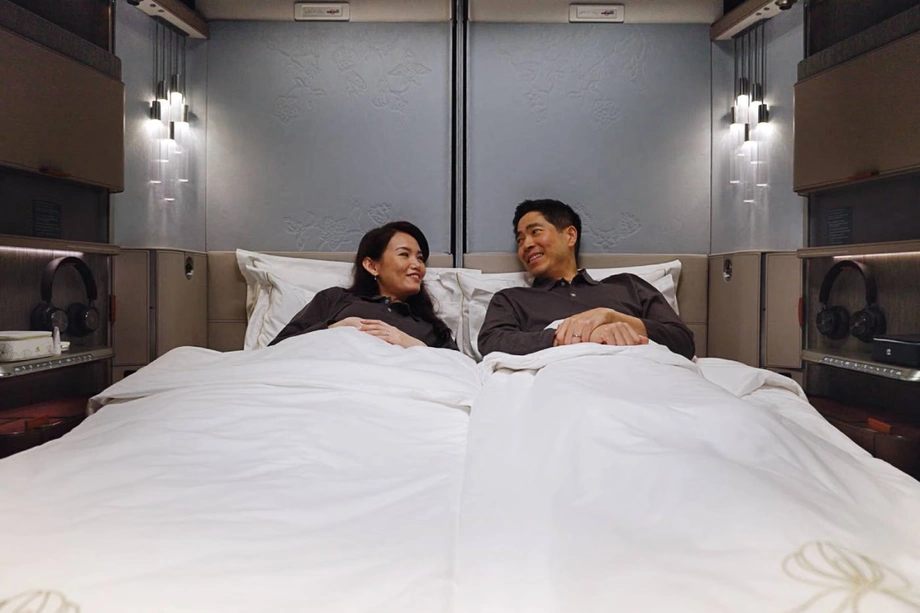
Unveiled on November 6, 2026, the programme covers 41 Airbus A350-900 aircraft scheduled for refurbishment and 31 incoming Boeing 777-9 jets, a total of 72 aircraft. Its most visible feature is a pair of adjoining first class suites that can become a shared sleeping space matching the dimensions of a standard queen mattress in the United States.
The changes extend beyond the most expensive seats. Business class gains sliding privacy doors and a central footwell, premium economy on the 777-9 gets more space between rows, and economy receives new storage, entertainment screens and a redesigned recline mechanism.
Singapore Airlines is also adding first class to its A350-900ULR fleet for the first time. ULR means ultra long range, the version used on nonstop journeys between Singapore and New York that can last about 19 hours. Those aircraft will carry fewer passengers after refurbishment, with more of the cabin devoted to suites and business class.
The announcement combines a product launch with a revised timetable. The new seats have been in development since 2018, and their original intended home, the Boeing 777-9, is still awaiting aircraft certification. Singapore Airlines has expanded the project to its existing Airbus fleet while waiting for the Boeing jets.
What makes the first class bed different?
Each new first class bed measures 80 inches by 30 inches. In the centre suites, two beds can join to create a surface measuring about 203 centimetres by 152 centimetres. Singapore Airlines describes it as the largest double bed in commercial aviation.
The width is the central selling point. Some competing airline beds reach 82 inches in length, compared with Singapore Airlines' 80 inches. For another familiar comparison, the proposed shared bed is about 13 centimetres longer and 17 centimetres wider than a standard British double mattress measuring 190 centimetres by 135 centimetres.
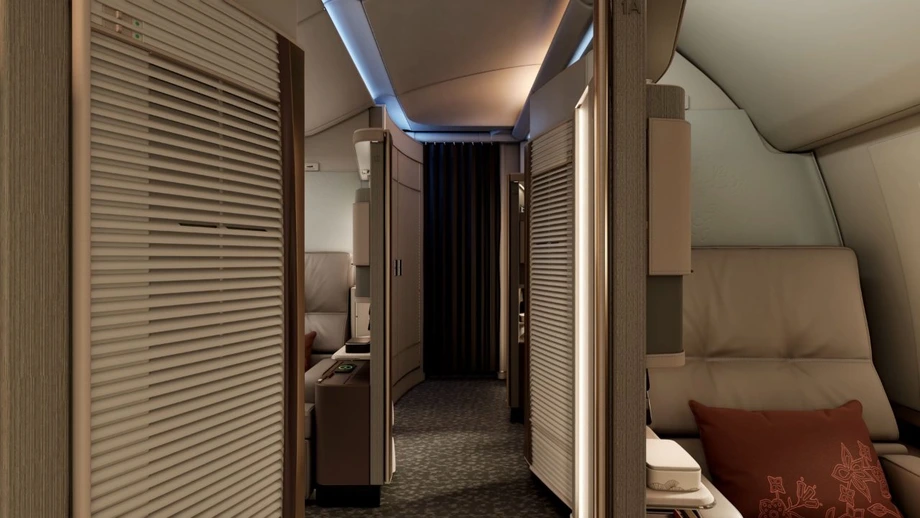
Passengers travelling together can open the divider between the centre suites to share space for relaxing or dining. The adjoining seats can also become a sofa for two. Curved sliding doors and full height central dividers allow the space to return to separate private suites.
PriestmanGoode designed the first class interiors, which feature Poltrona Frau leather, personal wardrobes and dedicated storage. Each suite has a 32 inch 4K entertainment screen, while an ottoman provides a seat for a dining companion. Bedding includes cotton sheets, duvets, a choice of pillows and mattress toppers from German company Paradies.
Ong Wah Li, Singapore Airlines' vice president for product experience, explained how the curved layout was intended to make the space feel less confined:
It's not about compromising, it's about designing the space.
The Boeing 777-9 will have six first class suites, including one central pair. The A350-900ULR will have four suites in a 1-2-1 arrangement, meaning one beside each window and two in the middle, with direct access to an aisle from every suite.
Business class changes how passengers sleep
Business class receives some of the most practical changes in the programme. The new seats recline into a flat bed without requiring passengers to flip over the backrest, and the footwell moves from the side to the centre. That allows passengers to stretch their legs forward rather than sleep at an angle.
Singapore Airlines said requests for a central footwell featured prominently in a survey of 5,000 frequent flyers. Its wider design research involved travellers, customers, staff and industry specialists.
Designworks, part of the BMW Group, developed the business class product with Singapore Airlines and seat manufacturer Recaro. Beds measure up to 79 inches long and 24 inches wide. Sliding doors, adjustable lumbar and leg support, and an electronically operated divider between central seats provide more control over comfort and privacy.
Selected central seats can become companion beds for people travelling together. Wireless phone charging, USB-C ports, additional storage and entertainment screens measuring up to 22 inches, depending on the aircraft, are also part of the design.
Smart controls linked to myKrisWorld will let first and business class passengers save preferred seat positions and lighting settings for later flights. The system is intended to reduce the adjustments needed each time a passenger settles into a familiar seat.
Why the new colours drew criticism
The business class cabin's grey and yellow palette prompted a much sharper reaction than the warmer first class interiors. Travel content creator Max Do compared the seats with furniture in medical or dental offices and criticised their appearance.
Ben Schlappig, a travel blogger, praised the first class design as elegant and consistent with Singapore Airlines' brand, while objecting to the business class finishes. Other people who tried the demonstration seats welcomed their privacy, comfort and practical controls.
Singapore Airlines responded on November 11. An airline spokesperson explained the thinking behind the materials and adjustable cabin lighting:
The colours, materials, and finishes were carefully selected to create a fresh, contemporary, and refined ambience, complemented by adjustable in-flight LED lighting throughout the journey.
Zach Griff, an aviation expert and travel newsletter author, focused on changes to the existing business class experience. He identified cramped footwells, the need to flip the seat into a bed, and bed firmness as three major passenger complaints.
Griff said the replacement addresses those problems:
This product fixes all three of those issues, and that's a big deal in and of itself.
Julien Cayla, associate professor of marketing at Nanyang Business School, said the intensity of the reaction reflected a strong attachment to the airline's brand. The debate leaves Singapore Airlines balancing a recognisable visual identity with a design intended to work better for sleeping, working and travelling with a companion.
What changes in premium economy and economy?
The incoming 777-9 will carry all four redesigned cabin classes. On the existing A350-900 fleet, the seat refurbishment centres on business class, with first class also being added to the ULR version. Passengers choosing a flight for the new premium economy or economy seats will therefore need the Boeing aircraft.
Premium economy on the 777-9 gains a seat pitch of 40 inches, up from 38 inches, and recline increases from 8 inches to 9 inches. Pitch measures the distance between the same point on successive seats and gives a useful indication of the space allocated to each row.
Factorydesign worked on the premium economy and economy cabins. Premium economy includes adjustable leg rests, headrests adjustable in four directions, a bottle holder, storage beneath the armrest and a separate cocktail tray. Screens measure up to 16 inches. The cabin will contain 36 seats arranged 2-4-2.
Economy will have 204 seats, mainly arranged 3-4-3, with pitch of 31 to 32 inches and recline of up to 6 inches. A new recline mechanism is intended to increase knee and shin clearance. Adjustable headrests, cupholders, coat hooks and divided pockets beneath the screen provide places for small belongings.
The economy screens measure up to 13 inches. A secondary display will show information such as Wi-Fi status and lavatory availability, allowing passengers to check flight details while keeping entertainment on the main screen.
The proposed 777-9 layout also means more seats across most economy rows than on Singapore Airlines' 777-300ER, which uses a 3-3-3 arrangement. The two aircraft have different cabin dimensions, while the published seating plans show a concrete change from nine to ten passengers across a typical row.
Fewer seats on the longest flights
The A350-900ULR refurbishment will reduce capacity from 161 passengers to 132, a loss of 29 seats, or about 18%. The new layout has four first class suites, 70 business class seats and 58 premium economy seats. The ULR aircraft will continue to operate without an economy cabin.
First and business class together will account for 74 of those 132 seats, about 56%. For passengers on journeys approaching 19 hours, that means more than half the aircraft will offer a flat bed with a privacy door.
The 777-9 follows a different balance. Its planned 300 seats comprise six in first class, 54 in business, 36 in premium economy and 204 in economy. First and business account for 20% of seats; including premium economy brings the share outside economy to 32%.
The comparable Singapore Airlines 777-300ER layout has 264 seats: four first class, 48 business, 28 premium economy and 184 economy. The 777-9 therefore adds 36 seats, including two more first class suites and six more business class seats.
Singapore Airlines has not announced which routes will receive the new cabins first. Introducing first class to the ULR fleet creates a new option for its longest nonstop services, while the timing of individual flights will depend on aircraft assignments and the refurbishment schedule.
Certification sets the timetable
Singapore Airlines' chief commercial officer, Lee Lik Hsin, said the seats intended for the 777-9 have received certification, while the aircraft itself has not. The A350 seats still require approval. Each aircraft type has its own approval process, so clearance for one installation does not carry over to the other.
Certification is the formal process through which aviation authorities check whether an aircraft or installed equipment meets safety requirements. Supply chain constraints have also contributed to the revised entry date.
The programme's main milestones show how long the airline has been waiting to introduce the designs:
- 2018: Development of the new cabin products began.
- 2021: The cabins had originally been intended to debut on the Boeing 777-9 as early as this year.
- November 2024: Singapore Airlines announced a S$1.1 billion refurbishment plan for 41 A350 aircraft.
- November 6, 2026: The airline unveiled the designs and confirmed an expected debut in the second half of 2027.
- End of 2030: The A350 refurbishment programme is expected to be complete.
Lee said the later introduction should not change the expected completion date for the A350 programme because the immediate problem concerns approval rather than the airline's ability to carry out the refurbishment work.
The 31 Boeing 777-9 aircraft are expected to become a central part of the airline's future long distance fleet, replacing older aircraft as the A380 eventually retires. Deliveries are expected to begin in 2027, subject to aircraft certification.
Meals, screens and airport lounges join the revamp
The next generation KrisWorld entertainment system brings 4K touchscreens, spatial audio and Bluetooth audio pairing across the cabins. Spatial audio creates a sense of sound coming from different directions, while Bluetooth pairing lets passengers connect compatible personal headphones without a cable.
Passengers will be able to view flight maps and wellness planners while continuing to watch entertainment. First class will also receive Bang & Olufsen wireless headphones. Singapore Airlines plans to begin introducing Starlink internet connectivity in early 2027.
More than 100 new and refreshed appetisers, main courses and desserts are being introduced across the airline's cabins. Indian chef Sanjeev Kapoor's Shahi Thali and Ruchi Thali are among the dishes for first and business class.
The participating chefs also include Monica Galetti, Nandu Jubany, Sid Sahrawat, Yoshihiro Murata and Zhu Jun. The menu changes extend to economy, although dishes and ingredients vary by cabin.
Business class passengers will receive sleeper suits for the first time. Updated amenity kits will include products from Sisley, Byredo and Ink & Water. On the ground, Singapore Airlines has invested more than S$130 million in renovating, refreshing and expanding SilverKris lounges worldwide, including a S$45 million commitment at Changi Airport's Terminal 2.
A costly contest for premium passengers
The S$2 billion investment includes the S$1.1 billion A350 refurbishment plan announced in 2024. Lee said Singapore Airlines would fund the work internally, drawing on a cash balance that stood at S$9.1 billion at the end of June 2026.
Premium demand helps explain the spending. International Air Transport Association figures put international first and business class passenger numbers at 109.7 million in 2025, an increase of 4.5%. Those passengers represented 5.5% of international travellers.
Singapore Airlines is competing with Emirates' refurbishment programme valued at US$5 billion, Air France's redesigned La Première cabin and British Airways' planned first class upgrade for its A380s. Rivals are spending heavily on the same combination of privacy, sleep and personal space.
Lee said demand for premium travel increasingly includes leisure passengers, families and parents sending children to university, alongside corporate customers. He also said first and business class seats cost much more per unit than economy seats, explaining why premium cabins absorb much of the investment.
Singapore Airlines says fares will not increase simply because a flight has the new seats. Lee said ticket prices depend on supply and demand. The airline has set no specific financial return target for the investment, instead expecting a better passenger experience to support operating performance.
The commercial choice is most visible on the ULR aircraft: Singapore Airlines is removing 29 seats while introducing first class and expanding business class to 70 seats. Passengers gain more private sleeping space, while the airline places greater weight on selling fewer, more expensive seats on its longest journeys.
Key Points
- Singapore Airlines is investing more than S$2 billion, about US$1.6 billion, in new cabins across 72 aircraft.
- The first redesigned aircraft is expected in the second half of 2027; A350 refurbishments are scheduled to finish by the end of 2030.
- Adjoining first class suites can form a bed measuring 80 inches by 60 inches.
- Business class gains sliding doors, central footwells, flat beds and saved seat settings.
- The 777-9 receives all four new cabin types; A350 upgrades focus on business class and first class for the ULR fleet.
- A350-900ULR capacity falls from 161 to 132 seats, including four first class suites.
- The airline has not named the first routes and says refurbishment alone will not determine fares.