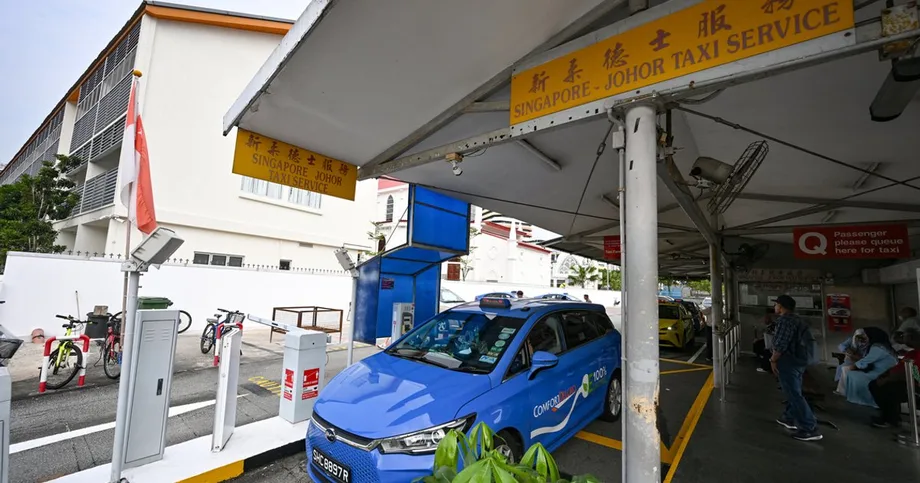
More licensed taxis and three booking platforms from November 16
Singapore and Malaysia will each raise their quota of licensed cross-border taxis from 300 to 500 on November 16, 2026, allowing a combined fleet of up to 1,000 vehicles. Singapore's CDG Zig and Malaysia's Kumpool will also receive licences to join GrabCar in providing bookings under the enhanced Cross-Border Taxi Scheme.
Contents
- More licensed taxis and three booking platforms from November 16
- How the quota grew from 200 to 500
- Where passengers can be dropped off
- Why pickup rules still depend on the taxi
- What Zig and Kumpool bring to bookings
- What passengers currently pay
- More flexibility for families and business travellers
- Licensed services ahead of holiday travel
- Key Points
The changes, announced by the two transport ministries on November 6, add room for 400 taxis across the scheme, an increase of about 67% from the current combined ceiling of 600. They complete a staged expansion towards a target first announced on December 5, 2025.
Passengers will have three licensed booking platforms instead of one, alongside a larger permitted taxi fleet. The expansion builds on changes introduced in May that allowed more flexible drop-offs, added designated pickup points and increased the availability of larger and premium vehicles for families and business travellers.
Singapore's Land Transport Authority chief executive, Ng Lang, explained the intended benefit of expanding licensed services:
By expanding the availability of licensed cross-border services, we are giving travellers more options and greater flexibility for their journeys.
How the quota grew from 200 to 500
Singapore and Malaysia have increased the quota in two stages. Before the May overhaul, each country could license 200 cross-border taxis. That rose to 300 on May 4, with the additional places prioritising larger and more premium vehicles.
November's increase adds another 200 places per country. Compared with the combined ceiling of 400 before May, the new ceiling of 1,000 is two and a half times as large. A quota is the maximum number of taxis permitted under the scheme; the number available for a particular journey depends on vehicles and drivers operating at that time.
The main steps in the expansion are:
- December 5, 2025: Both transport ministries announced a target of 500 licensed cross-border taxis per country.
- May 4, 2026: The quota rose from 200 to 300 per country as broader service changes were introduced.
- November 6, 2026: The ministries announced the next quota increase and licences for CDG Zig and Kumpool.
- November 16, 2026: The ceiling rises to 500 per country, and the two additional booking operators are to be licensed.
Where passengers can be dropped off
Licensed cross-border taxis previously had to use a single designated point in the other country for both picking up and dropping off passengers. Travellers whose destination was elsewhere then needed to arrange another part of the journey.
The enhanced scheme allows passengers to be dropped off anywhere in Singapore. In Malaysia, drop-offs are permitted within designated operating boundaries covering Johor Bahru, Iskandar Puteri, Forest City, Kulai and Senai.
A traveller heading to an address within those Malaysian operating areas can therefore finish the taxi journey at that destination rather than at the terminal. Someone travelling in the opposite direction can be dropped off at a destination across Singapore.
The ministries said passengers who had used the enhanced services responded positively to this flexibility. For families carrying luggage or business travellers heading to a meeting, reaching the destination directly can remove the need to find another vehicle after the border crossing.
Why pickup rules still depend on the taxi
Pickup arrangements remain more restricted than drop-offs. A licensed taxi can collect passengers without location restrictions in its home country. When operating in the neighbouring country, it must collect passengers at designated locations.
A Singapore taxi can therefore pick up a passenger at an address in Singapore for a permitted trip into Malaysia. For a pickup in Malaysia, that taxi must use an approved location. Malaysian taxis operate under the corresponding arrangement when collecting passengers in Singapore.
May's changes added three designated pickup points in each country, giving travellers more places to begin a return journey. The rules make the taxi's country of registration relevant when arranging a pickup, even though the destination may qualify for a direct drop-off.
The May overhaul also introduced additional requirements to support enforcement against illegal domestic trips. Those are journeys carrying passengers between two points within the neighbouring country, rather than transporting them across the border. The scheme's operating rules preserve its focus on travel between Singapore and Malaysia.
What Zig and Kumpool bring to bookings
CDG Zig, part of Singapore's ComfortDelGro group, and Malaysia's Kumpool will join GrabCar as licensed operators under the scheme. Their entry expands the number of platforms through which passengers can arrange an authorised cross-border taxi journey.
Michael Huang, head of Singapore point-to-point mobility business at Zig by ComfortDelGro, welcomed the award of its Cross-Border Ride-Hail Service Operator Licence and the increase in taxi licences. He described the company's preparations:
This will improve convenience for travellers between Singapore and Malaysia. We will work with the authorities and our drivers to operationalise the licences safely and reliably.
Zig said it would announce fare details later. Kumpool's fares and detailed booking arrangements were also not specified in the announcement. November 16 is the stated licensing date for both operators.
Grab's existing service already offers a shorter advance booking requirement than at its introduction. Passengers can now book a cross-border ride 90 minutes ahead, compared with the initial requirement of 12 hours. That reduces the planning time needed for travellers who cannot confirm their departure far in advance.
What passengers currently pay
The May overhaul also increased fixed fares. A taxi with four passenger seats travelling from Ban San Street Terminal in Singapore's Bugis area to Larkin Sentral Terminal in Johor Bahru, or a destination within the stated 35km range, costs S$80, up from S$60.
The corresponding journey from Larkin towards Ban San costs RM240, compared with RM120 previously. Those changes represent an increase of one third for the Singapore departure fare and a doubling of the fare for the reverse direction.
Grab's cross-border bookings cost more than a street hail journey from Ban San, while allowing a pickup at an address in Singapore and a drop-off within the permitted Malaysian operating area. Passengers are paying for a different journey arrangement as well as the crossing itself.
The fare comparison therefore involves more than choosing a booking platform. A terminal departure and a journey beginning at a home or workplace have different starting points. For a family or group, the relevant choice includes the total fare, vehicle size and any additional travel needed to reach the pickup location.
More flexibility for families and business travellers
Larger and premium vehicles were a priority when the quota first increased in May. The authorities identified families, larger groups and business travellers as users whose needs could be better served by a wider choice of vehicles.
A group travelling together may need more seating or luggage space than a standard taxi provides. A business traveller may value being collected near a workplace and dropped at a meeting address. The expanded scheme brings vehicle choice and more flexible destinations into the same licensed service.
Malaysia's Land Public Transport Agency, known as APAD, described the expansion as supporting the first and last parts of journeys between Johor Bahru and Singapore. In everyday terms, those are the links between someone's actual starting point, the main transport journey and the final destination.
APAD director-general Ahmad Radhi Ma'arof welcomed both the larger quota and the additional operators as a milestone for passenger movement. LTA and APAD officials have continued working together to identify further improvements to the services.
Licensed services ahead of holiday travel
Licensed taxis previously faced competition from illegal cross-border operators offering collection from homes and direct travel to a destination. More flexible drop-offs and additional pickup locations give authorised services greater scope to meet those passenger needs.
The ministries said the changes were intended to improve convenience while ensuring fairer operating conditions for transport providers and drivers in both countries. The policy combines a larger licensed fleet with rules governing where taxis may collect passengers and which journeys they may undertake.
Singapore's Senior Minister of State for Transport, Sun Xueling, said earlier improvements had received positive feedback. With the year end holidays approaching and travel demand potentially increasing, she urged passengers to plan ahead and use licensed cross-border taxis for safety.
For travellers, November 16 brings a higher taxi quota and two more licensed booking operators. Their practical choices will still depend on pickup location, destination, vehicle availability and the fare offered for the journey.
Key Points
- Singapore and Malaysia will each raise their cross-border taxi quota from 300 to 500 on November 16, 2026.
- The combined ceiling will rise from 600 to 1,000 licensed taxis, an increase of about 67%.
- CDG Zig and Kumpool will join GrabCar as licensed booking operators.
- Drop-offs are allowed anywhere in Singapore and within designated areas covering Johor Bahru, Iskandar Puteri, Forest City, Kulai and Senai.
- Taxis collecting passengers in the neighbouring country must use designated pickup locations.
- Grab bookings require at least 90 minutes of advance notice; Zig will announce its fares later.