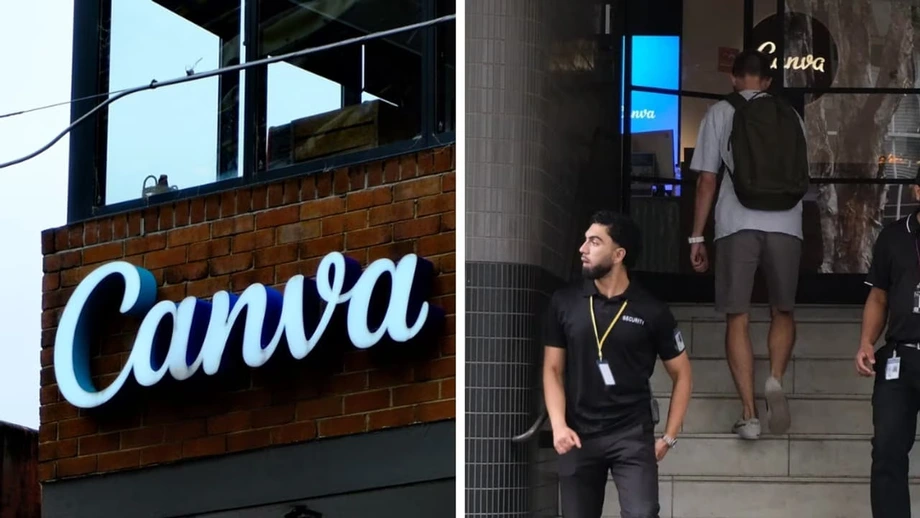
Nearly a quarter of Canva staff face changes
Canva is restructuring roles affecting 1,271 employees, or 22% of its workforce, while promising departing staff at least six months of salary, continued support and the chance to apply for US$10,000 grants to start businesses or community projects.
Contents
- Nearly a quarter of Canva staff face changes
- What departing employees will receive
- A grant fund and help finding another role
- Why Perkins wants smaller teams
- Sydney becomes a larger centre for product work
- Growth is continuing, but below earlier ambitions
- AI brings new products and new costs
- Investors have lowered their valuations
- The dates employees need to know
- Key Points
The changes, shared with employees in Australia on November 4, 2026, include redundancies, reassignment and requests to relocate. Canva has not disclosed how many of the 1,271 people will leave or which countries and teams face the largest reductions. The company employs more than 5,700 people across 37 countries, including India.
Co-founder and chief executive Melanie Perkins is combining Canva's Product, Growth and Platform teams, reducing management layers and making Sydney the main base for more product teams. Most hybrid employees will be expected to work from an office two to three days a week from January 2027.
The restructuring follows a cut in Canva's forecast for revenue growth in 2026, from 30% to 20%, after the cost of delivering artificial intelligence features prompted slower product rollouts. Perkins told employees that growth had slowed for the first time in a decade.
Perkins said the company had considered alternatives before deciding that its structure needed a larger change:
After exploring a wide range of alternatives, I've come to the difficult conclusion that small changes won't be enough.
For employees, the announcement creates several different decisions at once: finding another job, accepting a broader role or moving closer to a company hub. Canva's support package addresses the immediate transition, while its reorganisation changes how the remaining workforce will build and deliver products.
What departing employees will receive
Canva says everyone leaving through the restructuring will receive at least six months of salary, regardless of location. That amount includes statutory entitlements, meaning payments required under local employment law form part of the stated package.
Healthcare coverage will continue for 12 months in countries where Canva already provides that benefit. Employees and their families will also retain 12 months of access to Canva Care, the company's employee assistance programme.
Departing employees can keep their company MacBooks and will receive a year of LinkedIn Premium. Career assistance includes individual coaching, interview preparation and resume reviews, with members of Canva's Talent Acquisition team helping people prepare for their next applications.
Canva is also removing the usual one year vesting cliff for employees who joined within the past year. A vesting cliff is the minimum period someone normally needs to work before gaining rights to an initial portion of their promised company shares. Removing it gives recent recruits access to equity benefits earlier than the usual rules would allow.
The package combines money for living expenses with practical resources for finding work. A retained laptop can support applications and interviews, while continued healthcare and family assistance extend beyond an employee's final working day.
A grant fund and help finding another role
The Canva Collective Fund will offer US$10,000 grants to departing employees who want to start a business or undertake a community project. Employees have until December 14 to register their interest.
Perkins explained the purpose of the fund in her message to employees:
Whether it's starting a business or doing something meaningful for their local community, the fund is designed to help get those ideas off the ground,
Canva says it will take no ownership or equity in ventures created with the grants. Equity means a share of ownership in a business, so recipients will retain ownership rather than giving Canva a stake in exchange for funding.
Employees seeking another job can choose to join a talent directory that Canva will share with investors, partners and its wider industry network. Participation is voluntary, allowing departing staff to decide whether they want their details circulated.
Canva is keeping Slack and Gmail access available until the end of the announcement week so employees can contact colleagues and arrange how to communicate their departure. The company also cancelled meetings considered nonessential for the rest of that week and allowed staff to take the day off without recording leave.
Why Perkins wants smaller teams
Canva will bring Product, Growth and Platform together in a single Product organisation. The plan also reduces narrow specialisations, combines overlapping responsibilities and removes layers between employees and decisions.
Perkins said Canva's expansion had divided responsibility across too many teams. Work that contributes to a single feature could involve several groups, each responsible for only one part, making coordination harder.
Perkins described the intended change in direct terms:
We want to get back to spending more time building, and less time navigating how work gets done.
Smaller teams with broader responsibility are central to her proposal to "refound" Canva. Employees remaining in the business may take responsibility for a wider range of work, with fewer handovers between specialists and more decisions made within their teams.
The restructuring therefore reaches beyond the number of people leaving. It changes who owns a project, how decisions move through the company and the mix of skills Canva expects employees to bring to their roles.
Sydney becomes a larger centre for product work
Sydney will become the primary base for more product teams and certain other specialties where Canva wants closer collaboration. Employees asked to move will receive relocation support.
Most hybrid staff will be expected in an office two to three days each week from January 2027, depending on their location and role. For a company with teams in 37 countries, concentrating more work in selected hubs is a substantial change in how employees collaborate.
Canva is also building an office near Sydney's Central Station at a reported cost of more than $120 million. The construction provides a physical backdrop to the decision to bring more closely connected teams together in the city.
Employees whose roles move to Sydney may have to weigh relocation against family commitments, housing arrangements and professional plans. Those staying in hybrid roles will need to prepare for a regular office schedule as the new year begins.
Growth is continuing, but below earlier ambitions
Canva reduced its forecast for revenue growth in 2026 from 30% to 20% in August. That is a reduction of 10 percentage points, or one third of the growth rate it had previously expected.
The company slowed AI product rollouts to address high computing costs. Generative AI needs computing resources to create or edit content whenever a user submits a request. Across millions of users, the cost of serving those requests becomes a major operating expense.
Canva's June quarter revenue rose 25.2% from a year earlier to US$921.9 million. The company ended June with US$1.47 billion in cash and had recorded nine profitable years.
Internal figures described in reporting also showed monthly active users falling by 12 million compared with the same point in 2025. A monthly active user is someone who uses a service during a month, a measure companies use to track the size of their regular audience.
Revenue growth, user activity and cash reserves describe different parts of the business. Canva is still generating substantial sales, while its reduced forecast and falling user count put pressure on management to deliver products more efficiently and attract people back to the platform.
AI brings new products and new costs
Canva is investing in AI while competing with image generation tools from OpenAI and Google, including ChatGPT and Gemini, as well as businesses focused on AI design. Users can increasingly generate images, presentations and marketing material by describing what they want.
Canva AI 2.0 allows users to create and revise layered, editable designs through conversations with an assistant. Layers keep elements such as images, text and backgrounds separate, allowing a person to change individual parts of a design after it has been generated.
The company has also announced two models developed internally: Brush, for editing designs, and Craft, for generating images. These investments form part of Canva's effort to reduce dependence on outside AI providers and control more of the technology behind its products.
Canva announced an OpenAI agreement immediately before the restructuring, seeking further cost reductions. It also said it had already reduced the cost of serving an AI task by 90%.
Those developments capture the business challenge behind the workforce changes. Canva wants AI features that make designing easier, but it also needs to deliver them at a cost that supports continued growth. Its new structure is intended to put more responsibility for building those products inside fewer, more autonomous teams.
Investors have lowered their valuations
Blackbird and Airtree marked Canva's valuation down by 17% to US$34.9 billion from a peak of US$42 billion. A separate valuation used for employee shares was US$31 billion.
Canva is privately held, so these figures come from investor and employee share assessments rather than a share price set continuously on a public stock exchange. The difference matters to employees whose compensation includes shares, including recent recruits affected by the removal of the vesting cliff.
The lower valuations add pressure to a company that had been hoping to list in the United States. Alongside the reduced growth forecast, they show how expectations for the business have changed as AI competition and delivery costs reshape the design software market.
The dates employees need to know
Canva's changes stretch from the August forecast revision through the start of its new office expectations in January. The staff announcement followed a memo dated November 3 in the United States, with employees in Australia receiving the news on November 4.
- August 2026: Canva reduced its revenue growth forecast for the year from 30% to 20%.
- October 2026: Canva announced additional AI tools and technology developed for design.
- November 4, 2026: Employees in Australia were told about the restructuring affecting 1,271 people.
- The following week: Canva planned a company meeting to discuss the changes.
- December 14, 2026: Departing employees face the deadline to register interest in Canva Collective Fund grants.
- January 2027: Most hybrid employees are expected to begin working from an office two to three days a week.
Perkins acknowledged the personal consequences in her message to employees:
I'm deeply sorry for the pain and disruption this will cause for everyone affected,
The immediate task for affected staff is to understand their individual outcome and the support attached to it. For Canva, the next stage is putting the combined Product organisation and more concentrated team locations into practice while managing the costs of its AI expansion.
Key Points
- Canva's restructuring affects 1,271 employees, or 22% of staff, through redundancies, role changes and relocation requests.
- Departing employees will receive at least six months of salary, including statutory entitlements, and can keep their MacBooks.
- Healthcare continues for 12 months where already provided, while Canva Care covers departing employees and their families for a year.
- The Canva Collective Fund offers US$10,000 grants, with interest registration closing December 14.
- Product, Growth and Platform will merge into one organisation, with fewer management layers and broader responsibilities.
- Sydney will host more product teams, and most hybrid employees face regular office attendance from January 2027.
- Canva cut its forecast for revenue growth in 2026 from 30% to 20% as AI delivery costs and slower rollouts weighed on its plans.