A narrow lead, but no clear route to government
New Zealand's opposition Labour Party heads into the November 7, 2026 general election ahead of the governing National Party in a final campaign poll, yet neither political bloc has enough projected seats to govern alone. With household costs dominating voters' concerns, the Opportunity Party's 5.1% support could give a newcomer the deciding voice in who becomes prime minister.
Contents
- A narrow lead, but no clear route to government
- What the final polls show
- Why Opportunity's threshold matters so much
- Living costs lead, while fuel concern surges
- Labour gains trust on the biggest concerns
- Jobs figures sharpen the economic contest
- Two votes, and a majority that can change
- Different generations, different policy choices
- When voting ends and the count becomes final
- Key Points
The Freshwater Strategy poll, conducted with Infrastructure New Zealand from October 29 to November 3 and released on Friday, November 6, put Labour at 30.7% and National at 26.4%. Its projection for a Parliament of 120 members gave National and its partners ACT and New Zealand First 59 seats, two short of a majority. Labour, the Greens and Te Pāti Māori together would hold 55.
The pressure on Prime Minister Christopher Luxon's government reaches beyond the election arithmetic. An Ipsos survey found that 64% of respondents named inflation and living costs among their three biggest concerns, followed by healthcare at 45% and fuel prices at 31%. Unemployment reached 5.7% in the September quarter, its highest level since 2015.
Nearly 1.67 million people had already voted by Thursday, according to Electoral Commission figures. For those voting on Saturday, polling places are scheduled to open from 9 a.m. to 7 p.m. Preliminary results will begin arriving that evening, while official results, including special votes, are scheduled for November 27.
What the final polls show
Labour gained two percentage points from the previous Freshwater poll released on October 26, while National lost 1.2 points. The Greens stood at 13%, New Zealand First at 12%, ACT at 9.8% and Te Pāti Māori at 2%. Opportunity slipped 0.3 points to 5.1%, leaving it just above the threshold normally needed for seats through the nationwide party vote.
Other final polls placed the two largest parties closer together. Curia recorded National at 28.9% and Labour at 28.4%, while Verian put them at 30% and 29%. Reid Research gave Labour 30.6% and National 24.8%. Opportunity registered 5.8% in the Curia poll and 6% in Verian's.
The smaller parties also varied across surveys. The Greens recorded 14.4% with Curia, 16% with Verian and 14.5% with Reid Research. ACT was around 10% in those three polls, while New Zealand First ranged from 8% to 9.9%. Those differences matter because the eventual government needs support across several parties, rather than simply a first place finish for Labour or National.
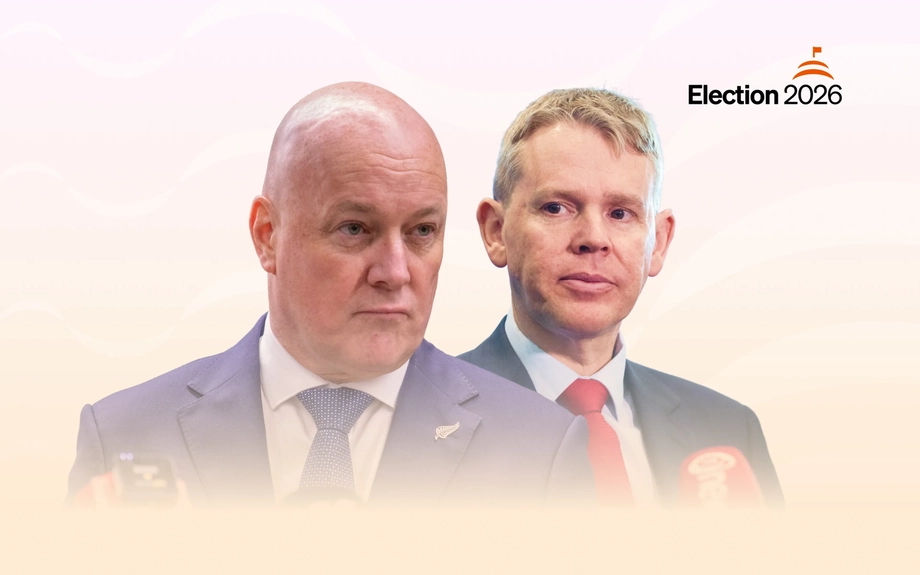
On the final campaign day, Luxon urged supporters to turn out. The prime minister framed the contest around the votes still to be cast:
The only poll that matters is tomorrow night.
Labour leader Chris Hipkins, who succeeded Jacinda Ardern as prime minister in 2023 before losing that year's election to Luxon, said his immediate goal was to lead the largest party. He left possible coalition arrangements for later:
We're banking on being the biggest party in Parliament. I'm feeling increasingly confident of that.
Why Opportunity's threshold matters so much
Opportunity leader Qiulae Wong, 38, entered politics about a year ago after responding to an advertisement for the leadership position. A former sustainable business consultant, she leads a party proposing a land tax and a universal basic income, a regular payment intended to replace welfare payments.
Opportunity has said it is open to working with either side and would speak first to the party holding the most seats. Its possible arrangements include joining a coalition, supporting a government on confidence and supply, or remaining on the crossbenches. Confidence and supply means helping a government survive essential parliamentary votes and pass its budget without necessarily joining the cabinet.
The Freshwater projection leaves six seats outside the two main blocs. If those seats went to Opportunity, either bloc could pass 61 with its support. A result below 5%, without an electorate victory, would instead leave Opportunity outside Parliament and change how seats are distributed among qualifying parties.
Luxon has ruled out a deal with Opportunity, creating a political constraint alongside the numerical one. Hipkins would also need to negotiate terms with potential partners. No coalition agreement has been settled, and negotiations could take weeks as parties wait for the final count and bargain over policies and ministerial positions.
Lara Greaves, an associate professor in politics at Victoria University of Wellington, described the smaller parties' negotiating position as "unprecedented territory". Their combined support gives them room to seek substantial policy commitments from whichever major party needs their votes.
Living costs lead, while fuel concern surges
Ipsos' 35th Issues Monitor surveyed 1,008 New Zealanders aged 18 and older through online panels from October 19 to 27. Respondents could select three leading concerns, so the percentages measure how widely each issue troubles people rather than dividing voters into separate groups. The survey reported a credibility interval of plus or minus 3.5 percentage points.
Fuel concern rose 14 percentage points from September to 31%, moving from seventh to third place and reaching its highest level since the monitor began in 2018. September's figure was 17%, meaning the share naming fuel among their leading concerns almost doubled in a month.
Amanda Dudding, executive director of public affairs at Ipsos New Zealand, linked that movement to the pressure of everyday expenses:
As fuel prices climbed to near-record levels across New Zealand, concern about the cost of fuel has surged into the top three issues facing the country. The result highlights how sensitive New Zealanders remain to increases in everyday household costs and reinforces the importance of cost-of-living pressures in shaping voter sentiment ahead of the election.
Healthcare concern also reached its highest level since the monitor began, at 45%. The economy ranked fourth at 30%, followed by unemployment at 19%. Housing registered 18%, poverty and inequality 16%, crime and law and order 14%, climate change 12%, and education 8%.
Carin Hercock, Ipsos New Zealand's country manager, said the survey coincided with prominent coverage of politicians engaging with gangs. Respondents nevertheless placed household finances ahead of crime, which stood 13 percentage points below its October 2024 level.
Labour gains trust on the biggest concerns
Labour was rated the party most capable of handling all five leading concerns for the third consecutive Ipsos survey. On inflation and living costs, its rating rose seven percentage points to 38%, compared with National's 24%. National also improved on that issue, gaining three points, but Labour's larger increase widened the gap.
Healthcare produced Labour's biggest advantage among the leading five issues: 42% chose Labour as most capable, against 21% for National. On fuel, the figures were 35% and 20%; on the economy, 34% and 29%; and on unemployment, 38% and 21%. Labour also led on housing, with 35% against National's 22%.
National retained a narrow advantage on crime and law and order, at 29% to Labour's 28%. That left its strongest issue in the survey outside the five concerns voters selected most often.
The government's average performance rating remained 4.1 out of 10. Some 26% gave it a positive score of seven to 10, while 42% gave it a negative score of zero to three. The negative share exceeded the positive share by 16 percentage points.
The campaign's policy choices follow those pressures. Labour proposes a capital gains tax to help finance measures including free doctors' visits and public transport with capped prices. A capital gains tax charges tax on certain profits made when assets are sold. National is campaigning against new taxes and says stronger trade and lower unnecessary government spending will help the economy.
Jobs figures sharpen the economic contest
Statistics New Zealand's figures released on November 4 put unemployment at 5.7% in the three months to September, up from 5.5% in the previous quarter. Employment fell 0.1%, while the participation rate, the share of working age people employed or actively seeking work, slipped to 70.4%.
Wage growth also slowed. The private sector labour cost index, excluding overtime, rose 0.4% during the quarter, compared with 0.7% in the preceding three months. Annual growth eased from 2.1% to 2.0%. For households, the figures describe a difficult combination: fewer employment opportunities and slower growth in pay alongside persistent concern about bills.
Barbara Edmonds, Labour's finance spokesperson, called the figures "a damning verdict on Christopher Luxon's economic management." Finance Minister Nicola Willis said economic uncertainty explained the data and backed staying with the government's plan to rebuild the economy.
The Reserve Bank had held its official cash rate at 2.75%, saying it wanted time to assess two earlier increases. Interest rates affect borrowing costs and spending, so weaker employment adds another consideration to decisions about inflation. Labour has promised to restore a dual mandate requiring the bank to consider both price stability and sustainable employment.
Two votes, and a majority that can change
New Zealand's mixed member proportional system, usually called MMP, gives each voter two choices. The party vote largely determines each qualifying party's share of parliamentary seats. The electorate vote chooses the member representing the voter's local area, with the candidate receiving the most votes winning.
A party normally qualifies for a share of seats by winning at least 5% of the party vote or one electorate. That second route matters for Te Pāti Māori, whose parliamentary strength may depend more on victories in Māori electorates than on its nationwide percentage. Campaign estimates suggest it could return about four MPs, depending on local results.
Parliament normally has 120 seats, but an overhang can expand it. If a party's nationwide vote entitles it to 30 seats and it wins 32 electorates, it keeps all 32, adding two seats to the chamber. The number needed for a majority then rises with Parliament's size.
Te Pāti Māori has encouraged supporters to give their party vote to Labour or the Greens while backing its electorate candidates. National could also create an overhang if it retains more electorates than its party vote would normally support. National has rejected advice to direct party votes to ACT or New Zealand First.
The final seat totals therefore depend on electorate victories as well as nationwide percentages. The 61 seat target used in the Freshwater projection applies to its assumed Parliament of 120 members; a larger chamber would require a different majority.
Different generations, different policy choices
Younger and older voters lean in sharply different directions in the Freshwater poll. Among those under 35, Labour recorded 40.7%, the Greens 22.8% and National 17.9%. Labour and the Greens together reached 63.5% in that group.
Among voters over 55, National stood at 32%, New Zealand First at 15.5% and ACT at 14.3%. Their combined support was 61.8%. Turnout across those age groups could therefore affect both the leading party and the balance between potential partners.
The partners bring distinct agendas. The Greens propose a wealth tax, taxes on large technology companies and action against supermarket dominance. Opportunity's land tax would place a charge on land ownership, while its proposed universal basic income would change how financial support reaches households.
ACT proposes ending affirmative action schemes at medical schools. New Zealand First wants major immigration changes, withdrawal from the Paris climate agreement and a review of the conversion therapy ban. Both ACT and New Zealand First have campaigned to limit the powers of the Waitangi Tribunal, which investigates claims concerning the Crown's treatment of Māori.
Smaller entrants are also seeking attention beyond domestic economic policy. Free Palestine leader Paul Hopkinson has said his party aims to bring the Palestinian issue into the campaign. Which proposals enter a government programme will depend on the parties that win seats and the agreements they reach.
When voting ends and the count becomes final
About 2,300 voting places are scheduled to open nationwide on November 7, with 530 candidates contesting electorates or standing on party lists. Election advertising must end and signs must be removed before midnight on November 6, followed by restrictions on campaigning until voting closes.
Overseas participation has also grown. About 126,000 enrolled voters told the Electoral Commission they were living abroad, compared with 92,600 in 2023, an increase of about 36%. Some 64% of those enrolled overseas voters live in Australia.
The main dates are:
- October 26: Advance voting began.
- November 6: The final campaign day, with advertising ending before midnight.
- November 7: Election day voting runs from 9 a.m. to 7 p.m., followed by preliminary results.
- November 27: Official results are scheduled, including special and overseas votes.
- December 3: The deadline for the Electoral Commission to return the election writ with the official results.
Votes are counted by hand. Special votes include ballots cast overseas and some cast away from a voter's home area. With Opportunity so close to 5%, the official count could be decisive for its entry to Parliament and the governing combinations available.
Key Points
- Labour leads National by 30.7% to 26.4% in the final Freshwater poll, but other polls show a closer contest.
- The poll projects 59 seats for the governing bloc and 55 for Labour, the Greens and Te Pāti Māori in a Parliament of 120 members.
- Opportunity's 5.1% support places it just above the threshold and potentially in a deciding position.
- Living costs concern 64% of Ipsos respondents, healthcare 45% and fuel prices 31%.
- Unemployment rose to 5.7% in the September quarter, its highest level since 2015.
- Voting closes at 7 p.m. on November 7. Official results are scheduled for November 27, with coalition negotiations potentially taking weeks.