Four hours to Kelantan, with fares that change
Malaysia's East Coast Rail Link (ECRL) will offer Economy Transit fares starting at RM125 one way between Gombak and Kota Bharu, with Express tickets starting at RM147, ahead of a targeted passenger launch on December 12, 2026. The 523km journey is expected to take about four hours by Express, compared with seven to eight hours by road.
Contents
- Four hours to Kelantan, with fares that change
- What will passengers actually pay?
- How much time does Express save?
- Who qualifies for cheaper tickets?
- How often will trains run?
- What will be on board?
- What changes for towns along the route?
- Which safety checks come next?
- How will the railway support its costs?
- Key Points
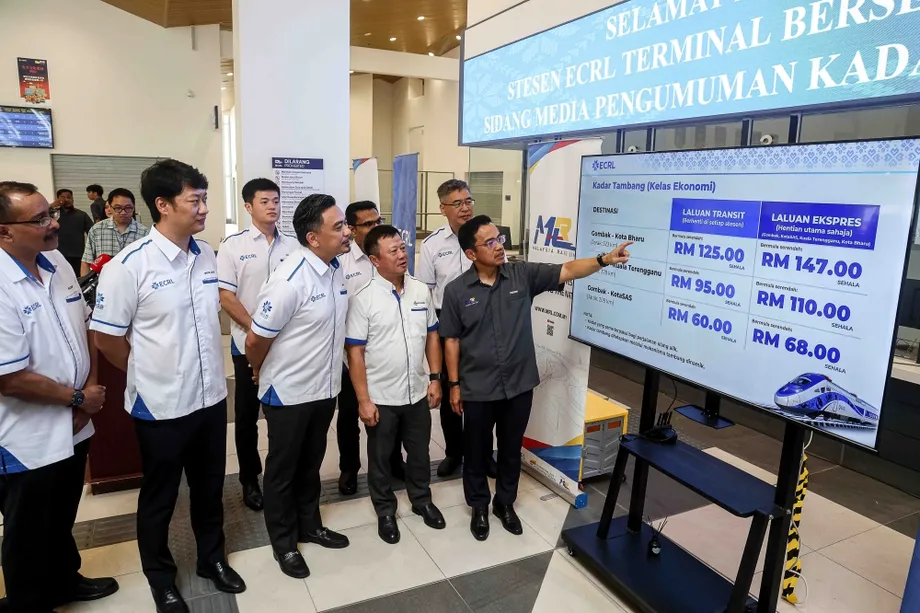
Malaysia Rail Link Sdn Bhd (MRL) chief executive officer Datuk Seri Darwis Abdul Razak announced the fares on October 19. Cabinet approved the pricing formula on October 16, following agreement in principle on a dynamic pricing mechanism on June 28, 2024. Under that system, ticket prices change according to demand, travel times and available seats.
The Pahang government's published fare announcement confirms starting prices of RM60 for Transit and RM68 for Express between Gombak and Kota Sultan Ahmad Shah, known as KotaSAS, in Kuantan. It also lists the RM125 and RM147 starting fares to Kota Bharu and the RM95 and RM110 starting fares to Kuala Terengganu.
Ticket sales are scheduled to begin in mid-November. Passenger operations remain subject to safety requirements and regulatory approvals, with further running tests and trial operations planned before the December target.
For travellers, the announcement provides the first practical basis for comparing the new railway with driving or taking a bus. The choice involves more than the cheapest ticket: Express trains save time, Transit trains serve more stations, and the fare paid will depend on when passengers book and travel.
What will passengers actually pay?
MRL's starting fares apply in both directions. The three main routes announced from Gombak are:
- Kota Bharu, 523km: Transit from RM125; Express from RM147.
- Kuala Terengganu, 378km: Transit from RM95; Express from RM110.
- KotaSAS in Kuantan, 209km: Transit from RM60; Express from RM68.
The government's published KotaSAS Express fare is RM68, matching MRL's main announcement; RM95 was also cited for that journey in coverage of the briefing.
Darwis said the Transit fare between Gombak and Kota Bharu has a middle price level of RM156. He explained the figure at the fare announcement:
Our mid-range for a Transit train from Kota Bharu to Gombak, or Gombak to Kota Bharu, is RM156,
RM156 is RM31, or about 25 per cent, above the RM125 starting fare. Prices can rise beyond RM156 when demand is strong, including during busy holiday periods. Passengers booking earlier or choosing selected travel times may find cheaper tickets, depending on availability.
Darwis also said an intervention mechanism would keep fares within a reasonable range if prices rose too high. He did not announce a numerical fare ceiling or the threshold that would trigger intervention.
How much time does Express save?
Express trains will serve four main stations: Gombak, KotaSAS, Kuala Terengganu and Kota Bharu. Transit trains will stop at every scheduled station, giving passengers in other towns access to the railway.
Between Gombak and Kota Bharu, Express services are expected to take about four hours, while Transit journeys may take up to five hours. Against the stated road journey of seven to eight hours, Express would save about three to four hours.
Kuala Terengganu passengers face a larger difference between the two rail services than those travelling to Kuantan. Express is scheduled to take two hours and 54 minutes to Kuala Terengganu, compared with three hours and 51 minutes by Transit, a saving of 57 minutes for a starting fare premium of RM15.
KotaSAS passengers would pay a starting premium of RM8 for Express, with the journey taking one hour and 27 minutes instead of two hours and five minutes. That is a saving of 38 minutes. For Kota Bharu, the starting premium is RM22 for a saving of about an hour.
Those comparisons use the announced starting fares. The difference between available tickets will change as dynamic prices move. Travellers will also need to allow time to reach their departure station and continue from their arrival station.
Who qualifies for cheaper tickets?
Children aged two to 12, Malaysian citizens aged 60 and above, persons with disabilities and government pensioners are among the groups eligible for concessions of up to 50 per cent. Students aged 13 to 24 will receive a 40 per cent discount.
Military veterans were also included among eligible groups in an account of Darwis's announcement. The detailed concession rules, including how eligibility will be checked and how discounts apply to changing fares, are due with the ticketing information.
For families, concessions could make a substantial difference to the total bill. A discount of 50 per cent halves the applicable fare, while a student receiving 40 per cent off pays 60 per cent of it. The final amount will depend on the fare available for the chosen journey and the booking conditions.
Bentong resident A. Chandran, 47, welcomed the student concession as help for parents, while expressing concern about dynamic fares for large families travelling during festive periods. His concern highlights a practical divide: passengers who can change their dates have more opportunity to seek cheaper seats than those tied to school holidays.
How often will trains run?
ECRL plans 12 daily services from Monday to Thursday, comprising six departures in each direction. From Friday to Sunday, that will increase to 16 services daily, with eight in each direction.
The weekend schedule therefore provides one third more departures than the schedule from Monday to Thursday. Across a full week, the announced pattern amounts to 96 services in both directions combined.
MRL expects to make about 2.2 million seats available during 2027 and is targeting approximately 1.4 million passengers. Those rounded figures imply that about 64 per cent of available seats would be occupied across the year, close to the company's initial planning assumption of around 60 per cent.
The occupancy measure, also called a load factor, describes how much of the available seating is used. Darwis said MRL hopes eventually to reach 90 per cent. Service frequency will be reviewed according to passenger demand and operational requirements.
What will be on board?
Ten electric multiple unit train sets will form the initial passenger fleet, operating at speeds of up to 160 kilometres per hour. These are trains powered by electricity, with passenger carriages operating together as a set.
Passengers will have Economy, Premium Economy and Business class options. Capacity will range from 409 to 425 passengers depending on the seating configuration. The announced starting fares concern Economy travel; prices for the other classes are to follow with the fuller ticketing details.
Facilities will include luggage racks, a food and beverage counter, a prayer room and dedicated seating for passengers with disabilities. MRL also plans 4G/5G connectivity and Wi-Fi along the route.
Operational communications will use LTE-Railway technology, a communications system for railway staff and equipment. That system supports the running of the railway, while passenger internet access serves people travelling on board.
What changes for towns along the route?
Gombak station sits next to the Gombak Integrated Transport Terminal, making onward connections part of the journey between the East Coast and the Klang Valley. In Pahang, the difference between Express and Transit will determine which towns passengers can reach directly.
Hanapi Mat Ripin, a private sector employee aged 51, considered the Gombak to Kuantan fares affordable. He explained why the stopping pattern matters for residents beyond the major Express stations:
People in Bentong, Temerloh and Maran who want to travel to Kuantan will have to take the transit services,
Chandran said Bentong residents expected a journey to Gombak of less than 30 minutes. He pointed to Bentong station's location along the Karak Expressway and the existing practice of residents commuting to Kuala Lumpur by bus.
Jason Lim, 40, highlighted the connection at Mentakab with KTM's Ekspres Rakyat Timuran, which could help passengers travelling from other parts of Malaysia, including Johor, reach the East Coast. He also viewed the railway as another transport option while Kuantan International Airport is under construction.
In Kelantan, resident Fiza Abdul Rahim, 38, considered the starting fares reasonable despite being more expensive than an express bus, because of the shorter journey. Muhammad Azrin Zainal Abidin, deputy chairman of the Malaysian Association of Hotels' Kelantan chapter, suggested cheaper weekday fares and expected the railway to help bring more visitors to the state.
Which safety checks come next?
MRL reported project completion of 98.16 per cent and said site acceptance tests and system integration tests had been completed. These checks examine installed equipment and whether systems such as signalling, communications and electricity supply work together.
Train testing began on August 25 and had covered more than 50,000km by the fare announcement. An inspection train completed a nonstop Gombak to Kota Bharu run in three hours and 19 minutes. Scheduled passenger Express services, which include intermediate stops, are planned at about four hours.
The Land Public Transport Agency, known as APAD, requires the first passenger train set to complete 3,000km of fault free running, with 1,500km required for subsequent sets. The first electric freight locomotive must also complete 3,000km, including 2,500km with its maximum formation and load and 500km without a load. Later freight locomotives require 1,250km under specified operating conditions.
Fault free running involves operating trains over a required distance while checking their reliability. The programme was brought forward from November to October. About 764 personnel had joined the operations and maintenance team, and emergency response procedures were scheduled for testing during November.
The main milestones are:
- June 28, 2024: Cabinet agreed in principle to dynamic pricing.
- August 25, 2026: Train running tests began.
- October 16: The fare implementation formula received approval.
- October 19: MRL announced the starting fares.
- October 23: Fault free running tests were scheduled to begin.
- November: Trial operations and emergency exercises are planned, with ticket sales targeted for the middle of the month.
- December 12: Passenger operations are targeted to begin, subject to safety approvals.
How will the railway support its costs?
MRL will remain the owner of the ECRL project and its assets. Operations and maintenance will be handled by a joint venture owned equally by MRL and China Communications Construction Company.
Darwis said no fare subsidy had been implemented at the time of the announcement. MRL hopes revenue will at least cover operating costs, while freight services will provide another source of income alongside passenger tickets.
Recovering the construction investment is a much longer task than paying for daily services and maintenance. Darwis described recovery through passenger revenue alone as taking "many, many, many years". Investment figures cited in accounts of his remarks were RM52.3 billion and RM50.27 billion, without an explanation of the difference in their scope.
MRL's stated goals include shorter journeys, more economic opportunities and stronger connections between Kelantan, Terengganu, Pahang and Selangor. Freight customers could help support operating revenue, while passenger services are intended to improve access to jobs, education, tourism and trade.
For travellers, the next practical milestone is the mid-November release of fuller fares, schedules and sales information. That will allow households to compare actual tickets, concession rules and departure times before the planned December opening.
Key Points
- Gombak to Kota Bharu Economy Transit fares start at RM125 one way; Express starts at RM147.
- Dynamic pricing means fares change with demand, booking time and seat availability. The middle Transit price level is RM156.
- Express journeys to Kota Bharu are expected to take about four hours, compared with up to five hours by Transit.
- Concessions include discounts of up to 50 per cent for eligible groups and 40 per cent for students aged 13 to 24.
- MRL plans 12 daily services from Monday to Thursday and 16 from Friday to Sunday.
- Ticket sales are targeted for mid-November, with passenger operations planned for December 12, 2026, subject to safety approvals.