Satellite Messages Reach Beyond Kazakhstan's Mobile Towers
Beeline Kazakhstan has introduced Starlink Mobile for compatible smartphones, bringing messages and selected internet services to places beyond the reach of its ground network. The service targets a large geographic gap: Beeline Kazakhstan chief executive Jabbor Kayumov said around 70% of the country's territory had never had traditional mobile coverage.
Contents
- Satellite Messages Reach Beyond Kazakhstan's Mobile Towers
- What the 70% Coverage Gap Means
- How a Regular Phone Connects to Space
- What Customers Can Use at Launch
- How Beeline Customers Activate Access
- From a 2025 Agreement to Customer Service
- A Safety Connection When Ground Networks Fail
- Eleven Million Users Across Three Countries
- Where the Wider Expansion Fits
- Key Points
VEON, Beeline's parent company, gives September 29, 2026, as the launch date; Kazakhstan's Ministry of Artificial Intelligence and Digital Development announced the introduction on September 28. Deputy Prime Minister and Digital Development Minister Zhaslan Madiyev described Kazakhstan as the first country in Central Asia to move Direct to Cell technology from practical testing into service for consumers.
Customers need a compatible 4G smartphone, a Beeline subscription and an open view of the sky. A separate satellite phone, dish or external antenna is unnecessary. Initial access is available on compatible Android devices, with other operating systems planned by the end of 2026.
Beeline is offering the service free for the first two months. Its immediate purpose is practical: helping someone send a message from a rural road, contact family from the mountains or communicate from a settlement without mobile reception.
The introduction marks a move into customer use after trials began in December 2025, although Beeline has also described the current service as being in testing. Availability depends on the handset, the services supported and whether a satellite connection can be established.
What the 70% Coverage Gap Means
Kazakhstan is the world's ninth largest country by land area. Its mountains, open steppe and long roads create a difficult task for mobile operators, particularly where settlements are small and far apart. Kayumov's estimate concerns territory: the service is intended to reach stretches of land that conventional networks have left uncovered.
Beeline had already extended its ground network to villages with populations of around 100 people and used solar panels to power base stations away from the electricity grid, according to VEON's November 2025 announcement. Satellite connectivity adds another way to serve locations beyond those towers.
Residents of remote settlements, tourists, road crews, utility workers and specialists working away from populated areas are among the intended users. For them, the most immediate change is the possibility of sending essential information without first travelling back into mobile coverage.
Beeline's satellite service complements its terrestrial network, meaning the towers and other equipment installed on the ground. Ground coverage remains the normal connection wherever it is available; a satellite provides an additional route where that connection disappears.
How a Regular Phone Connects to Space
Direct to Cell allows a compatible mobile phone to communicate with a satellite using the kind of mobile connection the handset already supports. In simple terms, the satellite acts like a mobile tower in space, connecting the phone to the wider network.
Starlink's satellites operate in low Earth orbit, relatively close to Earth compared with satellites positioned much farther out in space. VEON's November 2025 announcement described a constellation of more than 650 Direct to Cell satellites, linked into the wider Starlink network.
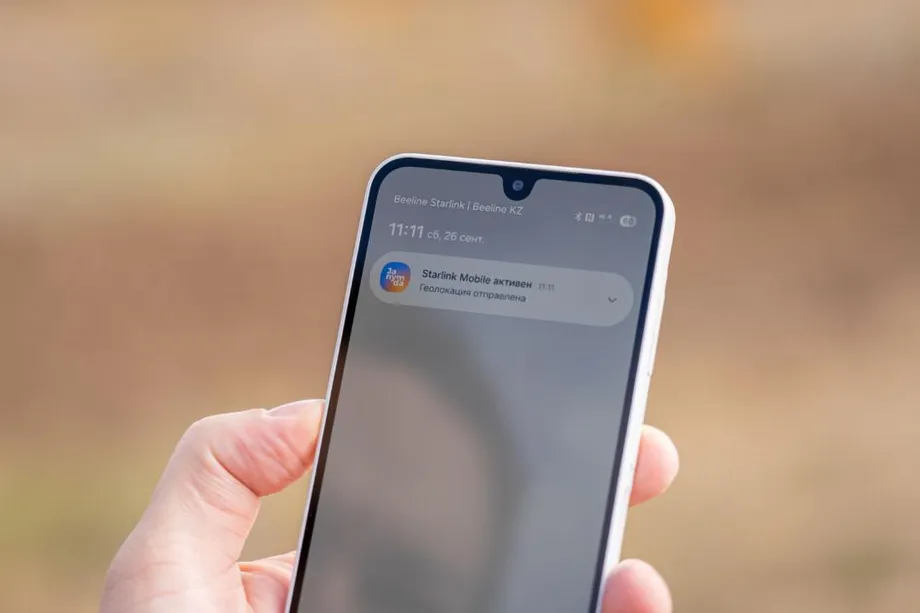
The service requires the user to be outdoors with a clear view of the sky. Buildings, terrain and other obstacles can affect whether a connection is possible. Where terrestrial reception is unavailable, the phone may find a network labelled Beeline Starlink, sometimes displayed as 401 04.
Automatic connection is possible when the necessary conditions are met, but customers may need to select the satellite network manually. Connection quality is expected to improve as the system develops.
What Customers Can Use at Launch
Beeline's initial service supports sending and receiving messages, including SMS, and access to selected applications or basic internet services. VEON also describes location sharing and applications adapted for satellite connectivity among the functions available across its Starlink Mobile markets.
For a traveller outside mobile coverage, those functions could mean sending a location to relatives or asking for assistance. For a worker on an isolated road, a short message could provide a way to report a problem without returning to a town.
The Kazakhstan introduction focuses on a limited set of communications rather than the full range of services customers ordinarily use over a strong ground connection. The list of supported applications, compatible handsets and conditions of access matters when deciding whether a particular phone can use it.
Satellite roaming options are not yet available, although Beeline has left open the possibility of introducing them later. Prices after the initial free period have not been specified, and an exact date for support on other operating systems has not been announced beyond the target of the end of 2026.
How Beeline Customers Activate Access
Beeline subscribers can prepare their phones through Janymda, the operator's application. The activation process combines an account setting in the app with a network setting on the handset.
- Update Janymda to the latest version.
- Activate Starlink within the application.
- Enable data roaming in the smartphone's settings.
- Move outdoors to a location with a clear view of the sky.
- When ground coverage is unavailable, select Beeline Starlink or 401 04 manually if the phone does not connect automatically.
The requirement to enable data roaming allows the phone to use the satellite connection through its network arrangements. Customers still need a compatible device and an active Beeline subscription.
Initial Android support makes handset compatibility a practical consideration. A phone's ability to use 4G is part of the requirement, while access during this first stage depends on whether that particular device is supported.
From a 2025 Agreement to Customer Service
The project developed through a commercial agreement, government support and practical trials. VEON's November 2025 announcement set out a plan to introduce messaging in 2026, followed by data connectivity.
Beeline and the ministry signed their memorandum during President Kassym-Jomart Tokayev's official visit to the United States. The announcement said both testing and commercial introduction were subject to standard regulatory approvals.
- September 2025: Beeline signed its commercial agreement for Starlink Direct to Cell.
- November 6, 2025: VEON announced the partnership and the memorandum signed with Kazakhstan's digital development ministry.
- December 2025: The first practical trials took place in Kazakhstan.
- September 28, 2026: The ministry announced the move into customer service.
- September 29, 2026: VEON's later account dates Beeline Kazakhstan's launch to this day.
- October 19, 2026: VEON and Starlink announced more than 11 million unique users across three markets.
Evgeniy Nastradin, identified as Beeline Kazakhstan's chief executive in the November 2025 announcement, described the partnership as a way to address gaps in remote regions. The current introduction combines messaging with limited internet access, extending the practical uses beyond the first messaging phase described in that announcement.
A Safety Connection When Ground Networks Fail
Kazakhstan's ministry has placed public safety at the centre of the project. A satellite connection can provide another route for communication in isolated areas and in places where damage has interrupted the ground network.
Madiyev, the deputy prime minister and minister responsible for artificial intelligence and digital development, explained that goal in VEON's November 2025 announcement:
The ability to send a message from a smartphone in an area without terrestrial coverage using a direct satellite-to-mobile connection without any additional equipment addresses critical public safety concerns and, without exaggeration, has the potential to save lives
A message can carry basic information that matters in an emergency: where a person is, what has happened and whether help is needed. Access still depends on the phone, an open view of the sky and the ability to establish a satellite connection.
Bulat Utemuratov, a Kazakhstani businessman and Verny Capital Group investor, also connected the project to the country's geography. He said distance should not become a barrier to access to modern technology, describing digital infrastructure as an investment in competitiveness and quality of life.
Eleven Million Users Across Three Countries
VEON's October 2026 update places Kazakhstan within a wider rollout. The company and Starlink said more than 11 million unique VEON customers had connected at least once across Ukraine, Kazakhstan and Bangladesh.
Kyivstar introduced the service in Ukraine on November 24, 2025, with free access for approximately 15.5 million users of 4G smartphones. Beeline followed in Kazakhstan in September 2026, and Banglalink launched in Bangladesh on October 9, 2026, for a customer base of 20 million.
VEON Group chief executive Kaan Terzioglu described the adoption milestone in the October announcement:
In less than a year, more than 11 million people have taken out their own phone, with no signal anywhere in sight, and connected through a Starlink Mobile satellite overhead.
The 11 million figure counts customers who connected at least once across the three countries. VEON said the service could reach more than 40 million people across its footprint. Using those figures, the number already connected amounts to roughly a quarter of that potential reach.
Ukraine's heaviest use has been in the south and east, according to VEON. In Bangladesh, the service is designed to help people stay reachable during cyclones, floods and extended power outages. Kazakhstan's emphasis is on distance, remote terrain and gaps between ground networks.
Where the Wider Expansion Fits
VEON's agreement with Starlink is nonexclusive and provides a framework for possible cooperation across all five of the group's operating markets. It creates a basis for expansion while individual services are introduced through local operators and national arrangements.
Beeline Kazakhstan brings a substantial existing customer base to that effort. VEON said in November 2025 that the operator served 11.7 million mobile customers and around one million fixed internet customers.
Kazakhstan has also outlined plans to bring Starlink satellite internet to 124 passenger trains. That initiative would provide connectivity on rail services, while Direct to Cell connects compatible individual phones beyond terrestrial coverage. The two projects address different parts of the country's communications needs.
For Beeline customers, the immediate milestone is access: compatible phones can now use selected communications services where the ground network ends. The next practical developments are broader device support, the terms that follow the free period and improvements in connection quality.
Key Points
- Beeline Kazakhstan has introduced Starlink Mobile for compatible smartphones outside terrestrial mobile coverage.
- Kayumov said around 70% of Kazakhstan's territory had never had traditional mobile service.
- The ministry announced the introduction on September 28, 2026; VEON dates the launch to September 29.
- Initial services include messages and selected internet functions, with compatible Android devices supported first.
- Customers must activate Starlink in Janymda, enable data roaming and have a clear view of the sky.
- Beeline is offering the first two months free, with support for other operating systems planned by the end of 2026.
- VEON and Starlink reported more than 11 million unique users across Ukraine, Kazakhstan and Bangladesh by October 19, 2026.