Astana Campus Moves Toward Its First Opening
The Eurasian Development Bank and AKASHI Data Center PLC have signed an agreement for up to $31.2 million to support a data center campus in Astana, Kazakhstan, with its first launch scheduled for May 2027. The EDB's official announcement dated June 26, 2026, gives a different financing figure: $90 million in agreed key terms for the first phase. The relationship between those two amounts has not been explained.
Contents
- Astana Campus Moves Toward Its First Opening
- What the Bank Has Agreed to Finance
- Why the Capacity Figures Need Care
- What Tier IV Means for Customers
- The Construction Dates to Watch
- Power and Connectivity Are Central to the Design
- AI Computing Gets a Separate Module
- Who Is Interested in the Space?
- A Bid to Export Digital Services
- Key Points
AKASHI plans a campus with four independent data center modules and a stated eventual capacity of 100 megawatts. Its construction schedule lists an initial computing equipment load of 5.28 MW and a May 2027 handover of the first server halls to anchor tenants. Banks, cloud providers, technology companies and developers of artificial intelligence systems are among the intended customers.
The project would give those customers somewhere to install critical computer systems without building and operating an entire data center themselves. For Kazakhstan, the commercial ambition reaches beyond serving local businesses: AKASHI wants international companies to buy computing infrastructure services delivered from Astana.
Construction is underway on an approximately 11 hectare site. The design for AKASHI Data Center 1, Phase 1, has received the Uptime Institute's Tier IV Certification of Design Documents, its highest design reliability category. An audit of the completed facility is scheduled for April 2027, before the planned first launch.
What the Bank Has Agreed to Finance
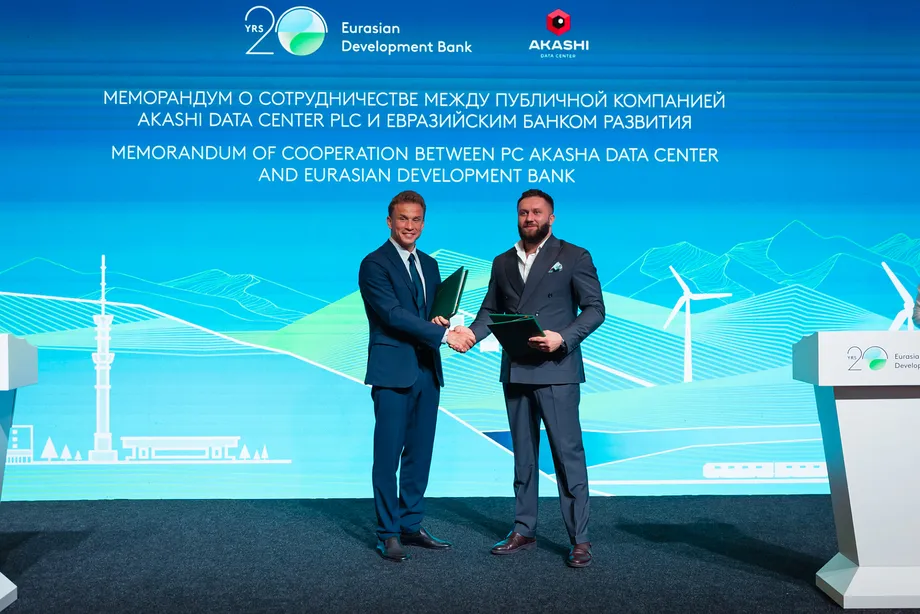
The EDB's June financing announcement says the bank and AKASHI agreed on key terms for $90 million at the EDB Annual Meeting and Business Forum in Almaty. Sergey Ignatov, the bank's senior managing director responsible for projects, and AKASHI chairman Vladislav Minkevich signed the agreement.
The bank described the financed first phase as a facility with 10 MW of capacity and space for 520 server racks. Racks are the frames that hold servers and related equipment, allowing a data center to accommodate many customers in an organised, controlled environment.
The agreement for up to $31.2 million is described as the EDB's first investment portfolio project involving data center construction. That announcement gives an estimated investment of approximately $354 million for the full campus, while the bank's June statement puts planned project investment at $230 million. Neither announcement explains how the two investment estimates relate.
Financing a first phase allows the developer to bring part of the campus into service before completing the wider development. Customers can begin installing equipment in the initial halls while later buildings add capacity. The distinction matters here because the first opening and the eventual 100 MW campus are separate milestones.
Why the Capacity Figures Need Care
The EDB's June statement describes a planned Astana facility with 41 MW of information technology capacity and 3,520 racks. AKASHI's construction page describes expansion to 100 MW and a full capacity of 4,224 racks. Its first phase is listed at 5.28 MW of IT load, while the financing announcements describe approximately 10 MW for that phase.
IT load means the electricity allocated to computing equipment. A facility also needs electricity for cooling, power conversion and other supporting systems. Readers therefore need to know whether a megawatt figure refers to the computers themselves or a wider measure of capacity. The announcements do not provide a common definition that reconciles all the figures.
The rack totals also describe different published plans: 3,520 in the EDB announcement and 4,224 on AKASHI's construction page. Across both descriptions, the practical direction is the same: a smaller initial opening, followed by a much larger development. The precise scope attached to each budget and capacity figure needs clarification as construction advances.
What Tier IV Means for Customers
The Uptime Institute's Tier IV category concerns a data center's ability to keep operating when equipment fails. The design aims to provide fault tolerance, meaning that backup systems and separate infrastructure paths can keep critical services running through a failure.
AKASHI's January 2026 milestone records Tier IV Certification of Design Documents, known as TCDD. This assessment covers the planned design. Certification of the completed facility, known as TCCF, involves a separate assessment of what has actually been built. AKASHI schedules that on-site audit for April 2027.
The EDB describes the project as Kazakhstan's first data center intended to meet Tier IV standards. AKASHI presents it as the first such development in Central Asia. Its current certification milestone is the approved design, with the completed facility audit still ahead.
For a bank or a cloud provider, reliability has a direct business purpose. A failure in power or cooling can interrupt access to applications and information. Building backup capacity into the facility gives customers a way to reduce that risk without constructing their own dedicated premises.
The Construction Dates to Watch
AKASHI's construction progress page lists a total build area of 60,000 square metres. Its schedule moves from ground preparation in late 2025 through engineering work, testing and certification in early 2027.
The developer's published milestones are:
- October 2025: land preparation completed, including grading, access roads and utility connections.
- November 2025: the foundation for the first data center building was poured.
- December 2025: structural steel and the building envelope began going up.
- January 2026: Tier IV design certification was listed for Data Center 1, Phase 1.
- February 2027: installation of cooling headers, power distribution and fire suppression is scheduled.
- March 2027: commissioning and testing of engineering systems are planned.
- April 2027: the completed facility audit is scheduled.
- May 2027: the first server halls are scheduled for handover to anchor tenants.
- From 2027 onward: additional buildings are planned as the campus expands toward 100 MW.
May falls within the second quarter of 2027, giving a more precise target than the broader 2027 commercial opening announced with the financing agreement. The construction schedule describes that milestone as a soft launch, with initial halls handed over to the first tenants.
Power and Connectivity Are Central to the Design
The campus plan includes dedicated electricity and telecommunications infrastructure alongside four independent data center modules. Separating the modules allows the development to operate and expand in distinct parts, while its power design provides backup for critical equipment.
Yan Pryanichnikov, deputy director for construction, described redundancy at the Central City Step-Down Substation and the Akashi substation. A substation changes electricity to the voltage needed farther along the supply network. Relay protection detects electrical faults and can isolate affected equipment.
Pryanichnikov explained how the backup arrangements are intended to work:
If one of the substation components fails, there is always a backup to ensure an uninterrupted power supply to the IT equipment.
He also said protection and automation at both substations are designed to prevent failures spreading through the power system. This puts part of the reliability effort outside the server halls, along the electricity supply route that the computers depend on.
AKASHI lists four independent optical fibre entry points and plans a carrier neutral campus. Carrier neutrality means customers can choose among telecommunications providers. Connections to Kazakhstani and international operators would allow businesses to select services that suit their network requirements.
AI Computing Gets a Separate Module
AKASHI is designing a separate module for artificial intelligence and high performance computing, with liquid cooling intended for equipment that produces large amounts of heat in a small space. Liquid cooling carries heat away using fluid, helping facilities manage densely packed computing hardware.
The planned customer base also includes more familiar digital services: financial institutions, telecommunications operators, cloud providers and companies running business applications. A shared commercial facility lets these organisations rent space and supporting infrastructure rather than finance their own buildings, power systems and cooling equipment.
Sergey Ignatov, EDB senior managing director responsible for projects, connected the financing to demand from cloud computing, digital platforms and AI in the bank's June announcement:
Demand for data storage and processing capacity in the region is growing rapidly, driven by the development of cloud services, digital platforms, and artificial intelligence-based solutions.
President Kassym-Jomart Tokayev has designated 2026 as Kazakhstan's Year of Digitalisation and Artificial Intelligence. The Astana development gives that policy focus a construction timetable: physical capacity must be built, powered, connected and tested before customers can put it to work.
Who Is Interested in the Space?
More than 40 companies from 12 countries have expressed interest in the campus's future capacity. AKASHI's construction page lists 2,576 reserved racks out of a planned 4,224. That works out to about 61 percent of the stated full rack capacity, using the developer's figures.
The same page labels its commercial pipeline as 107 percent filled. A sales pipeline generally includes potential business at different stages of discussion, while reserved racks are a separate measure. AKASHI does not define how its pipeline percentage is calculated or give a breakdown of signed customer contracts.
Yerassyl Ayubekov, AKASHI's chief commercial officer, said cloud providers would be the first customers, followed by hyperscalers, naming Google Cloud and Amazon as examples. Hyperscalers are companies operating computing services at very large scale. The names illustrate the type of customer AKASHI hopes to attract; the announced customer interest comes without a named tenant list.
The distinction between initial tenants and later demand matters for the build schedule. Early customers would occupy the first halls in 2027, while additional demand would support the planned expansion into the remaining campus capacity.
A Bid to Export Digital Services
Vladislav Minkevich, AKASHI's chairman, argues that Kazakhstan can earn revenue by hosting computing workloads for companies based abroad. Those companies would pay for services delivered in Kazakhstan, creating an export business around infrastructure rather than a physical shipment of goods.
Minkevich described the expected local economic activity:
When international companies host their computing workloads in Kazakhstan, export revenues are generated here, driving demand for local engineering expertise, telecommunications and services.
The proposal connects international customers to work performed locally: operating electrical and cooling systems, maintaining equipment and supplying network connectivity. AKASHI presents this as a new area of exports outside natural resources, with reliability central to winning overseas business.
The immediate test is the first phase. Completing engineering installation, commissioning the systems and passing the scheduled facility audit would move the project from a certified design toward an operating service. The May 2027 handover is the next concrete target for customers waiting to install their equipment.
Key Points
- The EDB and AKASHI have announced financing for an Astana data center, with $31.2 million and $90 million attached to different announcements and their relationship unexplained.
- AKASHI targets an initial launch in May 2027 and eventual campus expansion to 100 MW.
- Tier IV design certification has been obtained; an audit of the completed facility is scheduled for April 2027.
- Published project plans differ on total investment, IT capacity and rack numbers.
- The campus includes dedicated power infrastructure, four optical fibre entry points and a planned module using liquid cooling for AI computing.
- AKASHI lists 2,576 reserved racks out of 4,224 planned, approximately 61 percent.
- The commercial aim is to serve Kazakhstani customers and earn export revenue from international computing workloads.