72 aircraft, new suites and another wait for passengers
Singapore Airlines will introduce sliding doors in Business Class and First Class suites with double beds measuring 80 by 60 inches as part of an investment exceeding S$2 billion. Unveiled in Singapore on November 6, 2026, the new cabins are scheduled to enter service progressively from the second half of 2027, following another delay linked to certification and supply constraints.
Contents
- 72 aircraft, new suites and another wait for passengers
- Why the timetable has slipped again
- What goes on each aircraft
- First Class combines privacy with space for two
- Business Class changes how passengers sleep
- Premium Economy and Economy take a different route
- Screens, saved settings and internet arrive in stages
- Meals, sleepwear and airport services extend the refresh
- What SIA is trying to achieve, and what fares depend on
- Key Points
The programme covers 41 Airbus A350-900 aircraft already in the fleet and 31 incoming Boeing 777-9s, making 72 aircraft in total. Business Class will receive new seats across all of them. First Class will join the A350-900 ultra-long-range fleet for the first time, while the 777-9 will carry all four newly designed cabins, including Premium Economy and Economy.
Passengers will experience different versions of the upgrade depending on their aircraft. The A350 programme centres on new premium seats, with existing Premium Economy and Economy seats receiving a refresh where fitted. The completely new seats for those two cabins will arrive on the 777-9.
The airline has not announced which routes will receive the cabins or confirmed a service entry date for its 777-9s. Its A350 refurbishment target remains the end of 2030, even though the first aircraft is now due later than originally planned.
Alongside the seats, SIA is changing entertainment, meals, bedding, amenities and airport services. Some improvements, including Business Class sleepwear and planned Starlink installations, follow earlier schedules than the cabin rollout, so the changes will reach passengers in stages.
Why the timetable has slipped again
SIA originally planned to introduce the first refurbished A350-900 long-haul aircraft in the second quarter of 2026. That moved to the first quarter of 2027, before the latest postponement to the second half of that year.
Lee Lik Hsin, the airline's chief commercial officer, said the 777-9 seats have received certification, but the aircraft itself has not. The new A350 seats still require regulatory clearance. Approval requirements are separate for each aircraft type, meaning progress on the Boeing installation does not automatically clear the Airbus version.
Certification is the process through which aviation authorities check that equipment meets safety requirements. A seat with motors, doors, storage and screens must work safely as part of the aircraft cabin, including during an emergency. SIA's timetable therefore depends on regulatory approval as well as manufacturing and installation.
The main milestones are:
- November 2024: SIA announced the A350 refurbishment programme, initially targeting a first aircraft in the second quarter of 2026 and completion by the end of 2030.
- During 2026: The planned first service moved to the first quarter of 2027.
- November 6, 2026: SIA unveiled the cabins and moved their introduction to the second half of 2027.
- Early 2027: Starlink installation is planned to begin on selected existing fleets under a separate programme.
- End of 2030: SIA continues to target completion of the 41 A350 refurbishments.
Lee said the later start should not change the programme's completion target because certification, rather than installation capacity, is causing the delay. Each refurbishment is expected to take a couple of weeks in Singapore. Maintaining the 2030 deadline will require the work to fit into a shorter period after the first aircraft enters service.
What goes on each aircraft
The A350 programme comprises 34 aircraft configured for long-haul flying and seven ultra-long-range aircraft, known as ULRs. Each long-haul A350 will have 42 new Business Class seats. Each ULR will have 70 Business Class seats and four First Class suites.
The 777-9 configuration totals 300 passengers: six in First Class, 54 in Business Class, 36 in Premium Economy and 204 in Economy. Calculated from those figures, Economy accounts for 68 per cent of seats, while First and Business together account for 20 per cent.
Business Class has the widest reach across the investment. The planned configurations provide 1,428 new Business Class seats on the 34 long-haul A350s, 490 on the seven ULRs and 1,674 on the 31 Boeing aircraft. That adds up to 3,592 seats across the programme, compared with 214 First Class suites.
Aircraft assignment will also determine the details within a cabin. The A350 Business Class seat is narrower than its Boeing counterpart but has a larger screen. Passengers booking after the launch will therefore need to check both the aircraft type and whether an individual aircraft has completed its refurbishment.
First Class combines privacy with space for two
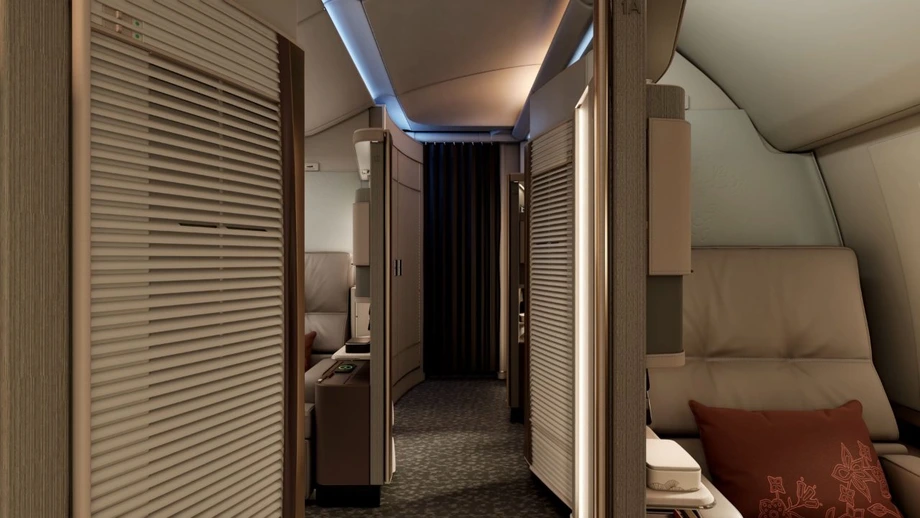
PriestmanGoode designed the new First Class suite, which Collins Aerospace is manufacturing. Curved sliding doors and walls approximately 67 inches high surround seats upholstered in Poltrona Frau leather. Every passenger has direct access to an aisle.
The centre suites provide the headline feature. Their divider retracts horizontally into a pocket, allowing two seats to become a shared sitting area, a sofa or a double bed measuring 80 inches long and 60 inches wide. SIA describes it as the largest double bed in commercial aviation.
Each individual seat also converts into a fully flat bed measuring 80 by 30 inches, approximately 203 by 76 centimetres. Electronically adjustable side wings, lumbar support, armrests and leg rests let passengers change their position. Crew will prepare beds with cotton linen, a duvet, a choice of pillows and a mattress topper from German bedding specialist Paradies.
A large table supports dining face to face or working, while a personal wardrobe and smaller storage spaces keep belongings nearby. Wireless charging, USB-C ports and universal power outlets are included. Each suite has a 32-inch 4K touchscreen, spatial audio and Bang & Olufsen wireless headphones, plus Bluetooth pairing for compatible personal headphones.
The ULR installation brings First Class to aircraft used on journeys such as Singapore's nonstop flights to Newark and New York JFK, which can last around 19 hours. On flights of that length, the ability to alternate between sitting, dining and sleeping shapes a substantial part of the journey.
Business Class changes how passengers sleep
Designworks, a BMW Group company, designed the new Business Class product, with RECARO Aircraft Seating manufacturing it. Seats follow a staggered 1-2-1 arrangement, with one seat beside each window and two in the centre. Every passenger can reach an aisle without climbing over a neighbour.
Sliding doors provide privacy, while electronically adjustable centre dividers allow companions to share space. Centre pairs alternate between positions closer together and farther apart. Selected pairs can become companion beds, although a join remains between the sleeping surfaces.
The seat reclines into a bed measuring 79 inches long, approximately two metres, and up to 24 inches wide. It replaces the need to manually flip over the seat to prepare the bed. A table that stows at an angle creates a larger footwell straight ahead, giving passengers more room to move their feet while lying down.
SIA is also adding adjustable upper and lower lumbar support, an adjustable leg rest and a padded bedsheet incorporating memory foam. The sheet can provide cushioning during sleep or extra support while seated. Physical controls put adjustments within reach without requiring passengers to navigate an entertainment menu.
The A350 seat measures 22 inches across, compared with 24 inches on the 777-9. Both have a stated seat pitch of 50 inches. Pitch measures the distance between matching points on successive seats, rather than the length of the bed or the amount of open legroom.
Grey surfaces, yellow accents and metallic details give Business Class a different appearance from SIA's warmer existing interiors. Its practical changes centre on the space passengers use: the footwell, nearby storage, a table measuring 22 by 14.7 inches, and charging points for personal devices.
Premium Economy and Economy take a different route
Factorydesign designed the new Premium Economy and Economy products, with Collins Aerospace manufacturing the seats. Both will debut on the 777-9. On the A350s, the corresponding cabins where fitted will retain existing seats with changes including upholstery and entertainment upgrades.
The 777-9 will have 36 Premium Economy seats in a 2-4-2 arrangement. Pitch is 40 inches, with recline of up to nine inches, leather upholstery, deeper cushioning and a headrest adjustable in four directions. Adjustable leg and foot supports, a cocktail tray, reading light, device holder, storage and USB-C ports complete the main features.
Premium Economy screens will measure up to 16 inches and support 4K pictures, spatial audio and Bluetooth headphones. The cabin offers more seat spacing than Economy while retaining a conventional reclining seat, rather than the fully flat bed available in Business Class.
Economy will have 204 seats arranged 3-4-3, meaning ten passengers across each full row. Pitch will be 31 to 32 inches. SIA says a redesigned seat structure and recline mechanism will create more knee and shin clearance, supported by new cushioning, wool blend upholstery and adjustable headrests.
The difference in published pitch is eight to nine inches between Premium Economy and Economy. That comparison describes row spacing; the seats also differ in width, cushioning, recline and support.
Economy passengers will have screens measuring up to 13 inches, USB-C charging, storage beneath the entertainment display, a cupholder and a coat hook. A secondary display will show flight details, Wi-Fi status and lavatory availability, allowing passengers to check basic information without leaving their main entertainment screen.
Screens, saved settings and internet arrive in stages
KrisWorld, SIA's entertainment system, is receiving a redesigned interface, more than 2,500 entertainment options, wellness features and personalisation. New equipment includes 4K touchscreens, OLED displays on selected aircraft, spatial audio and Bluetooth pairing.
OLED screens produce light within individual pixels, allowing deep blacks and strong contrast. In Business Class, the A350 installation will have a 22-inch 4K OLED screen, while the 777-9 version will have a 20-inch 4K screen. The larger aircraft therefore offers a wider seat but a smaller main display.
Business Class handsets will also show flight information, destination weather, connectivity status and lavatory availability. Wireless charging and universal power outlets complement USB charging, although the precise combination of sockets will vary across aircraft versions.
Smart controls integrated with myKrisWorld will allow passengers to save preferred seat positions for future flights through their KrisFlyer profiles. First Class adds remembered lighting settings. The aim is to reduce the need to repeat adjustments on each journey.
Starlink connectivity is planned from early 2027 on the A380, A350-900 long-haul and A350-900ULR fleets. Its installation follows a separate schedule from the seats, so an aircraft may receive the internet service before its cabin refurbishment.
Meals, sleepwear and airport services extend the refresh
SIA plans more than 100 new or refreshed appetisers, main courses and desserts across cabin classes, alongside expanded wine and spirits selections. Suites, First Class and Business Class passengers will receive custom Christofle serviceware.
New amenity kits will contain Sisley products in Suites and First Class, Byredo products in Business Class and Ink & Water products in Premium Economy. Economy passengers will receive collectible pouches containing travel essentials.
Business Class passengers will receive sleeper suits for the first time, with introduction planned by the end of 2026. They are intended for all long-haul flights and selected overnight services of medium duration. Suites and First Class will receive new cotton sleeper suits. New dishes and amenity kits are being introduced progressively on flights lasting more than six hours.
More than S$130 million has also been invested in renovating, refreshing and expanding SilverKris lounges worldwide, including at Changi Airport. The changes add seating, dining, working and resting options. First Class lounge customers in Singapore will have a full dining service similar to that in The Private Room.
At Changi, new services for Suites and First Class include priority immigration and security clearance, concierge assistance and buggy transfers between selected airport locations where available. Those changes extend the premium experience beyond the hours spent on board.
What SIA is trying to achieve, and what fares depend on
SIA's research involved more than 5,000 frequent travellers, customers, employees and industry specialists through surveys, interviews, focus groups and prototype testing. The wider project dates to 2015, while development of the new First Class product began in 2018 and involved roughly 30 design iterations.
Ong Wah Li, SIA's vice president of product experience, said customer feedback placed comfort ahead of other parts of the journey:
No matter how good the service or food is, we heard from our customers that comfort is really the most important thing,
The result combines two demands that can pull in different directions: privacy for someone travelling alone and shared space for companions. Doors and adjustable dividers let passengers choose between them. Changes to footwells, bedding and seat movement address the longer task of remaining comfortable through an overnight flight.
Lee said SIA would not raise fares on aircraft with the new seats simply because of the investment. Ticket prices will continue to depend on demand and supply. The airline is funding the programme internally and has set no specific return target for the spending.
SIA is also keeping its preferred balance between cabins rather than expanding Premium Economy at the expense of other classes. Lee said the airline believes its current mix optimises revenue and allows it to fill all cabins to high levels. For passengers, the immediate outcome is a staged upgrade: new service touches first, followed by new cabins as approvals, aircraft deliveries and refurbishments permit.
Key Points
- SIA is investing more than S$2 billion in new cabins across 41 existing A350s and 31 incoming 777-9s.
- The first upgraded cabins are scheduled for the second half of 2027, with A350 refurbishment completion still targeted for the end of 2030.
- First Class will join the A350-900ULR fleet, with centre suites combining into beds measuring 80 by 60 inches.
- New Business Class seats bring sliding doors, direct aisle access, reclining beds and larger footwells.
- Completely new Premium Economy and Economy seats will be installed on the 777-9; corresponding A350 cabins will receive a refresh.
- Starlink installations and some dining and amenity changes follow separate, earlier schedules.
- Routes receiving the new cabins have not been announced, and the 777-9 service entry date remains unconfirmed.