Nearly 3,900 Fewer Students Across Seven Camps
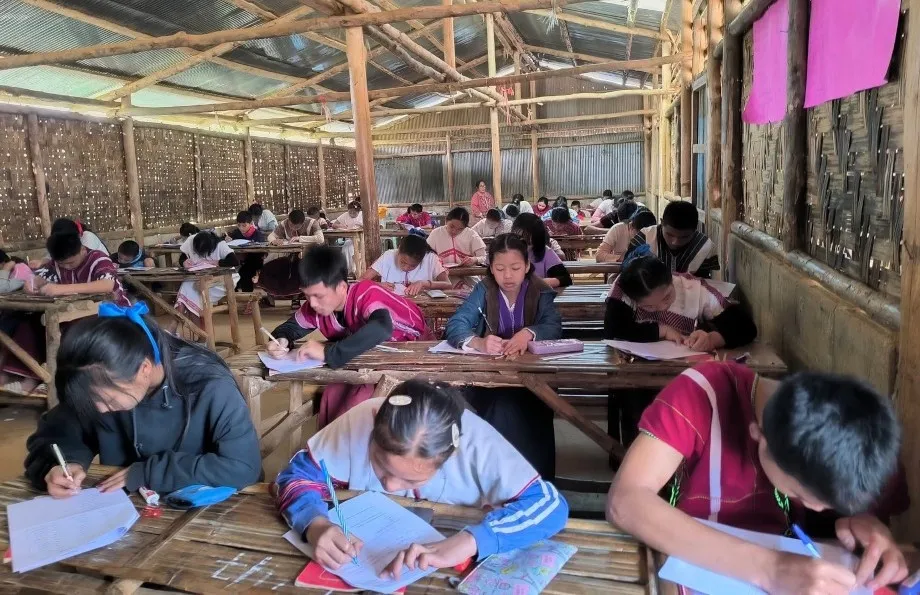
Schools across seven refugee camps on the Thai-Myanmar border recorded 3,833 fewer students in the 2025–2026 academic year as families struggling with food aid cuts sent teenagers to work. Figures from the Karen Refugee Committee Educational Entity (KRCEE) show enrollment at its 45 schools fell from 24,462 to 20,629, a decline of about 15.7 percent in one year.
Contents
- Nearly 3,900 Fewer Students Across Seven Camps
- Umpiem Shows How Families Are Being Squeezed
- How the Aid Crisis Developed
- Food and Medical Cuts Reach the Classroom
- Years of Growth Meet a Sudden Enrollment Fall
- Work Outside the Camps Carries Risks
- Other Classrooms Are Under Pressure Too
- Displacement Has Spread the Education Crisis
- What Education Support Needs to Address
- Key Points
At Umpiem Refugee Camp, a widowed mother of five described how the financial squeeze had already interrupted the education of two of her children. The 41-year-old mother said both sons left at the same stage of secondary school:
My eldest son dropped out in Grade 9 to work, and later my second son had to leave school in Grade 9 as well due to our financial crisis.
The pressure became more severe after The Border Consortium (TBC), a principal provider of refugee assistance along the border, ended food support for standard households on July 31, 2025. More than 80 percent of families were affected, while households classified as vulnerable or most vulnerable continued receiving limited rations.
For families dependent on aid, losing food support changes the calculation behind every school day. Money needed for school expenses must compete with money for meals. Older children can become potential earners, while younger children may leave school when their parents travel outside the camp for work.
A Save the Children report released on January 20, 2026, describes education under pressure from both shrinking assistance and years of rising demand. Its survey of about 2,500 students, parents and teachers in Thailand, conducted between late 2025 and early 2026, connects the school crisis with food shortages, clinic closures and reduced medical care.
Umpiem Shows How Families Are Being Squeezed
Umpiem has six primary and high schools. Their combined enrollment fell from 1,847 students in 2024–2025 to 1,785 in 2025–2026, a loss of 62 students, or about 3.4 percent.
Kaw Moo Rah No. 1 High School experienced a steeper decline. Its enrollment dropped from 532 to 480, a decrease of 52 students, or about 9.8 percent. The loss at that school alone was equivalent to most of the net decline across the camp.
Naw Wi Tu Paw, the principal of Kaw Moo Rah No. 1 High School, described simultaneous pressure on school budgets and family finances:
Parents can no longer cover school expenses, while donor funding for camp schools continues to shrink.
The principal said older students were leaving to earn money, while some younger children were being taken out of school because their parents needed to work elsewhere:
Older students in Grades 11 and 12 are leaving the camp to find jobs, while other parents who must work outside the camp have no choice but to take their children with them, pulling them out of school entirely.
Her account identifies two different needs. Teenagers need a way to continue learning without becoming responsible for replacing lost household income. Younger children need continuity in their education when the adults caring for them move for work.
How the Aid Crisis Developed
Funding reductions began in early 2025, before the July cutoff. The dismantling of United States foreign assistance, together with shortfalls from other donors, affected food assistance, education supplies and medical services across the nine border camps.
The sequence shows how several forms of support weakened within months:
- Early 2025: Aid cuts began affecting the camps, and the standard monthly food allowance fell to 77 Thai baht per adult, about US$2.30.
- March 2025: TBC warned that refugees faced a dangerous shortage of support without urgent funding.
- July 31, 2025: Food assistance ended for standard households, and International Rescue Committee health operations closed by the end of July.
- 2025–2026 academic year: KRCEE recorded 20,629 students across 45 schools, down from 24,462 the previous year.
- January 20, 2026: Save the Children released its warning based on research conducted in late 2025 and early 2026.
Food and Medical Cuts Reach the Classroom
Food assistance had already become very small before it stopped for most families. Earlier support was described as more than 100 baht per family member each month; by early 2025, the standard allowance had fallen to 77 baht per adult. Families were also facing rising food prices.
Children entered this period with existing nutritional problems. Chronic malnutrition among children younger than five increased between 2022 and 2024 for the first time in at least a decade. Chronic malnutrition means a child has received too little adequate food over a long period, potentially affecting growth and development.
Medical cuts added another demand on household budgets. Refugees described healthcare staffing being reduced by half, suspended patient referrals and hospital transport, and dwindling medication supplies as International Rescue Committee operations closed.
Families seeking treatment outside the camps could therefore face costs at the same time that their food support disappeared. A medical bill and school expenses draw on the same limited household resources.
Education also lost direct assistance. Support from the United States Agency for International Development (USAID) had supplied learning materials and essential school items. Its withdrawal left families needing to replace resources that had previously been provided.
Years of Growth Meet a Sudden Enrollment Fall
Save the Children found that student numbers in the camps had risen by about 33 percent, from approximately 18,000 in 2020 to approximately 24,000 in 2025. Renewed conflict in Myanmar had brought more refugees and migrant families into Thailand, increasing demand for classrooms and teachers.
Guillaume Rachou, executive director of Save the Children Thailand, described the condition of camp education:
Education in the camps along the Thai-Myanmar border is at breaking point.
The longer increase and the recent KRCEE decline describe pressures over different periods and school networks. Save the Children tracks growth from 2020 to 2025; KRCEE compares successive academic years across its 45 schools in seven camps. Together, the figures show schools carrying the demands of years of displacement as families become less able to keep children enrolled.
Population figures also use different counts. Save the Children describes an official population of about 90,000 across nine camps, while figures accompanying the July aid cuts put the total above 107,000, including about 91,000 people verified by Thai authorities and the United Nations refugee agency, UNHCR. The larger total includes people beyond the verified population.
Save the Children estimates that about 24,000 students live in the camps. Against an official population of roughly 90,000, that is approximately 27 percent, meaning more than one in four residents is a student.
Work Outside the Camps Carries Risks
Parents and school staff describe teenagers leaving for manual work because their families need immediate income. A camp education coordinator also reported declining attendance as more children were sent outside to work and parents struggled with school fees.
Restrictions on employment and movement were central to the crisis described in July 2025. Refugees were barred from lawful work outside the camps and faced limits on travel, leaving many dependent on assistance or informal jobs.
Some adults found agricultural day labor harvesting corn or rice. One refugee described fines of 500 to 1,000 baht for being outside the camp without authorization. Those sums were several times the reduced monthly food allowance of 77 baht per adult.
Pressure to find income also exposed families to debt and unsafe migration. Two women in their early twenties paid a broker 15,000 baht to take them to Bangkok, borrowing the money at 10 percent interest. They had neither jobs nor housing arranged. One needed money for her mother's medical care after losing her own job because of aid cuts.
For students, the immediate attraction of paid work sits beside another concern: whether education will lead to employment. The education coordinator said parents saw graduates from an older generation unable to find jobs. Restrictions affecting adults therefore also weakened confidence in the value of keeping children in school.
Other Classrooms Are Under Pressure Too
Migrant learning centres offer another route to education for children from Myanmar, but Save the Children found serious constraints there as well. Some classrooms held as many as 60 students, and teachers reported shortages of textbooks, science materials and information technology equipment.
A crowded class leaves a teacher with less time for each child. Missing books and equipment limit what pupils can practise, especially in subjects requiring experiments or computer access. These problems affect the quality of education even for children who remain enrolled.
Many migrant learning centres operate on rented land, creating uncertainty about whether they can remain in the same place. Teachers also described legal restrictions preventing them from holding teaching licences, affecting recognition of their professional work.
Thailand's Education for All policy guarantees free schooling for children who are not Thai nationals. Save the Children found that legal, financial and language barriers still prevented many migrant and undocumented children from enrolling.
School fees are therefore only part of the access problem. A family also needs an enrollment process it can navigate, a school that can accommodate the child's language needs, and confidence that seeking education will not expose family members to deportation.
Displacement Has Spread the Education Crisis
Myanmar's conflict is placing pressure on education on both sides of the border. An analysis of census data by the Institute for Strategy and Policy – Myanmar found that more than six million children of school age inside Myanmar had been deprived of formal education since the 2021 military coup.
The border camp population grew by about 35 percent after the coup, according to figures accompanying the July aid crisis. Fighting, military airstrikes and landmines continued to make return dangerous in border areas.
Children who reach Thailand may therefore arrive after disruption to their schooling, only to encounter classrooms with fewer resources or families unable to cover school expenses. The rise in demand and the reduction in assistance are connected through the same displaced households.
UNHCR warned on October 2 that 44 percent of refugee children globally remained out of school and that funding shortages threatened further losses in access. The border enrollment figures give a local measure of that wider problem: thousands fewer students attending one network of schools within a single academic year.
What Education Support Needs to Address
Save the Children is calling for diverse funding streams for camp education and effective enrollment routes for migrant, undocumented and stateless children without fear of deportation. Its recommendations address both the money needed to run schools and the barriers children face in reaching them.
The experiences at Umpiem show why classroom funding and family support need to work together. Schools need teachers and materials, while households need enough food and income to keep children studying rather than sending them to earn money.
Calls made during the July crisis also sought lawful employment and travel for refugees, alongside wider Thai language education. Such measures would give adults a route to support their households and make employment after graduation more attainable.
The figures do not identify how many of the 3,833 students missing from the KRCEE enrollment total entered work, moved elsewhere or enrolled in another school. No date has been given for restoring standard food assistance or replacing the lost education funding. Parents and principals have, however, described the immediate decision facing families: keep a child in class or find another source of income.
Key Points
- Enrollment across 45 KRCEE schools in seven camps fell by 3,833 students, or about 15.7 percent, between 2024–2025 and 2025–2026.
- Umpiem lost 62 students across six schools; Kaw Moo Rah No. 1 High School recorded a decline of 52.
- TBC ended food aid for standard households on July 31, 2025, affecting more than 80 percent of families while retaining limited assistance for vulnerable groups.
- Food shortages, medical cuts and lost school supplies are increasing pressure on household budgets.
- Save the Children surveyed about 2,500 people and called for more reliable education funding and accessible enrollment routes.
- Parents and education staff say children are leaving school to work or moving with parents who need employment.