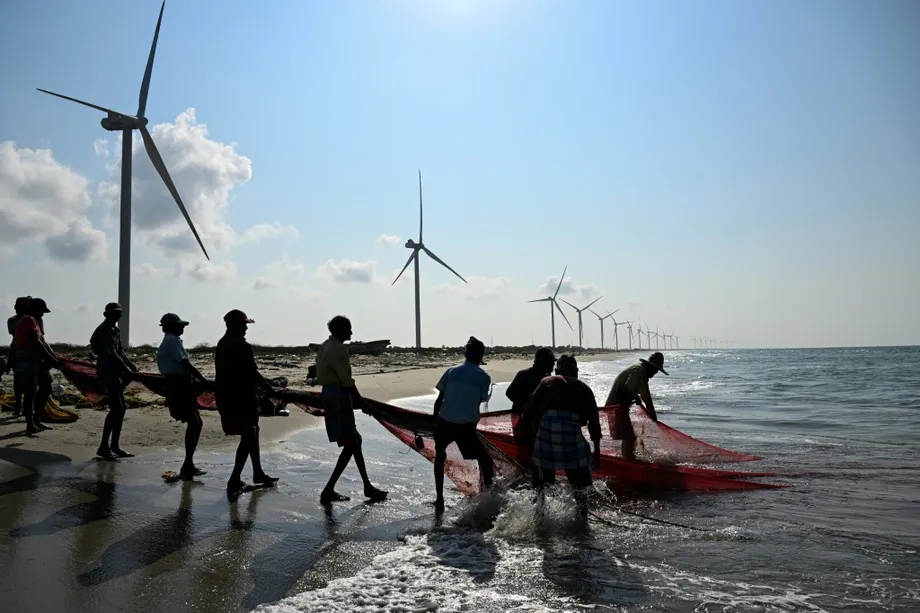
A national energy project meets a local livelihood crisis
Sri Lanka has frozen new wind power projects on the Mannar peninsula while allowing those already approved to proceed, as fishing communities demand action over shrinking catches, flooded homes and damage they associate with turbine construction. The dispute centres on a coastal development whose first 30 turbines began supplying electricity in 2020, with construction now begun on another 14.
Contents
- A national energy project meets a local livelihood crisis
- What the CEB built and promised
- Why fishermen blame the turbines
- Floodwater reaches homes, toilets and wells
- Bird protection is part of the dispute
- What has been stopped, and what can continue?
- The price argument behind the expansion
- Residents take their objections to court
- Key Points
The state utility Ceylon Electricity Board (CEB) puts the original wind farm's investment at approximately US$141 million. Its project plan projected more than 380 million units of electricity annually and the avoidance of 285,000 metric tonnes of carbon dioxide emissions each year. For residents living beside the turbines, however, the immediate concerns are earnings, drinking water and whether rain can drain from their villages.
In Pesalai, A. Stanislas Peries, head of the local fishermen's cooperative, says daily fishing earnings that once reached 5,000 rupees now barely exceed 1,000 rupees. Those figures suggest that an income previously earned in one day can now take roughly five days to collect.
The confrontation comes as war in the Middle East drives up fuel and electricity costs, increasing the pressure on Sri Lanka to develop domestic renewable energy. The government wants renewable sources to supply 70 percent of electricity by 2030. Mannar's residents are challenging where that infrastructure is built and how its effects are managed.
Lesley Jesurajan, a leading figure in the local civil society group OPEnE, described the community's objection as a dispute over location rather than the principle of renewable power.
We are not opposed to renewable energy in principle. But not here. There are plenty of other places to install wind turbines.
What the CEB built and promised
The CEB's Mannar project description identifies 30 turbines rated at 3.45 megawatts each, giving a total installed capacity of 103.5 megawatts. The turbines stand along Mannar island's southern coast, where the utility sought to capture strong seasonal monsoon winds.
Megawatts describe how much power a plant can produce at a given moment. Annual generation describes the electricity it supplies over time. The CEB projected more than 380 million units annually, with a unit meaning one kilowatt-hour, the standard quantity used to measure household electricity consumption.
The utility awarded the engineering, procurement and construction contract to Vestas Asia Pacific AS. Funding for the wind farm and associated facilities in Mannar and Anuradhapura was arranged through an Asian Development Bank loan. Danish company COWI AS provided consultancy services.
The CEB projected generation costs below five US cents per unit. Its plan also included wind forecasting to help manage electricity flowing into the national grid, alongside a radar system intended to detect birds and allow selected turbines to stop when necessary.
The project description records construction beginning in March 2019 and completion being scheduled for November 2020. It also explicitly lists new service roads and rehabilitation of existing roads, infrastructure that now features prominently in residents' complaints about drainage.
Why fishermen blame the turbines
Venkatasamy Kalimuththu, 65, has fished in Mannar since childhood. A recent haul, pulled ashore with tractor winches and the work of 20 men, contained a few good fish, small fry and clumps of seaweed. He says catches were much larger before the turbines appeared.
Kalimuththu believes shadows from the rotating blades discourage fish from approaching shallow water. He described his explanation this way:
When the fans rotate, the shadow falls on the water. So the fish don't swim up to the shallows.
Fishermen also cite competition from Indian trawlers. N.M. Aalam, secretary of the Federation of Northern Fisheries Cooperatives, says reduced catches could have several causes and has called attention to the absence of a government investigation.
Aalam described the uncertainty surrounding the decline:
It could be due to the turbines or many other factors, but we cannot prove it. Even the government is not investigating this.
Floodwater reaches homes, toilets and wells
Benedict Mary Vijiliya, president of the Women's Rural Development Society, lives in a village about 100 metres from the coast, surrounded by wind turbines. She says concrete foundations and trenches associated with access roads have obstructed rainwater flowing towards the sea.
Vijiliya has described water rising inside homes and shared photographs showing her house submerged under about a metre of water. Her account connects flooding with damage to housing, livestock, crops and the wells residents use for drinking water.
She described conditions during the rainy season:
During the monsoon rains, the water comes up to our waists and the toilets overflow.
Rebecca Miranda, a member of the Mannar Citizens' Committee and vice secretary of the Mannar Birds Club, says some communities experienced flooding lasting four to five months over the preceding three years. She reported 189 dengue cases and two deaths in certain villages, alongside repeated evacuations, crop losses and disruption to children's schooling.
Miranda also described a change in well water levels. Where water previously lay between 10 and 20 feet below ground depending on the season, residents now find it at seven to eight feet throughout the year, she said. Her account points to water remaining closer to the surface before further rain arrives.
Fr. G. A. Arulraj Croos, director of Caritas Valvuthayam, the social arm of the Catholic Diocese of Mannar, described the stakes in an account published by ICSF, the International Collective in Support of Fishworkers.
It is a survival issue, not merely an environmental concern.
That account also records complaints from Arippu about changed waterways, coastal erosion and drainage disruption following land acquisitions for turbines. Residents across the district describe noise and increasing pressure on land as further concerns.
Bird protection is part of the dispute
Mannar district includes a stretch of Sri Lanka's northwestern mainland and an island connected to it by a causeway. Talaimannar, on the island, is Sri Lanka's closest point to India. The surrounding seas support fishing communities, while the area includes the Vankalai Bird Sanctuary and important habitat for migratory birds.
Miranda cites estimates of around 15 million migratory birds passing through Mannar annually, with about one million remaining there. She also says 150 of the 250 migratory bird species visiting Sri Lanka use Mannar. These figures explain why residents have made bird protection a central part of their campaign.
The CEB says its bird detection radar is intended to trigger selective turbine shutdowns to avoid collisions. Miranda disputes how well that protection works in practice, citing maintenance and staffing problems. She also criticised environmental survey work conducted during daylight in July and August, saying it missed peak migration periods and birds arriving at night.
Protesters have raised concerns about mangroves, fish spawning grounds and endangered marine species, as well as bird flight paths. Youth groups have called for project permits to be revoked and Mannar island to receive protection as an ecological zone.
What has been stopped, and what can continue?
The government's current position permits projects already approved to proceed while freezing new projects in Mannar. That leaves a major point of disagreement: residents seeking an end to construction still face expansion under existing approvals.
The development has involved several decisions rather than a single cancellation. The main milestones are:
- March 2019: Construction began on the CEB's original Mannar wind farm.
- 2020: The first 30 turbines joined the national electricity grid.
- 2025: The government cancelled a contract awarded to India's Adani conglomerate for a further 52 turbines after a dispute over the electricity price.
- August 13: A meeting in Colombo led to an announced suspension of construction for one month while officials examined community concerns.
- Current position: New Mannar projects are frozen, while the government says projects already approved may proceed. Construction has begun on 14 additional turbines.
The expansion discussed after the August 13 meeting was described as a second phase of 50 megawatts. An account of discussions involving President Anura Kumara Dissanayake also described temporary holds affecting a plant of 20 megawatts already under way and a proposed plant of 50 megawatts. These descriptions leave the precise boundaries of the various approvals unclear.
Energy Minister Anura Karunathilaka says feasibility studies are being carried out to identify measures that could reduce flooding. Such studies examine whether proposed engineering work is practical and likely to address a problem.
Karunathilaka described the intended outcome:
We are carrying out feasibility studies. Once we implement this...the flood situation they are currently facing can be reduced.
At the earlier discussions with the president, Energy Minister Kumar Jayakody said the Land Reclamation Department had been asked to report on flood risks. Dissanayake also said projects would require Central Environmental Authority approval.
The price argument behind the expansion
Sri Lanka's government sees Mannar's wind as a way to produce electricity without buying fuel for every unit generated. The CEB's original projections paired a generation cost below five US cents per unit with substantial reductions in electricity produced from fossil fuels.
During discussions over the expansion, the Mannar project's electricity cost was presented as US$0.0465 per unit, compared with US$0.0826 per unit for electricity from Adani Group. Using those figures, the lower price is about 44 percent below the Adani price. A kilowatt-hour price matters because even small differences accumulate across millions of units purchased for the grid.
For residents, the same development carries costs in a different form: lost fishing income, damaged crops, repeated displacement and difficulty obtaining drinking water. Peries's comparison of daily earnings, from as much as 5,000 rupees to barely above 1,000, shows why electricity savings alone have failed to settle the argument locally.
Local campaigners also identify pressures beyond wind power. Members of the Mannar Citizens' Committee have pointed to aquaculture farms, sand mining and state farm development as other activities affecting the area. Their demands therefore include attention to how land and waterways are managed across Mannar, alongside decisions about individual turbines.
Residents take their objections to court
Father S. Marcus, a Catholic priest and head of the Mannar Citizens' Committee, has helped residents bring two complaints before Sri Lankan courts. A separate complaint has been filed against him.
Marcus says previous promises to reduce damage have not produced the changes residents expected. The court filings follow protests involving fishing communities, young people and church leaders in Vankalai and Talaimannar.
The government has announced studies and limits on new development, but no completion date for drainage remedies or next court hearing has been specified. Residents continue to seek protection for homes and livelihoods while approved energy projects retain permission to advance.
Key Points
- Sri Lanka has frozen new Mannar wind projects while allowing previously approved projects to proceed.
- The CEB's original wind farm has 30 turbines, 103.5 megawatts of capacity and an investment of approximately US$141 million.
- Fishing leaders report steep income losses, while residents describe prolonged flooding, damaged crops and contaminated wells.
- The CEB lists bird detection radar among its safeguards; local campaigners question its operation and environmental monitoring.
- The government is studying flood remedies, and residents have filed two court complaints.
- Sri Lanka aims to obtain 70 percent of its electricity from renewable sources by 2030.