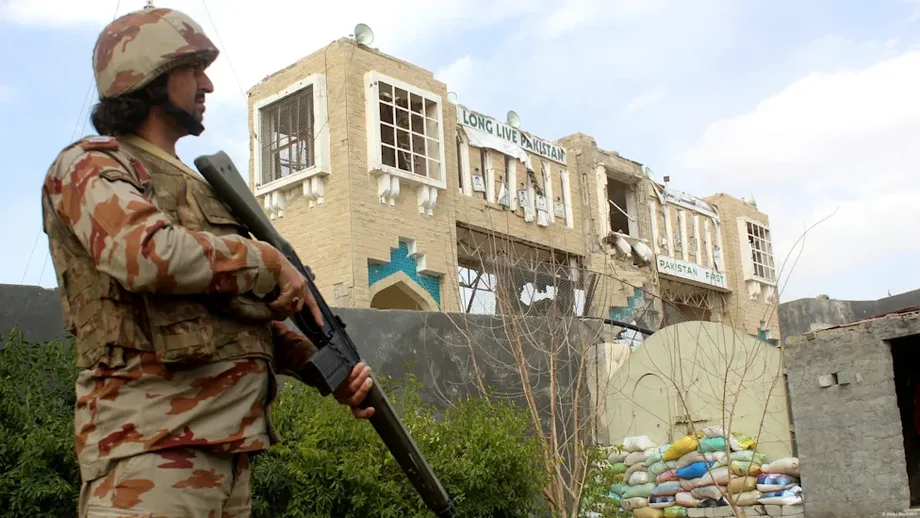
Border violence sharpens a dispute over who is backing whom
Afghanistan's Taliban authorities accuse Pakistan of helping armed groups that oppose their rule, while Islamabad denies the charge. The allegations have gained attention as resistance groups claim attacks across Afghanistan and Pakistan presses Kabul to curb militants it says are operating from Afghan territory.
Contents
Taliban Foreign Minister Amir Khan Muttaqi accused Pakistan of launching what he called a project to destabilize Afghanistan. He said thousands of armed people had gathered along the Durand Line, the border between the two countries, to undermine stability in Afghanistan. Pakistan's Ministry of Information rejected the accusations as propaganda.
The claims followed clashes between Afghan Taliban forces and armed groups near the border. In July, the Afghanistan Freedom Front (AFF) said it fought Taliban forces in Zebak district, in northeastern Badakhshan province. The group later claimed attacks in Nooristan and Kunar in October. Another group, the Afghanistan United Front (AUF), said it had begun operations in Kandahar, a southern province bordering Pakistan.
Taliban spokesperson Zabihullah Mujahid alleged that fighters involved in violence in Badakhshan crossed from Pakistan's Chitral district and later returned there. He also claimed Pakistani military personnel accompanied them. The Pakistani government denied that its personnel took part. The armed groups say their fighters are based inside Afghanistan and receive no outside support.
The dispute sits within a wider security crisis. Islamabad says the Taliban should act against armed groups, especially Tehreek-e-Taliban Pakistan (TTP), which has attacked Pakistani civilians and soldiers, and the Baloch Liberation Army (BLA), an outlawed separatist group active in Pakistan's Balochistan province. The Taliban deny that Afghan territory is being used to support attacks on Pakistan.
What are the resistance groups claiming?
The AFF and AUF are separate groups, and their claims describe a growing range of armed activity. The AFF has reported clashes in northeastern Afghanistan. The AUF says it is taking the fight into southern provinces such as Kandahar and Helmand, which are central to the Taliban's power base.
The AUF says it was formed in the United States in 2023 and began a military campaign called Operation Muharib in August 2026. Its leader, Sami Sadat, is a former commander of Afghanistan's army special forces. The group says its aim is to remove the Taliban from power and restore a constitutional system.
Between August 1 and November 13, the AUF claimed 126 attacks in 22 of Afghanistan's 34 provinces. It said the attacks killed 135 Taliban members and injured 60. The group claimed 37 attacks in Kandahar and 27 in Helmand. Those casualty figures are the AUF's own claims.
The group has also publicized attacks on military sites. Its spokesperson, Hilal Kakar, said the AUF targeted a Taliban army corps in Kandahar and a military base in Nawzad district, Helmand. On October 26, the group claimed attacks in six provinces, including Badakhshan, Kandahar and Zabul.
A conflict monitoring tally described fighting and attacks by armed groups as having doubled this year, spreading from 14 provinces last year to 28. It attributed 44 percent of recorded clashes to the AUF and said the National Resistance Front and AFF had also expanded their activity. The tally counts recorded clashes, while the AUF's 126 figure counts attacks claimed by the group, so the measures describe different things.
How strong is the evidence of Pakistani backing?
The Taliban argue that groups could not move fighters and supplies across the border without Pakistani permission. Shinkai Karokhail, a former Afghan lawmaker, said the alleged crossings would be impossible without Islamabad's support. She was referring to the clashes in Badakhshan and Nooristan.
Karokhail's view is one interpretation of the border geography, not a finding agreed by both governments. The Pakistani information ministry has denied involvement in the clashes, while the resistance groups insist they are rooted among Afghans inside the country.
Pakistani political analyst and former senator Afrasiab Khattak has argued that Islamabad is supporting Taliban opponents. He said their visits to the Pakistani capital were part of Pakistan's Afghanistan policy.
Taliban opponents come to Islamabad, hold meetings, and it is a part of Pakistan's policy toward Afghanistan.
Qandil Abbas, an associate professor of politics and international relations at Quaid-i-Azam University in Islamabad, drew a distinction between political and military help. She said Pakistan might support Taliban opponents politically, but not militarily.
Pakistan may provide political support to Taliban opponents, but not military support.
Former Afghan interior minister Ali Ahmad Jalali said Islamabad might use support for the opposition as leverage. In diplomacy, leverage means an advantage used to persuade another side to change its actions. Jalali linked that possible strategy to Pakistan's demand that the Taliban confront the TTP.
Former Balkh governor and Taliban opponent Atta Mohammad Noor has warned that resistance groups could become proxies for outside powers. That concern reflects a wider mistrust among opponents who may welcome help but fear that a foreign government could later withdraw it or use the groups to pursue its own goals.
Why are Pakistan and the Taliban at odds?
Pakistan says the TTP and BLA plan and launch attacks from Afghan territory, with Taliban support. Kabul rejects Pakistan's allegation that the TTP has sanctuary in Afghanistan. The two governments have traded accusations while border clashes and Pakistani airstrikes inside Afghanistan have added to tensions.
At an Economic Cooperation Organization summit in Islamabad, Pakistani Foreign Minister Ishaq Dar said Afghan authorities needed to address the security concerns of neighbouring countries, especially the threat of terrorism. Pakistan said Afghanistan was not invited to the meeting because Islamabad does not recognize the Taliban government.
Jalali argues that Pakistan is asking the Taliban to take action against a group with longstanding ties to them. He said the Taliban may lack both the willingness and the ability to fight the TTP, pointing to shared ideology and past cooperation. In his account, some Afghan Taliban members may even be among TTP fighters.
Pakistan once expected the Taliban to be a close partner after helping the movement during earlier periods, Jalali said. He argued that Islamabad provided the Taliban with shelter and political, diplomatic and military support, expecting cooperation after the movement returned to power in 2021. That expectation has not been met.
For Pakistan, the security dispute has practical consequences beyond the allegations. Pakistan's crossings at Torkham and Chaman have been closed for extended periods since October 2025, pushing Afghan traders to consider routes through Iran and Central Asia. A Pakistan border warning also showed how Islamabad has presented threats from Afghanistan as a reason for military readiness.
Does Pakistan want to replace the Taliban?
Jalali does not think Islamabad is trying to remove the Taliban from power. He said Pakistan is more likely to use pressure to seek cooperation against the TTP than to install a different government in Kabul. Other observers also doubt that Pakistan can or wants to overthrow the Taliban.
Malek Sitez, an Afghan researcher on international relations, says Pakistan has lost influence over Kabul. The Taliban's closer ties with India, Pakistan's longtime regional rival, have added to Islamabad's frustration. India upgraded its technical mission in Kabul to an embassy in October 2025, though it has not formally recognized the Taliban government.
The Taliban have also widened their contacts with other countries. Russia formally recognized their government in July 2025. On November 12, 2026, Russian Deputy Prime Minister Alexei Overchuk visited Kabul for trade and investment talks. An Afghan government statement put bilateral trade at more than US$349 million in the first eight months of 2026, more than double the amount in the same period a year earlier.
Those ties do not amount to a regional alliance, but they give Kabul more options. The October 5 Moscow Format meeting on Afghanistan ended without a joint statement for the first time since the forum began in 2017, reflecting disagreement over terrorism and responsibility for regional insecurity. Pakistan remains a major neighbour and a key route to the sea, yet repeated border closures and disputes encourage Afghan traders and officials to look elsewhere.
Khattak has described the Taliban as a continuing political card for Pakistan's government and military intelligence in regional competition. That view sits alongside the possibility that Islamabad might back Taliban opponents to pressure the authorities in Kabul. The two ideas can coexist: Pakistan could seek leverage against the Taliban without wanting to replace them.
Why opposition groups are wary of outside help
Armed resistance groups may see Pakistani support as useful, but several opponents doubt that it would last. Political analyst Aziz Barez said some could welcome help while viewing Pakistan's current position as a temporary effort to win concessions from the Taliban.
There is no guarantee that tomorrow the problems between Pakistan and the Taliban will be resolved and they will become old friends again.
The caution reflects Pakistan's changing relationships with Afghan movements over several decades. Khattak pointed to Pakistan's past support for Afghan groups fighting Soviet forces, later support for the Taliban against the government led by former mujahideen, and support for the Taliban during the two decades of war against the United States led coalition and the former Afghan government.
Resistance groups also face a separate question: whether they can build a broad political movement, rather than rely on armed attacks or outside backing. The AUF says it has expanded to 22 provinces and has publicized its claims more actively than other groups. The wider conflict tally also shows more provinces affected, but neither measure tells how much support the groups have among ordinary Afghans.
The Taliban, meanwhile, continue to hold power and have suppressed armed resistance and political dissent since returning to Kabul. On November 17, leader Hibatullah Akhundzada offered government positions to opponents according to competence and merit. Opposition figures dismissed the offer, arguing that joining the administration would make them officials under Taliban authority rather than partners sharing power.
Yasin Zia, leader of the AFF, linked Akhundzada's remarks to the group's armed resistance and said opponents wanted a political system in which sovereignty belonged to the people. National Resistance Front member Fazl Ahmad Manawi described the offer as appointments, not a partnership.
He does not want partners; he wants government functionaries.
The opposing claims leave key questions unsettled. Pakistan denies helping armed groups against the Taliban, and the Taliban deny giving sanctuary to militants who attack Pakistan. Publicly stated casualty totals for AUF operations come from the group itself, while the wider conflict count tracks recorded clashes. No future meeting or deadline to resolve the central security dispute has been announced.
Key Points
- The Taliban accuse Pakistan of backing armed groups that oppose their rule. Islamabad denies the charge.
- The AUF claimed 126 attacks in 22 provinces between August 1 and November 13, 2026, with 135 Taliban members killed and 60 injured.
- A conflict monitoring tally found fighting had spread from 14 provinces last year to 28 this year.
- Pakistan wants the Taliban to act against the TTP and BLA. Kabul rejects the accusation that Afghan territory is being used to support attacks on Pakistan.
- Analysts describe possible Pakistani support as leverage, while others doubt Islamabad wants to remove the Taliban from power.
- Taliban opponents remain wary that any Pakistani backing could be temporary and tied to Islamabad's dispute with Kabul.