Seven jobs, 30 pupils and a daily risk of arrest
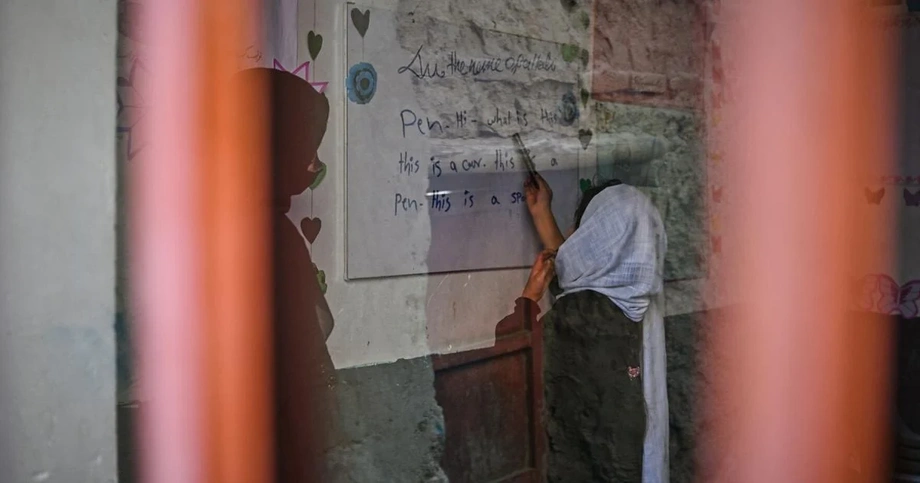
A beauty salon owner in Kabul reopened her business after a Taliban raid stripped her first hidden salon of its equipment and almost all its furniture. Her new apartment salon employs seven young women who help support their families. Elsewhere in the capital, two sisters teach about 30 children and young adults, including girls as old as 20, behind a door opened just wide enough to admit each student.
Contents
- Seven jobs, 30 pupils and a daily risk of arrest
- A salon rebuilt after a raid
- A classroom hidden inside a home
- How the education bans accumulated
- A former national player keeps soccer alive
- Rules extend from the street into the household
- Healthcare restrictions meet a shrinking workforce
- Leaving Afghanistan brings new barriers
- Women have written their own demands before
- International accountability advances as restrictions persist
- Key Points
A former national soccer player has found another way to keep part of her old life alive. Barred from competing, she boxes against a stack of old car tires and coaches boys in her home's small courtyard.
All three women described their lives anonymously because they feared arrest. Their activities meet immediate needs: earning money, keeping children learning and finding relief from isolation. Each also brings them into conflict with restrictions imposed since the Taliban returned to power in August 2021.
The scale of exclusion extends far beyond these homes. UNESCO estimates that 2.4 million Afghan girls have been denied secondary education. UN Women puts women's employment at 7%, compared with 84% for men, a gap of 77 percentage points. More than half of women surveyed leave home no more than once or twice a month.
Human Rights Watch's World Report 2026, reviewing developments in 2025, records the closure of beauty salons operated from homes, further limits on women's movement and restrictions reaching into healthcare, broadcasting and university teaching. The private spaces women use to preserve their livelihoods are also targets of enforcement.
A salon rebuilt after a raid
The Kabul salon owner, 40, had worked in beauty salons for years before authorities banned them. With her husband unable to find work, her earnings were essential to paying household bills and feeding their children.
Wedding preparations created demand even after the ban. She rented an apartment, bought equipment and built a clientele of about 30 women. Authorities eventually discovered the business and confiscated its contents.
The owner described the loss as both financial and deeply personal:
If my work, the only thing that gave me any sense of purpose, is taken away, what am I left with? How am I supposed to feed my children? How am I supposed to cover household expenses?
Calls from clients continued. Bills continued arriving too. She rented another apartment and started again, eventually employing seven women. Her decision restored income for several households, while exposing the workers to the possibility of another raid.
The salon owner said the fear accompanies even an ordinary interruption:
Every time there's a knock on the door, I worry the Taliban might be on the other side.
A classroom hidden inside a home
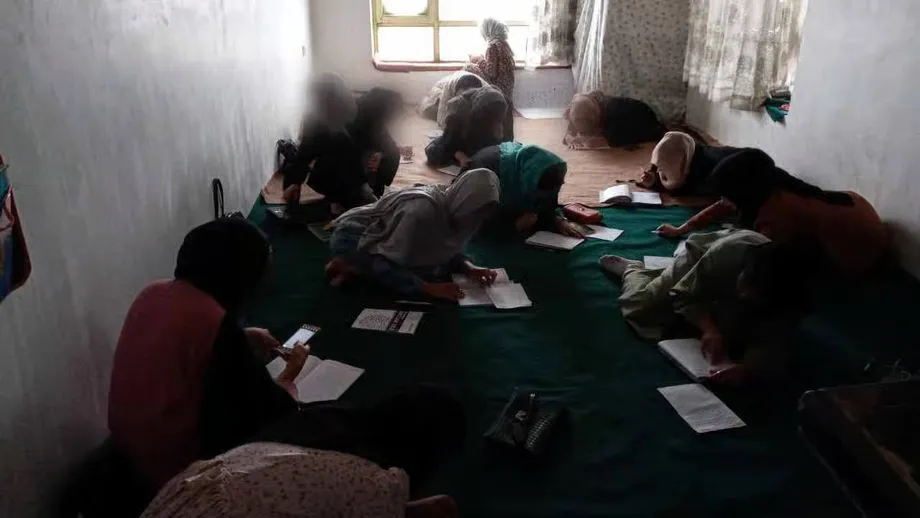
The secret school in Kabul teaches history, science, geography, mathematics, languages and Quranic studies. Students arrive at different times to avoid attracting attention. Inside, they sit on the floor at low plastic tables, with colorful drawings decorating the walls.
The main teacher is 20. Her teenage sister helps her. Neither has professional teacher training; they pass on what they learned before their own education was interrupted.
The older sister said depression helped drive her decision to establish the class. Teaching offered a purpose and a way to give other girls hope. Her sister said many pupils had fallen behind and needed somewhere to work toward their goals.
The teenage teaching assistant described the danger accompanying every lesson:
We fear that one day, they might come after us, accuse us of violating their rules, arrest us and take us away. We are absolutely terrified of that possibility.
The classroom brings together boys and girls excluded from different opportunities. Girls beyond primary school age make its ordinary lessons a secret activity, despite exceptions allowing some religious education and language courses.
How the education bans accumulated
The restrictions developed through successive decisions, closing routes from school into university and professional training. Medical education, once a remaining avenue for some women, was later closed too.
- August 2021: The Taliban returned to power after the withdrawal of troops led by the United States.
- March 2022: Authorities suspended girls' education beyond sixth grade.
- December 2022: Women were banned from universities.
- December 2024: Women were barred from medical training institutions.
- September 2025: Authorities banned university teaching from books written by women, according to Human Rights Watch.
- 2026: A United Nations education report recorded no female university enrollment and estimated that 2.4 million girls were excluded from secondary education.
Government spokesman Zabihullah Mujahid said in August that officials were working to address education restrictions:
Regarding the part (of education) that still has shortcomings, we are striving to resolve it comprehensively.
No reopening date has been announced. For pupils growing older each year, the delay means missing the lessons needed to advance into formal qualifications and professional work.
Hoda Jaberian, UNESCO's program coordinator for education in emergencies, warned that Afghanistan risks losing future teachers, healthcare professionals and other skilled workers. She called for girls and women to return to education:
The return of all girls and women to the education system is fundamental for us, and no alternative learning opportunity can replace their formal schooling.
The Kabul sisters' classroom shows both the determination behind alternative lessons and their practical limits. Two young women without professional training are trying to meet needs that would ordinarily require schools, qualified teachers, examinations and a route to further study.
A former national player keeps soccer alive
The former soccer player had earned a place on Afghanistan's national team as a teenager. Two years later, the ban on women's sports ended the future she had imagined.
She spent six months barely leaving her room. Eventually, she began exercising at home, using old tires for boxing practice and finding small spaces to play soccer. Coaching young boys gave her another connection to the sport.
The former national player explained why teaching them mattered:
I saw in them the same dreams and the same passion I had held during my own childhood. It feels really good for me to train with them. Sometimes, I see myself in them.
Her courtyard sessions help her through the days, but she wants refuge abroad. Women's exclusion from sport has also prompted action internationally. Cricket Scotland's restrictions on Afghanistan ties, announced in November 2026, stopped independently arranged series and certain training arrangements with Afghanistan's men while preserving fixtures required by International Cricket Council competitions.
Rules extend from the street into the household
The Ministry for the Promotion of Virtue and Prevention of Vice enforces restrictions on dress, movement and public behavior. Its officers can detain women accused of breaking the rules. Women have also described beatings.
A law with 35 articles introduced in 2024 includes compulsory dress requirements, restrictions on women's voices in public and requirements involving a mahram, a close male relative who accompanies a woman. Human Rights Watch describes workplace raids, checkpoints, phone inspections and questioning of passengers and pedestrians.
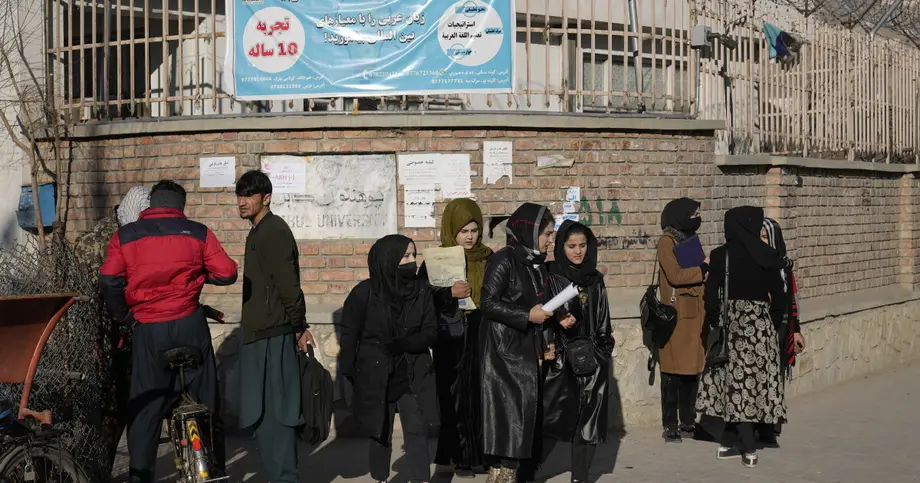
Kabul's walls carry messages about women's clothing, conduct and even perfume. Ministry spokesman Saif al-Islam Khyber described the messages as invitations to religious observance, good conduct and proper dress. Women interviewed about the signs described pressure and humiliation.
Ministry spokesman Mohammad Aslam Badriwal said the authorities were committed to rights under their interpretation of Islamic law. He described the ministry's priority in these words:
to ensure that our sisters are completely safe within society and are able to enjoy all their Sharia-granted rights.
UN Women's findings describe how restrictions shape everyday life. Nine in ten women surveyed said they needed a male relative's permission to leave home. Its assessment drew on household interviews with 2,190 people in February and March 2025 and telephone interviews with 2,811 people in April and May 2026.
Women's stated ambitions were concrete. In the 2025 survey, about 40% placed equal rights among their three leading goals, 33% selected independent income and 25% selected supporting their families. The hidden salon and classroom serve precisely those needs.
Healthcare restrictions meet a shrinking workforce
Women seeking medical care face a particularly damaging combination: barriers to treatment by men and a ban on training the next generation of female medical workers.
Doctors and patients have described orders preventing male dentists from treating women, enforced through raids and threats of imprisonment. Male doctors have also described requirements for a patient's mahram to be present, including during emergency care. Doctors reported restrictions on hiring female staff.
Farida, a pseudonym used by a 37 year old woman who returned from Iran to Herat, described having dental treatment interrupted after paying in advance. During her third appointment, the clinic sent her home. Staff later told her an order prevented male dentists from treating female patients. Three months later, her treatment was still unfinished.
No nationwide prohibition on male dentists treating women has been publicly announced. The reported enforcement also conflicts with a February statement by Taliban communications minister Hamdullah Nomani that male doctors would be considered mahram when treating female patients.
Human Rights Watch records another pressure on access: more than 400 health centers closed in 2025 because of funding shortages. Restrictions on movement and medical practice leave women navigating fewer facilities, fewer permitted providers and greater dependence on relatives to reach care.
Leaving Afghanistan brings new barriers
Iran and Pakistan have offered escape routes for women seeking education, but legal residency requirements and deportations are closing opportunities there too.
Zahra, a pseudonym for an Afghan woman who was close to finishing a medical degree when universities were closed to women, moved to Iran with her family. She said expired visas and the absence of legal residency prevented her and her sister from continuing their studies.
Iran restricted access to some services, including education, to foreigners holding valid residency documents from March 21, 2025. Temporary registration slips held by an estimated 2 million Afghans expired that month. Iranian officials say children can attend school when their parents have valid residency permits, with some paperwork completed during the school year.
About 1.9 million Afghans returned from Iran in 2025, including 1.26 million deported. United Nations figures cited nearly 492,300 further deportations by October 12, 2026.
Pakistan's Medical and Dental Council ordered Afghan medical students to return home and told colleges not to support their enrollment for the academic year. Courts issued interim protection against immediate deportation. Pakistani officials say Afghans with valid visas, residency papers and required local identity documents can study.
Nilofar, a pseudonym for a young Afghan woman in Quetta, could not enroll in school without residency papers. She instead attended an English course that did not require an identity card. Her experience echoes the limits faced by the Kabul home school: some learning continues, while the route to a recognized education stays blocked.
Women have written their own demands before
Afghan women's efforts to claim education, work and freedom of movement predate the current Taliban government. In June 2000, about 300 Afghan women gathered in Dushanbe, Tajikistan, and drafted the Declaration of the Essential Rights of Afghan Women.
The declaration listed ten rights, including education, fair working conditions, political participation, cultural activity and the choice of whether to wear a chadari, the Afghan burqa. Its organizers included Shoukria Haidar and writer Nasrine Gross. Ahmad Shah Massoud, then leading armed resistance to the Taliban, signed his support.
The declaration was later presented to Afghanistan's constitutional revision commission with hundreds of thousands of signatures. Article 22 of the 2004 constitution established equal rights and duties for women and men before the law.
Today's hidden businesses and lessons pursue several of those same demands in practical form. The salon pays women for skilled work. The sisters preserve access to learning. The former soccer player keeps sporting knowledge alive, even while her own chance to compete is denied.
International accountability advances as restrictions persist
The International Criminal Court issued arrest warrants in July 2025 for Taliban leader Hibatullah Akhundzada and Supreme Court chief Abdul Hakim Haqqani, alleging crimes against humanity through persecution of women, girls and LGBTQI+ people.
The United Nations Human Rights Council established an independent international accountability mechanism in October 2025. Its mandate includes investigating serious abuses, collecting and preserving evidence, identifying responsible people and supporting future prosecutions.
The continuing Taliban investigation remained open after judges closed other strands of the ICC's Afghanistan inquiry in November 2026. Those proceedings concern criminal responsibility, while women inside Afghanistan continue making daily decisions about work, lessons and medical treatment.
Human Rights Watch also cites UNAMA's first two quarterly reports of 2025, which recorded corporal punishment involving 414 people, including 83 women and three girls. Against that enforcement environment, anonymity, staggered arrivals and closed apartment doors are practical precautions for women trying to preserve a livelihood or education.
Key Points
- A Kabul salon reopened after a raid and now employs seven women supporting their families.
- Two sisters teach about 30 pupils in a secret home school, including girls as old as 20.
- UNESCO estimates that 2.4 million girls have been excluded from secondary education.
- UN Women records employment of 7% for women and 84% for men.
- Restrictions on medical education and treatment are reducing women's access to healthcare.
- Residency rules and deportations in Iran and Pakistan create further barriers for women seeking education abroad.
- International criminal proceedings continue, while no date has been announced for reopening formal education to girls and women.