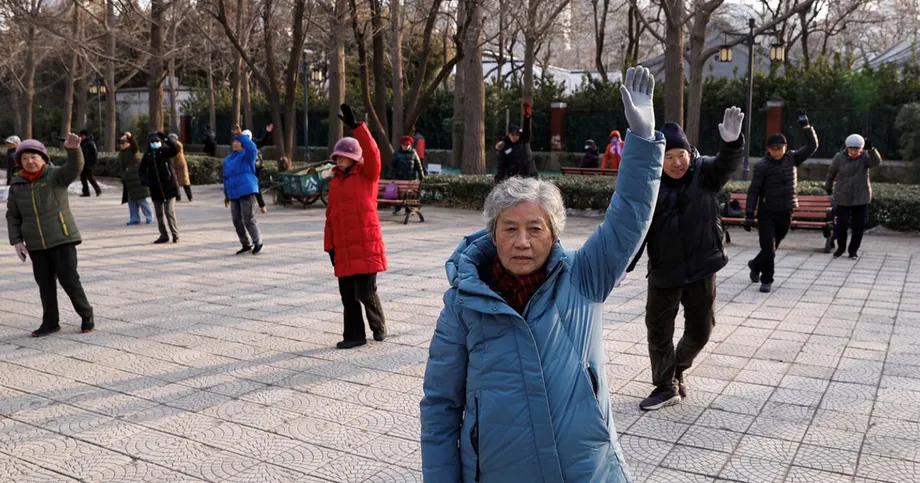
A population shift reaches the school gate
China had 223.65 million people aged 65 or older at the end of 2025, outnumbering children aged 0 to 14 by 10.89 million. Across 17 provincial regions, older residents now exceed children, while shrinking school networks are leaving buildings available for nursing homes, community kitchens and other services.
Contents
- A population shift reaches the school gate
- What the dependency ratios mean
- Where older residents outnumber children
- Similar totals can mean different needs
- Fewer schools, but millions of pupils remain
- How provinces are handling empty buildings
- Why conversion costs more than new beds
- Keeping a care centre open takes more than a subsidy
- Rural research points toward care closer to home
- Key Points
The National Bureau of Statistics recorded 212.76 million children aged 0 to 14 in its 2025 statistical communique, published on February 28, 2026. People aged 65 and above accounted for 15.9% of the population. The national population stood at 1.40489 billion, down 3.39 million from a year earlier, with 7.92 million births and 11.31 million deaths.
A provincial breakdown based on the China Statistical Yearbook 2026 shows how unevenly the change is spreading. The northeast, parts of the Yangtze River region and areas around the Bohai Sea have especially high numbers of older residents relative to people of working age. Several western and central regions still have comparatively large child populations.
Nanping, in Fujian province, offers a concrete example of the buildings left behind. By autumn 2025, it had 601 unused school sites. Among sites brought back into use, 20 served public purposes such as nursing homes, welfare homes and kitchens for older people. Others became factories, painting bases or family farms.
China's national dependency ratio crossover marked the point when older people first outnumbered children relative to the population aged 15 to 64. The provincial figures now show where local governments face the task of reshaping services, and why converting an empty classroom into a care facility involves much more than changing its furniture.
What the dependency ratios mean
A dependency ratio compares an age group with people aged 15 to 64. The child dependency ratio counts children aged 0 to 14 against that population. The older adult dependency ratio makes the same comparison for people aged 65 and above.
China's 2025 figures translate into approximately 23 older people and 22 children for every 100 people aged 15 to 64. Adding the two groups gives about 45 people outside that age range for every 100 within it. Because both ratios use the same population as their base, older people outnumbering children also means the older adult ratio is higher.
The calculation groups people by age. Actual care and financial responsibilities depend on employment, pensions, health, savings and family arrangements. Some older people continue working or help relatives, while some people aged 15 to 64 are students or have no paid employment.
Migration can change a province's ratio even without an increase in its older population. When younger adults leave for jobs elsewhere, the number of people in the working age group falls. Children and older residents then become a larger share of those who remain.
Where older residents outnumber children
Eleven provincial regions had more than 25 people aged 65 or older for every 100 people aged 15 to 64: Liaoning, Shanghai, Jilin, Heilongjiang, Tianjin, Jiangsu, Chongqing, Shandong, Sichuan, Hubei and Hebei.
Those 11 also had more older residents than children. Six other regions joined them: Hunan, Beijing, Shaanxi, Inner Mongolia, Shanxi and Zhejiang. The resulting group of 17 includes provinces, autonomous regions and municipalities administered directly by the central government.
The geography matters for service planning. Liaoning, Jilin and Heilongjiang form the northeast, while Shanghai, Jiangsu and Zhejiang belong to the Yangtze River Delta. Sichuan and Chongqing sit farther upstream along the Yangtze, and several northern regions lie around the Bohai Sea.
Children remain a larger part of the population structure elsewhere. The ten regions with the highest child dependency ratios were Tibet, Guizhou, Guangxi, Henan, Qinghai, Ningxia, Xinjiang, Gansu, Jiangxi and Yunnan. Those places continue to face substantial demand for education and services for families, even as older populations grow.
Similar totals can mean different needs
Eleven provincial regions had a combined dependency ratio above 46%: Shandong, Guizhou, Guangxi, Henan, Hebei, Hunan, Liaoning, Sichuan, Chongqing, Shaanxi and Anhui. Each therefore had more than 46 children and older adults combined for every 100 people aged 15 to 64.
Guizhou, Guangxi and Henan have relatively high child dependency ratios. Their immediate needs include classrooms, teachers and support for families. Their children could later expand the population of working age, although the local benefit will depend on education, employment and whether young adults stay or move away.
Liaoning and several other regions have a larger older adult component. Their service demands lean more toward assistance with daily life, meals and care. A similar combined ratio can therefore produce different spending priorities: one area needs to accommodate children, while another needs to make daily life manageable for older residents.
Local governments also have to plan below the provincial level. A province can contain expanding urban neighbourhoods alongside villages with empty schools. Decisions about a particular building depend on who still lives nearby and which services residents can reach.
Fewer schools, but millions of pupils remain
China had 8,000 fewer regular primary schools in 2025 than in 2024. The number of primary teaching points, smaller locations excluded from the regular school count, fell by 9,900. Kindergartens declined by 21,400.
The contraction in kindergartens extended across three years. Their number fell by 14,800 in 2023, 21,100 in 2024 and 21,400 in 2025, a combined decline of 57,300. The number of children attending kindergarten fell by about 3.58 million in 2025.
The statistics bureau recorded 32.255 million children in preschool education during 2025. Primary schools admitted 14.617 million pupils and had 101.783 million enrolled altogether. These figures show the scale of the education system that still has to be maintained as individual sites become surplus.
Urbanisation is changing where that demand sits. At the end of 2025, 67.89% of China's population lived in urban areas, an increase of 0.89 percentage points from a year earlier. As rural families move to towns and cities, school buildings can become unused in their former villages while children need places closer to their new homes.
The main dates show how the shift has moved from school numbers into local planning:
- 2023: China's kindergarten total fell by 14,800.
- 2024: A further 21,100 kindergartens disappeared from the national count.
- Autumn 2025: Nanping recorded 601 unused school sites.
- End of 2025: China's population aged 65 and above exceeded its population aged 0 to 14.
- February 28, 2026: The National Bureau of Statistics published its annual communique with national population and education figures.
How provinces are handling empty buildings
Hebei has issued a plan to manage and reuse unused school buildings through classification and different forms of use. Five provincial departments were involved: education, development and reform, finance, natural resources, and agriculture and rural affairs.
Hunan's education department and eight other departments have called for unused rural school sites and buildings to be brought back into use over about three years. Their approach involves classifying properties and carrying out the work in stages.
Nanping's inventory shows the difference between assigning responsibility for a property and opening a new service there. Of its 601 unused school sites, 196 were covered by custodial agreements with local governments, while village collectives managed 274.
Among the sites already reused, 20 served public purposes, 17 became business premises and four supported cultural tourism. The business uses included a chemical plant in Shaowu and a tea factory in Wuyishan. Painting bases and family farms were among the tourism uses. The published breakdown leaves the final use of many sites unspecified.
These choices reflect the range of local needs. A village may need a meal service for older residents, premises for employment or a place for community activities. Former education buildings are becoming assets that local authorities can assign to those different purposes.
Why conversion costs more than new beds
Zhang Sheng, an associate professor at Tianjin Chengjian University and a registered architect, has described a practical advantage of kindergarten buildings: a standard classroom can be divided into two or three rooms for older residents after suitable alterations.
Projects already operating show what those alterations involve. A former kindergarten in Jinan's Tianqiao district received accessibility improvements, a bathroom suitable for people with limited mobility and an upgraded fire safety system. Its kitchen became a dining service for older people, serving residents and delivering meals within the community.
In Sanming's Sanyuan district, Fujian, 553 square metres of unused kindergarten space became a centre combining care, leisure and education for older residents. The examples show that reuse can support both residential care and services for people who continue living at home.
Land arrangements, ownership and approvals can make conversion expensive. Education premises and welfare facilities may fall under different land use categories. Changes can require several departments to approve them, while fire safety work must account for residents who may need help leaving a building.
Liu Ming, a pseudonym used by a care operator, described a proposed conversion in which fire safety alterations and related applications alone were estimated at 500,000 yuan. Expensive decoration left from the kindergarten offered little help with those requirements.
The account of the sector also identifies two mandatory national standards, covering basic requirements for care institutions and the identification of major accident hazards, as taking effect on August 1, 2027. For conversion projects, meeting operating and safety requirements is part of the budget from the beginning.
Keeping a care centre open takes more than a subsidy
Liu Ming described a local funding arrangement for a community care institution with about 100 beds across 2,500 square metres. Construction and installation costs were approximately 1.2 million yuan, with a one time construction subsidy capped at 1 million yuan. Operating subsidies were linked to beds actually occupied.
At those figures, the maximum construction grant would cover about 83% of the stated construction and installation cost. Operators would still need to pay for staff, food, utilities, upkeep and daily care, along with any other project costs.
Liu Jianyu, an industry participant, estimated that a community care institution operating well could theoretically become profitable in around two years. Occupancy in many places, however, was described as below 60%. A building with empty beds still incurs costs, making the number of residents central to its finances.
Xi'an operator Ding Kunping's experience illustrates the risk. A facility with 120 beds initially housed just 18 older people, an occupancy rate of 15%. It endured five consecutive years of losses with family support before later developing into a care home rated at five stars in Shaanxi.
Government ownership combined with professional operation is one response. Public bodies can retain the property, support renovation and arrange longer leases, while a specialist operator provides services and a community health centre supplies medical support. Nationally, the statistics bureau counted 39,000 care institutions and 7.68 million eldercare beds at the end of 2025.
Rural research points toward care closer to home
A rural aging study published in Humanities and Social Sciences Communications projects the share of rural residents aged 65 and above rising from 13.49% in 2020 to 28.74% in 2050. Its rural older adult dependency ratio rises from 19.85% to 49.16% over the same period.
In everyday terms, that projected ratio means roughly five older people for every ten people aged 15 to 64 in rural areas by 2050, compared with about two in 2020. The study uses the 2020 census and PADIS-INT population forecasting software, with assumptions about fertility, mortality, migration and urbanisation.
The projected regional gap is wide. Heilongjiang's rural older adult dependency ratio reaches 88.06% in 2050, compared with 28.30% in Tibet. The researchers expect about 48% of provincial rural populations to pass a threshold of 20% aged 65 and above by 2030, and all except Tibet to pass it by 2050. Their model also projects small declines in the rural aging measure in Chongqing and Gansu in 2050.
The study reports that only 0.55% of rural older adults lived in care institutions, while 13.50% lived without caregiving assistance. Its proposal centres on family support and mutual help within villages, including assistance from younger, healthier older residents.
That approach gives former schools a possible role beyond residential beds. A reused building can provide meals, activities and a base for community support while residents remain in their own homes. The practical choice is which service fits the surrounding population, and how to keep that service staffed and funded.
Key Points
- China had 223.65 million people aged 65 or older and 212.76 million children aged 0 to 14 at the end of 2025.
- Older residents outnumbered children in 17 provincial regions, with strong concentrations in the northeast and several Yangtze and Bohai regions.
- The national kindergarten count fell by 57,300 across 2023 to 2025.
- Nanping recorded 601 unused school sites by autumn 2025, with some reused for care, meals, businesses and tourism.
- Conversion costs include accessibility work, fire safety and approvals. Occupancy and continuing operating income determine whether residential facilities can stay open.
- Rural population research projects growing care needs and proposes more mutual support within villages.