Eight exits and one transfer take effect after November 30
Eight Indonesian stocks will leave MSCI's combined Global Standard and Small Cap index coverage after trading closes on November 30, 2026, while Bumi Resources Minerals moves from Standard to Small Cap. The changes leave the MSCI Indonesia Index with seven companies, down from 18 at the beginning of the year, as authorities try to prevent a much broader exclusion of Indonesian shares from global investment benchmarks.
Contents
- Eight exits and one transfer take effect after November 30
- Which companies are leaving the indexes?
- Why the BRPT and BRMS changes matter for funds
- Indonesia's main MSCI basket has become much smaller
- A separate decision could remove Indonesia from broader benchmarks
- Ownership disclosure and trading conduct are central
- Stocks and the rupiah face pressure beyond review day
- The review also reshapes global indexes
- What happens before the June decision?
- Key Points
Barito Pacific, controlled by billionaire Prajogo Pangestu, will leave the Global Standard Index without joining Small Cap. Bumi Resources Minerals, associated with the Bakrie group, will leave Standard but enter Small Cap. Seven other companies will be deleted from Small Cap, including state controlled Jasa Marga, which completes the list of names affected.
The November review leaves Indonesia's emerging market classification unchanged. A separate MSCI consultation could move the country into standalone status, placing its shares outside the provider's emerging and frontier market index groupings. Feedback is due by April 30, 2027, with a decision on or before June 30.
The immediate changes become effective on December 1, following the November 30 market close. The review announcement was dated November 11 and became news in Indonesia on November 12. No Indonesian stocks were added to Global Standard, and Indonesia's Micro Cap constituents were unchanged.
The official MSCI Global Standard review, dated November 11, 2026, uses a price cutoff of October 20, 2026. It confirms no Indonesian additions and two deletions, Barito Pacific and Bumi Resources Minerals, effective after the November 30 close. MSCI says the results may be updated for corporate events, Ineligible Alert Board treatments or other relevant adjustments before the effective date.
Which companies are leaving the indexes?
MSCI's changes affect nine companies: eight leave the combined Standard and Small Cap coverage, while one transfers between those categories. Standard generally covers larger and medium sized companies; Small Cap covers smaller companies that meet its inclusion rules.
- Global Standard removal: PT Barito Pacific Tbk (BRPT).
- Transfer from Global Standard to Small Cap: PT Bumi Resources Minerals Tbk (BRMS).
- Small Cap removal: PT Avia Avian Tbk (AVIA).
- Small Cap removal: PT Ciputra Development Tbk (CTRA).
- Small Cap removal: PT Dayamitra Telekomunikasi Tbk (MTEL).
- Small Cap removal: PT Elang Mahkota Teknologi Tbk (EMTK).
- Small Cap removal: PT Jasa Marga (Persero) Tbk (JSMR).
- Small Cap removal: PT Rukun Raharja Tbk (RAJA).
- Small Cap removal: PT Solusi Sinergi Digital Tbk (WIFI).
The detailed constituent lists identify seven Small Cap deletions; a higher total of nine Small Cap deletions has also been reported, without a matching list of nine names. The seven named removals, together with Barito Pacific, produce the total of eight exits from combined coverage.
The official Global Standard report covers the two Standard deletions, not the Small Cap constituent changes, so it does not resolve the discrepancy in the Small Cap deletion count or establish the complete Small Cap list.
Why the BRPT and BRMS changes matter for funds
Barito Pacific held a 2.47% weight in the MSCI Indonesia Index before the review, while Bumi Resources Minerals accounted for 2.26%. Together, they represented 4.73% of the index. Their departure therefore changes almost one twentieth of its previous composition.
An index is a basket of shares used to represent a market. A passive investment fund tries to copy that basket, holding its shares in similar proportions. When an index removes a company, a fund tracking it must adjust its investments to match the new composition.
Funds tracking Standard benchmarks will consequently need to remove both BRPT and BRMS from the relevant portfolios. Funds following Small Cap benchmarks may need to buy BRMS as it enters their investment basket. Barito Pacific has no corresponding Small Cap addition in this review.
Investors can therefore expect different trading demands around the same date. BRMS faces a transfer between investor groups, while BRPT and the seven Small Cap deletions lose their places in those benchmark baskets. The actual value of trading will depend on the money tracking each index and how managers carry out their adjustments.
Indonesia's main MSCI basket has become much smaller
The MSCI Indonesia Index will contain seven companies after the changes, compared with nine immediately before them and 18 at the start of 2026. The decline from 18 to seven amounts to 11 companies, or about 61% of the starting total.
MSCI's consultation records a 55% fall in the index's free float adjusted market capitalisation between December 31, 2025 and September 30, 2026, from US$119.14 billion to US$53.36 billion. Over that period, its constituent count fell from 18 to nine and its weight in the MSCI Emerging Markets Index declined from 1.16% to 0.43%.
MSCI removed six Indonesian companies in May and another two in August. The May deletions included Chandra Asri Pacific, Barito Renewables Energy and Petrindo Jaya Kreasi, three companies controlled by Prajogo Pangestu. November's removal of Barito Pacific extends the retreat in index representation across his business interests.
Barito Pacific operates across petrochemicals, energy and infrastructure. Prajogo holds 71.37% of its shares, according to exchange ownership data cited in coverage of the review. Other affected companies span property, communications infrastructure, media and transport, spreading the changes across several parts of Indonesia's listed economy.
Fewer constituents mean international investors tracking the main Indonesian benchmark will hold a narrower selection of companies. Changes in the prices of those remaining businesses will consequently carry more influence within that basket, depending on their individual weights.
A separate decision could remove Indonesia from broader benchmarks
MSCI's October warning went beyond individual stock deletions. The provider cited problems with ownership transparency and coordinated trading as it considered moving Indonesia from emerging market to standalone status. Indonesia has held its MSCI emerging market classification since 1989.
The full Indonesia market reclassification consultation, issued in October 2026, proposes moving the MSCI Indonesia Indexes from Emerging Market to Standalone Market status across all relevant global and regional composite indexes. It also asks whether Frontier Markets status would be appropriate if respondents disagree with the standalone proposal, and seeks views on the implementation timetable and whether any move should happen in one step. MSCI says the proposal may or may not result in index changes.
Standalone markets sit outside MSCI's broad emerging and frontier market groupings. Moving Indonesia into that category would change the investment universe for funds whose rules require them to follow those benchmarks, potentially requiring sales across Indonesian holdings rather than only the companies named in November's review.
More than US$1.8 trillion in assets are benchmarked to MSCI's emerging market indexes, according to figures attributed to the provider. Indonesia accounts for only part of that investment universe, but inclusion gives its companies access to a large international pool of capital.
Goldman Sachs has estimated that a broader exclusion could trigger US$5.6 billion in passive investment outflows. Foreign investors have already withdrawn about US$5.4 billion from Indonesian equities during 2026. The potential passive selling estimate is therefore slightly larger than the foreign withdrawals recorded so far this year, although it remains conditional on a wider exclusion.
Ownership disclosure and trading conduct are central
MSCI's concerns focus on whether investors can identify who controls shares, how much stock is genuinely available for trading and whether prices reflect independent buying and selling. Authorities have tightened ownership disclosure requirements, pursued higher minimum free floats and taken action over concentrated shareholdings.
The consultation cites persistent opacity in shareholding structures, suspected coordinated trading and a lack of evidence of meaningful enforcement. MSCI says market participants have not consistently observed sufficient progress across the Indonesian equity market despite announced reforms, including disclosure of shareholders with ownership above 1%, more granular investor classifications, High Shareholding Concentration reporting and a roadmap towards a minimum free float of 15%.
MSCI is seeking evidence of stable and reliable ownership disclosures, consistent implementation of reforms and enforcement of the concentration framework and 1% disclosure threshold. It also asks for meaningful enforcement against coordinated trading and float manipulation, reliable free float across the broader market and sustained market surveillance beyond the largest securities. Respondents are asked whether reforms are complete and sustainable, and whether coordinated trading could return once the freeze on index changes is lifted.
Since January 2026, MSCI has frozen certain Indonesian index changes, including increases in Foreign Inclusion Factors or Number of Shares, additions to the MSCI Indonesia Investable Market Index and upward migrations across size segments. The consultation says that freeze will continue until further notice.
Free float means the shares available for ordinary investors to trade, rather than holdings kept by controlling owners or other strategic investors. If shares presented as publicly available are actually held by connected parties, investors may have a misleading picture of the supply they can buy or sell.
Earlier in November, the Indonesia Stock Exchange removed a threshold of 5 trillion rupiah in market capitalisation from its screening of companies that breach rules on highly concentrated ownership. Removing that threshold broadens the screening beyond companies above that size.
OJK, Indonesia's Financial Services Authority, has also imposed record trading fines totalling 2.1 trillion rupiah over manipulation involving Dian Swastatika Sentosa and concealed share allocations in the initial public offerings of Barito Renewables Energy and Petrindo Jaya Kreasi. The penalties targeted specified entities and other parties involved in the cases.
OJK's continuing market integrity concerns centre on whether similar ownership and trading problems can recur. For investors, the practical test is whether disclosure, supervision and penalties produce dependable information and workable trading conditions.
Stocks and the rupiah face pressure beyond review day
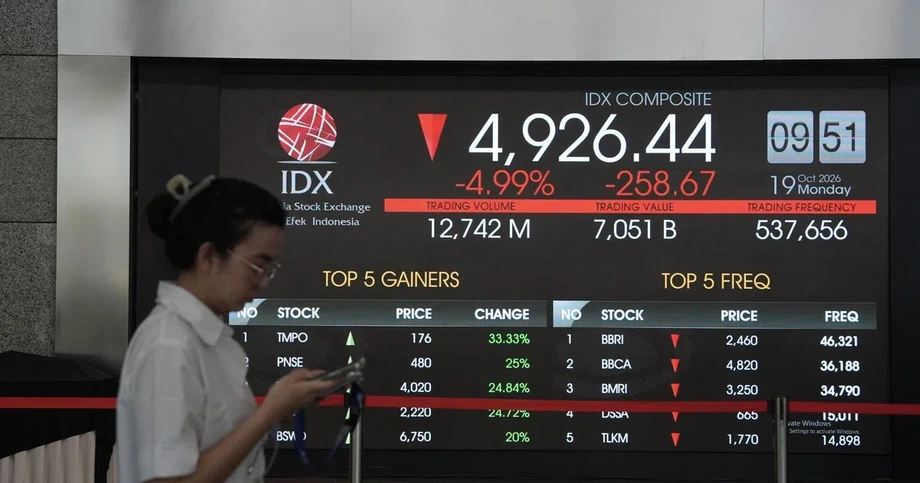
The Jakarta Composite Index had fallen more than 41% during 2026, placing Indonesia at the bottom of major global stock market performance rankings. On November 11, the benchmark closed down 0.21% at 5,115.04, while Barito Pacific fell 6.71%.
Foreign investors sold a net 20.76 billion rupiah across all Indonesian equity markets that day, including 20.08 billion rupiah in the regular market. Seven of the exchange's 11 sectors declined. Basic industry suffered the largest sector fall, at 1.86%, while transport rose 0.91%.
Prices moved in both directions around the review. Indonesian stocks rose during November 12 trading, with the benchmark up 1.3% at one reported point. The EIDO exchange traded fund and the MSCI Indonesia Index also recorded gains of 0.10% and 0.23%, respectively, in market updates surrounding the announcement.
The rupiah reached 18,248 per US dollar during November 12 trading. Bank Indonesia attributed currency pressure to US monetary policy expectations, concerns about MSCI's decision, domestic economic issues and greater demand for foreign currency toward the end of the year. A weaker rupiah increases the local currency cost of dollar payments, including imports and some company debts.
The review also reshapes global indexes
MSCI's November changes extend well beyond Indonesia. Its All Country World Index, known as ACWI, will remove 100 stocks and add 13, a net reduction of 87 constituents. The global Small Cap review adds 171 stocks and removes 243, reducing that basket by 72.
Other index families move differently. The ACWI Investable Market Index adds 113 companies and removes 272, while World All Cap adds 140 and removes 100. Frontier Markets adds 12 and removes 10, and Frontier Markets Small Cap adds 100 while removing 21.
New World Index entrants include US vaccine company Moderna and Canadian clothing company Aritzia. Major emerging market additions include China's Zhongji Innolight H, Life Insurance Corporation of India and Taiwan's Nan Ya Printed Circuit Board Corporation.
Indonesia is therefore part of a worldwide portfolio adjustment, with its changes taking place alongside an unresolved country classification consultation. Funds must prepare for November's constituent changes while authorities work toward the separate decision expected in 2027.
What happens before the June decision?
Indonesia Stock Exchange President Director Jeffrey Hendrik said the exchange has continued communicating with global index providers and international investors, explaining reforms and gathering feedback. Different providers are following their own review processes.
Jeffrey described FTSE Russell's position in October, following its confirmation of Indonesia's unchanged FTSE classification:
FTSE continues to classify Indonesia as a secondary emerging market, and Indonesia has not been placed on the watch list.
FTSE Russell plans an update on its treatment of Indonesian securities before its December review. MSCI's next regular constituent review comes in February, while its broader consultation continues into April.
MSCI will accept consultation feedback until April 30, 2027 and announce its decision on or before June 30, 2027. It says it will closely monitor Indonesian market developments and may issue an interim report with updates on the consultation.
- May and August 2026: MSCI removes six Indonesian companies and then another two.
- October 2026: MSCI proposes standalone status as regulators announce enforcement action and further reforms.
- November 30, 2026: The latest constituent changes are implemented after the market closes.
- December 1, 2026: The revised index composition becomes effective.
- February 9, 2027: MSCI is scheduled to announce its next regular review, effective March 1.
- April 30, 2027: Feedback closes on Indonesia's proposed reclassification.
- June 30, 2027: MSCI's final classification decision is due on or before this date.
The next several months give regulators time to demonstrate how ownership disclosure and trading supervision work in practice. Investors already have a firm date for the November changes; the wider classification outcome remains under consultation.
Key Points
- Eight Indonesian stocks leave combined MSCI Standard and Small Cap coverage, while BRMS transfers to Small Cap.
- The changes take effect after the November 30 close, effective December 1, 2026.
- BRPT and BRMS previously represented a combined 4.73% of the MSCI Indonesia Index.
- The main Indonesia index will have seven companies, compared with 18 at the start of 2026.
- Indonesia retains emerging market status while MSCI considers a separate move to standalone status.
- Reclassification feedback closes April 30, 2027, with a decision due by June 30.