A US$200 million agreement puts the next decisions with Timor-Leste
Timor-Leste is targeting 2034 for the start of Greater Sunrise operations as it moves to acquire Woodside Energy's 33.44% stake for up to US$200 million, Prime Minister Xanana Gusmão told Parliament on 10 November 2026. The government is also launching a US$12 million investigation of the seabed route for a pipeline to the country's southern coast.
Contents
- A US$200 million agreement puts the next decisions with Timor-Leste
- Why the government says Woodside agreed to sell
- Most of the purchase price depends on development
- Full ownership still leaves a large financing task
- A US$12 million survey moves the pipeline plan forward
- The milestones between the agreement and first gas
- The 2027 budget connects Sunrise with nearer projects
- Petroleum income faces a gap before 2034
- Potential partners draw attention across the region
- Key Points
The acquisition would give national petroleum company Timor GAP full ownership once a separate purchase of Osaka Gas's 10% interest is completed. Timor GAP currently holds 56.56%. Both transactions remain subject to conditions, with Woodside targeting completion in the first half of 2027.
Gusmão presented the purchase during the second day of parliamentary discussions on the proposed 2027 General State Budget. He described it as the result of nearly seven years of negotiations to bring Greater Sunrise gas to Timor-Leste rather than Darwin, Australia, creating jobs and industrial activity at home.
The immediate financial commitment is smaller than the headline price. Woodside's sale announcement specifies US$13.71 million at completion, US$11.29 million after a final investment decision and US$175 million after the first commercial cargo of liquefied natural gas, or LNG. LNG is gas cooled into liquid so ships can carry it overseas.
Timor-Leste gains greater authority over a resource containing about five trillion cubic feet of gas. It also takes on the task of securing financing, operating expertise and infrastructure while the country has no petroleum field currently producing.
Why the government says Woodside agreed to sell
Gusmão said Timor-Leste strengthened its negotiating position by telling Woodside before September that it would not renew the agreement concerning Greater Sunrise without an understanding on the project's future. He said that position accelerated discussions and helped bring about the sale.
The prime minister also described technical studies submitted during conciliation with Australia. The Conciliation Commission asked the parties to demonstrate financial capacity, he said, while Timor-Leste's assessments helped secure consideration of its proposed development route.
Gusmão questioned the technical documentation Woodside had submitted during that process:
"When we examined Woodside's report, we found no studies on Greater Sunrise," he said.
Petroleum and Mineral Resources Minister Francisco da Costa Monteiro gave a commercial explanation for the departure. He said Woodside decided to sell after an internal review found that Timor-Leste's development timetable did not fit the company's priorities for other projects.
Woodside Chief Executive Officer Liz Westcott said the company recognised Greater Sunrise's potential benefits for Timor-Leste and the region. She described the sale as a way to direct company resources elsewhere:
While Sunrise remains a high-quality resource, the transaction further simplifies Woodside's portfolio and allows capital and management attention to be focused on opportunities that present the greatest shareholder value.
Westcott also pointed to agreement in August on key principles for a new Production Sharing Contract and fiscal framework as an appropriate point to sell. Her explanation places the transaction alongside progress on project rules, while Gusmão's account stresses the pressure applied to secure Timor-Leste's preferred direction.
Most of the purchase price depends on development
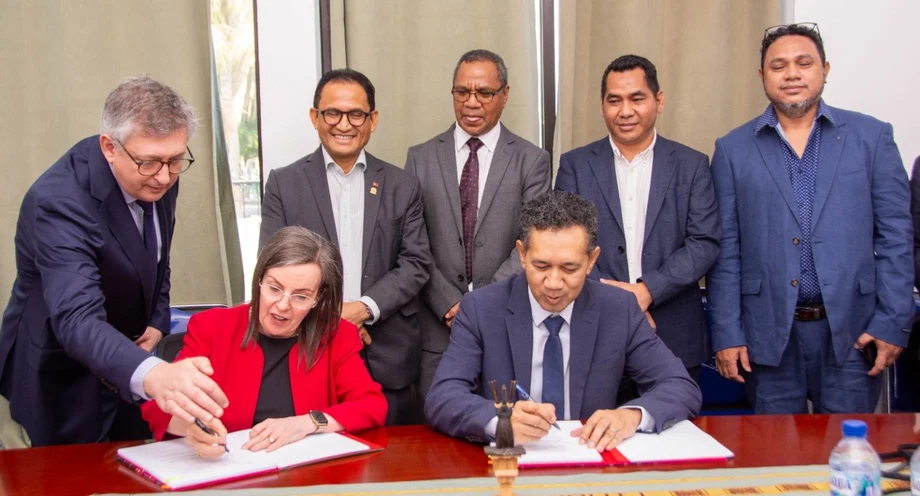
Timor GAP and Woodside signed the sale agreement on 27 October 2026, following the Woodside stake sale agreement. The contract covers Woodside's interests across titles NT/RL2, NT/RL4, JPDA PSC 03-19 and JPDA PSC 03-20, which together carry its 33.44% participating interest.
A participating interest is an ownership share in a petroleum venture, carrying rights to its output and obligations to contribute to its costs. Woodside will cease to hold that interest when the transaction closes.
The three payments work as follows:
- US$13.71 million is payable when the transaction completes, subject to adjustments.
- US$11.29 million becomes payable after an affirmative final investment decision to develop the resources for LNG production.
- US$175 million is payable within 365 days after loading begins for the first LNG cargo intended for sale.
The final cargo payment represents 87.5% of the maximum US$200 million consideration. Together, the two payments linked to development account for about 93.1%. A final investment decision is the formal commitment to fund and proceed with construction.
Monteiro forecast payment in March or April 2027 while formalities are completed. Woodside's contractual schedule places only the initial instalment at completion, with the balance tied to the later milestones. The agreement takes economic effect from 1 November 2026, with adjustments for funding contributions and working capital through completion.
Full ownership still leaves a large financing task
Timor GAP's existing 56.56% interest, Osaka Gas's 10% and Woodside's 33.44% add up to 100%. The Osaka Gas stake agreement, announced on 2 September 2026, is therefore essential to the government's plan for complete ownership.
Timor GAP President and Chief Executive Officer Rui Soares said the acquisitions would strengthen the company's ability to accelerate development and pursue an industrial and energy centre on the southern coast. He also acknowledged that full ownership brings substantial responsibility.
Woodside had been expected to operate Greater Sunrise. Its departure leaves Timor GAP, which has no experience operating a major gas project, needing to assemble the technical capability and commercial arrangements for a complex offshore development. A new financing or operating partner has not been announced.
The acquisition price is only one part of the spending involved. Separate funding is needed to develop the fields, lay pipelines, build processing facilities and connect them to export infrastructure. Deferring most of Woodside's purchase price reduces the money needed to close the sale, while construction financing remains a much larger task.
Historical sale prices give another measure of the transaction. Applying the prices paid for Shell's and ConocoPhillips' interests in 2018 and 2019 to a 33.44% share produces a comparison value of roughly US$378 million to US$391 million. Woodside's maximum US$200 million consideration is lower, and most of it depends on Greater Sunrise reaching production.
A US$12 million survey moves the pipeline plan forward
The Ministry of Petroleum and Mineral Resources launched the High Resolution Geophysical Survey programme on 10 November, with fieldwork scheduled to begin that month. Fugro Singapore Marine will carry out the US$12 million survey over an expected four months.
The investigation covers proposed pipeline routes from Greater Sunrise, Bayu-Undan and Chuditch to Natarbora. Geophysical surveying maps the seabed and conditions beneath it, helping engineers identify a route and potential hazards before detailed design and construction.
Further light and heavy geotechnical investigations are planned. Those studies collect and test seabed material so engineers can understand the ground that would support the pipeline. Contracts for these investigations were signed on 24 September, with follow-up work included in the ministry's 2027 budget proposal.
Fugro regional director Safri Drahman said the work would use seabed drilling technology in waters more than 3,000 metres deep. The wider programme of collecting field data is expected to take nearly a year, extending into 2027.
Monteiro said previous feasibility studies supported the technical possibility of the project. The new investigations are intended to establish the detailed conditions along the route for infrastructure expected to operate for 30 years or more.
The milestones between the agreement and first gas
Gusmão's 2034 operating target falls within the 2032 to 2035 range discussed when Woodside and Timor-Leste signed a cooperation agreement in November 2025 to advance a concept for LNG production in Timor-Leste. That earlier range depended on development choices and investment decisions.
The legal framework is also moving through approval. The technical agreement on frameworks covers the Petroleum Mining Code, Production Sharing Contract and fiscal regime. These documents set the operating rules, the contract for sharing production and the tax arrangements for the project.
President José Ramos-Horta said initial agreements could be signed within months, with the first expected early in 2027. Woodside's departure leaves Australia and Timor-Leste continuing work on the framework governing the resource.
- November 2025: Woodside and Timor-Leste agreed to advance a concept for LNG production in Timor-Leste.
- 2 September 2026: Timor GAP announced its agreement to acquire Osaka Gas's 10% interest.
- 24 September 2026: Contracts were signed for further pipeline route investigations.
- 27 October 2026: Timor GAP and Woodside signed the agreement for Woodside's 33.44% interest.
- November 2026: Geophysical fieldwork is scheduled to begin.
- First half of 2027: Woodside targets completion of its sale, subject to approvals.
- 2034: The government targets the start of Greater Sunrise operations.
The 2027 budget connects Sunrise with nearer projects
Timor-Leste's petroleum spending plans extend beyond Greater Sunrise. The proposed 2027 budget allocates US$244.8 million to new petroleum and minerals policies, including support for Timor GAP and development of Kuda Tasi, Jahal and Greater Sunrise.
The ministry's budget planning also describes an additional request of US$345.6 million, presented as a 64.3% increase. Within that request, US$222 million is assigned to Timor GAP packages: US$190 million for Kuda Tasi and Jahal, US$25 million for Chuditch-2 appraisal and US$7 million for Greater Sunrise preliminary engineering and development work.
Appraisal means examining a discovery more closely to determine its size and development potential. Preliminary engineering works through the broad design choices before the detailed engineering needed for construction.
Natarbora gas infrastructure carries a stated total contract value of US$118.75 million, with US$95.78 million scheduled for payment during 2027 and 2028. That spending connects the offshore ambitions to facilities on the southern coast.
Gusmão said construction at Kuda Tasi and Jahal should begin in 2027, with production in 2028. He cautioned that early revenue could be modest because proceeds would help recover previous investment, including studies and preparation costs. Production brings sales, but part of that money first pays back the spending needed to get the fields operating.
Petroleum income faces a gap before 2034
Bayu-Undan stopped producing in June 2025, and no other petroleum field is currently active. Kuda Tasi and Jahal are therefore intended to supply revenue years before Greater Sunrise's proposed start.
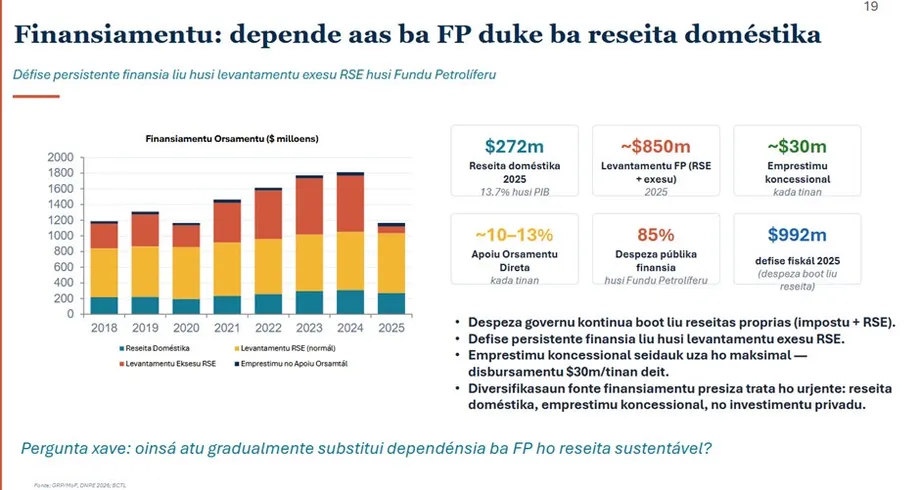
The International Monetary Fund has warned that Timor-Leste's Petroleum Fund could be depleted in the late 2030s under current policies without further reforms. The fund holds savings accumulated from petroleum income and supports government spending.
A 2034 start would put Greater Sunrise's arrival close to that projected period of pressure on national savings. The government must finance development while continuing to pay for public services and other investment during the years before new gas exports.
The southern coast already carries substantial spending tied to the development vision. About US$670 million has been spent on a freeway and international airport in anticipation of gas coming ashore. The highway, opened in 2017, has deteriorated, while the airport is barely used.
Gusmão said the benefits should extend beyond petroleum receipts. He called for training young Timorese and local professionals to manage the industry, alongside jobs, service contracts and markets for goods produced by nearby communities. Those opportunities depend on how the projects recruit workers and buy supplies as development proceeds.
Potential partners draw attention across the region
EnergyQuest head Rick Wilkinson said Chinese companies could be interested in Greater Sunrise for both its gas and the influence associated with a major investment. He pointed to Sinopec and CNOOC's substantial interests in two of Queensland's three LNG projects as evidence of their existing role in the sector.
Wilkinson also identified Malaysia's PETRONAS and Indonesian companies as possible sources of expertise or funding. Ramos-Horta has previously expressed interest in Chinese financing, and Timor-Leste has discussed the project with Chinese companies, including Sinopec.
MST Financial analyst Saul Kavonic warned that proceeding without an experienced operator would expose Timor-Leste to exceptional financial risk. Wilkinson's assessment was more open to possible Asian participation, while recognising the challenge of delivering the project.
Australia's Department of Foreign Affairs and Trade described Woodside's sale as a commercial decision and said the government remained committed to developing Greater Sunrise consistently with the Maritime Boundary Treaty. Australia and Timor-Leste also established a new partnership in January 2026 that included cooperation on the regulatory and fiscal framework.
For Timor-Leste, the central choice is how to combine greater ownership with the money and skills needed to deliver the southern coast plan. The next practical steps are approvals for the acquisitions, completion of seabed investigations and preparation of a development package that investors can fund.
Key Points
- Timor GAP agreed to buy Woodside's 33.44% Greater Sunrise interest for up to US$200 million, with completion targeted for the first half of 2027.
- Only US$13.71 million is payable at completion; US$175 million depends on the first commercial LNG cargo.
- Completing both the Woodside and Osaka Gas acquisitions would raise Timor GAP's ownership from 56.56% to 100%.
- A US$12 million seabed survey will investigate pipeline routes to Natarbora, followed by further ground testing.
- The government targets Greater Sunrise operations in 2034 and Kuda Tasi and Jahal production in 2028.
- Financing, operating expertise and development approvals remain central tasks as Timor-Leste seeks new petroleum income.