Seoul's housing backlog grows while the national total falls
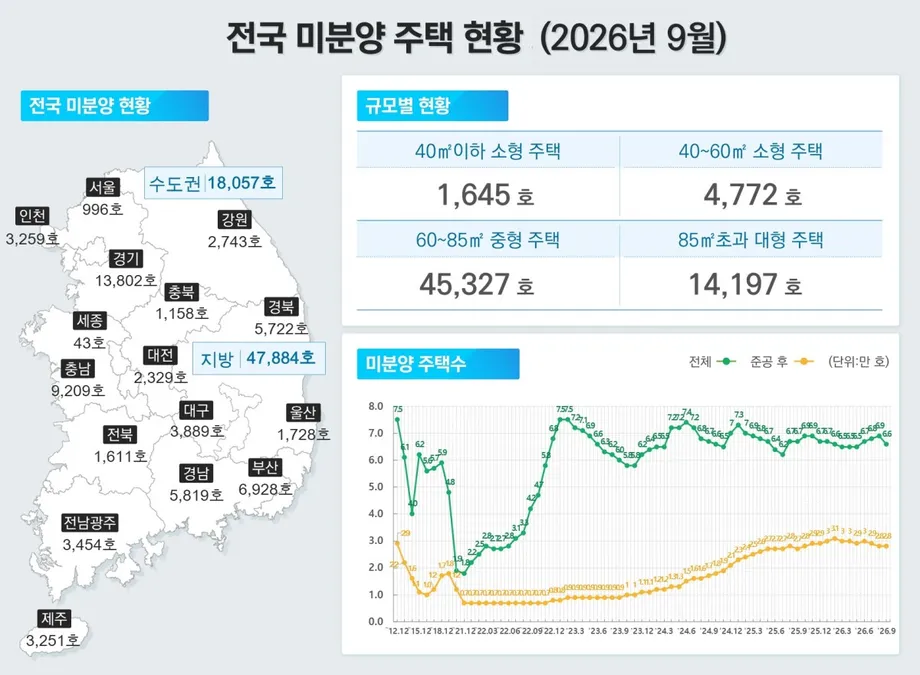
Seoul had 996 unsold homes at the end of September 2026, up 98 from August, even as unsold inventory fell across South Korea. More than two thirds of the capital's unsold homes, 683 units, were already completed, leaving developers waiting for buyers after construction had finished.
Contents
- Seoul's housing backlog grows while the national total falls
- Completed homes account for most of Seoul's backlog
- New apartment prices lose their discount
- Mortgage caps make cash the deciding factor
- Fewer transactions deepen the slowdown
- Why falling provincial inventory offers limited relief
- Builders face a thinner construction pipeline
- Unsold homes put pressure on construction finance
- Renters face monthly payments as future supply takes shape
- Key Points
The Ministry of Land, Infrastructure and Transport's September housing statistics show a market moving in different directions. Seoul's unsold inventory rose 10.9% in a month, while the national total fell 4.6% to 65,941. Across the wider metropolitan area, which includes Seoul, Gyeonggi Province and Incheon, the total declined 5.6% to 18,057.
Expensive new apartments and restrictions on borrowing are narrowing the pool of buyers able or willing to sign contracts. At some developments, asking prices exceed recent transactions at nearby apartments, weakening the financial attraction of buying before construction is finished.
Seoul's sales slowdown extends beyond new developments. Apartment purchases fell to 3,915 in September, down 14.7% from August and 42.4% from a year earlier. Developers face a growing backlog while households confront both high prices and limits on how much they can borrow.
Completed homes account for most of Seoul's backlog
Seoul's completed but unsold inventory increased by nine homes, or 1.3%, to 683 in September. These units represented about 68.6% of the city's 996 unsold homes. Nationally, completed homes accounted for about 41.8% of unsold inventory, based on 27,549 completed units out of 65,941.
A home awaiting a buyer during construction still has time to sell before residents are due to move in. A completed home has reached that deadline without producing the expected sales proceeds. For a developer with construction debt to repay, that creates more immediate financial pressure.
Seoul's total backlog was also above the 939 homes recorded at the end of 2025. The September figure was 57 units higher, an increase of about 6.1%. August's total of 898 shows that the monthly path has fluctuated, even though September ended above the level at the start of the year.
Gyeonggi and Incheon also recorded increases in completed inventory. Gyeonggi had 2,377 completed but unsold homes, up 3.6% from August, while Incheon had 1,422, up 1.5%. Across the metropolitan area, completed inventory rose 2.6% to 4,482 despite the decline in total unsold housing.
New apartment prices lose their discount
Construction costs are changing the calculation for people considering a new apartment. Higher material and labor costs have pushed prices upward, sometimes beyond the prices paid for comparable homes nearby.
Buying before completion, commonly called a presale, means agreeing to purchase a home while it is still being built. Where price caps kept new apartments substantially cheaper than surrounding properties, buyers could see a clear financial advantage. A higher asking price removes that attraction and gives buyers a reason to compare existing homes more closely.
At The H Firstier Shinbanpo Estera, a redevelopment complex in Seoul's Seocho District, an apartment measuring 84 square meters was reportedly priced at about 4 billion won. That was roughly 700 million won above the July transaction price for a home of the same size at nearby Maple Xi, where residents began moving in during 2025.
The comparison puts the nearby transaction at about 3.3 billion won, making the new apartment approximately 21% more expensive. Buyers choosing between those properties face a substantial price gap, alongside differences in completion date, building features and individual apartment characteristics.
For developers, the practical problem is straightforward: a prestigious Seoul address may attract attention, but a buyer still needs a reason to pay more than the price of a nearby alternative.
Mortgage caps make cash the deciding factor
South Korea's lending restrictions add another constraint. The stress debt service ratio, introduced in 2024, assesses whether a borrower could keep meeting debt payments under a higher interest rate assumption. A household's income and existing repayments therefore affect how much it can borrow.
Loan caps for expensive homes set a separate ceiling on mortgage borrowing, regardless of the loan to value ratio. The loan to value ratio is the share of a property's value that a lender can finance. Under the limits described for these purchases, the ceilings are:
- 600 million won for homes priced at 1.5 billion won or less.
- 400 million won for homes priced above 1.5 billion won and up to 2.5 billion won.
- 200 million won for homes priced above 2.5 billion won.
A buyer considering a home priced at 4 billion won would therefore face a mortgage cap equal to just 5% of the purchase price. At least 3.8 billion won would need to come from funds other than that mortgage, before taxes and transaction costs. Income assessments and other lending conditions can further restrict borrowing.
Households with strong earnings but limited accumulated wealth can consequently struggle to enter the market. An unnamed real estate industry official described financing restrictions as a barrier for buyers short of capital and expected more contract cancellations at expensive developments that had lost their price advantage.
Fewer transactions deepen the slowdown
Seoul recorded 674 fewer apartment purchases in September than in August, when 4,589 transactions were recorded. Compared with the 6,796 purchases in September a year earlier, the decline amounted to 2,881 transactions.
The capital's apartment sales fell more sharply than apartment sales nationally, which were down 23.7% from a year earlier. Across all housing types, Seoul recorded 7,318 purchases, down 7.2% from August and 33.4% from the previous September.
South Korea recorded 48,997 housing purchases nationwide, a monthly increase of 1.3% but an annual decline of 22.7%. Provincial purchases rose 4.8% from August to 23,695, while metropolitan purchases fell 1.7% to 25,302.
For households hoping to sell an existing property before buying a new apartment, fewer transactions can complicate the move. For developers, the combination of expensive units, restricted financing and slower trading reduces the number of buyers able to complete a purchase promptly.
Why falling provincial inventory offers limited relief
Provincial unsold housing fell 4.2% in September to 47,884 units. Busan's total declined 8.8% to 6,928, South Chungcheong's fell 3.9% to 9,209, and South Gyeongsang's dropped 8.0% to 5,819.
Reduced building activity helps explain those declines. When fewer developments reach the sales stage, fewer new homes enter the unsold total. Existing stock can gradually sell down even while buyer demand remains subdued.
Ulsan illustrates the effect of new launches. Several projects went on sale there in September, and unsold inventory rose 45.2% to 1,728 homes. North Jeolla also recorded an increase, with inventory up 5.4% to 1,611.
Completed inventory adds another layer. Nationally, completed but unsold homes fell by 531 to 27,549. Provincial completed inventory declined 2.7% to 23,067, but South Chungcheong's increased 15.9% to 2,652. A province can therefore have fewer unsold homes in total while facing a growing backlog of finished properties.
Builders face a thinner construction pipeline
South Korea approved 25,938 homes for construction in September, down 45.4% from a year earlier. Construction began on 16,046 homes, a decline of 46.4%. Permits show what builders have permission to construct; starts show projects that have actually moved into building work.
September permits were 20% higher than in August, but the total for January through September was still down 13.4% from a year earlier at 189,873 homes. Provincial permits over those nine months fell 29.0% to 76,197.
Seoul followed a different pattern in approvals. Its permits for January through September rose 33.3% to 44,371 homes. Yet completed homes over that period fell 17.6% to 26,881, showing the gap between authorizing a project and delivering homes people can occupy.
Only 14 homes received approval for sale in Seoul during September, compared with 254 a year earlier. Across the first nine months, however, the capital's approvals for sale were up 73.7%. Developers' launch schedules can produce large monthly swings, making the longer period useful for understanding the pipeline.
Unsold homes put pressure on construction finance
Developers commonly use project financing loans to pay for construction and repay those loans with money received from buyers. When completed apartments remain unsold, expected cash arrives late while interest and other project expenses continue.
A prolonged backlog can leave less money for debt repayments and construction bills. Developers may need additional financing, face higher borrowing costs or delay new projects. Contractors and financial institutions with exposure to those projects can also come under pressure.
Seoul's increase in completed inventory therefore matters beyond the 996 homes in the headline total. The timing of sales affects whether individual projects generate enough cash to meet their obligations. The statistics do not provide a project by project schedule of outstanding debt or repayments.
Buyers, meanwhile, are likely to make sharper distinctions between developments. Homes with competitive prices, price caps or convenient subway access may attract stronger demand, while expensive properties without a clear advantage may need longer to find purchasers.
Renters face monthly payments as future supply takes shape
Monthly rent accounted for 68.6% of rental transactions nationally during January through September, up from 62.6% a year earlier. In Seoul, the share rose from 64.3% to 70.1%. Among Seoul apartments alone, it increased from 44.4% to 52.7%.
Jeonse, the Korean rental arrangement based on a large refundable deposit, accounted for 59,482 transactions nationwide in September, down 25.7% from a year earlier. Monthly rental transactions fell more slowly, by 9.3% to 136,728. Households are increasingly entering arrangements that require recurring rent, often alongside a deposit.
Future housing plans run on a much longer timetable than current sales and rental decisions. On October 29, the government announced six proposed housing sites in Gyeonggi Province with capacity for 76,700 homes. Construction is targeted to begin by 2030, while prices and move in dates have not been announced.
The key dates show how the present backlog and future supply plans sit alongside each other:
- End of 2025: Seoul had 939 unsold homes.
- August 2026: The capital's unsold total stood at 898.
- September 2026: Unsold inventory rose to 996, including 683 completed homes.
- October 29, 2026: The government announced sites for 76,700 homes near Seoul.
- 2030: Target for beginning construction at those proposed sites.
Seoul's immediate challenge is matching homes already offered for sale with households able to pay for them. The government's longer construction timetable addresses future availability, while today's buyers must weigh current prices, borrowing limits and the cost of remaining in rented housing.
Key Points
- Seoul's unsold homes rose 10.9% in September to 996, while the national total fell 4.6% to 65,941.
- Completed homes accounted for 683 units, or about 68.6% of Seoul's unsold inventory.
- High asking prices and mortgage caps are increasing the amount buyers need from other funds.
- Seoul apartment purchases fell 42.4% from a year earlier to 3,915.
- Falling provincial inventory coincided with a sharp reduction in construction activity.
- Completed unsold homes increased across Seoul, Gyeonggi and Incheon, putting pressure on project cash flow.
- New housing sites near Seoul have a construction start target of 2030.