Six sites bring the housing plan to 103,900 homes
South Korea plans to build 76,700 homes across six proposed public housing sites in Gyeonggi Province, with construction targeted to begin by 2030. Almost half of the new homes would be in Gimpo Ara, a development of 37,000 homes beside Seoul's Gangseo district.
Contents
- Six sites bring the housing plan to 103,900 homes
- Where the homes would be built
- Gimpo Ara carries almost half the new supply
- Guri would turn a stalled project into housing
- Hanam combines housing with culture and transport plans
- Goyang expands an existing district as Uijeongbu reuses military land
- How the government intends to start construction faster
- Land transactions face scrutiny around the sites
- Possible Seoul locations remain outside this announcement
- Key Points
The Ministry of Land, Infrastructure and Transport announced the locations on October 29, 2026, at its second regular housing supply briefing. The sites span Gimpo, Guri, Hanam, Uijeongbu and Goyang, all within about five kilometers of Seoul's boundary.
The announcement follows the August 13 housing supply plan, which proposed 100,000 homes on new public housing land. Together with 27,200 homes announced earlier at three locations, Seoul Gangseo, Namyangju Downtown and Gyeonggi Gwangju Station Area 2, the latest allocation brings the planned total to 103,900, or 3,900 above that initial target.
All six sites require the removal of green belt development restrictions. The ministry says the selected land has already suffered environmental damage, has relatively low conservation value, or faces scattered development that would benefit from coordinated planning.
For households looking for a home, the key date is 2030, the government's deadline for starting construction. The ministry has not announced when homes will go on sale or when residents can move in, nor has it provided prices or detailed eligibility rules.
Where the homes would be built
Hanam accounts for two of the six locations. Goyang's contribution comes from enlarging an existing district, while Guri would replace a stalled commercial development with a public housing project.
- Gimpo Ara, in Gochon: 37,000 homes.
- Guri Geonwon, in Sano: 14,600 homes.
- Hanam Misa K-Culture, in Misa: 12,000 homes.
- Hanam Gamil 2, in Gamil: 6,500 homes.
- Goyang Daegok Knowledge Convergence expansion: 4,000 additional homes.
- Uijeongbu Darakwon, in Howon: 2,600 homes.
The ministry's approach combines housing with transport, employment and local services. Several developments depend partly on railway extensions still being pursued, alongside roads and rail lines already operating.
Green belts restrict building to limit urban expansion and protect land around cities. Removing those restrictions would allow the government to prepare these areas for housing and related facilities. The ministry argues that planned development is appropriate because of the condition of the selected sites and the risk of further uncoordinated building.
Young adults and newly married couples are among the intended beneficiaries. The government's stated priority is to supply homes in places where people want to live, with access to jobs and Seoul's transport network.
Gimpo Ara carries almost half the new supply
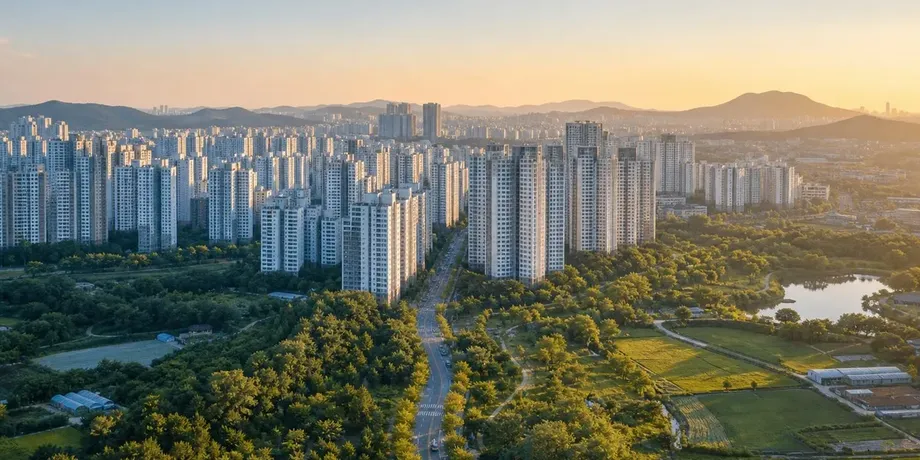
Gimpo Ara is the largest project by both land area and housing allocation. About 3.65 million square meters in Gochon would accommodate 37,000 homes, roughly 48.2 percent of the 76,700 announced.
The site lies along the Han River next to Seoul's Gangseo district. Existing road connections include Gimpo Hangang Road and the Seoul Ring Expressway. A proposed extension of subway Line 5 is also being pursued nearby. The extension passed a preliminary feasibility study in March 2026.
The government plans to connect the new neighborhood with the Hangang Cinepolis industrial complex and the Gochon logistics complex. The aim is to place housing near employment areas, giving residents access to work and everyday services within the surrounding district.
Gimpo's size makes its progress especially consequential for the wider program. Its planned 37,000 homes exceed the combined 35,100 allocated to Guri, both Hanam sites and Uijeongbu. Decisions on land preparation, transport and construction in Gimpo will therefore affect a large share of the announced supply.
Guri would turn a stalled project into housing
Guri Geonwon would provide 14,600 homes on about 1.44 million square meters in Sano. The site had been intended for the Guri E-Commerce New Growth High-Tech City project, which was held up for a prolonged period because of concerns including its commercial viability.
The government now plans to convert the area into a public housing project. It is also considering relocating an agricultural and fisheries wholesale market as part of creating a neighborhood with housing, employment and services near the water.
Guri is the second largest of the six allocations. Together, Guri and Gimpo account for 51,600 homes, about 67.3 percent of the new total. Much of the program's numerical weight therefore rests on these two developments.
The site is near the Seoul Ring Expressway, and the announcement describes access to Jamsil Station in around 30 to 39 minutes. For future residents, the practical transport picture will include how the neighborhood connects to surrounding roads and public transport as its detailed plans develop.
Hanam combines housing with culture and transport plans
Hanam's two proposed districts would supply 18,500 homes, making the city the second largest recipient after Gimpo. The projects have different roles: Misa combines housing with riverside recreation and cultural facilities, while Gamil 2 would connect with an existing residential district.
Hanam Misa K-Culture would provide 12,000 homes near Misa Island. Subway Line 5 operates nearby, while extensions of Lines 3 and 9 are being pursued. The government also plans a park along the Han River and a K-Culture complex.
The cultural complex is part of the proposed development, alongside housing and public space. Its inclusion gives Misa a broader purpose than residential construction alone, although the announcement does not detail its facilities or operating arrangements.
Hanam Gamil 2 would add 6,500 homes across about 710,000 square meters. The government intends to connect it with the existing Gamil district and develop public transport links around the proposed Line 3 extension.
The ministry is also considering improvements to the West Hanam interchange together with transport measures for the Hanam Gyosan district. Planning across those neighboring areas will be important for how residents reach major roads, stations and local services.
Goyang expands an existing district as Uijeongbu reuses military land
Goyang's allocation is an expansion of the Daegok Knowledge Convergence district. About 420,000 square meters south of Daegok Station would be added to the existing development north of the station. The existing district was designated in September 2026.
The change would increase the district's planned area from about 1.99 million to 2.41 million square meters. Its housing allocation would rise from 9,400 to 13,400 homes, an increase of 4,000, or about 42.6 percent. Only those additional 4,000 homes count toward the latest 76,700 announcement.
Daegok Station serves five rail lines, including GTX-A and subway Line 3. The government plans to link the areas north and south of the station and improve transfers, creating a more integrated neighborhood around the transport hub.
Uijeongbu Darakwon would provide 2,600 homes on about 280,000 square meters in Howon. The site includes Camp Jackson, land returned by US forces, and is close to Dobongsan Station, where subway Lines 1 and 7 connect.
The Darakwon plan includes more employment opportunities, everyday services and a park with sports facilities. Its reuse of former military land gives the project a different starting point from the larger developments in Gimpo and Guri.
How the government intends to start construction faster
The ministry plans to apply the accelerated public housing construction model introduced in the August 13 package. It aims to reduce the period between announcing a new site and starting construction from 68 months to 37 months.
That is a reduction of 31 months, or about 45.6 percent. In ordinary terms, the proposed process would take a little over three years rather than more than five and a half years.
The model brings forward work at successive stages and allows procedures to run at the same time. Approvals, compensation for land and site preparation would overlap where possible, while consultations between agencies on impact assessments would proceed more quickly.
Land Minister Hong Ji-seon said the government would apply the model throughout the process, from district designation to the start of building. He also identified young adults, newly married couples and other people seeking homes for their own use as priorities.
The main milestones announced so far are:
- August 13: The government set out its plan for 100,000 homes on new public housing land and initially disclosed three locations, Seoul Gangseo, Namyangju Downtown and Gyeonggi Gwangju Station Area 2, totaling about 27,200 homes.
- October 29, 2026: The ministry announced six further candidate sites totaling 76,700 homes.
- By 2030: The government aims to begin construction at the newly announced sites.
The next stages involve turning candidate locations into designated housing districts, arranging compensation, completing the necessary assessments and preparing land. Those steps will determine how quickly the announced allocations become building projects.
Land transactions face scrutiny around the sites
The ministry said it checked land ownership among its employees, employees of the Korea Land and Housing Corporation, known as LH, and direct ancestors and descendants of people involved in the work. It said those checks found no suspected cases of speculation using undisclosed development information.
A broader review examined 2,917 land transactions over the preceding three years in the proposed districts and nearby areas. Authorities selected 654 transactions for investigation into unusual activity, approximately 22.4 percent of the total reviewed.
Further targeted investigations are planned. The ministry said transactions suspected of breaking the law would be referred to investigative authorities.
The government also plans to narrow land transaction permit zones established around the August 13 announcement. These zones require official permission for covered land purchases, giving authorities a way to control speculative demand around possible development sites.
Restrictions would remain in areas affected by the six candidate developments, while other designated green belt areas in Seoul and nearby parts of the capital region would be released. The ministry says the adjustment is intended to keep controls around the projects while reducing property restrictions elsewhere.
Possible Seoul locations remain outside this announcement
The six sites are close to Seoul, but all lie in Gyeonggi Province. Several locations within Seoul that had been discussed as possible housing sites were absent from the October 29 announcement.
They include returned US military land at Yongsan, the Tancheon Water Reclamation Center, a reserve forces training ground in Naegok, parts of Segok and Jagok, the Suseo rail depot and land near the Olympic Athletes' Village in Bangi.
Hong said the government had first announced candidate sites agreed with local governments. Working discussions with the Seoul Metropolitan Government were continuing on locations where cooperation could proceed relatively quickly.
The minister said returned military land at Yongsan would require legislation and public discussion, making it a longer process. For now, the concrete expansion is concentrated just beyond Seoul's boundary, with most of the homes assigned to Gimpo, Guri and Hanam.
Key Points
- Six proposed sites in Gyeonggi Province would supply 76,700 homes within about five kilometers of Seoul's boundary.
- Including 27,200 homes announced earlier at Seoul Gangseo, Namyangju Downtown and Gyeonggi Gwangju Station Area 2, the planned total reaches 103,900 against the August 13 plan's original target of 100,000.
- Gimpo Ara accounts for 37,000 homes, almost half the latest allocation.
- All six developments require green belt restrictions to be removed.
- The government targets construction starts by 2030 using a process designed to shorten preparation from 68 to 37 months.
- Authorities selected 654 of 2,917 land transactions for further scrutiny.
- Potential housing sites inside Seoul remain under discussion.