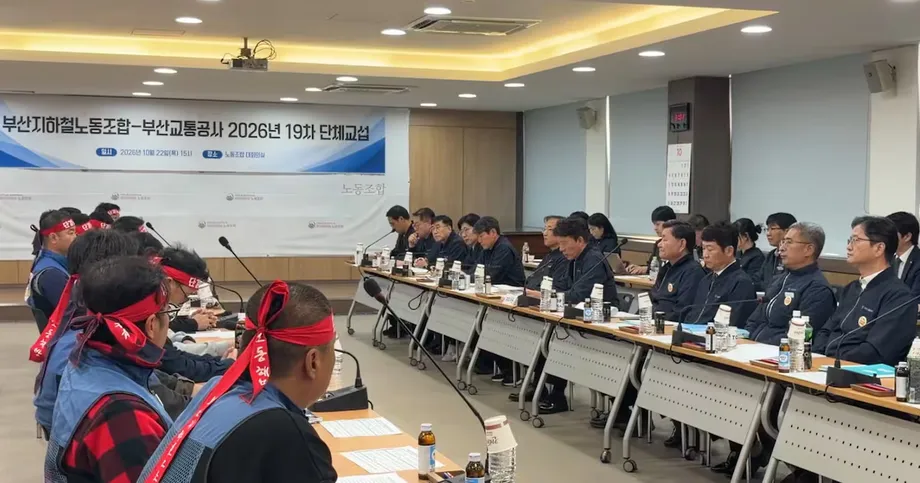
Six Hours of Final Talks End Without a Deal
Busan's subway union declared a strike for October 23, 2026, after the 19th round of collective bargaining ended without agreement at about 9 p.m. on October 22. The final negotiations exposed a remaining gap over recruitment: the union reduced its demand to 73 additional workers, while Busan Transportation Corporation offered about 20 and said it would ask the city to authorize roughly 12 more.
Contents
- Six Hours of Final Talks End Without a Deal
- What Passengers Can Expect on Each Line
- Hiring Numbers Remained Far Apart
- The Dispute Extends Beyond Train Staffing
- Why Management Says Recruitment Is Constrained
- How the Dispute Reached a Strike
- Who Will Keep the Subway Running?
- Busan Prepares Buses, Taxis and Station Support
- Further Talks Remain Possible
- Key Points
The walkout was scheduled to begin with the first trains on Friday, making it the union's first strike since July 10 and 11, 2019. The corporation plans to maintain normal weekday rush hour service on Lines 1, 2 and 3, with substantial reductions at other times. Automated Line 4 is scheduled to operate normally throughout the day.
Management and union representatives began their final session at 3 p.m. at Nopo vehicle depot in Busan's Geumjeong District. New corporation president Kim Tae-ho represented management on his first day in office, while union chairman Oh Mun-je attended for the workers. Staffing, working conditions and bargaining involving contractors and subcontractors remained unresolved.
The announced start was the first train, identified as 5 a.m. in the service announcement; the union's advance strike notices had specified 6 a.m. on October 23. Passengers were being advised to check their particular train schedules, especially outside the protected commuting periods.
Busan's emergency plan aims to keep weekday subway operations at an average of 75% of normal. For passengers, the largest change is expected between the morning and evening commuting periods, when fewer trains will run and some scheduled gaps will reach 20 minutes.
What Passengers Can Expect on Each Line
Lines 1, 2 and 3 are scheduled to maintain their usual weekday service from 7:30 to 9 a.m. and from 5:30 to 7:30 p.m. Trains during those periods are planned to run every four to five minutes.
The corporation's plan following the bargaining breakdown puts service on those three lines at about 50% of normal outside commuting hours. Busan's earlier contingency plan specified 58%, with intervals of eight to 20 minutes. Both schedules concentrate operating resources on the busiest commuting periods and leave passengers with fewer departures during the rest of the day.
Line 4 uses an automated system without drivers and is scheduled to maintain 100% of its normal service. The reductions therefore fall mainly on people using the other three lines outside the designated peak periods, including those traveling before 7:30 a.m. or returning after 7:30 p.m.
The city's weekday target of 75% means roughly one quarter fewer train services across the planned operation. The effect will vary by line and time: a passenger traveling during the protected rush hour may have the usual timetable, while someone making the same journey at midday may face a much longer gap between departures.
Hiring Numbers Remained Far Apart
The union tied its recruitment demands to safe working practices, existing workloads and staffing for the Yangsan Line, which is scheduled to open in December. It argued that about 700 additional employees were needed to follow safety manuals, including requirements for some work to be performed by teams of two.
During the final negotiations, the union submitted a revised request for 100 additional workers, then lowered that figure to 73. Management proposed about 20 extra positions and said it would seek approval from Busan for roughly 12 more.
Even if those additional positions were approved, the possible management package would total about 32 workers, leaving a gap of approximately 41 against the union's final request. The extra 12 positions were a proposal to seek city approval, rather than an agreed recruitment commitment.
The union's broader bargaining platform also included a request for 328 safety personnel and 34 additional public service workers, a total of 362 positions. Those demands covered staffing for additional railway operations as well as workers in other employment categories. By the end of the October 22 session, the immediate negotiations had narrowed to much smaller recruitment figures, without producing a settlement.
The Dispute Extends Beyond Train Staffing
Union demands included restoring the number of services on Line 2, improving treatment and pay arrangements for public service workers, and improving working conditions for cleaning staff employed through subcontractors.
Public service workers are an employment category within the dispute. The union sought both additional positions and changes to their wage structure. Its demands also covered workers employed by subsidiaries, bringing several groups of employees into the negotiations rather than focusing solely on train crews.
Contractor and subcontractor bargaining concerns who takes part in discussions over employment conditions when work is carried out through another company. A cleaner may work within the subway system while being employed by a contractor rather than directly by the corporation. The union wanted the bargaining process to address conditions affecting these workers.
Kim Jun-woo, the Busan Subway Union's senior vice chairman, said at a briefing around 9 p.m. that the gap over staffing remained too large and that the corporation maintained it could not resolve the contractor bargaining issue. The union subsequently proposed a 20th bargaining session and said it was willing to resume discussions if management brought a more accommodating proposal.
Why Management Says Recruitment Is Constrained
Busan Transportation Corporation cited a financial deficit exceeding 500 billion won and government guidelines governing total personnel spending as reasons it could not accept a large recruitment expansion.
Those guidelines limit spending on employees across the organization. Recruiting more people adds continuing salary costs, so the bargaining involves both the number of employees and the amount the corporation is permitted to spend on them.
The union requested a wage increase of 3.5%. Management was reviewing the same percentage, described as the maximum permitted under government wage guidelines. Staffing and working conditions remained the central obstacles as the final talks broke down.
The December opening of the Yangsan Line gives the recruitment dispute an approaching operational deadline. The union says more workers are needed for the additional railway service and to keep workloads manageable. Management says its finances and spending rules restrict how many people it can hire. Any settlement must turn those competing positions into a specific number of approved posts.
How the Dispute Reached a Strike
Negotiations began in May and continued through 18 rounds before the final October 22 meeting. The Busan Regional Labor Relations Commission also attempted mediation, a process in which an outside body helps the parties seek an agreement, but that effort ended without resolution on September 29.
The union secured support for industrial action in a ballot held from September 21 to 23. Of the 4,115 members who voted, 87.6% supported the strike proposal. It then began a campaign of strictly following work rules on October 1 and an overnight protest outside Busan City Hall on October 13.
- May 28: The first main collective bargaining session began.
- September 21 to 23: Union members voted on industrial action, with 87.6% of participating voters supporting it.
- September 29: Labor commission mediation ended without agreement.
- October 1: The union began its campaign of strictly following work rules.
- October 13: Workers began an overnight protest outside Busan City Hall.
- October 22: The 19th bargaining session began at 3 p.m. and broke down at about 9 p.m.
- October 23: The union scheduled its strike from the first trains, followed by a press conference and rally.
The previous subway strike lasted two days in July 2019. The new action was announced more than seven years later, after months of negotiations had failed to resolve the staffing and employment disputes.
Who Will Keep the Subway Running?
The corporation plans to deploy 2,231 essential, internal and external support personnel during the strike. It described that total as equivalent to 44.5% of its current workforce.
The deployment consists of 1,305 essential personnel, 490 other corporation employees and 436 external support workers. Essential personnel cover seven areas: train operation, traffic control, vehicle maintenance, electrical systems, signals, communications and track.
Busan's subway is designated an essential public service workplace. Employees assigned to essential duties must continue working during a strike, allowing a reduced railway operation to continue while other union members withdraw their labor.
The emergency arrangements cover train scheduling and safety management as well as staffing. Keeping trains moving requires control room staff, maintenance workers and people responsible for power, signals and tracks, alongside the employees operating services and assisting passengers.
Busan Prepares Buses, Taxis and Station Support
Busan held an emergency coordination meeting on October 20 with the Busan Metropolitan Police Agency, the transportation corporation, Yangsan City and other relevant agencies. The city announced its contingency arrangements on October 21, before the final bargaining session.
The measures include suspending the voluntary program under which participating motorists leave their cars unused on a designated weekday. The city also plans to concentrate taxis around subway stations and arrange additional city bus services to help absorb passengers affected by reduced train operations.
Municipal employees could be assigned to assist with station duties if the strike continues and the corporation requests personnel support. That part of the plan depends on a request from the operator.
The transport measures address different stages of a journey. Extra buses can provide alternatives along affected routes, while taxis near stations can help passengers complete a trip or change their travel plans. Passengers using Lines 1 to 3 outside rush hour should allow additional time and check departure schedules before setting out.
Further Talks Remain Possible
The union scheduled a strike declaration press conference for 9 a.m. on October 23 in the plaza outside Busan City Hall, followed by a rally at 10:30 a.m. It also proposed another bargaining session after the final talks collapsed. No time for a 20th session or end date for the strike was announced.
Kim Tae-ho, the newly appointed corporation president, said before the final negotiations ended that management would keep working toward a settlement while preparing to maintain services.
"I will engage in negotiations responsibly until the very end and work to reach a swift agreement," he said.
Hwang Hyun-cheol, director of Busan's Transportation Bureau, also urged management and the union to continue negotiations and reach an agreement quickly. The immediate tasks are to operate the emergency timetable, handle the October 23 disruption and determine whether a new staffing proposal can bring both sides back to the table.
Key Points
- The 19th bargaining session broke down at about 9 p.m. on October 22, prompting the union to declare a strike from October 23.
- The final recruitment positions remained apart: the union sought 73 additional workers, while management offered about 20 and proposed seeking approval for roughly 12 more.
- Lines 1 to 3 are scheduled to maintain normal weekday rush hour service, with reduced departures at other times. Line 4 is scheduled to operate normally.
- Busan aims to maintain an average of 75% of normal weekday subway operations using 2,231 essential and support personnel.
- Additional bus services, taxis near stations and suspension of the voluntary car restriction program form part of the city's response.
- The union proposed another bargaining round, but no meeting time or strike end date was announced.