Jakarta, Yogyakarta and Bali bring boys into cancer prevention
Indonesia is extending free vaccination against human papillomavirus, or HPV, to boys in Jakarta, Yogyakarta and Bali, adding protection for children who can later develop cancers linked to the virus or pass the infection to others. The pilot targets fifth-grade pupils, generally aged 10 to 11, through the school immunization program.
Contents
- Jakarta, Yogyakarta and Bali bring boys into cancer prevention
- How the expansion is reaching schools
- Why boys also need protection
- Why the program starts before adolescence
- Girls' coverage has fallen as the pilot advances
- What health officials say about safety
- Vaccination and screening address different generations
- Key Points
The expansion follows the nationwide introduction of HPV vaccination for girls in 2023. In Karangasem, Bali, free vaccination for boys began in early September 2026 under Minister of Health Decree No. 839 of 2026, which establishes the pilot program for boys. Yogyakarta had announced an August start through Bulan Imunisasi Anak Sekolah, known as BIAS, or Schoolchildren Immunization Month.
The Ministry of Health puts Indonesia's annual toll from cervical cancer linked to HPV at about 22,000 women. Boys face their own risks: globally, about 95,000 men were diagnosed with cancers related to HPV in 2022, and 44,000 died from those cancers.
Vaccinating boys gives the program two connected purposes. It can protect them against diseases caused by HPV and help reduce circulation of a virus responsible for most cervical cancers. The cervix is the lower part of the womb, connecting it to the vagina.
How the expansion is reaching schools
BIAS gives health authorities an established way to reach children in the same school year. The boys' pilot focuses on fifth-grade pupils, while the national program continues to provide free vaccination for girls. The three pilot provinces are Jakarta, the Special Region of Yogyakarta and Bali.
Karangasem Health Office head Dr. I Gusti Bagus Putra Pertama said the district's program follows the ministerial decree and targets boys in fifth grade, or around age 11. He described vaccination as early protection against infections that can eventually cause cancer in certain organs.
Yogyakarta's announcement came at a July 30, 2026, press conference at the city's Department of Communication, Informatics and Encryption. Dr. Endang Sri Rahayu, who heads communicable disease prevention and control and immunization at the Yogyakarta City Health Office, said boys and girls in fifth grade would receive the vaccine free through schools.
The policy has developed through several stages:
- 2023: Indonesia began nationwide HPV vaccination for girls.
- April 20, 2026: Health Minister Budi Gunadi Sadikin said vaccination would extend to boys that year.
- July 30, 2026: Yogyakarta officials announced an August launch through BIAS.
- Early September 2026: Karangasem began free HPV vaccination for boys.
The expansion remains a pilot in three provinces. A date for extending free vaccination to boys throughout Indonesia has not been announced.
Why boys also need protection
HPV can infect the skin and the moist tissue lining parts of the body. Some types cause genital warts, while others can lead to cancer after an infection persists. Vaccination is intended to prevent infection before that process begins.
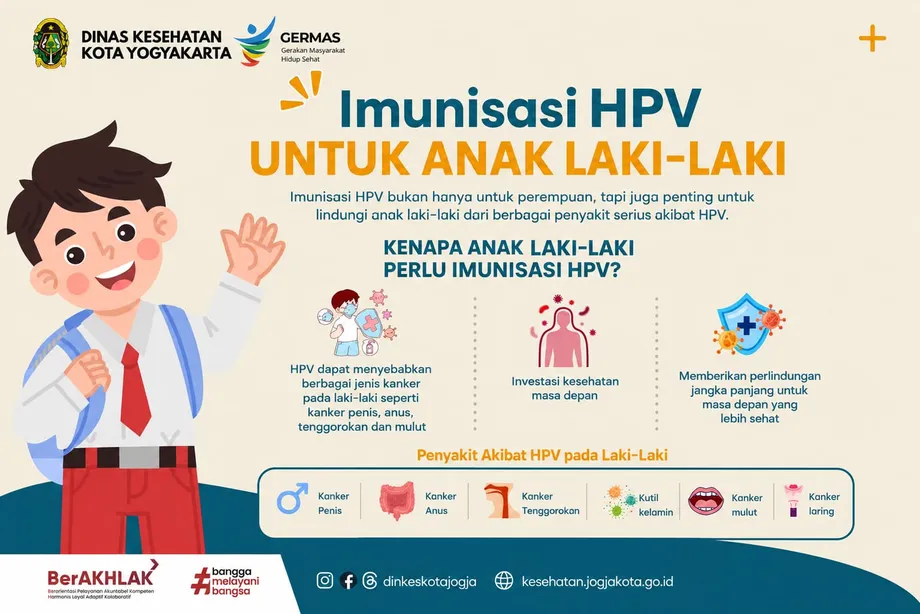
Endang identified anal, penile and oropharyngeal cancers among the risks for males. Oropharyngeal cancer affects the middle part of the throat, including the area around the tonsils and the base of the tongue. The expansion therefore gives boys protection with a direct benefit to their own health.
Men can also carry HPV without symptoms and transmit it to partners later in life, Endang said. Health Minister Budi Gunadi Sadikin made the same connection when discussing the expansion in April: women bear the burden of cervical cancer, while transmission can originate from men.
Vaccinating more children can reduce the opportunities for the virus to move between people. Endang described this as building community immunity, meaning that wider protection makes transmission less likely. She also rejected claims that HPV vaccination belongs only to women's reproductive health or is tied to sexual orientation. Its purpose is to prevent disease in both sexes.
Why the program starts before adolescence
Dr. Indri Yogyaswari, the Ministry of Health's immunization director, said vaccination during elementary school produces a stronger immune response than vaccination in adulthood. Giving the vaccine early also allows protection to develop before a child encounters HPV later in life.
Indri said one dose given between ages 9 and 14 can provide 88 to 90 percent protection. She put protection at about 60 percent when vaccination first begins after age 20, even with two doses. These are the ministry's stated protection figures; the school program's practical message is to reach children within the younger age group.
A vaccine trains the body's immune system to recognize a virus and respond when it encounters it. For HPV, prevention before exposure is central to the program. The fifth-grade schedule places vaccination within the age range identified by the ministry while making delivery possible through schools.
Parents of boys in the pilot provinces now have a free school vaccination opportunity that previously focused on girls. Karangasem's health office has asked parents to support participation so eligible children can receive protection early and the district can reach more of its target population.
Girls' coverage has fallen as the pilot advances
The ministry reports that coverage of the single HPV dose among fifth-grade girls has reached 83.5 percent, compared with 90.8 percent in 2025. That is a decline of 7.3 percentage points. Put simply, the figures represent about 84 vaccinated children out of every 100 eligible girls, compared with about 91 previously.
Coverage among boys in the three pilot provinces has reached 88 percent, according to the ministry. That is 4.5 percentage points above the latest figure for girls, although the boys' figure covers only the pilot provinces and the girls' figure describes the national program. The reporting period for the latest percentages was not specified.
Girls remain central to Indonesia's cervical cancer prevention effort. Expanding access to boys adds another group to protect, while the fall in girls' coverage leaves more eligible pupils without the vaccination intended for their school year.
The ministry identifies misinformation and hoaxes about vaccine safety as obstacles to meeting immunization targets. Schools and health offices therefore face two linked tasks: delivering doses to eligible children and answering concerns that may keep families from participating.
What health officials say about safety
Prof. Hinky Hindra Irawan Satari, head of the National Committee for Adverse Events Following Immunization, said the HPV vaccine used in the government program is safe and has undergone rigorous clinical trials.
Reactions after vaccination are generally mild, he said. They can include pain where the injection was given or dizziness, and usually resolve on their own. Explaining these expected reactions gives families a clearer idea of what a child may experience after receiving a dose.
An adverse event following immunization is a health problem that occurs after a vaccination and may require assessment. Monitoring such events is part of vaccine safety work. Hinky's committee provides the specialist oversight referenced by the ministry as it addresses public concern.
Endang's comments also address another barrier: mistaken beliefs about who the vaccine is for. Including boys makes the purpose more visible as prevention of HPV infection and related disease across both sexes, rather than a service intended solely for girls.
Vaccination and screening address different generations
The Ministry of Health has also integrated cervical cancer screening for women aged 30 into the Free Health Check program. This creates a second route for prevention alongside vaccination of schoolchildren.
Vaccination aims to prevent infections that could cause disease years later. Cervical screening checks for signs of risk or changes in cervical cells so women can receive further assessment and treatment when needed. The two services address different points in the development of cancer.
Indonesia's annual estimate of about 22,000 cervical cancer deaths is consistent in scale with the description of one death every 25 minutes used when the expansion was announced in April. The toll explains why protection for today's children is being pursued alongside services for adult women.
Karangasem officials linked the boys' pilot to Indonesia's ambition to eliminate cervical cancer by 2030. In public health, elimination means reducing a disease to a very low level. Reaching that ambition requires sustained vaccination coverage, access to screening and care for women who need treatment.
The immediate changes are concrete: boys in three provinces are being added to free school vaccination, girls remain eligible nationwide, and cervical screening has been incorporated into the Free Health Check program for women aged 30. Maintaining participation in each service is central to reducing future illness and deaths.
Key Points
- Free HPV vaccination for boys is being piloted in Jakarta, Yogyakarta and Bali, targeting fifth-grade pupils.
- Karangasem began vaccinating boys in early September 2026 under Minister of Health Decree No. 839 of 2026.
- The ministry reports vaccination coverage of 88 percent among boys in the pilot provinces and 83.5 percent among fifth-grade girls nationally.
- Girls' coverage is down 7.3 percentage points from 90.8 percent in 2025.
- HPV vaccination can protect boys against cancers linked to the virus and help reduce transmission.
- Indonesia is combining childhood vaccination with cervical screening for women aged 30 through the Free Health Check program.