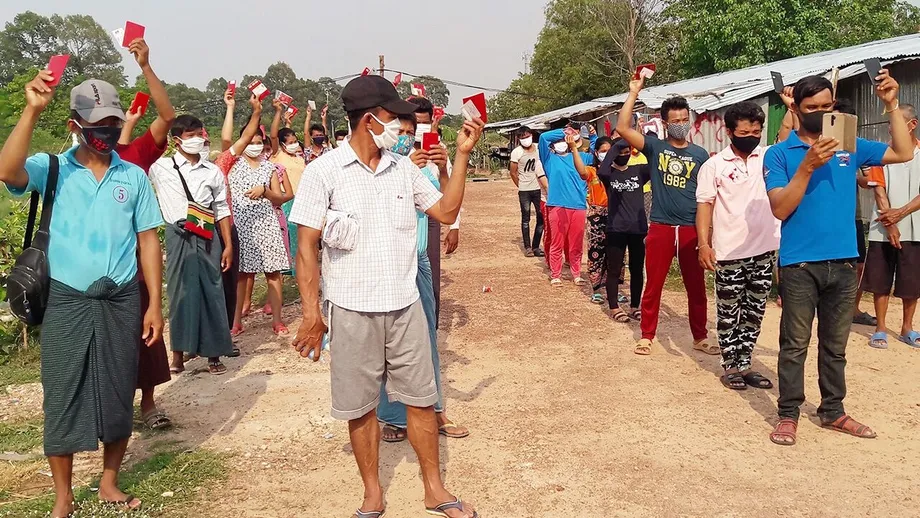
Workers face new demands to keep their jobs legal
Myanmar migrant workers in Thailand are allegedly being asked to pay about 6,000 baht each in income tax to Myanmar's military government while obtaining identity documents needed for legal employment. Employer representative Nilubon Pongpayom raised the complaint at Parliament in Bangkok on November 2, 2026, describing charges that she said were being collected inside Certificate of Identity centres.
Contents
- Workers face new demands to keep their jobs legal
- How the charges allegedly accumulate
- Employers say they are advancing the money
- The 2% tax and the 25% transfer requirement
- A proposal to keep registration under Thai control
- Personal data becomes part of the dispute
- Border violence drives calls for a firmer response
- Thailand is also trying to retain experienced workers
- Fair treatment is part of the reform demand
- Key Points
The alleged 2% tax comes on top of document fees and unofficial payments demanded for access to appointments, according to Nilubon, who represents the White Employers group. She estimated that about 700,000 workers needed Certificates of Identity, known as CI documents, while more than one million held passports approaching expiry.
The People's Party called for Thai supervision of the centres and a formal diplomatic challenge to Myanmar's collection of income tax from workers in Thailand. A migrant policy network has gone further, proposing that the centres temporarily close while Thailand allows workers already recorded in its systems to retain their right to stay and work.
A CI document helps establish a worker's identity for the process of obtaining lawful status in Thailand. When access to that document depends on additional payments, the immediate problem reaches beyond paperwork: a worker can struggle to keep a job legally, and an employer can lose staff.
Nilubon's estimate of the affected workforce shows the scale of the concern. The two groups she identified may overlap, so they cannot simply be added together. Either way, the dispute involves large numbers of people whose jobs depend on documents that must be issued or renewed.
How the charges allegedly accumulate
Nilubon said passport related fees payable through 7-Eleven had risen from 310 baht to 710 baht and then to 2,670 baht. The Thailand Migration Reform Consortium, or TMR, also identified 2,670 baht as the publicly stated CI fee, while saying some workers reported actual costs exceeding 5,000 baht.
The White Employers group wrote to the Department of Employment about the increases. A parliamentary security committee subsequently invited the department's director general and the group to discuss the issue. Nilubon said those discussions revealed that additional taxes imposed by Myanmar authorities had been included in payment receipts without an explanation to workers or employers.
Myanmar brokers also allegedly demanded 1,350 to 1,500 baht from workers who had already paid their fees and secured CI appointments. Workers who refused those unofficial queue payments could not proceed with their applications, Nilubon said.
For the further 2% charge demanded inside the centres, she said workers were instructed to transfer money through TrueMoney and then make another payment at 7-Eleven. The earnings period and calculation used to arrive at the roughly 6,000 baht demand were not specified.
The amounts describe different alleged costs at different stages. A worker trying to budget for registration needs to know the document fee, any tax demanded and any other payment separately. Nilubon's complaint was that employers and workers were encountering charges without that clarity.
Employers say they are advancing the money
Thai employers were paying some of the costs in advance because workers could not afford them, Nilubon said. She described businesses already facing losses from flooding and warned that further expenses could worsen labour shortages.
Nilubon, speaking for the White Employers group, described the pressure on businesses trying to retain workers through the legal system:
"We are trying to do everything legally, but instead face costs forced on us by Myanmar's military government, especially when employers are already affected by flooding," Nilubon said.
She said employers feared losing workers when neither side could meet the demands:
"If we do not pay, the workers cannot afford it themselves. Eventually, they will no longer stay with us, making labour shortages even worse," she added.
The dispute therefore affects household earnings and business operations at the same time. Workers need valid documents to maintain lawful employment, while businesses need experienced staff to remain at work.
The 2% tax and the 25% transfer requirement
Sahassawat Kumkong, a People's Party MP for Chonburi, said Myanmar required workers abroad to send at least 25% of their income home through banks controlled by the military government, alongside a 2% income tax. TMR also raised concerns about demands for proof that workers had transferred 25% of their earnings through designated channels.
The two requirements serve different purposes. The 2% demand is described as a tax, while the 25% requirement concerns how much money workers must send home and which channels they must use. Workers may already send money to support relatives, but a compulsory transfer rule restricts their choice over how they manage those earnings.
Sahassawat argued that tying these conditions to identity documents gave Myanmar's authorities too much influence over whether people could continue working legally in Thailand. He said a worker unable to renew documents could fall outside the formal employment system, with consequences for the Thai business employing that person.
Pisan Manawapat, the People's Party's shadow foreign minister, called for Thailand to formally notify Myanmar that the party considers the 2% tax inconsistent with international law and the bilateral double taxation agreement signed in 2002.
A double taxation agreement sets rules for how two countries tax income that connects them both, including ways to address overlapping tax claims. The party's position is a legal challenge it wants Thailand to make. Any assessment of an individual worker's liability would require the relevant treaty provisions and tax circumstances.
A proposal to keep registration under Thai control
TMR submitted policy proposals to security agencies and the Labour Ministry on October 30. It called for the temporary suspension of Myanmar operated CI centres while complaints about fees, tax conditions, personal data and access for Thai representatives are investigated.
The consortium proposed that Thailand preserve the right to stay and work for migrants already registered or recorded in Thai systems. Authorities could use existing identification numbers for people without Thai nationality, biometric records and employer registers, under criteria set by Thailand.
TMR cited Section 17 of the Immigration Act B.E. 2522, enacted in 1979, and Section 14 of the Emergency Decree on Managing the Work of Aliens B.E. 2560, enacted in 2017, as provisions for officials to consider when arranging temporary relief. Its proposal would avoid making a newly issued CI document the sole condition for retaining lawful status during a transition.
The consortium also called for identity checks and individual risk assessments, a joint investigation by relevant Thai agencies, secure complaint channels and protection for complainants. It wanted clear conditions on transparent fees, Thai supervision, data protection and freedom from intimidation before centres reopened.
Sahassawat proposed immediate reform and Thai oversight if the centres remain necessary, alongside a review of whether Thailand still needs them. He acknowledged that the labour minister had introduced checks on additional charges and was considering temporary extensions, but argued that these steps left the underlying structure unchanged.
Personal data becomes part of the dispute
TMR raised concerns that sensitive information collected during documentation could be used to track political opponents or people of conscription age. It called for restrictions on sharing such information without an adequate legal basis and safeguards.
The consortium wanted identity verification separated from nationality certification. In practical terms, its proposal would allow Thai agencies to establish who a person is for employment administration without making every stage depend on fresh approval from Myanmar's authorities.
Workers considering whether to enter the process may weigh more than its price. TMR said travel, document requirements and concerns about personal or family safety could discourage some migrants from registering or renewing their status.
People's Party leader Natthaphong Ruengpanyawut also called for a clearer migrant worker database. That proposal and TMR's privacy concerns address two needs that must be managed together: Thailand needs accurate records to administer employment, while workers need protection for information that could expose them or relatives to danger.
Border violence drives calls for a firmer response
Sahassawat connected the CI dispute to wider concerns about Myanmar's military and Thai sovereignty. On November 1, he said Myanmar aircraft had dropped two bombs the previous night near Mae Sam Laep in Mae Hong Son province, across the Salween River on Myanmar's side of the border.
According to Sahassawat, the blasts damaged homes, a local health facility and government buildings in Thailand, forcing residents to leave the area. He also cited a warning from Myanmar's military government against Thai officials and businesses trading with the Karen National Union, or KNU, and threats against warehouses on Myanmar's side.
The MP called for a formal diplomatic protest seeking an explanation and responsibility for the damage, as well as a review of cooperation over CI centres. He also said an additional 31 Myanmar military government officials had been permitted to work at the centres in Thailand.
Pisan's proposed response included reviewing Thailand's gradual diplomatic approach and addressing cross border munitions, drugs and river contamination through efforts to tackle Myanmar's prolonged conflict. He accused Myanmar's military of disregarding Thailand and the Association of Southeast Asian Nations' Five-Point Consensus.
The recent sequence shows how labour complaints and border tensions converged:
- October 30, 2026: TMR proposed temporarily suspending CI centres and introducing interim registration controlled by Thailand.
- October 31: Myanmar aircraft dropped two bombs across from Mae Sam Laep, according to Sahassawat.
- November 1: Sahassawat called for diplomatic action and a review of cooperation with Myanmar's military government.
- November 2: Nilubon described the alleged tax and queue payments at Parliament, while the People's Party presented its reform proposals.
Thailand is also trying to retain experienced workers
The pressure over CI documents comes as Thailand and Myanmar consider easing another disruption to lawful employment. They have agreed in principle to waive a requirement for Myanmar workers to spend 30 days at home after completing four years under their government recruitment agreement.
That discussion concerns 45,834 workers reaching the limit in 2026 and another 46,906 in 2027, a combined 92,740. The immediate exemption proposal covers workers completing their term in 2026 and still requires the relevant immigration and employment approvals.
The proposed waiver and the CI dispute concern different administrative processes, but both affect whether employers can retain people who already know their jobs. Removing a compulsory break can reduce disruption; expensive or inaccessible document renewal can create another interruption.
Thailand has also opened legal employment to eligible Myanmar refugees in nine border camps. About 42,600 registered residents of working age were eligible to apply under that policy, which created a separate route to work rather than resolving the CI complaints.
Fair treatment is part of the reform demand
Natthaphong said migrant workers are indispensable to Thailand's economy and called for fair wages, safe conditions and protection from exploitation, forced labour and trafficking for workers of every nationality.
He linked those standards to Thailand's pursuit of membership in the Organisation for Economic Co-operation and Development, or OECD. He also proposed reviewing occupations reserved for Thai nationals, supporting Thai workers and employers in improving their skills, and providing Thai language learning and other help for migrants adapting to life in the country.
Sahassawat described the current registration system as difficult, slow and expensive. Hidden charges, he argued, encouraged corruption and discouraged formal registration, leaving Thailand without reliable information about how many migrants worked in particular industries.
Natthaphong also condemned an assault on a migrant worker protest leader outside the United Nations office on Ratchadamnoen Nok Road in Bangkok. He said disagreement with protesters could never justify physical violence in a democracy governed by law.
The immediate policy choice is how to investigate the alleged collections while keeping workers in lawful employment. The proposals range from stronger Thai supervision to temporarily replacing the CI requirement with checks using records Thailand already holds.
Key Points
- Employer representative Nilubon Pongpayom alleged that Myanmar workers faced a 2% tax demand of roughly 6,000 baht during CI processing.
- She also alleged unofficial queue charges of 1,350 to 1,500 baht, separate from document fees.
- TMR proposed temporarily closing CI centres and preserving lawful status through registration controlled by Thailand.
- The People's Party called for Thai oversight, simpler registration and a formal challenge to Myanmar's tax collection.
- Workers and employers face the immediate risk of disrupted employment when document costs or conditions prevent renewal.