Air power and foreign supplies sustain a widening civilian crisis
Myanmar's military is deliberately attacking civilians to frighten them into submission, United Nations human rights investigator Kelley Currie has warned, as foreign aircraft, aviation fuel and military financing help sustain a war that the armed forces have been unable to win.
Contents
- Air power and foreign supplies sustain a widening civilian crisis
- What happened after the military takeover?
- Russia and China supply the aircraft
- Iranian fuel keeps the aircraft flying
- A market strike shows the human cost
- Spare parts, payments and sanctions
- Corruption finances war and tighter control
- Why diplomatic engagement worries the UN investigator
- A court decision could bring new danger for Rohingya
- Key Points
The UN Human Rights Office recorded at least 982 civilians killed in military airstrikes in 2025, including 232 children. Children accounted for almost one in four of those deaths. The total was more than 50 percent higher than in 2024, showing the growing human cost of a campaign dependent on equipment and supplies from abroad.
Currie, the UN Human Rights Council's special rapporteur on human rights in Myanmar, said increasing weapons purchases from China, Russia and other countries were feeding a catastrophic human rights situation. She also warned that governments were renewing contact with Myanmar's military authorities without securing reductions in violence, releases of political prisoners or talks involving all parties.
Her warning connects three pressures on civilians: attacks from the air, an economy increasingly shaped by corruption, and the danger of renewed violence against minorities ahead of a possible International Court of Justice ruling concerning the Rohingya.
What happened after the military takeover?
Myanmar's armed forces seized power from Aung San Suu Kyi's elected government in February 2021. Security forces violently suppressed widespread protests, and armed resistance expanded into a civil war across much of the country.
The military retains a major advantage in weapons and manpower, including aircraft supplied by Russia and China. Yet heavy force has failed to defeat its opponents. Currie estimated that the authorities still control about half of Myanmar's territory, where they have also invested in surveillance and policing.
The conflict and the international response have developed through several key stages:
- 2017: The military's crackdown on the Rohingya became the subject of the genocide case now before the International Court of Justice.
- February 2021: The military overthrew the elected government, triggering protests and an expanding armed conflict.
- February 2021 to December 2022: Myanmar imported $406 million in arms and related goods from Russia and $267 million from China, according to a UN special rapporteur's report published in 2023.
- August 2023: The United States authorized sanctions targeting people and businesses operating in Myanmar's jet fuel sector.
- October 2024 to December 2025: Nine shipments of Iranian jet fuel reportedly delivered roughly 175,000 tons to Myanmar's military.
- 2025: The UN Human Rights Office recorded at least 982 civilian deaths in military airstrikes.
Russia and China supply the aircraft
Myanmar manufactures none of its combat aircraft, making foreign suppliers central to its air campaign. Russia supplies MiG-29 fighters, Yak-130 light attack jets and Su-30SME fighters. Yak-130s and MiG-29s have reportedly been used in attacks on residential areas.
The UN figures for February 2021 through December 2022 put Russian and Chinese arms and related exports at a combined $673 million. Russia accounted for about 60 percent of that combined amount, with $406 million, compared with China's $267 million. Much of the equipment came from companies owned by the two states.
China's Foreign Ministry rejected the UN report, describing it as a smear against normal arms trade between sovereign countries. Deliveries nevertheless continued: in 2024, the Aviation Industry Corporation of China supplied one K-8 light attack aircraft, six FTC-2000G light combat aircraft and one Y-8 transport aircraft.
The FTC-2000G can carry up to three tons of missiles, rockets or bombs and was priced at $8.5 million per aircraft. Arms dealer Dr. Naing Htut Aung, director of Gateways Hong Kong, brokered the purchase. Myanmar also ordered 16 JF-17 fighters, jointly built by China and Pakistan, in 2016, although most of those delivered were later reportedly grounded because of structural cracks and other defects.
Iranian fuel keeps the aircraft flying
Myanmar also has limited capacity to refine aviation fuel. Reported deliveries by tankers in Iran's shadow fleet, vessels used to move cargo through opaque trading networks, supplied roughly 175,000 tons in nine shipments between October 2024 and December 2025. The trade was estimated to have earned Iran about $123 million.
The fuel supported a bombing campaign that struck more than 1,000 civilian locations during those 15 months. Iran has also become a major supplier of urea, a fertilizer that Myanmar's military uses in manufacturing munitions.
Leaked import records examined by the activist research group Justice For Myanmar describe six cargoes totaling more than 843,000 barrels and valued at $109.5 million between December 2024 and November 2025. How many of those cargoes overlap with the nine reported shipments has not been resolved, so a combined shipment total is unavailable.
The records identified National Energy Prime Aviation Services, or NEPAS, as the actual buyer. NEPAS is a joint venture between the military controlled Myanma Petrochemical Enterprise and the privately owned Asia Sun group. The arrangement places a state enterprise and a private business inside the same aviation fuel supply chain.
Documents concerning individual purchases describe Iranian aviation fuel being labeled as South African diesel. One contract signed in May 2025 covered 202,000 barrels and directed a $26 million payment to the Thai company Tawan-Oil Trading's account at Siam Commercial Bank. UN trade data and shipping information recorded no diesel trade between South Africa and Myanmar in 2025.
A market strike shows the human cost
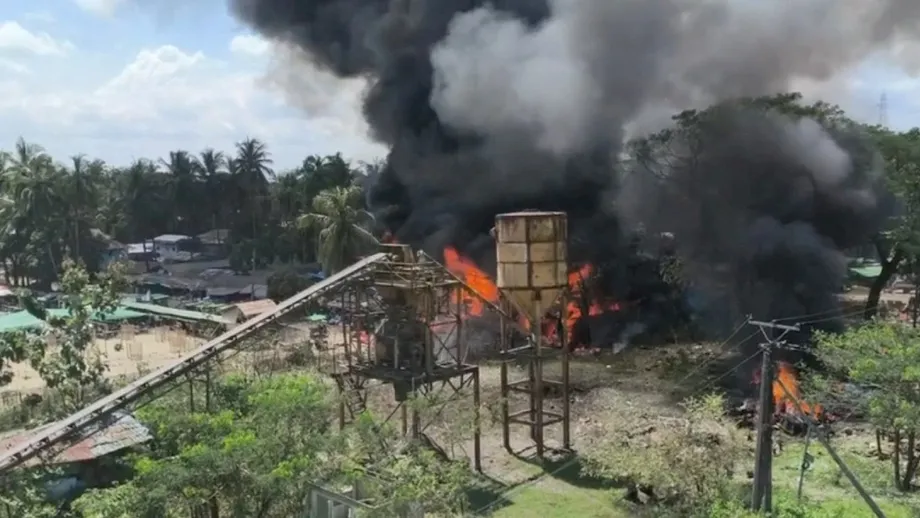
A September 28 airstrike on a market in Kyauktaw, an Arakan Army stronghold in Rakhine State, killed 50 people and wounded 58, according to aid workers at the scene. The Arakan Army gave a death toll of 49 and the same number of wounded, including 22 people in critical condition.
The market attack illustrates the danger civilians face in places contested by the military and armed opposition groups. Markets bring together traders, shoppers and people transporting food, placing everyday economic activity within reach of the air campaign.
Video recorded over the Kyauktaw area in the following days was examined by Myanmar Witness. A weapons specialist identified one aircraft as consistent with a Russian Yak-130 and another as consistent with a JF-17. The specialist assessed from the audio that each released at least one munition. The footage documented those subsequent flights; the aircraft responsible for the September 28 market attack were not identified in that analysis.
Spare parts, payments and sanctions
Aircraft require maintenance, replacement parts and financing as well as fuel. Justice For Myanmar found that Malaysian company FJ Global had sought quotations from international suppliers for components for Myanmar's K-8W aircraft, Russian Orlan-10E drones and several helicopter types, including the Kamov Ka-28, Mi-17 and Mi-2.
FJ Global received financing in February 2026 from Perbadanan Usahawan Nasional Berhad, a Malaysian company backed by the state and owned by a foundation chaired by Prime Minister Anwar Ibrahim. The finding places a Malaysian financing institution alongside the commercial procurement networks serving Myanmar's military.
The United States already has authority to target the aviation fuel trade. In August 2023, the Treasury Department's Office of Foreign Assets Control issued a sector determination allowing sanctions against people or companies operating in Myanmar's jet fuel sector. Such a determination provides a legal basis for sanctions; individual designations are the decisions that identify particular targets.
That makes companies arranging cargoes, payments and delivery important to the international response. Interruptions at any of those points can affect whether fuel reaches military aircraft, while continued access helps the air campaign operate despite pressure on the government.
Corruption finances war and tighter control
Currie said Myanmar's legal economy had contracted since the takeover while illicit business had expanded. She described military officers relying on patronage networks, illegal payments and activities spread across legitimate commerce, loosely regulated transactions and black markets.
Currie, explaining how military rule had affected economic management, said:
When military officers generally try to run an economy, they don't do a very good job," she said. "In Myanmar, they're spectacularly bad at it.
The practices she described included currency arbitrage, demands for shares in businesses and kickbacks collected from farmers through higher levels of food and agriculture supply chains. Currency arbitrage means making money from differences in exchange rates. Where access to favorable rates is controlled, people with official connections can gain an advantage over ordinary businesses.
For farmers and traders, demands for payments remove money from livelihoods already disrupted by war. For the authorities, Currie said, the proceeds help fund government operations, military equipment and systems for monitoring people.
Currie also described how the money was used inside territory held by the authorities:
"They've also used those funds to upgrade their surveillance capabilities and their ability to police inside the territory that they still control, which is about half of the country," she said.
Why diplomatic engagement worries the UN investigator
Members of the Association of Southeast Asian Nations rebuked Myanmar's military after the 2021 takeover, but some regional governments have lately appeared more receptive to warmer relations. Currie said engagement was taking place without demands for concrete changes in the government's conduct.
Her proposed priorities were specific: reduce violence, release political prisoners and pursue peace talks involving all parties. Those measures would affect people facing airstrikes, families seeking detained relatives and communities living across competing areas of control.
The Assistance Association for Political Prisoners, an independent watchdog, says more than 32,000 people have been detained since the takeover, including Suu Kyi. At least 15,000 remain behind bars. The first figure counts people detained over the period; the second describes the continuing prison population.
Currie's concern is that diplomatic contact can proceed while the military retains access to weapons, money and tools of domestic control. Her call places changes experienced by civilians at the center of any attempt to rebuild relations with the authorities.
A court decision could bring new danger for Rohingya
Currie warned of possible violence if the International Court of Justice rules that Myanmar committed genocide or failed to prevent it during the military's 2017 crackdown on the Muslim Rohingya minority. The court considers legal responsibility between states, including obligations under the Genocide Convention.
Nick Koumjian, head of the UN Independent Investigative Mechanism for Myanmar, said he had seen reports that judges wanted to deliver a ruling that year, with October mentioned. He expected the court to give advance notice. No confirmed judgment date was given in his remarks.
Currie said groups associated with hate speech and incitement against minorities were becoming more active online and in political spaces controlled by the authorities. She identified non-Buddhist communities and people outside the majority Bamar ethnic group, including the Rohingya, as potential targets.
Currie described the activity she had observed:
"I have been seeing some signals on the ground in Myanmar that the groups that were responsible for hate speech and stirring up violence against non-Buddhist, non-Bamar minorities, including the Rohingya, that they are becoming much more active online," she said.
The warning comes against a long history of exclusion. The Rohingya's loss of citizenship documentation helped remove access to political participation, while documentation restrictions also affect schooling, work, travel and medical care. Currie called on all countries to monitor the situation closely as the court decision approaches.
Key Points
- UN investigator Kelley Currie accused Myanmar's military of deliberately attacking civilians to terrorise them into submission.
- The UN Human Rights Office recorded at least 982 civilians killed in military airstrikes in 2025, including 232 children.
- Russian and Chinese aircraft, Iranian fuel and foreign procurement networks help sustain the air campaign.
- Currie said corruption finances military purchases, surveillance and policing in territory controlled by the authorities.
- At least 15,000 political prisoners remain detained, according to the Assistance Association for Political Prisoners.
- Currie warned of possible violence against minorities ahead of an anticipated International Court of Justice ruling concerning the Rohingya.