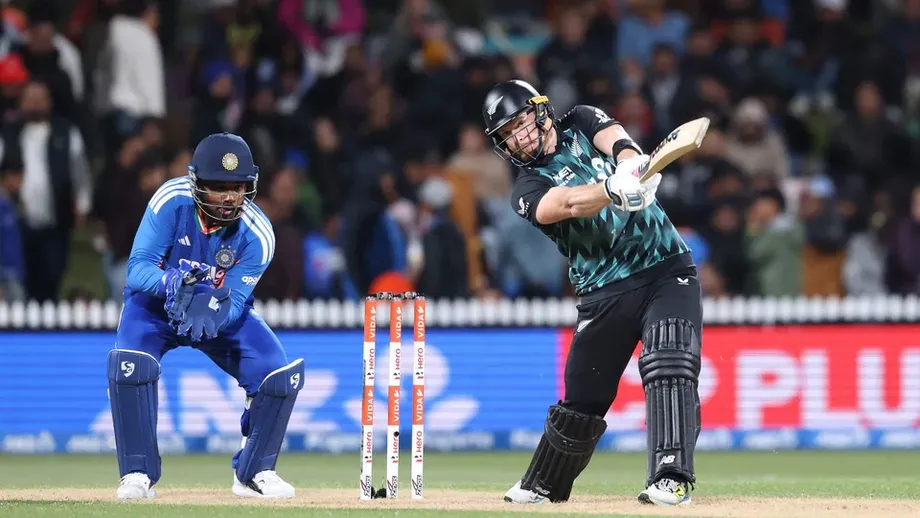
Phillips takes the record, India take the series
Glenn Phillips finished with 341 runs across five innings against India, passing Phil Salt's record for a bilateral Twenty20 international series as New Zealand won the final match by seven wickets at Seddon Park in Hamilton on November 1, 2026. India still claimed the series 3-2, having won the opening three matches.
Contents
- Phillips takes the record, India take the series
- How five innings built a record
- A century that changed New Zealand's finish
- Seifert makes the Hamilton chase manageable
- Milne limits India after a recovery
- Where Phillips stands among the leading scorers
- Phillips explains his approach as the tour moves on
- Key Points
Phillips made an unbeaten 65 from 38 balls in the finale, helping New Zealand reach 195/3 in 18 overs after India posted 191/8. Tim Seifert led the chase with 93 from 50 deliveries, while Adam Milne's four wickets for 19 runs had earlier kept India's total within reach.
Salt's previous benchmark was 331 runs for England against the West Indies in 2023. Phillips began the final match on 276, needed 56 to move ahead and finished 10 runs clear. His five innings produced scores of 82 not out, 70, 17, 107 and 65 not out.
The outcome separates two achievements that can easily become tangled: Phillips was the outstanding individual batter, while India won enough matches to secure the trophy before New Zealand's late recovery. The hosts won the last two games, turning a deficit of 3-0 into a much closer final score.
For Phillips, the Player of the Series award recognised both volume and consistency. He reached at least 50 in four of his five innings and finished unbeaten twice, contributing in matches New Zealand lost as well as those they won.
How five innings built a record
Phillips began with an unbeaten 82 from 40 balls in Christchurch, entering after New Zealand had lost two wickets for 80. His acceleration helped the hosts reach 225/4, a total India nevertheless overhauled with four wickets and two balls remaining.
India's successful opening chase showed why Phillips' runs alone could not settle the series. Sanju Samson made 67 from 33 deliveries and Naman Dhir finished unbeaten on 42 from 15, taking the visitors to 230/6.
Phillips followed with 70 from 43 balls in the second match. He shared a partnership worth 116 with Bevon Jacobs as New Zealand made 180/5, but India won again. His lowest score, 17 in the third match, came as the visitors secured an unassailable lead.
The decisive stages of his record pursuit unfolded across the following dates:
- October 22, Christchurch: Phillips opened the series with 82 not out, but India chased 226 to take the lead.
- By the end of the third match: scores of 70 and 17 had taken Phillips to 169 runs, while India had secured the series.
- October 30, Auckland: his 107 from 49 balls lifted his total to 276 and helped New Zealand claim their first win.
- November 1, Hamilton: an unbeaten 65 took him to 341, beyond Salt's record of 331.
Phillips scored 172 runs in the final two matches, just over half his series total. Those innings also coincided with New Zealand's two victories, giving his strongest finish a direct effect on the results.
A century that changed New Zealand's finish
Phillips' only hundred came at Eden Park in Auckland, where New Zealand made 259/7 and beat India by 87 runs. His century in Auckland helped produce New Zealand's highest T20I total and their largest victory by runs against India in the format.
New Zealand's 259 surpassed their previous best of 254/5 against Scotland in 2022 by five runs. It also exceeded England's 257 against India earlier in 2026, setting a new highest T20I total against the visitors.
Phillips reached 50 from 31 deliveries, then needed only another 15 balls to complete his century. His attack included four consecutive sixes during a Nitish Kumar Reddy over that cost 32 runs. He finished with six fours and 10 sixes, worth 84 of his 107 runs.
Jacob Duffy then took four wickets for 23 runs as India finished on 172/9. New Zealand had finally combined Phillips' batting with enough wickets to control the opposing innings. The victory could no longer change the series winner, but it gave the hosts a chance to finish with consecutive wins.
Seifert makes the Hamilton chase manageable
Seifert supplied the biggest innings of the final match, striking 11 fours and five sixes in his 93. Those boundaries produced 74 runs, almost four fifths of his total, and helped New Zealand complete a target of 192 with 12 balls unused.
New Zealand lost Finn Allen for two in the second over, dismissed by Arshdeep Singh. Daryl Mitchell responded with 29 from 16 balls, including four sixes, before Varun Chakravarthy took his wicket. Mitchell's contribution helped prevent that early dismissal from turning into a prolonged slowdown.
Phillips then joined Seifert and kept the chase moving. His unbeaten 65 included eight fours and three sixes, which supplied 50 of his runs. Together, the pair repeatedly found the boundary rather than allowing India's bowlers to build pressure through quiet overs.
Seifert fell seven runs short of his first T20I century when an inside edge off Nitish Kumar Reddy struck his stumps. Phillips stayed to finish the match, completing both New Zealand's victory and his own record pursuit.
A seven wicket win means New Zealand had lost only three of their available 10 wickets when they passed the target. Finishing in 18 overs also shows the pace of the chase: the hosts had two full overs remaining, rather than needing the last few deliveries to get home.
Milne limits India after a recovery
Milne's 4/19 was the strongest bowling contribution in Hamilton. After New Zealand captain Mitchell Santner chose to field, India slipped to 19/2 before Ishan Kishan and captain Shreyas Iyer repaired the innings.
Kishan scored 61 from 32 balls and Iyer made 50 from 23. Their combined 111 runs accounted for about 58 percent of India's total of 191. Both scored quickly enough to give India a route towards a larger total after the early wickets.
New Zealand kept taking wickets, however. Nathan Smith and Blair Tickner claimed two each, joining Milne in accounting for all eight dismissals. India's innings ended at 191/8, leaving the home side a required scoring rate of 9.6 runs an over.
Milne's figures describe four wickets taken while conceding 19 runs. In a match where both teams scored freely, that combination mattered: his wickets interrupted India's progress while his limited runs conceded reduced the pressure on New Zealand's chase.
Where Phillips stands among the leading scorers
Phillips' 341 placed him ahead of Salt and Pakistan's Mohammad Rizwan on the list of most runs in a bilateral T20I series, a contest between two national teams. The record counts runs accumulated across the series rather than the highest score in one innings.
- Glenn Phillips, New Zealand: 341 against India in 2026.
- Phil Salt, England: 331 against the West Indies in 2023.
- Mohammad Rizwan, Pakistan: 316 against England in 2022.
- Sahil Chouhan, Estonia: 297 against Cyprus in 2024.
- Mark Chapman, New Zealand: 290 against Pakistan.
Phillips finished 25 runs ahead of Rizwan and 51 ahead of Chapman's New Zealand benchmark. His lead over Salt was smaller, at 10, but the unbeaten final innings took him past both the national and international records in the same chase.
His average was 113.67 because he scored 341 runs and was dismissed three times. A batting average divides runs by dismissals, so his two unbeaten innings increased that figure. His simple average per innings was 68.2 runs across five appearances.
Four scores of at least 50 also put Phillips alongside Rizwan and Japan's Sabaorish Ravichandran, the other batters identified as having achieved that feat in a bilateral T20I series. India's Abhishek Sharma was the next highest scorer in this series with 197, leaving Phillips 144 runs clear.
Phillips explains his approach as the tour moves on
Phillips, New Zealand's Player of the Series, described calmness as central to his batting after the final match. He said:
(Having that) calm and the composure, it's a nice feeling,
The New Zealand batter also identified attacking spin as a key part of the chase, drawing a comparison with the way India had played earlier in the series.
Spin was going to be the type of bowling that needed to be taken down. Obviously we saw the Indian boys do it to us, and they did it very effectively.
Phillips' comments matched the practical demands of the final innings. New Zealand needed to keep scoring through the middle overs, when spin could otherwise have slowed the chase and pushed the required rate higher. Seifert's boundary hitting and Phillips' unbeaten finish kept that pressure under control.
The teams next turn to a series of five one day internationals, beginning at Eden Park in Auckland on Wednesday, November 4. Each side can bat for up to 50 overs in that format, compared with 20 in T20 cricket, giving batters more time to build an innings and bowlers longer spells.
India's planned ODI captaincy change will see Shubman Gill lead the opening three matches before Iyer takes charge for the final two. Gill and KL Rahul are due to leave the ODI group after the November 10 match in Hamilton to prepare for the Tests.
India therefore move into the next stage of the tour with the T20I trophy, while New Zealand carry consecutive victories and Phillips' record. Hamilton gave the hosts a strong finish without changing the result India had already secured.
Key Points
- Glenn Phillips scored 341 runs, passing Phil Salt's bilateral T20I series record of 331.
- India won the series 3-2 after taking the opening three matches.
- New Zealand won the Hamilton finale by seven wickets, reaching 195/3 in 18 overs.
- Tim Seifert made 93 from 50 balls, while Phillips finished unbeaten on 65 from 38.
- Adam Milne took 4/19 as India were restricted to 191/8.
- The ODI series begins in Auckland on November 4.